1 428 résultats
1979Very Good Kazakh Paperback. Cr. 8vo. (20 x 14 cm). In Kazakh. 167, [1] p. Kazakstan tarihinin bibliyografiyasi (Revolusyusa deyingi deyip). Bibliyografiylik körsetkish. Bibliography of Kazakh history.
1994New English Paperback. Pbo. Roy. 8vo. (24 x 17 cm). In English. [x], 526 p. Requiem for a would-be republic: The rise and demise of the former Soviet Republic of Azerbaijan. A personal account of the years 1991-1993.
2014New English Paperback. Pbo. Roy. 8vo. (24 x 17 cm). In Turkish. 194, [2] p., b/w ills. Osmanli Devleti'nde Livaneliler. Families and famous people from Artvin city (Livaneliler family) in the Ottoman Empire.
2018New Turkish Original bdg. HC. Roy. 8vo. (24 x 17 cm). 2 volumes set: (292 p.; 370 p.). Anadolu Beylikleri hakkinda arastirmalar I-II: Vol. I: C?oban-Ogullari Beyligi. Candar-Ogullari Beyligi. Mesaliku?'l-ebsar'a go?re Anadolu Beylikleri. Vol. II: Eratna devleti. Kadi Burhaneddin Ahmed ve devleti. Mutahharten ve Erzincan Emirligi. ISBNs: 9789751600851 / 9789751600868.
1921Very Good English Paperback. Pbo. Roy. 8vo. (24 x 17 cm). In Ottoman script. 103 p. Hegira: 1337 = Gregorian: 1921. Özege: 1433. First and only edition. A study on Azerbaijanian literature. Azerbaycan edebiyatina bir nazar.
1930réf. 107251930 plaquette in-quarto à l'italienne (booklet oblong in-quarto), couverture verte (green cover), 8 illustrations photographiques aquarellées hors-texte - gravées et imprimées par (8 photographic colored illustrations plate - engraved and printed by) Gillot, sans pagination, sans date (début vingtième Siècle) à Paris L. Boulanger Editeur,
réf. DADAX0190069511New unknown
réf. SONG0765625083Used: Good unknown
2011New English Paperback. Pbo. 4to. (24 x 20 cm). In English. 684 p. Ills. "Since the time I became a lecturer, I have always desired to be a different and out of the ordinary academic. I have wanted to be different for my students; I have avoided things everyone does and desired to tell them that there is a real world outside that is not comparable to what the course books teach. I have advised them to think objectively and scientifically, read and assess the proper sources to reach for the truth, use their reasoning skills, and read and study much if they choose to have an academic career like I did. I have also advised them to absolutely experience abroad. As a researcher, writer, traveler. To get to know a country, introduce it, and observe th truths about it within its borders".
2007New English Paperback. Pbo. 4to. (30 x 21 cm). In Turkish. 112 p., color and b/w ills. Ilk Türk kadin ressam Mihri Rasim (Müsfik) Açba. 1886, Istanbul - 1954, New York.
2008New English Paperback. Pbo. Roy. 8vo. (24 x 17 cm). In English. 508 p. Part 1: MIDDLE TURKIC: 1. Qarakhanid Literature and the Beginnings of Turco-Islamic Culture. In: Central Asian Monuments (ed. Hasan B. Paksoy, Istanbul, 1992), 73-80. 2. On Nature in Karakhanid Literature. Journal of Turkish Studies 4 (1980), 7-35. 3.Three Turkic Verse Cycles Relating to Inner Asian Warfare. Harvard Ukrainian Studies 3/4, 1979-80 (= Eucharisterion Omeljan Pritsak, Part 1), 151-65. 4.Inner Asian Wisdom Traditions in the Pre-Mongol Period. Journal of the American Oriental Society 101.1 (1981), 87-95. 5.Kashgari on the Tribal and Kinship Organization of the Turks. Archivum Ottomanicum 4 (1972), 23-43. 6.Kashgari on the Beliefs and Superstitions of the Turks. Journal of the American Oriental Society 95.1 (1975), 68-80. 7.The Alexander Romance in the Diwan Lughat at-Turk. Humaniora Islamica 1 (1973), 233-44. 8.Baraq and Buraq. Central Asiatic Journal 15.2 (1971), 102-17. 9.Middle Turkic Vulgarisms. In: Aspects of Altaic Civilization II (ed. L. V. Clark and P. A. Draghi, Bloomington, Indiana, 1978), 59-64. 10.Introduction to Wisdom of Royal Glory (Chicago, 1983). 11.Textual Problems in Kutadgu Bilig. Journal of Turkish Studies 3 (1979), 89-99.12.Animal Traits in the Army Commander. Journal of Turkish Studies 1 (1977), 95-112. 13.Some Notes on the Middle Turkic Glosses. Journal of Turkish Studies 5 (1981), 41-44. Part 2: OTTOMAN: 14.The Lyric in the Romance: The Use of Ghazals in Persian and Turkish Masnavis. Journal of Near Eastern Studies 43.1 (1984), 9-25. 15.The Romance of Iskender and Gülshah. In: Turkic Culture: continuity and Change (ed. S. M. Akural, 1987 = Indiana University Turkish Studies 6), 95-103. 16.Inner and Outer Oguz in Dede Korkut. Turkish Studies Association Bulletin 6.2 (1982), 21-25. 17.The Seyahatname of Evliya Çelebi as a Literary Monument. Journal of Turkish Literature 2 (2005), 71-83. 18.Turkic Languages and Turkish Dialects according to Evliya Çelebi. Altaica Osloensia: Proceedings from the 32nd Meeting of the Permanent International Altaistic Conference, ed. Bernt Brendemoen, Oslo, 1990, 89-102. 19.The Languages of the World according to Evliya Çelebi. Journal of Turkish Studies 13 (1989 = Gerhard Doerfer Festschrift), 20.Evliya Çelebi on the Armenian Language of Sivas in 1650. Annual of Armenian Linguistics 4 (1983), 47-56. 21. "Mi?disi": An Armenian Source for the Seyahatname. Wiener Zeitschrift für die Kunde des Morgenlandes 76 (1986 = Festschrift Andreas Tietze), 73-79. 22.Marrying a Sultana: The Case of Melek Ahmed Pasha. In: Decision Making and Change in the Ottoman Empire (ed. Caesar E. Farah, Kirksville, Missouri, 1993), 169-182. 23. An Unpublished Account of mum söndürmek in the Seyahatname of Evliya Chelebi. In: Bektachiyya: Études sur l'ordre mystique des Bektachis et les groupes relevant de Hadji Bektach (ed. A. Popovic and G. Veinstein, Istanbul: Isis, 1995), 69-73. 24. Establishing the Text of Evliya Çelebi's Seyahatname: A Critique of Recent Scholarship and Suggestions for the Future. Archivum Ottomanicum 18 (2000), 139-44. 25."Shall We Tear Down That Observatory?" Evliya Çelebi and Philology. [unpublished English original of: "Su Rasadi Yikalim mi" Evliya Çelebi ve Filoloji. In: Evliya Çelebi ve Seyahatname (ed. Nurhan Tezcan & Kadir Atlansoy, Dogu Akdeniz Üniversitesi, 2002), 99-118. 26.Some Reflections on the Editing of Book 9 of the Seyahatname. In: Izzet Gündag Kayaoglu Hatira Kitabi: Makaleler (ed. Oktay Belli, Yücel Dagli, M. Sinan Genim; Istanbul, 2005), 122-32. 27.Some Reflections on the Editing of Book 10 of the Seyahatname. In: Journal of Turkish Studies 30/1 (2007 = In memoriam Sinasi Tekin, I
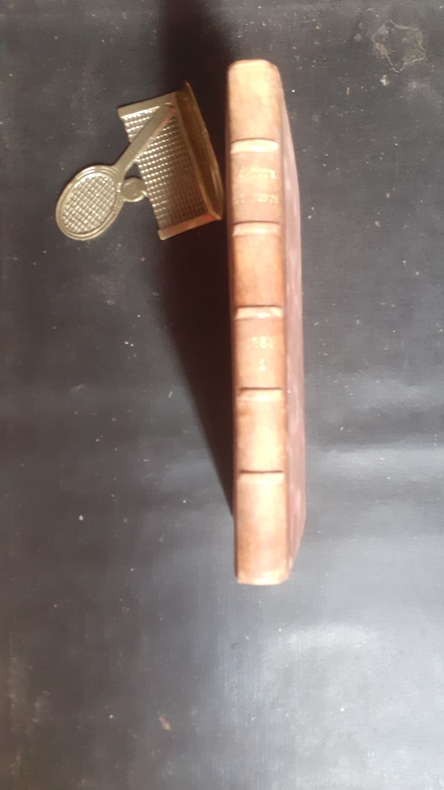
1847réf. 54978A. René et Cie, Imprimeurs-éditeurs 1847 In-8. Reliure de l’époque demi-basane bordeaux, dos lisse, filets, auteur, titre et tomaison dorés, 408 pp. Rousseurs soutenues ne gênant pas la lecture, coins de pied et coupes frottées. Assez bon exemplaire en l’état. Poids sans emballage : 400 grammes.
1936Mm 185x250 Studi bizantini e neoellenici volume quinto. Brossura editoriale di pagine VIII-740, macchie e piccole abrasioni ai piatti, legatura un po' lenta. Parzialmente intonso. SPEDIZIONE IN 24 ORE DALLA CONFERMA DELL'ORDINE.
réf. QWA-21786Librairie Hachette et Cie, 1884, in-4 rel. 1/2 bas. racinée (22,5 x 30,5), 436 p., nombreuses gravures par "nos plus célèbres artistes", 10 cartes et plans, bonne reliure d'époque, dos à 5 faux-nerfs, tranches mouchetées, bon état
1938réf. 12429Paris Librairie Orientaliste Paul Geuthner 1938 Un volume in-8 broché, 90 pages et table. Exemplaire non coupé, bon état.
1877réf. 9765Paris, Caen, Rouen Derache, F. Le Blanc-Hardel, Le Brument 1877 In-8 Fort 814 pp, (.) Ou collection de mémoires et de renseignements sur la statistique monumentale de la France. Illustrations en noir in et hors-texte, dont planches dépliantes, intérieur frais et rares rousseurs. Dos insolé et frotté, couvertures légèrement passées.
1997réf. 16972BBBerlin, Aufbau Taschenbuch Verlag (= Reihe: 'Aufbau-Taschenbücher', Band 8503 sowie 'Aufbau Thema'), 1997. 8°, 127 S., farbig illustr. original Kartonage (Paperback), 1. Auflage Papier ein wenig nachgedunkelt, Vorderdeckel und Rückdeckel an den Ecken minimal knickspurig, sonst ein sehr gutes, sauberes Exemplar.
2016New English Paperback. Pbo. Roy. 8vo. (24 x 17 cm). In Turkish. 750 p. Eski Türk yazitlari söz varlgi incelemesi. Philological researches on 102 Turkish / Turkic inscriptions (24 inscriptions from Mongolia, 56 inscriptions from Yenisei River Basin, 12 inscriptions from Altai Region). TURKOLOGY Turkish / Turkic literature Central Asia Asian culture Epigraphy Yenisey - Orkhun inscriptions.
1990Fine English Paperback. Pbo. 4to. (28 x 20 cm). In Turkish. 55, [13] p., b/w plts. Tepres. A study on Crimean folklore.
réf. 17989aafGenève, Henri Kündig, 1905, gr. in-4°, 84 p., illustré notamment de deux cartes dépliantes en couleurs, non coupé, brochure originale.
1993réf. 7701993 - reliure - Editions Flammarion - 1993 - In-folio (31 x 24,5 cm) broché - 327 pages - Très riche iconographie en couleurs et en noir et blanc avec de nombreuses photographies - Traduction de Jean-Paul Mourlon - ISBN : 2-08-201-940-3 - Ouvrage intitulé : "Tapis de tribus. De l'Anatolie à l'Afghanistan"
1919Very Good Turkish, Ottoman (1500-1928) Original manuscript autograph letter / correspondence signed 'Üçüncü Kafkas Firkasi Kumandan Vekili Avni'. 18x11,5 cm. In Ottoman script. 1 p. Full. It starts with 'Huve'. Dated 8/6/[13]35 AH = [1919 AD]. Written from Trabzon to Mühimme? Mintikasi levâzim reisi Yüzbasi Rafet Efendi. "1) 27 Tabur Kumandan Vekâleti'nde bulunan Yüzbasi Mehmed efendi ile mezunen terhisi kolordudan emir verilmistir. Mezkûr tabur kumandanligina vekâleten mühimme? mintika levâzim reisi Rafet Efendi tabi'kilinmistir. 2) 12. Alay Kumandanligina ve Yüzbasi Rafet Efendi'ye teblig kilinmistir. / Reply to Yaver Mustafa Efendi. An Ottoman army auttograph of Kafkas Army.
1922Very Good Turkish, Ottoman (1500-1928) Original Ottoman manuscript historical document. 28x21,5 cm. In Ottoman script (Old Turkish with Arabic letters). 10 lines on 1 p. Signed, and three Ottoman stamps. During the Haydarpasa Fire in 1922, the warning about the Jewish resident of Beyoglu Vitali Efendi's house on Haydarpasa, Mandira Street, where the windows were broken and they were not fitted. The aforementioned warning was prepared by Vitali Efendi's tenant "Abulafya". Transcription in Turkish: "Dersaadet Kâtîb-i Adlîligi Memûriyet-i Valâsina: Efendim, Beyoglu'nda, Tozkoparan'da Bahar Apartmani'nda mukîm Mösyö Vitali Bahar'in Haydarpasa'da, Mandira Sokagi'nda 80 numero ile mudkîm bir bab hanesinde müstecîren ikâmet etmekteyim. Geçen hafta vuku' cevelân harikte, harikin tesîrâti ile hanenin pencerelerinde mevcut camlar kirilip harap olmustur. Kendisine...". The fire in Haydarpasa 1922 came to be known in history as "the Fire of Haydarpasa Çayir", because it broke out in one of the houses in Çayirbasi and spread further. It broke out on July 29, 1922.
1990Fine Russian Paperback. Cr. 8vo. (20 x 14 cm). In Russian. 110, [2] p. Deiatelnost apparata upravleniia Turkmenskoi SSR po ukrepleniiu sozialistichesko, zakonnosti.
1936Fine Turkish Paperback. Roy. 8vo. (24 x 17 cm). In Turkish. 46 p., [12] numerous b/w plates. Le Coq was a Prussian / German brewery owner and wine merchant, who at the age of 40 began to study archaeology. Aided by his wealth, von Le Coq became a famous archaeologist and explorer of Central Asia. Von Le Coq was convinced that the influence of Ancient Greece could be found as far in the east as China. However, organising expeditions to Central Asia and China was beyond his means. The German archaeologist Hermann Parzinger has found a letter in the Prussian State Archive which reveals that the financial backing to von Le Coq's expedition came from no one else than the last German emperor Wilhelm II. Wilhelm was obsessed with Greek culture and supported one of the expeditions with 32,000 German gold marks. Von Le Coq was associated with the Museum für Völkerkunde (now called the Ethnological Museum of Berlin) in Berlin. Serving as assistant to the head of the Museum, Professor Albert Grünwedel, Le Coq helped plan and organize expeditions into the regions of western Asia, specifically areas near the Silk Road such as Gaochang. When Grünwedel fell ill before the departure of the second expedition, Le Coq was assigned to lead it. His account of the second and third German Turpan expeditions was published in English in 1928 as Buried Treasures of Chinese Turkestan. The expeditions found extensive networks of Buddhist and Manichaean cave temples in the Xinjiang region of Northwest China. Although many of the manuscripts found in the cave were destroyed during the excavation, von Le Coq speculated that he had discovered a major Manichaean library. Some of the paintings also led him to believe that he had found evidence of an Aryan culture, related to the Franks. With the help of his assistants, Theodor Bartus, Le Coq carved and sawed away over 360 kilograms (or 305 cases) of artifacts, wall-carvings, and precious icons, which were subsequently shipped to the museum. In Buried Treasures ..., Le Coq defends these "borrowings" as a matter of necessity, citing the turbulent nature of Chinese Turkestan at the time of the expeditions. Chinese consider this seizure a "colonial rapacity" comparable to the taking of the Elgin Marbles or the Koh-i-Noor diamond. The artifacts were put on display at the museum and were open to the public until 1944 when the relics were destroyed in a British bombing raid during World War II. This Turkish translation of 'Manichaica aus Chotscho'.