1442 resultados
ref. SONG0700706372Used: Good unknown
1970Very Good Turkish Original posters. Double elephant folio. (100 x 70 cm). Descriptive texts in Turkish. 9 plates set, b/w photographic plates and runic scripts. Plates show Kül Tigin and Bilge Kagan's scripts and photographic plates of their west, east, north and south frontlines; and plates and scripts of Tonyuquq's stone with their all maps comprising area of inscriptions (Orkhon Valley, region on the western Orkhon River in Mongolia, near Ögii Lake. More specifically, they stand about fifty miles north of the Erdene Zuu Monastery, and approximately twenty-five miles northwest of the Ordu-Baliq). In addition last plate shows photographic plates of researches and archaeological area of period excavations. Not Yenisey inscriptions on plates. Orhon Inscriptions, and the Khöshöö Tsaidam monuments are two memorial installations erected by the Göktürks written in Old Turkic alphabet in the early 8th century in the Orkhon Valley in Mongolia. They were erected in honor of two Turkic princes, Kul Tigin and his brother Bilge Khagan. The inscriptions, in both Chinese and Old Turkic, relate the legendary origins of the Turks, the golden age of their history, their subjugation by the Chinese, and their liberation by Ilterish Qaghan. According to one source, the inscriptions contain "rhythmic and parallelistic passages" that resemble that of epics. The inscriptions were discovered by Nikolay Yadrintsev's expedition in 1889, published by Vasily Radlov. The original text was written in the Old Turkic alphabet and was deciphered by the Danish philologist Vilhelm Thomsen in 1893. Thomsen first published the translation in French in 1899. He then published another interpretation in Danish in 1922 with a more complete translation. They were erected by the Göktürks in the early 8th century. They commemorate the brothers Bilge Khagan (683-734) and Kul-Tegin (684-731), one a politician and the other a military commander. Both were descendants of Ilterish Qaghan of the Second Turkic Khaganate, which was a prominent Turkic nomadic society during the Tang dynasty. The Göktürks have left artifacts and installations all over their domain, from China to Iran. But only in Mongolia have any memorials to kings and other aristocrats been found. The ones in Khöshöö Tsaidam consist of tablets with inscriptions in Chinese and Old Turkic characters. Both monuments are stone slabs originally erected on carved stone turtles within walled enclosures. Bilge Khagan's stone shows a carved ibex (the emblem of Göktürk Kagans) and a twisted dragon. In both enclosings, evidence of altars and carved depictions of human couples were found, possibly depicting the respective honorary and his spouse. The Old Turkic inscriptions on these monuments were written by Yollug Tigin who was nephew of Bilge Khagan. These inscriptions together with the Tonyukuk inscription, are the oldest extant attestation of that language. The first portion of the Turkic translations seems to be Bilge Khagan discussing the commemoration of the tablet, as well as mentioning the extent of the empire. One passage reads, "To the East I have made campaigns as far as the Shantung plain, and almost reached the sea; to the South I have made campaigns as far as Tokuz-Ersin and almost reached Tibet; to the West I have made campaigns beyond Yenchii-Iigiiz (Pearl River) as far as Timir-Kapig (The Iron Gate); to the North I have made campaigns as far as the land of the Yer-Bayirku's. To all these lands have I led (the Turks). The forest of Mount Otiikin has no [foreign] overlord; the forest of Mount Otiikin is the place where the kingdom is held together." Continuing on, the inscriptions discuss the conquests of the Bilge Khagan and the struggles that he and his people face with the Chinese. The inscriptions even describe the Turks being enslaved by the Chinese. However, the inscriptions also highlight Bilge Khagan's accomplishment of uniting his people. As one passage reads...
ref. 23534P., Plon, Nourrit, 1889, in 4° relié pleine percaline rouge décorée de l'éditeur, tranches dorées, XII-458pp. ; rousseurs aux premières et dernières pages ; plat inférieur fané, ors du dos passés.
2003ref. x-1402011237Kluwer Academic Pub 2003. Hardcover. New. 1st edition. 204 pages. 9.25x6.50x0.75 inches. Kluwer Academic Pub hardcover
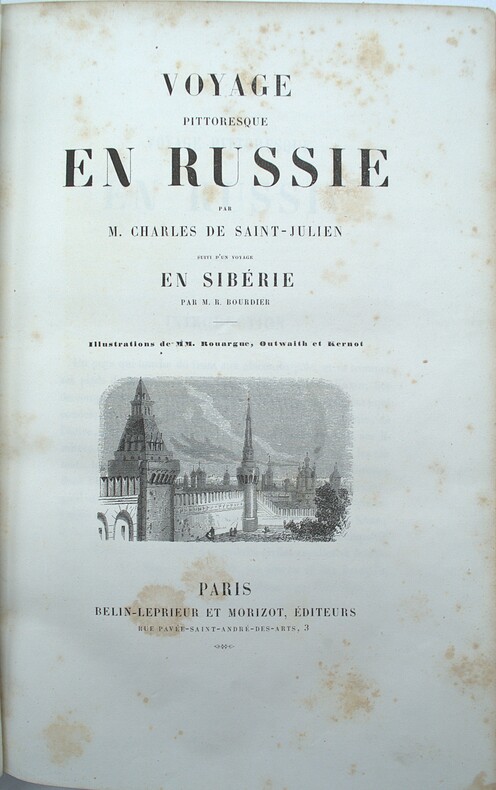
ref. PHO-2485Paris : Belin-Leprieur et Morizot éditeurs, sd. (1854), 540pp., demi chagrin rouge, dos à nerfs avec auteur et titre, estampage aux plats, tranches dorées. Rousseurs éparses, coins légèrement usés. Illustré de 21 gravures par Rouargue et Kernot, dont un frontispice et 8 en couleurs, vignette au titre.
19088vo., Second Edition, with portrait frontispiece in photogravure (original tissue guard present), title in red and black, plates in photogravure and illustrations in the text, neat contemporary inscription on title, free endpapers lightly browned; original oatmeal buckram, backstrip with leather labels (chipped at edges) framed and lettered in gilt, gilt top, uncut, corners lightly bruised else a very good, bright, clean copy. Mummery's classic account was first published in 1895. In this, arguably the best, edition the frontispiece of Aiguille Verte is replaced by the author's portrait. Neate *555.
ref. SONG0199757364Used: Good unknown
1903Very Good Turkish, Ottoman (1500-1928) Original newspaper. Folio. (49 x 33 cm). In Ottoman script (Old Turkish with Arabic letters) and imprint details in bilingual in Russian and Turkish. 4 p. An early issue of this extremely rare newspaper published in Tbilisi by Mehemmedaga Sahtahtli between 1903 and 1905 as 392 issues in total, published for all Turks and Islamic groups in Russia, which had a significant position in the modernization history of Azerbaijani and Russian Turks and the political and social changes at the end of the 19th and the early 20th centuries for Islamic minorities in Russia. The articles were included in this issue as follows: Tiflis-Musahabe by Mehemmed Bey Kasimbekov, pp. 1-2 (about the Girls' Schools in the Caucasus.; Türkistan'a Seyahat by Tacir Arif, pp. 2-3 [Voyage into Turkestan], Öz Muhbirlerimizden-Uralsk'dan-Men Garra' Gurra'-Tercüman ve Muharriri, pp. 3 [an article criticizing "Sark-i Rus"' publishing policy]; Kirim, Öz Muhbirlerimizden-Kirim'dan-Akmescid'de Darü'l-Muallimîn, pp. 3-4 [about the school for theachers, which was opened in Akmescit (Simferopol) in 1870 and provides education in Russian, the number of students and the education program and the inadequacy of the Muslim education of the same school]; Öz Muhbirlerimizden-Bakû'dan, pp. 4 [about the Muslims of Baku losing their influence from the commercial life of the city]; etc. The first Turkish newspapers titled "Ziya", "Ziya-yi Kafkasiye" and "Keshkul" published in Tbilisi in the 19th century were closed by the Russian authorities. The newspaper "Sark-i Rus", published in 1891, long after the closure of Keskul, became the first Turkish newspaper published in the Caucasus at the beginning of the 20th century. Mehemmedaga Sahtahtli, or Mammad agha Shahtakhtinski (1846-1931), was an Azerbaijani linguist and public figure. In 1902, Shahtakhtinski returned to Caucasus and settled in Tiflis. Here in March 1903, he founded the Azeri-language newspaper Sharg-i Rus ("The Russian Orient") dedicated to the academic enlightenment of the Muslims of the Caucasus. His articles propagated the necessity of Europeanisation, which he saw as the only possible way to a stable and developed future. He sharply criticised Islamic fanaticism, which in his opinion was a major obstacle in the development of Azeri culture and was incompatible with the idea of progress. He also dismissed Pan-Turkism, a popular theory among Turkic-speaking scholars and political activists of the time, and propagated the use of folk Azeri as a literary language, as opposed to the common practice of using Ottoman Turkish. He was among the peacemakers during the bloody Armenian-Tatar massacres of 1905-1907. In 1907, he was elected to the State Duma of the Russian Empire (second convocation). After dissolution of the duma, he worked for Petersburg-based newspaper "Russia", then edited by Pyotr Stolypin. Between 1908 and 1918, Shahtakhtinski lived in various parts of the Middle East, including Anatolia, Iraq and Persia, meanwhile writing articles for "Turkestan Times" (Russian: Turkestanskie Vedomosti). During this time abroad, he worked at the Russian embassy to the Ottoman Empire as translator between 1909 and 1912. In 1919, he returned to then-independent Azerbaijan to give lectures at the newly established Azerbaijan State University. Shahtakhtinski was among the numerous scholars who had followed Mirza Fatali Akhundov in proposing an alphabet reform for Azeri, suggesting to reform the existing Perso-Arabic script. The unsuitability of the Arabic alphabet to Turkic languages in general was in his opinion a major obstacle to the spread of literacy among Azeris. Between 1879 and 1903, Shahtakhtinski designed several model alphabets for Azeri, some of them Roman-based, however none of them was implemented in practice. He attended Congress of the Peoples of the East, acting as an interpreter for Turkish, French, German, Persian and Arabic in 1920. In 1923, Shahtakhtinski as member of a special four-mem

2016New Turkish Original bdg. HC. 4to. (28 x 20 cm). In Turkish. 704 p., ills. Gobustan'in gizemi: Kipçaklar'a giden yol. Gobustan: History and culture.; Etymology of Gobustan.; Geography.; Turkic / Turkish peoples.; Kipchaks.; Turkish language in the region.; Religion. Book has 733 numerous visual material including photographs, maps, illustrations, drawings... A very heavy and oversize volume.
ref. DADAX0700706356New unknown
ref. DADAX070071264XNew unknown
ref. DADAX0700706372New unknown
ref. DADAX0415565278New unknown
ref. DADAX0415519497New unknown
1993Mm 300x365 Catalogo della mostra di Amburgo e di Stoccarda del 1993. Volume rilegato in tela nera con titolo impresso al piatto ed etichetta applicata al dorso, custodia sempre in tela, 392 pagine profusamente illustrate a colori. Testo in lingua inglese - english text. Copia in condizioni di nuovo - brand new. Spedizione in 24 ore dalla conferma dell'ordine.
ref. DADAX0415332605New unknown
ref. DADAX0415486602New unknown
ref. DADAX0700715045New unknown
ref. DADAX0415776155New unknown
ref. DADAX0700706399New unknown
ref. DADAX0415544297New unknown
ref. DADAX0415325900New unknown
ref. DADAX0700706577New unknown
ref. DADAX1409422747New unknown
ref. DADAX1472446909New unknown