492 résultats
2004réf. SONG0851622003Boosey & Hawkes 2004-06-01. paperback. Used: Good. 9.00x0.51x12.00. Buy with confidence. Excellent Customer Service & Return policy. Boosey & Hawkes paperback
2005réf. SONG0825672902Brand: Schirmer Trade Books 2005-02-01. hardcover. Used: Good. 6.56x0.80x9.50. Buy with confidence. Excellent Customer Service & Return policy. Brand: Schirmer Trade Books hardcover
2001réf. SONG0851623182Boosey & Hawkes 2001-07-01. paperback. Used: Good. 9.00x0.32x12.00. Buy with confidence. Excellent Customer Service & Return policy. Boosey & Hawkes paperback
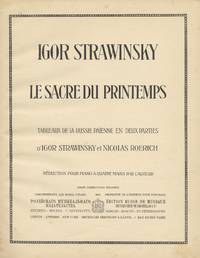
1913réf. 41314Berlin - Moscou - St. Petersbourg: Édition Russe de Musique PN R.M.V. 196 1913. Folio. Original publisher's ivory cloth-backed dark ivory printed boards 1f. recto title verso blank 1f. recto half-title in French verso blank 1f. recto half title in Russian verso blank 1f. recto dedication to Nicolas Roerich verso blank 9-89. i blank pp. Binding slightly worn browned and foxed with manuscript annotation to blank upper margin of upper deleted in black ink. Slightly browned throughout; corners thumbed; some minor imperfections. In very good condition overall. First Edition first issue of the four-hand piano arrangement and the first appearance in print of the music pre-dating the full score by eight years. Rare. Kirchmeyer 15-1. De Lerma S3. White 21 p. 207. Crawford p. 543. "Unlike the orchestral score which did not appear in print until early 1922 the piano-duet version was published by Édition Russe de Musique shortly before the première and was soon reissued in response to considerable demand. But special importance attaches to this four-hand version not only for historical reasons but because of its specific aesthetic quality for it directly brings out the "pianistic" nature of many of the work's musical ideas. True not for a moment do we forget that The Rite of Spring owes a large part of its impact to its orchestral sound now subtly differentiated now brutally violent. But it allows the structural workings of a piece invented at the piano and developed in close contact with the instrument to come all the more trenchantly to the fore. It was not least because of this trenchancy and "closeness to the origin" that the piano version has in recent decades begun to emerge from its primary role as an object of study and a rehearsal aid and to take on a second life as an independent concert piece. It has even formed the basis of a number of ballet productions." Meyer ed.: Igor Stravinsky Le Sacre du printemps Manuscript of the Version for Piano Four Hands Facsimile p. 23 The momentous first performance of The Rite took place in Paris at the Théâtre des Champs-Elysées on 29 May 1913. It was conducted by Monteux with choreography by Vaslav Nijinsky and set and costume designs by Nicolas Roerich. "It is now theatrical history that the first performance by the Russian Ballet . created a scandal of the first magnitude ." White: Stravinsky. The Composer and His Works p. 216. Since that time there have been a number of other versions of the ballet one choreographed by Leonide Massine 1920 at the Théâtre des Champs-Elysées with Roerich's original set designs and another by Kenneth Macmillan 1962 at Covent Garden with set designs by Sydney Nolan "but the work is more popular and seems to make a greater impact in the concert hall than on the stage. Its triumphant rehabilitation as one of the most important works in the symphonic repertory of the twentieth century dates from its first concert performances - in Moscow February 1914; conductor S. Koussevitzky Paris Casino de Paris April 1914; conductor Monteux and London Queen's Hall 7 June 1921; conductor Eugene Goossens." Ibid Diaghilev referred to The Rite of Spring as "the 20th century's Ninth Symphony." Austin: Music in the 20th Century p. 252. "Le sacre du printemps was to remain the most notoriously violent score of a time when huge noisy orchestras and harsh dissonance were more or less commonplace appurtenances of the new music. The primitive imagery of Russian symbolism of the kind exploited by Roerich had always carried a certain revolutionary tone a note of challenge to ossified social structures. But behind all the racket behind the wilfully discordant harmonies and convulsive metric irregularities lay a genuinely innovatory kind of musical thinking whose point would not become clear until Stravinsky himself began to deconstruct it in subsequent works." Stephen Walsh in Grove Music Online. Édition Russe de Musique [PN R.M.V. 196] unknown
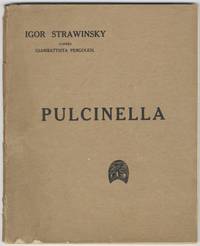
1920réf. 41305London Genève: J. & W. Chester Ltd. PN J. & W. C. 9707 1920. Folio. Original publisher's printed dark ivory wrappers with decorative device to upper and publisher's details within decorative border to lower. 1f. recto title verso printed notice regarding first performance with named cast list and scenario 86 pp. Named cast includes Massine Pulcinella Thamar Karsavina Pimpinella Tchernicheva Prudenza Nemtchinova Rosetta Novac Fourbo Idzikowky Caviello Zverew Florindo Cecchetti Il Dottore Kostetsky Tartaglia and Bourman Okimowsky Micholaitchik and Loukin Petits Pulcinella. Wrappers somewhat worn and soiled; torn at spine with minor loss; partially detached. Minor internal wear; two small chips to blank lower margin of title and upper wrapper. First Edition. Scarce. Kirchmeyer 34-1. White p. 282. De Lerma P60. CPM Vol. 54 p. 440. Pulcinella commissioned by the Russian impresario and founder of the Ballets Russes Sergei Diaghilev 1872-1929 was first performed in Paris at the Opéra on 15 May 1920 with Ernest Ansermet conducting. The libretto and choreography were by Léonide Massine with costumes and sets designed by Pablo Picasso. J. & W. Chester, Ltd. [PN J. & W. C. 9707] unknown
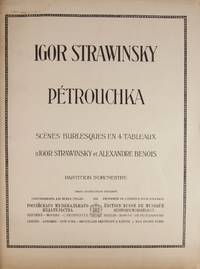
1912réf. 41313Berlin Moscou St. Pétersbourg .: Édition Russe de Musique PN R.M.V. 127 1912. Folio. Newly bound in quarter dark green cloth with mid-brown paper boards dark red title label gilt to upper and spine. 1f. recto title verso blank i named cast list ii synopsis i orchestration i recto dedication "À Alexandre Benois" verso blank 7-156 pp. 1f. errata tipped in to rear pastedown. With text in Russian and French. Named cast for the first performance by Diaghilev's Ballets Russes at the Théâtre du Chatelet in Paris on 13 June 1911 includes Tamar Karsavina Le Ballerine Vaslav Nijinsky Petrushka Orlow Le Maure and Enrico Ceccheti Le vieux Charlatan; the performance was conducted by Monteux with maître du ballet Fokine and sets and costumes designed by Benois and executed by Anisfeld sets and Caffi and Worobiew costumes. Small area of faint dampstaining and minor cockling to upper inner margins. An attractive copy. First Edition first issue. Rare. Kirchmeyer 12-1. Hirsch II 905. De Lerma P15. White p. 193. Crawford p. 533. "The emergence of Stravinsky as a modernist with an individual manner unlike any other can be dated with some precision to his early work on Petrushka. In March 1910 during the later stages of composing The Firebird he had experienced the famous 'fleeting vision' out of which The Rite of Spring was to grow. But when Diaghilev and Nijinsky visited him in Lausanne in September 1910 they found him at work on something quite different a concert piece for piano and orchestra called 'Petrushka's Cry'. Together with a 'Russian Dance' composed soon afterwards this music was to form the basis of the ballet which Diaghilev instinctively urged him to write instead. . It is from the systematic attempt to render the particular flavour of traditional Russian life into music that Petrushka derives many of its freshest and most original qualities. . Looked at in general terms the opening sequence of Petrushka is a prototype of later Stravinskian form. Its underlying rhythmic design may not be complex in the same way as that of The Rite of Spring or the later Russian works but its intricacy of rhythmic detailing and its mixture of a highly fluid pattern of melodic stress with an inert background harmony laid the groundwork for a technique which through many changes of superficial style was to serve him for the rest of his life." Walsh: The Music of Stravinsky pp. 24-29. "Petroushka proved just as successful with the public and critics as The Firebird had been; but it was undoubtedly a more original work. In the first place Stravinsky had been able to play a leading part in the construction of the scenario which had not been the case with The Firebird. Secondly whereas the music of The Firebird showed that the pupil had learnt all that his master had had to teach him in Petrushka for the first time the authentic voice of the new master is heard." TNG Vol. 18 pp. 244-245. The rare first edition first issue of Stravinsky's colorful and well-loved ballet inspired by the St. Petersburg Shrove-tide Fair. Édition Russe de Musique [PN R.M.V. 127] unknown
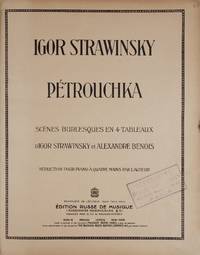
1912réf. 41390Berlin Moscou Leipzig New-York: Édition Russe de Musique PN R.M.V. 150 1912. Folio. Contemporary half black calf with marbled boards label of the Parisian music rental firm Rouart-Lerolle to upper marbled endpapers. 1f. recto title verso blank i named cast list referring to first production of 1911 in French i synopsis in Russian and French i "general remarks" in Russian and French i blank i dedication to A. Benois i blank 7-84 ii blank pp. Photographic transfer from engraved plates. With "ROME MAI 1911" and printer's note "Imp. C. G. Röder Leipzig." to lower outer corner of p. 84. Rouart Lerolle and "5" handstamps to title and first four leaves. Binding worn rubbed bumped and abraded; hinges split; small label with "143" in manuscript to upper board. First Edition first issue. Kirchmeyer 12-4. De Lerma P17. Crawford p. 533. Distinguishing imprint to title below crest found in the first issue is as follows: PROPRIÉTÉ DE L'ÉDITEUR POUR TOUS PAYS / ÉDITION RUSSE DE MUSIQUE / RUSSISCHER MUSIKVERLAG G.M. above BH below/ FONDÉE PAR S. ET N. KOUSSEWITZKY / BERLIN MOSCOU LEIPZIG NEW-YORK / POUR LA FRANCE ET SES COLONIES: MUSIQUE RUSSE PARIS 3 RUE DE MOSCOU / POUR L'ANGLETERRE ET SES COLONIES; THE RUSSIAN MUSIC AGENCY LONDRES W.I 34 PERCY STREET "The emergence of Stravinsky as a modernist with an individual manner unlike any other can be dated with some precision to his early work on Petrushka. In March 1910 during the later stages of composing The Firebird he had experienced the famous 'fleeting vision' out of which The Rite of Spring was to grow. But when Diaghilev and Nijinsky visited him in Lausanne in September 1910 they found him at work on something quite different a concert piece for piano and orchestra called 'Petrushka's Cry'. Together with a 'Russian Dance' composed soon afterwards this music was to form the basis of the ballet which Diaghilev instinctively urged him to write instead. . It is from the systematic attempt to render the particular flavour of traditional Russian life into music that Petrushka derives many of its freshest and most original qualities. . Looked at in general terms the opening sequence of Petrushka is a prototype of later Stravinskian form. Its underlying rhythmic design may not be complex in the same way as that of The Rite of Spring or the later Russian works but its intricacy of rhythmic detailing and its mixture of a highly fluid pattern of melodic stress with an inert background harmony laid the groundwork for a technique which through many changes of superficial style was to serve him for the rest of his life." Walsh: The Music of Stravinsky pp. 24-29. "Petroushka proved just as successful with the public and critics as The Firebird had been; but it was undoubtedly a more original work. In the first place Stravinsky had been able to play a leading part in the construction of the scenario which had not been the case with The Firebird. Secondly whereas the music of The Firebird showed that the pupil had learnt all that his master had had to teach him in Petrushka for the first time the authentic voice of the new master is heard." TNG Vol. 18 pp. 244-245. Petrushka one of Stravinsky's best-known and loved works represents the essence of Diaghilev's monumental Ballets Russes era. The ballet received its first performance with the incomparable Nijinsky in the title role at the Théâtre du Châtelet on 13 June 1911 conducted by Pierre Monteux with choreography by Fokine and designs by Alexandre Benois. Édition Russe de Musique [PN R.M.V. 150] unknown
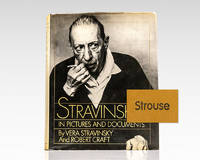
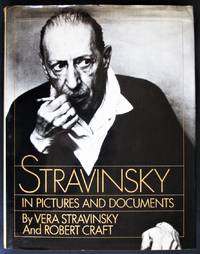
1978réf. 152209New York: Simon and Schuster 1978. First edition of this authoritative biography of Igor Stravinsky. Quarto original cloth profusely illustrated with black-and-white photographs. From the collection of Tony Grammy and Emmy Award-winning composer Charles Strouse and his wife choreographer Barbara Siman. Over his 50-year career Charles Strouse wrote the music for such iconic musical theater hits as Bye Bye Birdie Applause and Annie as well as the theme song for the classic sitcom All in the Family "Those Were the Days". His partnership with Martin Charnin on Annie produced one of Broadway's most successful scores ever with "Tomorrow" and other songs from the production becoming enduring American musical standards admired by generations. His reach knew no genre or generation – from a number-one Billboard hit in 1958 to Jay-Z's Grammy-winning sampling of "It's the Hard-Knock Life" four decades later – and his honors include three Tony Awards and induction into both the Songwriters and Theater Halls of Fame. With his ownership stamp to the front free endpaper. Near fine in a very good dust jacket. Designed by Edith Fowler. Jacket design by Robert Anthony. Stravinsky in Pictures and Documents 1978 is a monumental documentary biography of Igor Stravinsky 1882-1971 assembled by the composer's widow Vera Stravinsky 1888-1982 and his longtime musical associate and amanuensis Robert Craft 1923-2015. Departing from conventional narrative the authors tell the story of one of the twentieth century's supreme musical figures largely through primary materials hundreds of photographs letters diary entries contracts and other documents drawn from the Stravinsky archive many published here for the first time accompanied by Craft's connecting commentary and a wealth of annotation. The result is an unusually intimate chronicle that follows Stravinsky from his Russian childhood and the epoch-making early ballets The Firebird Petrushka and The Rite of Spring through his years in Switzerland France and the United States illuminating not only his music but the artists writers and impresarios among them Diaghilev Picasso and Cocteau who populated his extraordinary life. Vera a painter and former dancer who became Stravinsky's second wife and Craft who lived within the Stravinsky household for more than two decades were uniquely placed to compile this rich and authoritative record. Simon and Schuster hardcover
1941réf. 200-03964Edward B. Marks Music Corporation 1941. paperback. Good. Good with wear and markings. Looks like an interesting title. Edward B. Marks Music Corporation paperback
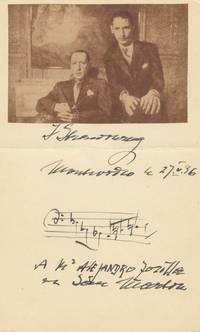
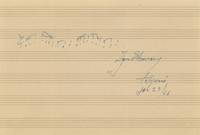
réf. 396731 measure from the opening of the first movement. Notated in black ink on an album leaf 203 x 123 mm. Dated "Montevideo le 27. v. 1936." Inscribed to the Uruguayan political figure Alejandro Zorrilla de San Martin 1909-1987 prominent member of the Uruguayan National Party with a reproduction photograph of Stravinsky and his son Soulima to head. Slightly browned; horizontal crease to upper portion just below Stravinsky's signature; manuscript identification and minor remnants of former mount to verso. The Firebird L'Oiseau de feu; Zhar-ptitsa a fairy tale ballet in two scenes was first performed by Diaghilev's Ballets Russes in Paris at the Opéra on 25 June 1910 conducted by Gabriel Pierné. The original choreography was by Michel Fokine with sets and costumes by Alexandre Benois; this seminal work led to further important Stravinsky-Diaghilev collaborations including Petrushka 1911 and The Rite of Spring 1913. unknown
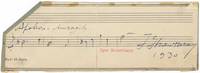
réf. 396614 measures from the third number Pas d'Action. Notated in blue/black ink on music paper with "No. 1-12 lines" printed at lower left corner; "Igor Stravinsky" typed in red below quotation. Somewhat worn and browned; irregularly trimmed with upper left corner cropped not affecting quotation; recto reinforced at upper left corner and left margin with light blue paper; creased and partially split at central fold; margins hand-ruled with double black line; upper margin slightly stained; mounted on printed excerpt with remnants of adhesive to verso. Apollon Musagète a neoclassical ballet in two tableaux was commissioned in 1927 by Elizabeth Sprague Coolidge for a festival of contemporary music to be held in 1928 at the Library of Congress in Washington D.C. Composed between 1927 and 1928 the work was choreographed by the 24-year-old George Balanchine to a libretto by the composer; scenery and costumes were by André Bauchant with new costumes designed by Coco Chanel in 1929. unknown
1978réf. 017881Simon and Schuster 1978. This is a very good hardcover copy with a very good dust jacket not price-clipped with just light wear. SIGNED by Vera Stravinsky and dated December 1978 and inscribed to a well known music archivist on the front endpaper. Also signed by Robert Craft. Otherwise completely clean slight moisture rippling to bottom page edges.Closed tear to top edge of dust jacket spine. Illustrated in black & white. 11" high X 8" wide 688 pages. Large heavy book foreign shipping will be extra. This book will be securely wrapped and packed in a sturdy box and shipped with tracking. Signed by Author. First Edition. Hard Cover. Very Good/Very Good. Simon and Schuster, Hardcover
réf. 39498Four measures containing the theme of the closing of the first scene of the composer's Danse Russe. Notated unbarred on dark ivory music paper in blue ink signed and dated Hollywood 23 January 1966. On an album leaf 141 x 199 laid down to backing board. Small hole to blank upper margin; two light vertical creases. Petrushka a ballet in 4 scenes with music by Stravinsky choreography by Michel Fokine and set and costume designs by Alexandre Benois was written for the 1911 season of Diaghilev's Ballets Russes and first performed in Paris at the Châtelet on 13 June 1911. The premiere was conducted by Pierre Monteux with Vaslav Nijinsky as Petrushka Tamar Karsavina as lead ballerina and Enrico Cecchetti as the charlatan. The work became one of the most popular productions of the revolutionary Ballets Russes and one of Stravinsky's best-loved compositions. unknown
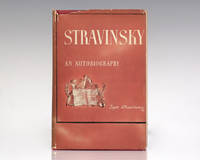
1936réf. 141339New York: Simon & Schuster 1936. First edition of the composer's classic autobiography. Octavo original cloth. Near fine in a very good dust jacket bookplate owner name. Jacket design by George Salter. Rare in the original jacket. An Autobiography chronicles the first half-century of Stravinsky's life all the while offering his opinions and "abhorrences." A Parsifal performance at Bayreuth "At the end of a quarter of an hour I could bear no more." Nijinsky "The poor boy knew nothing of music." Spanish folk music "Endless preliminary chords of guitar playing." Simon & Schuster hardcover
1925réf. 39219London Genève Paris Bruxelles: J. & W. Chester Ltd.; Rouart Lerolle & Cie.; Maison Chester PN J.W.C. 15521 1925. Quarto. Ivory wrappers with upper printed in black. 3 i blank pp. Wrappers worn and slightly soiled with minor tears and creasing to edges and corners. Browned. A re-issue of the first edition. Kirchmeyer 33-2. J. & W. Chester, Ltd.; Rouart, Lerolle & Cie.; Maison Chester [PN J.W.C. 15521] unknown
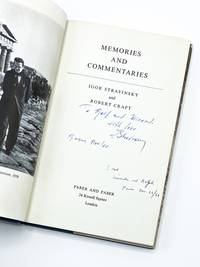
1960réf. 45960London: Faber and Faber 1960. First edition. Very good in very good jacket. First printing of this collection of conversations with the iconic composer inscribed in the year of publication to his well-connected friends Miranda and Ralph Levy. Igor Stravinsky's storied career spanned from Russia to France and finally to the US where his innovative style caused ripples throughout the music world. MEMORIES AND COMMENTARIES finds the composer reflecting on his many influences friends and colleagues and was compiled with the help of his frequent collaborator and confidant Robert Craft. This copy features an inscription from Stravinsky to "Ralph and Miranda Levy" a television pioneer and well-known jewelry designer respectively. Miranda Levy was noted in her obituary as "the woman who jump-started the Santa Fe Opera" by introducing its founding director to Stravinsky Roberts. Stravinsky supervised the opera house's opening production of his "A Rake's Progress" in 1957 and subsequently returned to Santa Fe every summer after that until 1963. A warm association between arguably the 20th century's most important composer and two significant supporters. 8.5'' x 5.25''. Original blue cloth binding. Original unclipped 25s pictorial dust jacket. Black-and-white frontispiece with 21 black-and-white illustrations. 184 pages including index. Inscribed by Stravinsky "To Ralph and Miranda" Levy dated November 1960 in Rome. With the Levy's subsequent gift inscription below. Jacket with light edgewear slight chipping to corners and spine ends. Binding with mild edgewear and bumping to spine ends; faint damping close inspection only. Faber and Faber unknown
réf. 107899London John Lehmann 1947. . First edition first impression dedication copy from the author to his wife; 8vo; publisher's tan cloth titles to spine gilt on a black ground black topstain with the dust jacket in the particularly good dust-jacket. The non plus ultra example being the copy inscribed by the author to his wife to whom the book is formally dedicated 'TO MY WIFE'. With White signed presentation inscription to the front free endpaper ' To Dodo without whose sympathy encouragement and judgement this book cd never have been written Eric 1947'. Eric Walter White's first foray into the critical study of Stravinsky about whom he would go on to write a compendious history. Through these two works White became the great composer's most important biographer. Eric and Dodo white married in 1939. London, John Lehmann, 1947. hardcover
réf. 0486404137.Gpaperback. Good. Access codes and supplements are not guaranteed with used items. May be an ex-library book. paperback
1984réf. 33014Basel: Kunstmuseum Basel 1984. Hardcover. Fine. Small folio. 386 pp. Illustrated. Kunstmuseum Basel hardcover
1966réf. 951091966. Rare autograph letter signed by Russian-born composer Igor Stravinsky. One page type-written dated December 21st 1966 and addressed to John McClure at Columbia Records the letter reads "Dear John Please answer this Mercury Record letter for me telling them that they can have the permission though they can have it I think without asking me in any case. I have been ordered to rest -- no conducting at all -- after Chicago. This postpones our January plans I greatly regret to say and not only for me as I realize bu can't help. Happy New Year to you and your wife. Igor Stravinsky." The recipient John McClure was an American recording producer at Columbia Records throughout the 1950s and later operated in a freelance capacity. He worked on over 30 recordings with Stravinsky 200 with Leonard Bernstein and oversaw recordings by the Boston Pops Orchestra under John Williams. Double matted and framed with a black and white portrait of Stravinsky. The entire piece measures 19.5 inches by 14.5 inches. In fine condition. Stravinsky found recordings a practical and useful tool in preserving his thoughts on the interpretation of his music. As a conductor of his own music he recorded primarily for Columbia Records beginning in 1928 with a performance of the original suite from The Firebird and concluding in 1967 with the 1945 suite from the same ballet. Although most of his recordings were made with studio musicians he also worked with the Chicago Symphony Orchestra the Cleveland Orchestra the CBC Symphony Orchestra the New York Philharmonic Orchestra the Royal Philharmonic Orchestra and the Bavarian Broadcasting Symphony Orchestra. unknown
1962réf. 847621962. Single page typed signed letter with notes in Stravinsky's hand. Typed signed letter from 1962 to Igor Styravinsky from Carl Haverlin pioneer in radio broadcasting and longtime president of Broadcast Music Inc. The letter is on Broadcast Music Inc. stationary and Haverlin writes to inquire about some illustrations which Dulac had made for Stravinsky's Firebird Ballet. He writes: "I.take the liberty of asking you if your memory will bring forth any background on the sketches." In the margin adjacent to this sentence Stravinsky writes "Not at all!" in red pen. Haverlin closes the letter with: "Photostats of the sketchbook pages are enclosed." Beneath this Stravinsky writes along with his signature "I find it unfortunately very bad." Matted and framed opposite a photograph of Stravinsky. The entire piece measures 26.5 inches by 19.25 inches. Igor Stravinsky was a Russian-born composer pianist and conductor. He is widely considered one of the most important and influential composers of the 20th century. Stravinsky's compositional career was notable for its stylistic diversity. He first achieved international fame with three ballets commissioned by the impresario Serge Diaghilev and first performed in Paris by Diaghilev's Ballets Russes: The Firebird 1910 Petrushka 1911 and The Rite of Spring 1913. The last of these transformed the way in which subsequent composers thought about rhythmic structure and was largely responsible for Stravinsky's enduring reputation as a musical revolutionary who pushed the boundaries of musical design. His "Russian phase" which continued with works such as Renard the Soldier's Tale and Les Noces was followed in the 1920s by a period in which he turned to neoclassical music. The works from this period tended to make use of traditional musical forms concerto grosso fugue and symphony drawing on earlier styles especially from the 18th century. In the 1950s Stravinsky adopted serial procedures. His compositions of this period shared traits with examples of his earlier output: rhythmic energy the construction of extended melodic ideas out of a few two- or three-note cells and clarity of form and of instrumentation. unknown
1969réf. 256031New York: Alfred A Knopf 1969. First edition. ix i 350 xi pp. 8vo. Publisher's green cloth faded at edges in very good edge-worn dustjacket. First edition. ix i 350 xi pp. 8vo. Signed on the flyleaf "Igor Stravinksy / 1.30.70" and inscribed by co-author Robert Craft. The recipient was Miranda "Mirandi" Massoco Levy 1914-2011 the doyenne of Sante Fe cultural life instumental in the success of the Sante Fe Opera and a close friend of Stravinsky. Alfred A Knopf unknown
2003réf. DADAX0571505074Faber & Faber 2003-01-01. paperback. New. 6.42x0.18x11.58. Buy with confidence. Excellent Customer Service & Return policy. Faber & Faber paperback
1936réf. 255987London: Gollancz 1936. First English edition. Illustrated. 286 pp. 1 vols. 8vo. Publisher's black cloth repaired at head of spine in yellow printed dust jacket spine darkened and chipped with some loss to title small book ticket to spine. First English edition. Illustrated. 286 pp. 1 vols. 8vo. Inscribed on the ffep "A Sam & Louise Dushkin. Leur ami I Stravinsky. Paris 30.3.36." Samuel Dushkin 1891-1976 was a concert violinist who worked closely with Stravinsky on the composition of the latter's Violin Concerto 1931 his first major work for the instrument. Dushkin premiered the work in concert with Stravinsky conducting the Berlin Symphony Orchestra. Stravinsky recounts his collaboration with Dushkin on pp. 268-278 of his memoir. "I was very glad to find in him besides his remarkable gifts as a born violinist a musical culture a delicate understanding and - in the exercise of his profession - an abnegation that is very rare" p. 270. Stravinksy was inspired by his success with the Violin Concerto to compose a sonata for violin and piano which he took on tour with Dushkin to Europe and America ". a deeper knowledge of the violin and close collaboration with a technician like Dushkin had revealed possibilities which I longed to explore" p. 275. An important association marking a milestone in the expansion of Stravinksy's evolution as a composer. Gollancz unknown
1940réf. 244796Cambridge 1940. One page typewritten signed in black ink. 1 vols. 4to. Old folds. Fine with original typed mailing envelope typed name "Igor Strawinsky" above printed return address. One page typewritten signed in black ink. 1 vols. 4to. "Stravinsky began his stay in the United States at Harvard University delivering six Charles Eliot Norton lectures on musical poetics during the 1939-1940 academic year" ADNB. In this brief formal letter Stravinsky acknowledges receipt of an edition of the Russian legend retold and illustrated by Donald E. Cooke. It was Stravinsky's 1910 score of The Firebird for the Ballets Russes that first brought him international notice. The New York Times obituary of Stravinsky published on 6 April 1971 noted "He also was not pleased that 'The Firebird' remained his most popular composition." Uncommon document from early in Stravinsky's residence in the U.S. when he still spelt his surname with "w" in his signature and return address. unknown