476 résultats
réf. 16-4196London: J. & W. Chester Ltd. 1924. 30.7x 24.4 cm. 862 2pp. Light foxing on a few pages and tfhe cover. . From the collection of the poet and playwright René Morax . He founded his Théâtre du Jorat near Mézières Switzerland in 1903. Made entirely of wood so as to be integrated into the barns of the surrounding countryside it was described this way in an early account: “A theater decidedly unlike any other. A sort of vast chalet a kind of huge barn smelling of resin dried hay fresh fruit and on days when there was a performance Sunday clothes but retaining the rustic dignity of a shrine. A large stage descending in broad steps toward the orchestra pit …”The theater was closed for several years during the Great War and Morax conceived a drama on the subject of King David to reopen it in 1921. When he turned to his wealthy friend Werner Reinhart who incidentally had recently funded the creation of Stravinsky’s Soldier’s Tale telling him that he was taking inspiration from Hindu theater for this work his patron offered to lend rare Hindu drums in addition to financial assistance. The text is drawn from the Hebrew Bible I and II Samuel I Kings in addition to the Huguenot Psalter which includes poetry by Clément Marot. The poet’s brother Jean Morax set to work designing costumes and sets. After several more established composers turned him down René on the advice of Stravinsky and the distinguished conductor Ernest Ansermet chose the then unknown twenty-eight year old Arthur Honegger. “When Swiss poet Rene Morax 1873-1963 was looking for a composer for his new King David libretto Stravinsky recommended the twenty-nine-year-old Arthur Honegger a composer who just six years later creating the film score for Abel Gance’s Napoleon would reveal himself as a master of music’s ability to translate epics into sweeping evocative sound. In 1921 right on the cusp of his first successes Honegger wrote the David score in a flush of creative energy.”. Provenance from the estate of René Morax. Expertise by Claire PIGUET Geneva London: J. & W. Chester, Ltd., [1924] hardcover
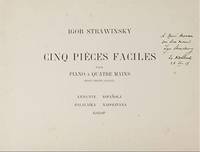
réf. 16-4195Genève: Edition Ad. Henn 1917. . Oblong 4to. 19.8 25.7 cm. 28pp. Original wraps loose as issued. Signed at Morges Switzerland and dated Noel 1917 and inscribed .The poet and playwright René Morax founded his Théâtre du Jorat near Mézières Switzerland in 1903. Made entirely of wood so as to be integrated into the barns of the surrounding countryside it was described this way in an early account: “A theater decidedly unlike any other. A sort of vast chalet a kind of huge barn smelling of resin dried hay fresh fruit and on days when there was a performance Sunday clothes but retaining the rustic dignity of a shrine. A large stage descending in broad steps toward the orchestra pit …”The theater was closed for several years during the Great War and Morax conceived a drama on the subject of King David to reopen it in 1921. When he turned to his wealthy friend Werner Reinhart who incidentally had recently funded the creation of Stravinsky’s Soldier’s Tale telling him that he was taking inspiration from Hindu theater for this work his patron offered to lend rare Hindu drums in addition to financial assistance. The text is drawn from the Hebrew Bible I and II Samuel I Kings in addition to the Huguenot Psalter which includes poetry by Clément Marot. The poet’s brother Jean Morax set to work designing costumes and sets. After several more established composers turned him down René on the advice of Stravinsky and the distinguished conductor Ernest Ansermet chose the then unknown twenty-eight year old Arthur Honegger. “When Swiss poet Rene Morax 1873-1963 was looking for a composer for his new King David libretto Stravinsky recommended the twenty-nine-year-old Arthur Honegger a composer who just six years later creating the film score for Abel Gance’s Napoleon would reveal himself as a master of music’s ability to translate epics into sweeping evocative sound. In 1921 right on the cusp of his first successes Honegger wrote the David score in a flush of creative energy.”. Provenance from the estate of René Morax. Expertise by Claire PIGUET Geneva Genève: Edition Ad. Henn, 1917. paperback
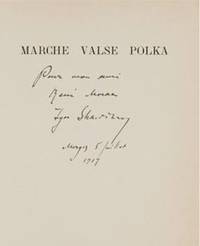
réf. 16-4192Genève: Edition Ad. Henn 1917. . Oblong 4to. 19.5 x 27.3 cm. 2 8pp. Original wraps. . Signed at Morges Switzerland and dated 5 Juillet 1917 and inscribed .The poet and playwright René Morax founded his Théâtre du Jorat near Mézières Switzerland in 1903. Made entirely of wood so as to be integrated into the barns of the surrounding countryside it was described this way in an early account: “A theater decidedly unlike any other. A sort of vast chalet a kind of huge barn smelling of resin dried hay fresh fruit and on days when there was a performance Sunday clothes but retaining the rustic dignity of a shrine. A large stage descending in broad steps toward the orchestra pit …”The theater was closed for several years during the Great War and Morax conceived a drama on the subject of King David to reopen it in 1921. When he turned to his wealthy friend Werner Reinhart who incidentally had recently funded the creation of Stravinsky’s Soldier’s Tale telling him that he was taking inspiration from Hindu theater for this work his patron offered to lend rare Hindu drums in addition to financial assistance. The text is drawn from the Hebrew Bible I and II Samuel I Kings in addition to the Huguenot Psalter which includes poetry by Clément Marot. The poet’s brother Jean Morax set to work designing costumes and sets. After several more established composers turned him down René on the advice of Stravinsky and the distinguished conductor Ernest Ansermet chose the then unknown twenty-eight year old Arthur Honegger. “When Swiss poet Rene Morax 1873-1963 was looking for a composer for his new King David libretto Stravinsky recommended the twenty-nine-year-old Arthur Honegger a composer who just six years later creating the film score for Abel Gance’s Napoleon would reveal himself as a master of music’s ability to translate epics into sweeping evocative sound. In 1921 right on the cusp of his first successes Honegger wrote the David score in a flush of creative energy.”. Provenance from the estate of René Morax. Expertise by Claire PIGUET Geneva Genève: Edition Ad. Henn, 1917. paperback
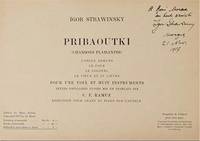
réf. 16-4193Genève: Edition Ad. Henn 1917. . Oblong 4to. 19 x 27.7 cm. 2 14pp. Original wraps. . Signed at Morges Switzerland and dated 21 Nov. 1917 and inscribed .The poet and playwright René Morax founded his Théâtre du Jorat near Mézières Switzerland in 1903. Made entirely of wood so as to be integrated into the barns of the surrounding countryside it was described this way in an early account: “A theater decidedly unlike any other. A sort of vast chalet a kind of huge barn smelling of resin dried hay fresh fruit and on days when there was a performance Sunday clothes but retaining the rustic dignity of a shrine. A large stage descending in broad steps toward the orchestra pit …”The theater was closed for several years during the Great War and Morax conceived a drama on the subject of King David to reopen it in 1921. When he turned to his wealthy friend Werner Reinhart who incidentally had recently funded the creation of Stravinsky’s Soldier’s Tale telling him that he was taking inspiration from Hindu theater for this work his patron offered to lend rare Hindu drums in addition to financial assistance. The text is drawn from the Hebrew Bible I and II Samuel I Kings in addition to the Huguenot Psalter which includes poetry by Clément Marot. The poet’s brother Jean Morax set to work designing costumes and sets. After several more established composers turned him down René on the advice of Stravinsky and the distinguished conductor Ernest Ansermet chose the then unknown twenty-eight year old Arthur Honegger. “When Swiss poet Rene Morax 1873-1963 was looking for a composer for his new King David libretto Stravinsky recommended the twenty-nine-year-old Arthur Honegger a composer who just six years later creating the film score for Abel Gance’s Napoleon would reveal himself as a master of music’s ability to translate epics into sweeping evocative sound. In 1921 right on the cusp of his first successes Honegger wrote the David score in a flush of creative energy.”. Provenance from the estate of René Morax. Expertise by Claire PIGUET Geneva Genève: Edition Ad. Henn, 1917. paperback
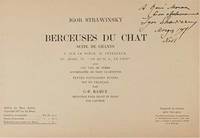
réf. 16-4194Genève: Edition Ad. Henn 1917. . 24 x 31.5 cm. 4 20pp. Original wraps. Front cover stained along edges. . Signed and dated 28 viii 17 and inscribed .The poet and playwright René Morax founded his Théâtre du Jorat near Mézières Switzerland in 1903. Made entirely of wood so as to be integrated into the barns of the surrounding countryside it was described this way in an early account: “A theater decidedly unlike any other. A sort of vast chalet a kind of huge barn smelling of resin dried hay fresh fruit and on days when there was a performance Sunday clothes but retaining the rustic dignity of a shrine. A large stage descending in broad steps toward the orchestra pit …”The theater was closed for several years during the Great War and Morax conceived a drama on the subject of King David to reopen it in 1921. When he turned to his wealthy friend Werner Reinhart who incidentally had recently funded the creation of Stravinsky’s Soldier’s Tale telling him that he was taking inspiration from Hindu theater for this work his patron offered to lend rare Hindu drums in addition to financial assistance. The text is drawn from the Hebrew Bible I and II Samuel I Kings in addition to the Huguenot Psalter which includes poetry by Clément Marot. The poet’s brother Jean Morax set to work designing costumes and sets. After several more established composers turned him down René on the advice of Stravinsky and the distinguished conductor Ernest Ansermet chose the then unknown twenty-eight year old Arthur Honegger. “When Swiss poet Rene Morax 1873-1963 was looking for a composer for his new King David libretto Stravinsky recommended the twenty-nine-year-old Arthur Honegger a composer who just six years later creating the film score for Abel Gance’s Napoleon would reveal himself as a master of music’s ability to translate epics into sweeping evocative sound. In 1921 right on the cusp of his first successes Honegger wrote the David score in a flush of creative energy.”. Provenance from the estate of René Morax. Expertise by Claire PIGUET Geneva Genève: Edition Ad. Henn, 1917. paperback
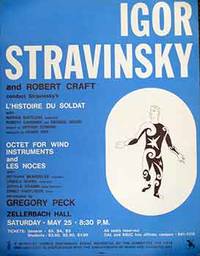
réf. 51-3548Berkeley: UC Zellerbach Hall Mya 1968. Poster in blue and black. 22.75 x 17 inches. Very good with small closed tear at lower margin."It was May of 1968 in Berkeley and Zellerbach Hall was soon to open its spacious glass doors for the first time. The program to be played: Igor Stravinsky’s “Symphony of Psalms” and “Oedipus Rex” conducted by Robert Craft and the celebrated composer himself. Unfortunately Stravinsky had fallen ill and was unable to conduct. But he did still attend this inaugural performance at UC Berkeley’s famous music hall — legend has it that the distracted audience was more enraptured by Stravinsky’s reaction to the music than by the actual performance itself." Berkeley: UC Zellerbach Hall, Mya 1968. unknown
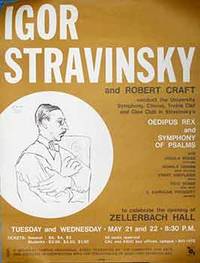
réf. 51-3549Berkeley: UC Zellerbach Hall May 1968. Poster in ochre and black. 22.75 x 17 inches. Very good."It was May of 1968 in Berkeley and Zellerbach Hall was soon to open its spacious glass doors for the first time. The program to be played: Igor Stravinsky’s “Symphony of Psalms” and “Oedipus Rex” conducted by Robert Craft and the celebrated composer himself. Unfortunately Stravinsky had fallen ill and was unable to conduct. But he did still attend this inaugural performance at UC Berkeley’s famous music hall — legend has it that the distracted audience was more enraptured by Stravinsky’s reaction to the music than by the actual performance itself." Berkeley: UC Zellerbach Hall, May 1968. unknown
réf. 15-8077New York: Perls Gallery 1940. 8vo. Printed Wrappers Very Good Illustrations. 4 pp. Theodore Stravinksy was the son of Igor Stravinksy.The Perls Gallery in New York was founded in 1937 by Klaus Gunther Perls 1912-2008 and his brother Franz R. Perls1910-1975 after having worked at their mother's Galerie Kate Perls in Paris. Following his marriage to Amelia Blumenthal of Philadelphia in 1940 Klaus and Amelia B. Perls jointly ran the gallery. They specialized in modern French painting while Franz established the Frank Perls Gallery in Beverly Hills He originally dealt in works by Maurice Utrillo Maurice de Vlaminck and Raoul Dufy that his mother sent from Paris until the Nazi occupation. When she was forced to flee France he began dealing in now little known contemporary American artists including Darrel Austin and in Mexican and South American art such as Mario Carreno. After the war Klaus again dealt in French art from the School of ParisArtists in the Perls' stable included Rouault Picasso Léger Derain Dufy Matisse Modigliani Pascin Soutine and Vlaminck. The Perls Galleries closed in 1997. New York: Perls Gallery, 1940. unknown
1983réf. 150933N.p.: PBS 1983. Vintage reference publicity photograph of noted ballerina Vera Zorina in three separate poses from the 1983 television episode originally aired on February 14 on PBS. With a descriptive promo sheet affixed to the verso as issued. This episode of "Great Performances" featured dancers performing three pieces choreographed by George Balanchine to the works of composer Igor Stravinsky. 8 x 10 inches. Near Fine. PBS unknown
réf. 1246927896.Gpaperback. Good. Access codes and supplements are not guaranteed with used items. May be an ex-library book. paperback
1941réf. 200-03964Edward B. Marks Music Corporation 1941. paperback. Good. Good with wear and markings. Looks like an interesting title. Edward B. Marks Music Corporation paperback
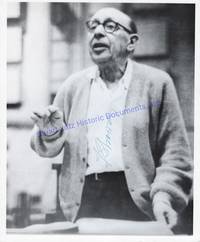
réf. 6573IGOR STRAVINSKY 1882-1971. Stravinsky was a Russian composer best remembered for The Firebird and The Rite Of Spring. He is considered one of the greatest composers of the Twentieth Century.PS. 8 x 10. No date. No place. A black and white photograph signed I Stravinsky in blue ballpoint ink across his torso. The image shows an older man with his right arm raised perhaps conducting. The blue ink has great contrast with his white shirt and it is in very fine condition. unknown
1957réf. 294547Les Concerts du Domaine Musical 1957. First Edition. Trade Paperback. 18 unnumbered pages. B/W illustrations. Performed by Orchestre du Sudwestfunk conducted by Hans Rosbaud. Program also included work by Anton Webern Arnold Schonberg and Alan Berg. Tipped-in B/W photograph 6 x 8 inches of Stravinsky on front cover. First edition first printing. Very good copy with tipped-in B/W photograph of Stravinsky on front cover Cover with mild wear. Lower right corner of photograph is creased with craese on lower right of front cover. Les Concerts du Domaine Musical paperback
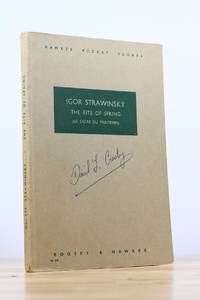
1960réf. 33435London: Boosey & Hawkes 1960. Paperback. Hawkes Pocket Scores. 7 x 10in. 139pp. Publisher's stiff printed wraps. Signed by the conductor and composer Pierre Boulez at the title page. This is the former copy of the composer David Lewis Crosby who attended Boulez's performance with the Cleveland Symphony Orchestra of The Rite of Spring at Oberlin College in November of 1967 with the concert program laid-in. Most pertinently Boulez and the Cleveland Orchestra would two years later record the definitive interpretation of The Rite of Spring for Columbia Masterworks. NEAR FINE. Shows some light toning and furrowing of the spine several annotations of the score in pencil by Crosby otherwise remains Fine/As New. As pictured. Boosey & Hawkes paperback
réf. 0486413926.Gpaperback. Good. Access codes and supplements are not guaranteed with used items. May be an ex-library book. paperback
réf. 0711941947.Gpaperback. Good. Access codes and supplements are not guaranteed with used items. May be an ex-library book. paperback
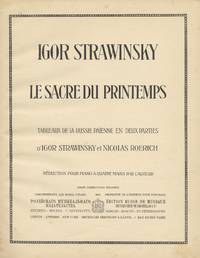
1913réf. 41314Berlin - Moscou - St. Petersbourg: Édition Russe de Musique PN R.M.V. 196 1913. Folio. Original publisher's ivory cloth-backed dark ivory printed boards 1f. recto title verso blank 1f. recto half-title in French verso blank 1f. recto half title in Russian verso blank 1f. recto dedication to Nicolas Roerich verso blank 9-89. i blank pp. Binding slightly worn browned and foxed with manuscript annotation to blank upper margin of upper deleted in black ink. Slightly browned throughout; corners thumbed; some minor imperfections. In very good condition overall. First Edition first issue of the four-hand piano arrangement and the first appearance in print of the music pre-dating the full score by eight years. Rare. Kirchmeyer 15-1. De Lerma S3. White 21 p. 207. Crawford p. 543. "Unlike the orchestral score which did not appear in print until early 1922 the piano-duet version was published by Édition Russe de Musique shortly before the première and was soon reissued in response to considerable demand. But special importance attaches to this four-hand version not only for historical reasons but because of its specific aesthetic quality for it directly brings out the "pianistic" nature of many of the work's musical ideas. True not for a moment do we forget that The Rite of Spring owes a large part of its impact to its orchestral sound now subtly differentiated now brutally violent. But it allows the structural workings of a piece invented at the piano and developed in close contact with the instrument to come all the more trenchantly to the fore. It was not least because of this trenchancy and "closeness to the origin" that the piano version has in recent decades begun to emerge from its primary role as an object of study and a rehearsal aid and to take on a second life as an independent concert piece. It has even formed the basis of a number of ballet productions." Meyer ed.: Igor Stravinsky Le Sacre du printemps Manuscript of the Version for Piano Four Hands Facsimile p. 23 The momentous first performance of The Rite took place in Paris at the Théâtre des Champs-Elysées on 29 May 1913. It was conducted by Monteux with choreography by Vaslav Nijinsky and set and costume designs by Nicolas Roerich. "It is now theatrical history that the first performance by the Russian Ballet . created a scandal of the first magnitude ." White: Stravinsky. The Composer and His Works p. 216. Since that time there have been a number of other versions of the ballet one choreographed by Leonide Massine 1920 at the Théâtre des Champs-Elysées with Roerich's original set designs and another by Kenneth Macmillan 1962 at Covent Garden with set designs by Sydney Nolan "but the work is more popular and seems to make a greater impact in the concert hall than on the stage. Its triumphant rehabilitation as one of the most important works in the symphonic repertory of the twentieth century dates from its first concert performances - in Moscow February 1914; conductor S. Koussevitzky Paris Casino de Paris April 1914; conductor Monteux and London Queen's Hall 7 June 1921; conductor Eugene Goossens." Ibid Diaghilev referred to The Rite of Spring as "the 20th century's Ninth Symphony." Austin: Music in the 20th Century p. 252. "Le sacre du printemps was to remain the most notoriously violent score of a time when huge noisy orchestras and harsh dissonance were more or less commonplace appurtenances of the new music. The primitive imagery of Russian symbolism of the kind exploited by Roerich had always carried a certain revolutionary tone a note of challenge to ossified social structures. But behind all the racket behind the wilfully discordant harmonies and convulsive metric irregularities lay a genuinely innovatory kind of musical thinking whose point would not become clear until Stravinsky himself began to deconstruct it in subsequent works." Stephen Walsh in Grove Music Online. Édition Russe de Musique [PN R.M.V. 196] unknown
réf. 0486413950.Gpaperback. Good. Access codes and supplements are not guaranteed with used items. May be an ex-library book. paperback
1960réf. mon0000137321Faber & Faber 1960-01-01. Hardcover. Good. 2.7979 in x 23.1824 in x 16.6873 in. Ex-library book usual markings. Hardback/Hardcover with dust cover. Clean text sound binding. Faber & Faber hardcover
1953réf. mon0000144145Boosey & Hawkes 1953-01-01. Unknown Binding. Acceptable. in x in x in. Ex-library book usual markings. Hardback/Hardcover with dust cover. Well read copy with some spine wear but still useable colouring of page edges due to age. Boosey & Hawkes unknown
1997réf. 260225008Sne Can 1997-04-22. Audio CD. New. 0x0x0. Brand new factory sealed condition. Sne (Can) unknown
1979réf. 510001David R. Godine Publisher 1979. First Edition. Hardcover with Dust Jacket. FINE/FINE. SIGNED and INSCRIBED by Stephen Spender on half-title 'To Stathis and Ralph.' Stathis Orphanos was a photographer noted for his portraits of writers including Stephen Spender. He and his partner Ralph Sylvester also operated the Los Angeles fine-press publishing company 'Sylvester & Orphanos.' Spender collaborated with them in the publication of Graham Greene's Weed Among Flowers and Tsarouchis: The Face of Modern Greece. First Printing. 80pp. Heathered cloth orange paper label gilt spine lettering orange endpapers colour plates throughout. An exceedingly clean and crisp copy. Dust jacket has some trivial shelf wear otherwise sharp. David R. Godine Publisher hardcover
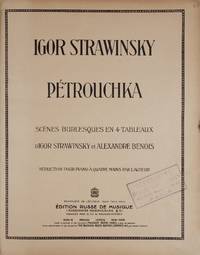
1912réf. 41390Berlin Moscou Leipzig New-York: Édition Russe de Musique PN R.M.V. 150 1912. Folio. Contemporary half black calf with marbled boards label of the Parisian music rental firm Rouart-Lerolle to upper marbled endpapers. 1f. recto title verso blank i named cast list referring to first production of 1911 in French i synopsis in Russian and French i "general remarks" in Russian and French i blank i dedication to A. Benois i blank 7-84 ii blank pp. Photographic transfer from engraved plates. With "ROME MAI 1911" and printer's note "Imp. C. G. Röder Leipzig." to lower outer corner of p. 84. Rouart Lerolle and "5" handstamps to title and first four leaves. Binding worn rubbed bumped and abraded; hinges split; small label with "143" in manuscript to upper board. First Edition first issue. Kirchmeyer 12-4. De Lerma P17. Crawford p. 533. Distinguishing imprint to title below crest found in the first issue is as follows: PROPRIÉTÉ DE L'ÉDITEUR POUR TOUS PAYS / ÉDITION RUSSE DE MUSIQUE / RUSSISCHER MUSIKVERLAG G.M. above BH below/ FONDÉE PAR S. ET N. KOUSSEWITZKY / BERLIN MOSCOU LEIPZIG NEW-YORK / POUR LA FRANCE ET SES COLONIES: MUSIQUE RUSSE PARIS 3 RUE DE MOSCOU / POUR L'ANGLETERRE ET SES COLONIES; THE RUSSIAN MUSIC AGENCY LONDRES W.I 34 PERCY STREET "The emergence of Stravinsky as a modernist with an individual manner unlike any other can be dated with some precision to his early work on Petrushka. In March 1910 during the later stages of composing The Firebird he had experienced the famous 'fleeting vision' out of which The Rite of Spring was to grow. But when Diaghilev and Nijinsky visited him in Lausanne in September 1910 they found him at work on something quite different a concert piece for piano and orchestra called 'Petrushka's Cry'. Together with a 'Russian Dance' composed soon afterwards this music was to form the basis of the ballet which Diaghilev instinctively urged him to write instead. . It is from the systematic attempt to render the particular flavour of traditional Russian life into music that Petrushka derives many of its freshest and most original qualities. . Looked at in general terms the opening sequence of Petrushka is a prototype of later Stravinskian form. Its underlying rhythmic design may not be complex in the same way as that of The Rite of Spring or the later Russian works but its intricacy of rhythmic detailing and its mixture of a highly fluid pattern of melodic stress with an inert background harmony laid the groundwork for a technique which through many changes of superficial style was to serve him for the rest of his life." Walsh: The Music of Stravinsky pp. 24-29. "Petroushka proved just as successful with the public and critics as The Firebird had been; but it was undoubtedly a more original work. In the first place Stravinsky had been able to play a leading part in the construction of the scenario which had not been the case with The Firebird. Secondly whereas the music of The Firebird showed that the pupil had learnt all that his master had had to teach him in Petrushka for the first time the authentic voice of the new master is heard." TNG Vol. 18 pp. 244-245. Petrushka one of Stravinsky's best-known and loved works represents the essence of Diaghilev's monumental Ballets Russes era. The ballet received its first performance with the incomparable Nijinsky in the title role at the Théâtre du Châtelet on 13 June 1911 conducted by Pierre Monteux with choreography by Fokine and designs by Alexandre Benois. Édition Russe de Musique [PN R.M.V. 150] unknown
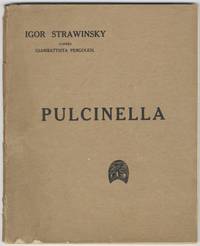
1920réf. 41305London Genève: J. & W. Chester Ltd. PN J. & W. C. 9707 1920. Folio. Original publisher's printed dark ivory wrappers with decorative device to upper and publisher's details within decorative border to lower. 1f. recto title verso printed notice regarding first performance with named cast list and scenario 86 pp. Named cast includes Massine Pulcinella Thamar Karsavina Pimpinella Tchernicheva Prudenza Nemtchinova Rosetta Novac Fourbo Idzikowky Caviello Zverew Florindo Cecchetti Il Dottore Kostetsky Tartaglia and Bourman Okimowsky Micholaitchik and Loukin Petits Pulcinella. Wrappers somewhat worn and soiled; torn at spine with minor loss; partially detached. Minor internal wear; two small chips to blank lower margin of title and upper wrapper. First Edition. Scarce. Kirchmeyer 34-1. White p. 282. De Lerma P60. CPM Vol. 54 p. 440. Pulcinella commissioned by the Russian impresario and founder of the Ballets Russes Sergei Diaghilev 1872-1929 was first performed in Paris at the Opéra on 15 May 1920 with Ernest Ansermet conducting. The libretto and choreography were by Léonide Massine with costumes and sets designed by Pablo Picasso. J. & W. Chester, Ltd. [PN J. & W. C. 9707] unknown
réf. 44711068like new. unknown