Stravinsky, VeraBiblio.com

492 résultats
1978réf. 68373New York : Simon And Schuster 1978. First Edition. Hardback. Fine cloth copy in an equally fine dw. Particularly and surprisingly well-preserved; tight bright clean and especially sharp-cornered. Literally as new and still in the publisher's protective shrink-wrap. ; 688 pages; Description: 688 p. 16 leaves of plates : ill. ; 28 cm. Subjects: Stravinsky Igor 1882-1971. Composers--Biography. New York : Simon And Schuster hardcover
1969réf. 1iCh0056New York: Alfred A. Knopf/A Borzoi Book/Published by Alfred A. Knopf Inc. 1969. Book. Illus. by Anita Karl Jacket Design; Stravinsky on His Eighty-Six Birthday by Bobby Klein Back Cover Photo. Very Good. Hardcover. 1st Edition. 8vo or 8° Medium Octavo: 7¾" x 9¾" tall. 350 ix xi pp. Stated first edition! A rare hard-to-find out-of-print scarce true collectible gem! An excellent addition to any collection! A great almost spotlessly clean copy! Solidly and tightly bound essentially and nearly flawless copy with minimal internal and external wear and use. Copy with crisp pages spotlessly clean text and light shelf wear. Smooth covers. Dust jacket suffers some cuts and tears around places. Price inside front flap cut out. Edges of dust jacket taped with adhesive tape for reinforcement. Pictures of actual copy -not displayed here!- available upon request. . Alfred A. Knopf/A Borzoi Book/Published by Alfred A. Knopf, Inc. Hardcover
réf. 75-1220Paris FR: Musee d'Art Moderne De La Ville De Paris 1980. 4to. 121pp. Very Good. Softcover. Mostly black and white plates throughout. En Francais. Paris, FR: Musee d'Art Moderne De La Ville De Paris, 1980 paperback
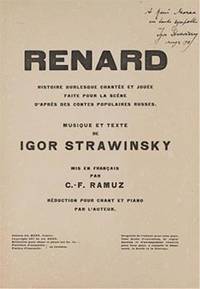
réf. 16-4191Genève Edition Ad. Henn 1917. . 4to. 28 x 19.8 cm. 8 64pp. Original wraps. Front cover mainly detached. Signed at Morges Switzerland and dated 1918 and inscribed .The poet and playwright René Morax founded his Théâtre du Jorat near Mézières Switzerland in 1903. Made entirely of wood so as to be integrated into the barns of the surrounding countryside it was described this way in an early account: “A theater decidedly unlike any other. A sort of vast chalet a kind of huge barn smelling of resin dried hay fresh fruit and on days when there was a performance Sunday clothes but retaining the rustic dignity of a shrine. A large stage descending in broad steps toward the orchestra pit …”The theater was closed for several years during the Great War and Morax conceived a drama on the subject of King David to reopen it in 1921. When he turned to his wealthy friend Werner Reinhart who incidentally had recently funded the creation of Stravinsky’s Soldier’s Tale telling him that he was taking inspiration from Hindu theater for this work his patron offered to lend rare Hindu drums in addition to financial assistance. The text is drawn from the Hebrew Bible I and II Samuel I Kings in addition to the Huguenot Psalter which includes poetry by Clément Marot. The poet’s brother Jean Morax set to work designing costumes and sets. After several more established composers turned him down René on the advice of Stravinsky and the distinguished conductor Ernest Ansermet chose the then unknown twenty-eight year old Arthur Honegger. “When Swiss poet Rene Morax 1873-1963 was looking for a composer for his new King David libretto Stravinsky recommended the twenty-nine-year-old Arthur Honegger a composer who just six years later creating the film score for Abel Gance’s Napoleon would reveal himself as a master of music’s ability to translate epics into sweeping evocative sound. In 1921 right on the cusp of his first successes Honegger wrote the David score in a flush of creative energy.”. Provenance from the estate of René Morax. Expertise by Claire PIGUET Geneva Genève, Edition Ad. Henn, 1917. paperback
réf. 16-4196London: J. & W. Chester Ltd. 1924. 30.7x 24.4 cm. 862 2pp. Light foxing on a few pages and tfhe cover. . From the collection of the poet and playwright René Morax . He founded his Théâtre du Jorat near Mézières Switzerland in 1903. Made entirely of wood so as to be integrated into the barns of the surrounding countryside it was described this way in an early account: “A theater decidedly unlike any other. A sort of vast chalet a kind of huge barn smelling of resin dried hay fresh fruit and on days when there was a performance Sunday clothes but retaining the rustic dignity of a shrine. A large stage descending in broad steps toward the orchestra pit …”The theater was closed for several years during the Great War and Morax conceived a drama on the subject of King David to reopen it in 1921. When he turned to his wealthy friend Werner Reinhart who incidentally had recently funded the creation of Stravinsky’s Soldier’s Tale telling him that he was taking inspiration from Hindu theater for this work his patron offered to lend rare Hindu drums in addition to financial assistance. The text is drawn from the Hebrew Bible I and II Samuel I Kings in addition to the Huguenot Psalter which includes poetry by Clément Marot. The poet’s brother Jean Morax set to work designing costumes and sets. After several more established composers turned him down René on the advice of Stravinsky and the distinguished conductor Ernest Ansermet chose the then unknown twenty-eight year old Arthur Honegger. “When Swiss poet Rene Morax 1873-1963 was looking for a composer for his new King David libretto Stravinsky recommended the twenty-nine-year-old Arthur Honegger a composer who just six years later creating the film score for Abel Gance’s Napoleon would reveal himself as a master of music’s ability to translate epics into sweeping evocative sound. In 1921 right on the cusp of his first successes Honegger wrote the David score in a flush of creative energy.”. Provenance from the estate of René Morax. Expertise by Claire PIGUET Geneva London: J. & W. Chester, Ltd., [1924] hardcover
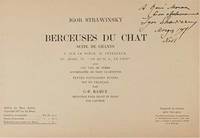
réf. 16-4195Genève: Edition Ad. Henn 1917. . Oblong 4to. 19.8 25.7 cm. 28pp. Original wraps loose as issued. Signed at Morges Switzerland and dated Noel 1917 and inscribed .The poet and playwright René Morax founded his Théâtre du Jorat near Mézières Switzerland in 1903. Made entirely of wood so as to be integrated into the barns of the surrounding countryside it was described this way in an early account: “A theater decidedly unlike any other. A sort of vast chalet a kind of huge barn smelling of resin dried hay fresh fruit and on days when there was a performance Sunday clothes but retaining the rustic dignity of a shrine. A large stage descending in broad steps toward the orchestra pit …”The theater was closed for several years during the Great War and Morax conceived a drama on the subject of King David to reopen it in 1921. When he turned to his wealthy friend Werner Reinhart who incidentally had recently funded the creation of Stravinsky’s Soldier’s Tale telling him that he was taking inspiration from Hindu theater for this work his patron offered to lend rare Hindu drums in addition to financial assistance. The text is drawn from the Hebrew Bible I and II Samuel I Kings in addition to the Huguenot Psalter which includes poetry by Clément Marot. The poet’s brother Jean Morax set to work designing costumes and sets. After several more established composers turned him down René on the advice of Stravinsky and the distinguished conductor Ernest Ansermet chose the then unknown twenty-eight year old Arthur Honegger. “When Swiss poet Rene Morax 1873-1963 was looking for a composer for his new King David libretto Stravinsky recommended the twenty-nine-year-old Arthur Honegger a composer who just six years later creating the film score for Abel Gance’s Napoleon would reveal himself as a master of music’s ability to translate epics into sweeping evocative sound. In 1921 right on the cusp of his first successes Honegger wrote the David score in a flush of creative energy.”. Provenance from the estate of René Morax. Expertise by Claire PIGUET Geneva Genève: Edition Ad. Henn, 1917. paperback
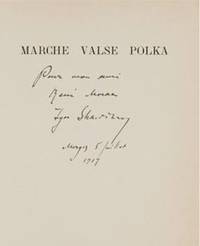
réf. 16-4192Genève: Edition Ad. Henn 1917. . Oblong 4to. 19.5 x 27.3 cm. 2 8pp. Original wraps. . Signed at Morges Switzerland and dated 5 Juillet 1917 and inscribed .The poet and playwright René Morax founded his Théâtre du Jorat near Mézières Switzerland in 1903. Made entirely of wood so as to be integrated into the barns of the surrounding countryside it was described this way in an early account: “A theater decidedly unlike any other. A sort of vast chalet a kind of huge barn smelling of resin dried hay fresh fruit and on days when there was a performance Sunday clothes but retaining the rustic dignity of a shrine. A large stage descending in broad steps toward the orchestra pit …”The theater was closed for several years during the Great War and Morax conceived a drama on the subject of King David to reopen it in 1921. When he turned to his wealthy friend Werner Reinhart who incidentally had recently funded the creation of Stravinsky’s Soldier’s Tale telling him that he was taking inspiration from Hindu theater for this work his patron offered to lend rare Hindu drums in addition to financial assistance. The text is drawn from the Hebrew Bible I and II Samuel I Kings in addition to the Huguenot Psalter which includes poetry by Clément Marot. The poet’s brother Jean Morax set to work designing costumes and sets. After several more established composers turned him down René on the advice of Stravinsky and the distinguished conductor Ernest Ansermet chose the then unknown twenty-eight year old Arthur Honegger. “When Swiss poet Rene Morax 1873-1963 was looking for a composer for his new King David libretto Stravinsky recommended the twenty-nine-year-old Arthur Honegger a composer who just six years later creating the film score for Abel Gance’s Napoleon would reveal himself as a master of music’s ability to translate epics into sweeping evocative sound. In 1921 right on the cusp of his first successes Honegger wrote the David score in a flush of creative energy.”. Provenance from the estate of René Morax. Expertise by Claire PIGUET Geneva Genève: Edition Ad. Henn, 1917. paperback
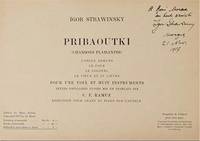
réf. 16-4193Genève: Edition Ad. Henn 1917. . Oblong 4to. 19 x 27.7 cm. 2 14pp. Original wraps. . Signed at Morges Switzerland and dated 21 Nov. 1917 and inscribed .The poet and playwright René Morax founded his Théâtre du Jorat near Mézières Switzerland in 1903. Made entirely of wood so as to be integrated into the barns of the surrounding countryside it was described this way in an early account: “A theater decidedly unlike any other. A sort of vast chalet a kind of huge barn smelling of resin dried hay fresh fruit and on days when there was a performance Sunday clothes but retaining the rustic dignity of a shrine. A large stage descending in broad steps toward the orchestra pit …”The theater was closed for several years during the Great War and Morax conceived a drama on the subject of King David to reopen it in 1921. When he turned to his wealthy friend Werner Reinhart who incidentally had recently funded the creation of Stravinsky’s Soldier’s Tale telling him that he was taking inspiration from Hindu theater for this work his patron offered to lend rare Hindu drums in addition to financial assistance. The text is drawn from the Hebrew Bible I and II Samuel I Kings in addition to the Huguenot Psalter which includes poetry by Clément Marot. The poet’s brother Jean Morax set to work designing costumes and sets. After several more established composers turned him down René on the advice of Stravinsky and the distinguished conductor Ernest Ansermet chose the then unknown twenty-eight year old Arthur Honegger. “When Swiss poet Rene Morax 1873-1963 was looking for a composer for his new King David libretto Stravinsky recommended the twenty-nine-year-old Arthur Honegger a composer who just six years later creating the film score for Abel Gance’s Napoleon would reveal himself as a master of music’s ability to translate epics into sweeping evocative sound. In 1921 right on the cusp of his first successes Honegger wrote the David score in a flush of creative energy.”. Provenance from the estate of René Morax. Expertise by Claire PIGUET Geneva Genève: Edition Ad. Henn, 1917. paperback
réf. 16-4194Genève: Edition Ad. Henn 1917. . 24 x 31.5 cm. 4 20pp. Original wraps. Front cover stained along edges. . Signed and dated 28 viii 17 and inscribed .The poet and playwright René Morax founded his Théâtre du Jorat near Mézières Switzerland in 1903. Made entirely of wood so as to be integrated into the barns of the surrounding countryside it was described this way in an early account: “A theater decidedly unlike any other. A sort of vast chalet a kind of huge barn smelling of resin dried hay fresh fruit and on days when there was a performance Sunday clothes but retaining the rustic dignity of a shrine. A large stage descending in broad steps toward the orchestra pit …”The theater was closed for several years during the Great War and Morax conceived a drama on the subject of King David to reopen it in 1921. When he turned to his wealthy friend Werner Reinhart who incidentally had recently funded the creation of Stravinsky’s Soldier’s Tale telling him that he was taking inspiration from Hindu theater for this work his patron offered to lend rare Hindu drums in addition to financial assistance. The text is drawn from the Hebrew Bible I and II Samuel I Kings in addition to the Huguenot Psalter which includes poetry by Clément Marot. The poet’s brother Jean Morax set to work designing costumes and sets. After several more established composers turned him down René on the advice of Stravinsky and the distinguished conductor Ernest Ansermet chose the then unknown twenty-eight year old Arthur Honegger. “When Swiss poet Rene Morax 1873-1963 was looking for a composer for his new King David libretto Stravinsky recommended the twenty-nine-year-old Arthur Honegger a composer who just six years later creating the film score for Abel Gance’s Napoleon would reveal himself as a master of music’s ability to translate epics into sweeping evocative sound. In 1921 right on the cusp of his first successes Honegger wrote the David score in a flush of creative energy.”. Provenance from the estate of René Morax. Expertise by Claire PIGUET Geneva Genève: Edition Ad. Henn, 1917. paperback
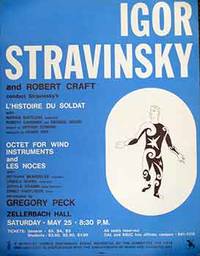
réf. 51-3548Berkeley: UC Zellerbach Hall Mya 1968. Poster in blue and black. 22.75 x 17 inches. Very good with small closed tear at lower margin."It was May of 1968 in Berkeley and Zellerbach Hall was soon to open its spacious glass doors for the first time. The program to be played: Igor Stravinsky’s “Symphony of Psalms” and “Oedipus Rex” conducted by Robert Craft and the celebrated composer himself. Unfortunately Stravinsky had fallen ill and was unable to conduct. But he did still attend this inaugural performance at UC Berkeley’s famous music hall — legend has it that the distracted audience was more enraptured by Stravinsky’s reaction to the music than by the actual performance itself." Berkeley: UC Zellerbach Hall, Mya 1968. unknown
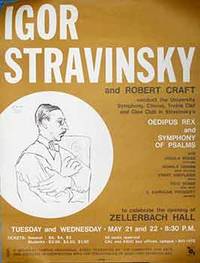
réf. 51-3549Berkeley: UC Zellerbach Hall May 1968. Poster in ochre and black. 22.75 x 17 inches. Very good."It was May of 1968 in Berkeley and Zellerbach Hall was soon to open its spacious glass doors for the first time. The program to be played: Igor Stravinsky’s “Symphony of Psalms” and “Oedipus Rex” conducted by Robert Craft and the celebrated composer himself. Unfortunately Stravinsky had fallen ill and was unable to conduct. But he did still attend this inaugural performance at UC Berkeley’s famous music hall — legend has it that the distracted audience was more enraptured by Stravinsky’s reaction to the music than by the actual performance itself." Berkeley: UC Zellerbach Hall, May 1968. unknown
réf. 15-8077New York: Perls Gallery 1940. 8vo. Printed Wrappers Very Good Illustrations. 4 pp. Theodore Stravinksy was the son of Igor Stravinksy.The Perls Gallery in New York was founded in 1937 by Klaus Gunther Perls 1912-2008 and his brother Franz R. Perls1910-1975 after having worked at their mother's Galerie Kate Perls in Paris. Following his marriage to Amelia Blumenthal of Philadelphia in 1940 Klaus and Amelia B. Perls jointly ran the gallery. They specialized in modern French painting while Franz established the Frank Perls Gallery in Beverly Hills He originally dealt in works by Maurice Utrillo Maurice de Vlaminck and Raoul Dufy that his mother sent from Paris until the Nazi occupation. When she was forced to flee France he began dealing in now little known contemporary American artists including Darrel Austin and in Mexican and South American art such as Mario Carreno. After the war Klaus again dealt in French art from the School of ParisArtists in the Perls' stable included Rouault Picasso Léger Derain Dufy Matisse Modigliani Pascin Soutine and Vlaminck. The Perls Galleries closed in 1997. New York: Perls Gallery, 1940. unknown
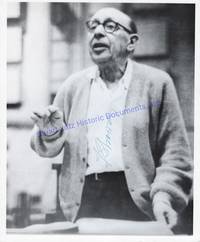
réf. 6573IGOR STRAVINSKY 1882-1971. Stravinsky was a Russian composer best remembered for The Firebird and The Rite Of Spring. He is considered one of the greatest composers of the Twentieth Century.PS. 8 x 10. No date. No place. A black and white photograph signed I Stravinsky in blue ballpoint ink across his torso. The image shows an older man with his right arm raised perhaps conducting. The blue ink has great contrast with his white shirt and it is in very fine condition. unknown
1957réf. 294547Les Concerts du Domaine Musical 1957. First Edition. Trade Paperback. 18 unnumbered pages. B/W illustrations. Performed by Orchestre du Sudwestfunk conducted by Hans Rosbaud. Program also included work by Anton Webern Arnold Schonberg and Alan Berg. Tipped-in B/W photograph 6 x 8 inches of Stravinsky on front cover. First edition first printing. Very good copy with tipped-in B/W photograph of Stravinsky on front cover Cover with mild wear. Lower right corner of photograph is creased with craese on lower right of front cover. Les Concerts du Domaine Musical paperback
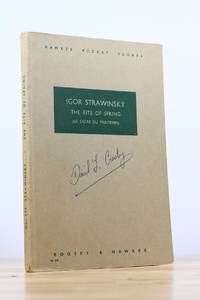
1960réf. 33435London: Boosey & Hawkes 1960. Paperback. Hawkes Pocket Scores. 7 x 10in. 139pp. Publisher's stiff printed wraps. Signed by the conductor and composer Pierre Boulez at the title page. This is the former copy of the composer David Lewis Crosby who attended Boulez's performance with the Cleveland Symphony Orchestra of The Rite of Spring at Oberlin College in November of 1967 with the concert program laid-in. Most pertinently Boulez and the Cleveland Orchestra would two years later record the definitive interpretation of The Rite of Spring for Columbia Masterworks. NEAR FINE. Shows some light toning and furrowing of the spine several annotations of the score in pencil by Crosby otherwise remains Fine/As New. As pictured. Boosey & Hawkes paperback
réf. 0486413926.Gpaperback. Good. Access codes and supplements are not guaranteed with used items. May be an ex-library book. paperback
réf. 0711941947.Gpaperback. Good. Access codes and supplements are not guaranteed with used items. May be an ex-library book. paperback
réf. 0486413950.Gpaperback. Good. Access codes and supplements are not guaranteed with used items. May be an ex-library book. paperback
1960réf. mon0000137321Faber & Faber 1960-01-01. Hardcover. Good. 2.7979 in x 23.1824 in x 16.6873 in. Ex-library book usual markings. Hardback/Hardcover with dust cover. Clean text sound binding. Faber & Faber hardcover
1953réf. mon0000144145Boosey & Hawkes 1953-01-01. Unknown Binding. Acceptable. in x in x in. Ex-library book usual markings. Hardback/Hardcover with dust cover. Well read copy with some spine wear but still useable colouring of page edges due to age. Boosey & Hawkes unknown
1997réf. 260225008Sne Can 1997-04-22. Audio CD. New. 0x0x0. Brand new factory sealed condition. Sne (Can) unknown
1979réf. 510001David R. Godine Publisher 1979. First Edition. Hardcover with Dust Jacket. FINE/FINE. SIGNED and INSCRIBED by Stephen Spender on half-title 'To Stathis and Ralph.' Stathis Orphanos was a photographer noted for his portraits of writers including Stephen Spender. He and his partner Ralph Sylvester also operated the Los Angeles fine-press publishing company 'Sylvester & Orphanos.' Spender collaborated with them in the publication of Graham Greene's Weed Among Flowers and Tsarouchis: The Face of Modern Greece. First Printing. 80pp. Heathered cloth orange paper label gilt spine lettering orange endpapers colour plates throughout. An exceedingly clean and crisp copy. Dust jacket has some trivial shelf wear otherwise sharp. David R. Godine Publisher hardcover
réf. 44711068like new. unknown
2006réf. Q-159615649XMusic Minus One 2006-11-01. Paperback. New. In shrink wrap. Looks like an interesting title! Music Minus One paperback
1996réf. Q-379576100XSCHOTT MUSIK INTL MAINZ 1996-07-01. Sheet music. New. In shrink wrap. Looks like an interesting title! SCHOTT MUSIK INTL MAINZ unknown