496 résultats
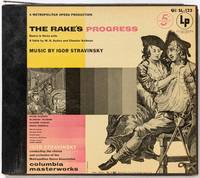
1953réf. 564101New York: Columbia 1953. Hardcover. Very Good. Original 33 1/3 rpm vinyl album. Three records in paper sleeves along with four pages of text bound into a box with a hinged lid. Some scratches and light wear that may partially affect playback but overall still very good or better in a very good box with rubbing and edgewear including a small bit of the top of the lid missing. Laid in are two programs from performances of The Rake's Progress: "Metropolitan Opera Thursday Evening February 19 1953" and "Carnegie Hall American Opera Society Opening Evening November 20 1962. Columbia hardcover books
1986réf. 28001Bis, [1986]. BIS-CD-336 CD CD
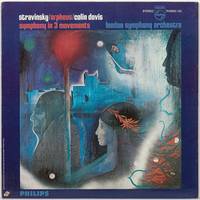
1967réf. 606019No place: Philips 1967. Softcover. Near Fine. Original stereo 12" 33 1/3 rpm vinyl record. Conducted by Colin Davis. Performed by the London Symphony Orchestra. Violin solo by Erich Gruenberg. Liner notes by Bernard Jacobson. Some very light wear from being handled and played else near fine in a very good cardboard sleeve with some foxing rubbing and bumping. PHS 900-153. Red labels with silver print. Philips unknown books
1992réf. 27996Sony Classical, 1992. SK 48057 CD CD
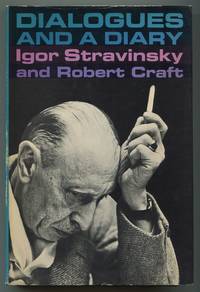
1966réf. 47652NY: Knopf 1966. First Edition. 8vo pp. x 352 xiii. Indexes. Black cloth printed in purple and gilt. A VG tight copy in chipped price-clipped and somewhat insect-damaged dj. Short writings by Stravinsky and diary entries by Craft regarding I. S. Knopf unknown books
1987réf. 37191RCA, 1987. GD86529 1 CD CD
1980réf. 439685Berkeley: University of California Press 1980. Softcover. Very Good. First paperback edition. Trade paperback. 140pp. Illustrated from black and white photographs. Page edges foxed wrappers curled very good. University of California Press unknown books
1963réf. 548698Garden City New York: Doubleday & Company 1963. Hardcover. Near Fine/Very Good. First edition. 279pp. Illustrated with photographic plates. Pages slightly toned else near fine in a lightly toned very good dust jacket with modest wear to the extremities. Doubleday & Company hardcover books
1962réf. 592727Garden City New York: Doubleday & Company 1962. Hardcover. Fine/Near Fine. First edition. 192pp. Illustrated from black and white photographs. Fine in a near fine dust jacket with a crease on the front flap and some toning. A biography starting with the composer's early life along with discussions of several of his scores and a commentary on two well-known New York music critics. Doubleday & Company hardcover books
1962réf. 549631Garden City New York: Doubleday & Company 1962. Hardcover. Near Fine/Very Good. First edition. 192pp. Pages lightly age-toned near fine in a slightly toned very good dust jacket with a lightly tanned spine and modest edgewear. A biography starting with the composer’s early life along with discussions of several of his scores and a commentary on two well-known New York music critics. Doubleday & Company hardcover books
1960réf. 595463Garden City New York: Doubleday & Company 1960. Hardcover. Fine/Very Good. First edition. 167pp. Tiny bookseller ticket Grolier Book Shop on front fly else fine in a very good dust jacket with moderate edgewear. Stravinsky recounts the great artistic events and vivid personalities that have played important parts in his life. Doubleday & Company hardcover books
1960réf. 549632Garden City New York: Doubleday & Company 1960. Hardcover. Near Fine/Very Good. First edition. 167pp. Pages faintly age-toned near fine in a faintly spine-tanned very good dust jacket with a barely visible 1" slash on the front panel and modest wear to the extremities. Stravinsky recounts the great artistic events and vivid personalities that have played important parts in his life. Doubleday & Company hardcover books
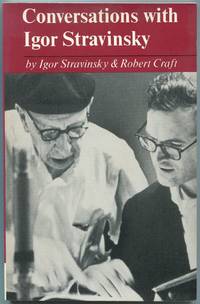
1969réf. 256031New York: Alfred A Knopf 1969. First edition. ix i 350 xi pp. 8vo. Publisher's green cloth faded at edges in very good edge-worn dustjacket. First edition. ix i 350 xi pp. 8vo. Signed on the flyleaf "Igor Stravinksy / 1.30.70" and inscribed by co-author Robert Craft. The recipient was Miranda "Mirandi" Massoco Levy 1914-2011 the doyenne of Sante Fe cultural life instumental in the success of the Sante Fe Opera and a close friend of Stravinsky. Alfred A Knopf unknown books
1969réf. 35875NY: Knopf 1969. First edition. 350 pp w/indexes. Fine in very near fine dust jacket. The sixth collaboration. NY: Knopf, unknown books
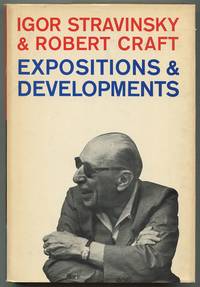
1962réf. 114781Garden City NY: Doubleday 1962. Hardcover. Good/Very Good. First edition. Good in very good dust jacket. Illustrated light browning. Underlining in ink throughout text name on end paper. Dustwrapper browning and rubbed with tiny tearing. Doubleday hardcover books
1984réf. 20607New York: Alfred A. Knopf. Fine in Fine dust jacket. 1984. First Edition; First Printing. Cloth. 0394528131 . First edition/first printing in about Fine condition with little shelf wear in Fine dust-jacket. From the collection of Betty Anderson legendary art director of publisher Knopf in the late 20th century as evidenced by her small and unobtrusive inventory number and signature on front paste down; This book is a collection of writings by Igor Stravinsky spanning from 1906 to 1971. The writings span a wide range of topics from music theory to autobiography. The book is edited by Robert Craft and includes a biography of Stravinsky by Robert Craft.; Selected Correspondence; Vol. 2; Photographs; 8vo . Alfred A. Knopf hardcover books
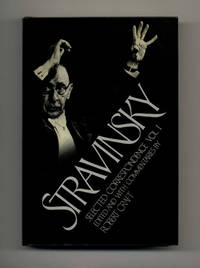
1982réf. 20606New York: Alfred A. Knopf. Very Good in Near Fine dust jacket. 1982. First Edition; First Printing. Cloth. 0394518705 . First edition/first printing in Very Good condition with slightly cocked spine in Near Fine dust-jacket. From the collection of Betty Anderson legendary art director of publisher Knopf in the late 20th century as evidenced by her small and unobtrusive inventory number and signature on front paste down; This book is a compilation of the writings of Igor Stravinsky edited by Robert Craft. The writings cover a wide range of topics from music theory to autobiography. The book provides a wealth of information on the life and work of Igor Stravinsky.; Selected Correspondence; Vol. 1; Photographs; 8vo . Alfred A. Knopf hardcover books
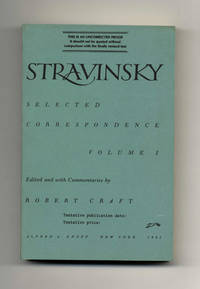
1981réf. 20889New York: Alfred A. Knopf. Fine. 1981. Advance Review Copy; First Printing. Softcover. Uncorrected Proof of the first American edition/first printing in Fine condition. From the collection of Betty Anderson legendary art director of publisher Knopf in the late 20th century as evidenced by her small and unobtrusive inventory number and signature; This book is a collection of correspondence between Igor Stravinsky and a number of people including his friends Robert Craft and Nadia Boulanger. It covers a wide range of topics including Stravinsky's work life and thoughts.; Stravinsky: Selected Correspondence; Vol. 1; 8vo . Alfred A. Knopf paperback books
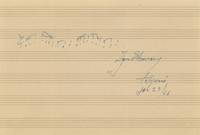
réf. 39498Four measures containing the theme of the closing of the first scene of the composer's Danse Russe. Notated unbarred on dark ivory music paper in blue ink signed and dated Hollywood 23 January 1966. On an album leaf 141 x 199 laid down to backing board. Small hole to blank upper margin; two light vertical creases. Petrushka a ballet in 4 scenes with music by Stravinsky choreography by Michel Fokine and set and costume designs by Alexandre Benois was written for the 1911 season of Diaghilev's Ballets Russes and first performed in Paris at the Châtelet on 13 June 1911. The premiere was conducted by Pierre Monteux with Vaslav Nijinsky as Petrushka Tamar Karsavina as lead ballerina and Enrico Cecchetti as the charlatan. The work became one of the most popular productions of the revolutionary Ballets Russes and one of Stravinsky's best-loved compositions. unknown books
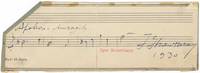
réf. 396614 measures from the third number Pas d'Action. Notated in blue/black ink on music paper with "No. 1-12 lines" printed at lower left corner; "Igor Stravinsky" typed in red below quotation. Somewhat worn and browned; irregularly trimmed with upper left corner cropped not affecting quotation; recto reinforced at upper left corner and left margin with light blue paper; creased and partially split at central fold; margins hand-ruled with double black line; upper margin slightly stained; mounted on printed excerpt with remnants of adhesive to verso. Apollon Musagète a neoclassical ballet in two tableaux was commissioned in 1927 by Elizabeth Sprague Coolidge for a festival of contemporary music to be held in 1928 at the Library of Congress in Washington D.C. Composed between 1927 and 1928 the work was choreographed by the 24-year-old George Balanchine to a libretto by the composer; scenery and costumes were by André Bauchant with new costumes designed by Coco Chanel in 1929. unknown books
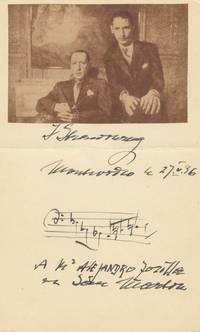
réf. 396731 measure from the opening of the first movement. Notated in black ink on an album leaf 203 x 123 mm. Dated "Montevideo le 27. v. 1936." Inscribed to the Uruguayan political figure Alejandro Zorrilla de San Martin 1909-1987 prominent member of the Uruguayan National Party with a reproduction photograph of Stravinsky and his son Soulima to head. Slightly browned; horizontal crease to upper portion just below Stravinsky's signature; manuscript identification and minor remnants of former mount to verso. The Firebird L'Oiseau de feu; Zhar-ptitsa a fairy tale ballet in two scenes was first performed by Diaghilev's Ballets Russes in Paris at the Opéra on 25 June 1910 conducted by Gabriel Pierné. The original choreography was by Michel Fokine with sets and costumes by Alexandre Benois; this seminal work led to further important Stravinsky-Diaghilev collaborations including Petrushka 1911 and The Rite of Spring 1913. unknown books
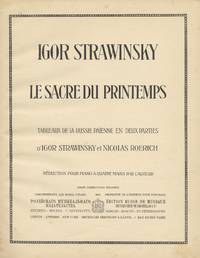
1913réf. 41314Berlin - Moscou - St. Petersbourg: Édition Russe de Musique PN R.M.V. 196 1913. Folio. Original publisher's ivory cloth-backed dark ivory printed boards 1f. recto title verso blank 1f. recto half-title in French verso blank 1f. recto half title in Russian verso blank 1f. recto dedication to Nicolas Roerich verso blank 9-89. i blank pp. Binding slightly worn browned and foxed with manuscript annotation to blank upper margin of upper deleted in black ink. Slightly browned throughout; corners thumbed; some minor imperfections. In very good condition overall. First Edition first issue of the four-hand piano arrangement and the first appearance in print of the music pre-dating the full score by eight years. Rare. Kirchmeyer 15-1. De Lerma S3. White 21 p. 207. Crawford p. 543. "Unlike the orchestral score which did not appear in print until early 1922 the piano-duet version was published by Édition Russe de Musique shortly before the première and was soon reissued in response to considerable demand. But special importance attaches to this four-hand version not only for historical reasons but because of its specific aesthetic quality for it directly brings out the "pianistic" nature of many of the work's musical ideas. True not for a moment do we forget that The Rite of Spring owes a large part of its impact to its orchestral sound now subtly differentiated now brutally violent. But it allows the structural workings of a piece invented at the piano and developed in close contact with the instrument to come all the more trenchantly to the fore. It was not least because of this trenchancy and "closeness to the origin" that the piano version has in recent decades begun to emerge from its primary role as an object of study and a rehearsal aid and to take on a second life as an independent concert piece. It has even formed the basis of a number of ballet productions." Meyer ed.: Igor Stravinsky Le Sacre du printemps Manuscript of the Version for Piano Four Hands Facsimile p. 23 The momentous first performance of The Rite took place in Paris at the Théâtre des Champs-Elysées on 29 May 1913. It was conducted by Monteux with choreography by Vaslav Nijinsky and set and costume designs by Nicolas Roerich. "It is now theatrical history that the first performance by the Russian Ballet . created a scandal of the first magnitude ." White: Stravinsky. The Composer and His Works p. 216. Since that time there have been a number of other versions of the ballet one choreographed by Leonide Massine 1920 at the Théâtre des Champs-Elysées with Roerich's original set designs and another by Kenneth Macmillan 1962 at Covent Garden with set designs by Sydney Nolan "but the work is more popular and seems to make a greater impact in the concert hall than on the stage. Its triumphant rehabilitation as one of the most important works in the symphonic repertory of the twentieth century dates from its first concert performances - in Moscow February 1914; conductor S. Koussevitzky Paris Casino de Paris April 1914; conductor Monteux and London Queen's Hall 7 June 1921; conductor Eugene Goossens." Ibid Diaghilev referred to The Rite of Spring as "the 20th century's Ninth Symphony." Austin: Music in the 20th Century p. 252. "Le sacre du printemps was to remain the most notoriously violent score of a time when huge noisy orchestras and harsh dissonance were more or less commonplace appurtenances of the new music. The primitive imagery of Russian symbolism of the kind exploited by Roerich had always carried a certain revolutionary tone a note of challenge to ossified social structures. But behind all the racket behind the wilfully discordant harmonies and convulsive metric irregularities lay a genuinely innovatory kind of musical thinking whose point would not become clear until Stravinsky himself began to deconstruct it in subsequent works." Stephen Walsh in Grove Music Online. Édition Russe de Musique [PN R.M.V. 196] unknown books
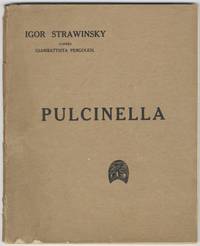
1920réf. 41305London Genève: J. & W. Chester Ltd. PN J. & W. C. 9707 1920. Folio. Original publisher's printed dark ivory wrappers with decorative device to upper and publisher's details within decorative border to lower. 1f. recto title verso printed notice regarding first performance with named cast list and scenario 86 pp. Named cast includes Massine Pulcinella Thamar Karsavina Pimpinella Tchernicheva Prudenza Nemtchinova Rosetta Novac Fourbo Idzikowky Caviello Zverew Florindo Cecchetti Il Dottore Kostetsky Tartaglia and Bourman Okimowsky Micholaitchik and Loukin Petits Pulcinella. Wrappers somewhat worn and soiled; torn at spine with minor loss; partially detached. Minor internal wear; two small chips to blank lower margin of title and upper wrapper. First Edition. Scarce. Kirchmeyer 34-1. White p. 282. De Lerma P60. CPM Vol. 54 p. 440. Pulcinella commissioned by the Russian impresario and founder of the Ballets Russes Sergei Diaghilev 1872-1929 was first performed in Paris at the Opéra on 15 May 1920 with Ernest Ansermet conducting. The libretto and choreography were by Léonide Massine with costumes and sets designed by Pablo Picasso. J. & W. Chester, Ltd. [PN J. & W. C. 9707] unknown books
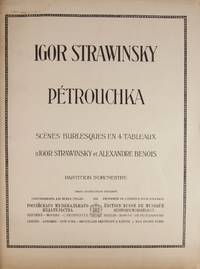
1912réf. 41313Berlin Moscou St. Pétersbourg .: Édition Russe de Musique PN R.M.V. 127 1912. Folio. Newly bound in quarter dark green cloth with mid-brown paper boards dark red title label gilt to upper and spine. 1f. recto title verso blank i named cast list ii synopsis i orchestration i recto dedication "À Alexandre Benois" verso blank 7-156 pp. 1f. errata tipped in to rear pastedown. With text in Russian and French. Named cast for the first performance by Diaghilev's Ballets Russes at the Théâtre du Chatelet in Paris on 13 June 1911 includes Tamar Karsavina Le Ballerine Vaslav Nijinsky Petrushka Orlow Le Maure and Enrico Ceccheti Le vieux Charlatan; the performance was conducted by Monteux with maître du ballet Fokine and sets and costumes designed by Benois and executed by Anisfeld sets and Caffi and Worobiew costumes. Small area of faint dampstaining and minor cockling to upper inner margins. An attractive copy. First Edition first issue. Rare. Kirchmeyer 12-1. Hirsch II 905. De Lerma P15. White p. 193. Crawford p. 533. "The emergence of Stravinsky as a modernist with an individual manner unlike any other can be dated with some precision to his early work on Petrushka. In March 1910 during the later stages of composing The Firebird he had experienced the famous 'fleeting vision' out of which The Rite of Spring was to grow. But when Diaghilev and Nijinsky visited him in Lausanne in September 1910 they found him at work on something quite different a concert piece for piano and orchestra called 'Petrushka's Cry'. Together with a 'Russian Dance' composed soon afterwards this music was to form the basis of the ballet which Diaghilev instinctively urged him to write instead. . It is from the systematic attempt to render the particular flavour of traditional Russian life into music that Petrushka derives many of its freshest and most original qualities. . Looked at in general terms the opening sequence of Petrushka is a prototype of later Stravinskian form. Its underlying rhythmic design may not be complex in the same way as that of The Rite of Spring or the later Russian works but its intricacy of rhythmic detailing and its mixture of a highly fluid pattern of melodic stress with an inert background harmony laid the groundwork for a technique which through many changes of superficial style was to serve him for the rest of his life." Walsh: The Music of Stravinsky pp. 24-29. "Petroushka proved just as successful with the public and critics as The Firebird had been; but it was undoubtedly a more original work. In the first place Stravinsky had been able to play a leading part in the construction of the scenario which had not been the case with The Firebird. Secondly whereas the music of The Firebird showed that the pupil had learnt all that his master had had to teach him in Petrushka for the first time the authentic voice of the new master is heard." TNG Vol. 18 pp. 244-245. The rare first edition first issue of Stravinsky's colorful and well-loved ballet inspired by the St. Petersburg Shrove-tide Fair. Édition Russe de Musique [PN R.M.V. 127] unknown books
1912réf. 41390Berlin Moscou Leipzig New-York: Édition Russe de Musique PN R.M.V. 150 1912. Folio. Contemporary half black calf with marbled boards label of the Parisian music rental firm Rouart-Lerolle to upper marbled endpapers. 1f. recto title verso blank i named cast list referring to first production of 1911 in French i synopsis in Russian and French i "general remarks" in Russian and French i blank i dedication to A. Benois i blank 7-84 ii blank pp. Photographic transfer from engraved plates. With "ROME MAI 1911" and printer's note "Imp. C. G. Röder Leipzig." to lower outer corner of p. 84. Rouart Lerolle and "5" handstamps to title and first four leaves. Binding worn rubbed bumped and abraded; hinges split; small label with "143" in manuscript to upper board. First Edition first issue. Kirchmeyer 12-4. De Lerma P17. Crawford p. 533. Distinguishing imprint to title below crest found in the first issue is as follows: PROPRIÉTÉ DE L'ÉDITEUR POUR TOUS PAYS / ÉDITION RUSSE DE MUSIQUE / RUSSISCHER MUSIKVERLAG G.M. above BH below/ FONDÉE PAR S. ET N. KOUSSEWITZKY / BERLIN MOSCOU LEIPZIG NEW-YORK / POUR LA FRANCE ET SES COLONIES: MUSIQUE RUSSE PARIS 3 RUE DE MOSCOU / POUR L'ANGLETERRE ET SES COLONIES; THE RUSSIAN MUSIC AGENCY LONDRES W.I 34 PERCY STREET "The emergence of Stravinsky as a modernist with an individual manner unlike any other can be dated with some precision to his early work on Petrushka. In March 1910 during the later stages of composing The Firebird he had experienced the famous 'fleeting vision' out of which The Rite of Spring was to grow. But when Diaghilev and Nijinsky visited him in Lausanne in September 1910 they found him at work on something quite different a concert piece for piano and orchestra called 'Petrushka's Cry'. Together with a 'Russian Dance' composed soon afterwards this music was to form the basis of the ballet which Diaghilev instinctively urged him to write instead. . It is from the systematic attempt to render the particular flavour of traditional Russian life into music that Petrushka derives many of its freshest and most original qualities. . Looked at in general terms the opening sequence of Petrushka is a prototype of later Stravinskian form. Its underlying rhythmic design may not be complex in the same way as that of The Rite of Spring or the later Russian works but its intricacy of rhythmic detailing and its mixture of a highly fluid pattern of melodic stress with an inert background harmony laid the groundwork for a technique which through many changes of superficial style was to serve him for the rest of his life." Walsh: The Music of Stravinsky pp. 24-29. "Petroushka proved just as successful with the public and critics as The Firebird had been; but it was undoubtedly a more original work. In the first place Stravinsky had been able to play a leading part in the construction of the scenario which had not been the case with The Firebird. Secondly whereas the music of The Firebird showed that the pupil had learnt all that his master had had to teach him in Petrushka for the first time the authentic voice of the new master is heard." TNG Vol. 18 pp. 244-245. Petrushka one of Stravinsky's best-known and loved works represents the essence of Diaghilev's monumental Ballets Russes era. The ballet received its first performance with the incomparable Nijinsky in the title role at the Théâtre du Châtelet on 13 June 1911 conducted by Pierre Monteux with choreography by Fokine and designs by Alexandre Benois. Édition Russe de Musique [PN R.M.V. 150] unknown books