19,908 results
1817ref. 37583London: Printed by Thomas Davison Whitefriars for Longman Hurst Rees Orme and Brown 1817. First thus. xv 261 1; vii i 232 pp. 2 vols. 8vo. Bound in full contemporary brown polished calf spines rubbed brown binder's ticket on front pastedowns "Bound by Smith 49 Long Acre" in each volume; front joint of vol. I starting fixing to preliminaries else very good. First thus. xv 261 1; vii i 232 pp. 2 vols. 8vo. INSCRIBED on the first blank leaf of volume I "With the author's best regards March 1834 London" and on the title page of both volumes "To my dear Aunt Mrs. Moore E.V. Holland." Lady Holland's Aunt Mrs. Moore of NYC was Clement C. Moore's mother. The first volume containing the account of Lope de Vega's life and writings was first published in 1806; this is the first two volume edition and the first containing the treatment of Guillen de Castro. Printed by Thomas Davison, Whitefriars for Longman, Hurst, Rees, Orme and Brown unknown books
1973ref. 79925San Francisco: Apex Novelties 1973. First edition. 48 pp. Fine in illustrated wrappers. Black and white reproductions from the respective artists’s sketchbooks. San Francisco: Apex Novelties unknown books
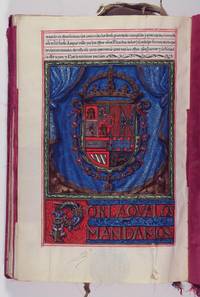
1721ref. 55346Spain: Chancellary Court of Granada 1721. Original manuscript. Hardcover. Fine. Small folio 33 by 22 cm / 11-7/8 by 7-7/8 in. Illuminated manuscript on vellum. Main text in black ink masterfully penned in fine clear Gothic style ruled and bordered in red. 82 unnumbered leaves 4 blank comprising 6 full-page miniatures and 144 pages of text generally 32 lines per page. 36 richly illuminated bands with initials appear throughout the text with occasional ornate initials in black ink. The finely detailed miniatures are painted in rich colors and decorated with metallic gold and silver. The royal seal of Philip V of Spain is stamped in black ink at the bottom margin on the recto of all text leaves as well as the final three blanks; the initials of a royal notary appear at the bottom margin of each page of text. Bound in contemporary crimson velvet lightly rubbed with decorative brocade ribbon ties worn and frayed. All edges gilt; crimson silk guards bound-in to protect the miniatures and illuminated bands. Text in Spanish. Manuscript on vellum fine and clean throughout. Overall a very well-preserved bound document. Sumptuously illustrated 18th-century manuscript nobility patent carta ejecutoria de hidalguia commissioned by the De la Barra family of Castile to memorialize the recognition of its noble status in the reign of Philip V King of Spain. As depicted in the illustrated family tree and noted at the opening of the text the family traces their noble ancestry back through five generations to Don Bartholome de la Barra y Zuñiga. "During the late medieval era many individuals received the honor of hidalgo status the lowest rank of nobility but with the passage of time this noble status was not always locally recognized. If a person or family was willing to submit a documented family history to local officials of the Chamber of Hijosdalgo of the Chancellery Court of either Valladolid of Granada they could sue for formal recognition" Neary. While few succeeded in these suits those who did would often commission luxury copies of the paperwork bound with the royal seal. While customized for each family the text and images of these nobility patents follow a standardized template which must elaborate on three key themes: religious devotion; service to the crown; and purity of blood limpieza de sangre. The latter required that the family demonstrate the absence of Jewish Muslim or "heretical" ancestry. As is commonly the case the present example opens with an image of the Virgin Mary here receiving the devotion of four members of the De la Barra family depicted on their knees before a sumptuously appointed church altar. The facing image depicts the Father the Son and the Holy Spirit in the form of a dove looking down upon the infant Jesus. The other full-page miniatures depict the De la Barra family tree; their coat of arms King Philip V; and the royal coat of arms. The richly illuminated bands contain the names of De la Barra family members or introduce key sequences in the presentation and disposition of the suit. The final four pages of text comprise an official copy of the court's final decision. Penned in an ordinary scribal hand this concluding document was usually written on paper; in the present case the declaration appears on parchment at the special request of the family. The document is signed by Santiago Alcalde y Linares royal notary escribano and dated 3 July 1721. Provenance: The engraved bookplates of C. L. F. Robinson Newport Rhode Island and Mary MacMillin Norton appear on the opening blank leaf. Charles L. F. Robinson 1874-1916 described in the auction sale catalogue of his library as "a liberal and discriminating collector of rare books" who acquired many volumes from the Hoe and Huth collections was best known as a collector of rare Americana. A clipping from the auction catalogue lot 595 describing the present manuscript is laid in; a typescript of the description is tipped in at the inner margin along with another printed catalogue description possibly from another sale. Robinson served at one time as president of the Colt Patent Firearms Manufacturing Company of Hartford Connecticut. The Anderson Galleries Catalogue of Rare Books Comprising the Valuable Library of the Late Col. Charles L. F. Robinson of Hartford Conn. lot 595 p. 136; E. A. Neary "Spanish Golden Age Nobility Documents" in: Digital Collections for the Classroom. Online via Newberry Library April 13 2023. [Chancellary Court of Granada] hardcover books
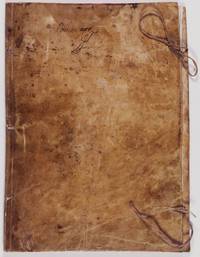
1711ref. 50903Alagon Zaragoza Spain 1711. Hardcover. Folio. 12x9". 8 leaves the final leaf backed in paper. Manuscript bound in limp vellum. Protected with 2 paper leaves and 2 maroon silk sheets bound and encased within plain contemporary paper-backed vellum covers with cloth string ties. Contains 2 leaves with gorgeous full-page illustrations elaborately hand-colored in ink and gilt the first depicting the family arms of García the second with the royal arms of Don Felipe within decorative borders. Fine clear cursive hand in black ink within two sets of double-ruled borders 25 lines per page; 7 gold capitals superimposed on a landscape within square black borders mark the sub-sections of the text followed by initial lines in gilt letters. Text and illuminations fine and clean; vellum covers lightly soiled. Text block now loose within covers. Early eighteenth-century illuminated "carta de hidalguia" manuscript a patent of nobility for one Alonso García an inhabitant of Montejo de la Vega de la Serrezuela in the Spanish province of Segovia Castilla and León. The motto appearing on his arms reads: García De Arriba Nadie Diga May No One Speak from Above. The royal decree of King Felipe V is dated 5 May 1711; the document was notarized on 12 June 1711 in Alagón a municipality located in the Spanish province of Zaragoza. In addition to the notarial stamp of the king Yo el Rey at least four witnesses have signed the manuscript on the final page. The document concludes with the formula: "El Mgd. Majestad hace merced à Alonso García vecino y natural del lugar de Montejo de la Vega de que por los días de su Vida pueda gozar; y ser reputado en la dicha Villa y demas partes que residiere por hijodaldgo y obtener las preheminencias que por ello le tocaren." The Majesty grants Alonso García a resident and native of Montejo de la Vega that he may enjoy for the days of his life and be well-regarded as a noble in that town and other places in which he may reside and obtain the privileges to which he is entitled. References: Revista de historia y de genealogía española 1912-1931 p.102: Alonzo García is noted in a list of those ennobled in the State of Castilla Castile since the year 1710. hardcover books
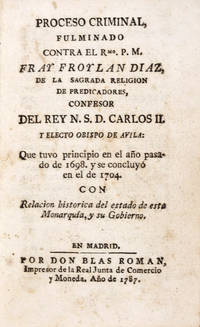
1788ref. 28844Madrid: Don Blas Román; Don Antonio Espinosa Criticos Documentos; D. Joseph Doblado Apendice 1788. First edition. Hardcover. fair. 16mo. 230 2 277 1 4 146pp. Original full calf with gold lettering on spine. All edges red. Marbled endpapers. Fascinating work on the trial of Dominican Froilan de Llanos who was the official confessor of Charles II of Spain. Fray Froylan Diaz de Llanos was convinced that the king's poor health was a result of a spell cast on him. In 1698-1699 under the Head Inquisitor Juan Tomas de Rocaberti's supervision he performed a series of exorcisms over the king after which he stated that Charles II was indeed under the influence of evil forces for which various persons from the royal court were responsible among others Queen Maria Anna of Neuburg. When the queen found out about the accusations against her Froylan Diaz de Llanos was dismissed from the post of royal confessor and transferred to the diocese of the city of Avila and subsequently arrested by the Tribunal of the Inquisition on charges of heresy. Some age wear on binding with rubbing on spine and along edges. Minor and sporadic foxing throughout. Binding in overall good- to good interior in very good condition. Don Blas Román; Don Antonio Espinosa (Criticos Documentos); D. Joseph Doblado (Apendice) hardcover books
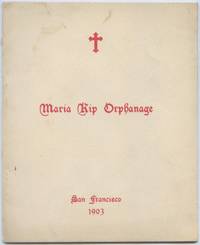
1903ref. 540317San Francisco: Maria Kip Orphanage 1903. Softcover. Very Good. First edition. Small octavo. 40pp. Frontispiece of the orphanage. Stapled off-white wrappers printed in red. Some light toning and a couple of tiny stains on the wrappers staples a bit rusted very good. Nearly half of the pamphlet is devoted to advertisers and patrons. Maria Kip Orphanage unknown books
1977ref. 386338San Francisco: Sun King 1977. Softcover. Near Fine/Near Fine. Magazine. Folio. 47pp. Newsprint wrappers. Near fine with some light toning and wear. A first wave punk zine that includes the Lester Bangs article "The Roots of Punk"; Richard Meltzer's column Bebop on Your Mama; a Patti Smith penned piece on Robert Bresson; a full-page comic by Spain Rodriguez; articles on The Nuns The Dils The Avengers Richard Hell and Cheap Trick along with heap of coverage of the San Francisco music scene. Sun King unknown books
1990ref. 368091Santa Barbara: Joshua Odell Editions / Capra Press 1990. Hardcover. Very Good/Near Fine. First edition. Slightly bowed front board with faint spotting else very good in a near fine dust jacket with a tiny tear on the rear flap fold. Inscribed by the author. Joshua Odell Editions / Capra Press hardcover books
1850ref. 49643Madrid 1850. Folio pp. 8; fine. A list of the prints in the museum. OCLC locates only an 1857 edition. unknown books
1958ref. 43554Bilbao: Escuelas Graficas de la Santa Casa de Misericordia 1958. 8vo pp. 54; numerous black & white photographic illustrations large folding map at rear; extremities lightly soiled else very good in original stapled pictorial wrappers. [Escuelas Graficas de la Santa Casa de Misericordia] unknown books
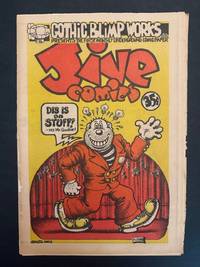
1969ref. 13188East Village New York: Peter Leggieri and the East Village Other 1969. First Edition. Original Wraps. Very Good in Wraps. First Edition. Original Wraps. "During its eight-issue run the publication displayed comics in both color and black-and-white. The first issue was titled Gothic Blimp Works Presents: Jive Comics. Vaughn Bodé was the founding editor but soon stepped down after the first two issues. At Bodé's invitation Bhob Stewart became the publication's editor introducing a line-up of contributing artists and writers that included Larry Hama Michael Kaluta Willy Mendes George Metzger Ralph Reese Steve Stiles and Bernie Wrightson. The first two issues also featured work by Bodé Joel Beck Roger Brand Robert Crumb Kim Deitch Simon Deitch Bill Griffith Ron Haydock Jay Lynch Trina Robbins Spain Rodriguez Art Spiegelman John Thompson Larry Todd and S. Clay Wilson." While Zap Comix officially started the underground comics movement in the US Blimp Works created national readership and networks to collectively identity as a distinct comic art movement. Features the distinctive oversexualized art of Robert Crumb known for his characters as Mr. Natural and Keep on Truckin'. Important collection billed as "the first Sunday underground comic paper." Scarce complete holdings in the US. Light chipping fading fold lines one issue with dampstaining and general newsprint toning else tight bright and unmarred. Complete run of eight issues with color and b/w illustrations. fo. Var. pg. Peter Leggieri and the East Village Other unknown books
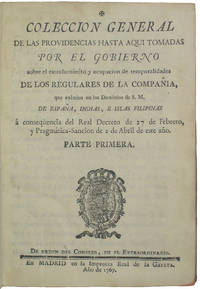
1784ref. 44155Madrid: En la Imprenta Real de la Gazeta 1784. First edition. Contemporary mottled calf compartments decorated in gilt red morocco spine label titled in gilt sewn in green silk ribbon marbled endpapers. A very good copy head band worn with a small chip and a tiny split at the joint owner's bookplate and booksellers engraved plate on front pastedown contents quite bright and clean. 104 91 135 144 4 74 pp. 4to. Five volumes bound in one. Parts 1 2 3 set in condensed type; parts 4 and 5 in expanded type. Royal decrees from Charles III and instructions decisions and regulations issued by the Consejo en el Extraordinario and its president the Conde de Aranda and others--concerning the expulsion of the Jesuits. "These collections contain the documents relative to the expulsion of the Jesuits from the Spanish dominions and the confiscation of their property including the names of the colleges and houses of the order the application of the confiscated property &c. A complete series consists of five parts which are rarely found together. Our collation is of parts I. to III. only" Sabin 14304. Part 4 p. 75-127 contains the papal brief "Dominus ac Redemptor" by Clement XIV in Latin and Spanish. Earlier versions containing parts or all of the first three sections are not all that uncommon but those containing all five parts remain relatively rare. Other than this copy only two others have appeared in the auction records of ABPC and RBH since 1953 the first at the John B. Stetson sale at Parke Bernet and the second at Bonhams in a modern binding and dampstained. Palau 56516. See Sabin 14304. Medina BHA: IV 4228. En la Imprenta Real de la Gazeta unknown books
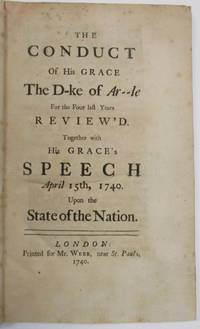
1740ref. 38832London: Printed by Mr. Webb near St. Paul's 1740. 249-1633-34334-56 page 39 1 blank pp. Page 15 misnumbered '51' as issued. Bound in later dark plain wrappers. Very Good. ESTC records four variants all determined by the craziness of the pagination. In all printings the text is continuous. None of ESTC's records quite matches ours. The closest ESTC T222817 tracks ours up to the last printed page which ESTC notes as page '57' rather than our '39.' "Relates in part to Spanish interference with the American trade" Sabin and the Duke's apparent support of Spanish interests. The pamphlet describes Spanish incursions upon British interests in the New World and Spain's disruption of British vessels. England asserted "That the Subjects of the Crown of Great-Britain have an undoubted Right to navigate in the American Seas to and from any Part of His Majesty's Dominion; and for carrying on such Trade and Commerce as they are justly intitled to in America." Sabin 10227. Kress 4493. Printed by Mr. Webb, near St. Paul's unknown books
1739ref. 36319London: Printed for T. Cooper. 1739. 63 1 blank pp. Bound in modern vellum. Early leaves dusted minor scattered foxing. Else Very Good. "In Spanish and English and relates principally to affairs in America" Sabin with particular emphasis on Florida. The book charges that the King of England authorized Captains of the ships 'Pompey Galley' and 'Fortune' to cruise the Florida coast and collect loot from ship-wrecks. With a force of 600 men the English overpowered Spaniards who were guarding their own collection of salvaged loot and "did rob about 400000 pesoes without any other pretense but that of their greediness." The Madrid printing in Spanish issued earlier in 1739.The document sets forth Spanish grievances dating from the early 1700s relating to conflicts in the New World-- from Newfoundland to Florida and the West Indies. The conflicts came to a head in the War of Jenkins' Ear commenced in October 1739. Sabin 17026. Servies 334. Bartlett John Carter Brown Library 618. ESTC N27944. Printed for T. Cooper... unknown books
1971ref. 235928San Francisco: Good Times 1971. Newspaper. 32p. folded tabloid underground newspaper news opinion reports actions psychedelia ads illustrations photos evenly toned lightly worn address label on front wrap else very good condition. Originally San Francisco Express Times. Cover is a full-page cartoon by Spain titled "Massacre at Attica or: 'Efficient Police Action.'" Also includes an interview with Allen Ginsberg. Good Times unknown books
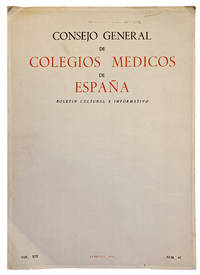
1956ref. M14352Spain: 1956. 1956. Series: Consejo General de Colegios Medicos de Espana Boletin cultural e informativo. Vol. XIX num. 97 Febrero 1956. 4to. 71 11 pp. Illustrated throughout. Cover printed in red & black. Original printed wrappers; spine mended with kozo. Small library discard rubber-stamp on upper cover. Very good. Single issue of this Spanish medical journal. Features some current issues on surgery including a paper on infant mortality. Lots of ads with interesting designs. / CONTENTS selected: Rehabilitacion de los movimientos de la cintura escapular y del hombro en cirugia toracica - C. Martinez Bordiu y Luis Esteban Mugica; Orientaciones actuales en el tratamiento quirurgico del cancer gastrico - Jacinto de Miguel del Campo; Tumores pardos de los tendones de la mano - Jacinto Dargallo Raventos; Evolucion y futuro de la mortalidad infantil espanola - Antonio Arbelo Curbelo; "¡Quien supiera escribir!" - Antonio de Soroa y Pineda; Yo he sido misionero en la selva del Maranon - Luis Trinchan Martin; Cosas de la vida . . . profesional - Manuel Luengo Tapia; Algunos aspectos de la medicina actual y de la profesion medica - Jose Alix y Alix; etc. English Rehabilitation of shoulder girdle and shoulder movements in thoracic surgery - Current orientations in the surgical treatment of gastric cancer - Tumors of the tendons of the hand - Evolution and future of Spanish infant mortality - "If only I knew how to write!" - I have been a missionary in the Maranon jungle - Some aspects of today's medicine and the medical profession - etc. 1956. unknown books
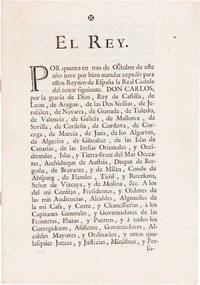
1769ref. 48900Madrid. December 9 1769. The Funds They Left Behind A royal decree discussing the finances of the Jesuit order in the Spanish territories after their expulsion from Spain in 1767 stamp-signed by King Charles III and docketed by his secretary. Gathered signatures stitched. Minor toning some loss to the last leaf affecting the stamped signature of the King and a couple of other words. Good. unknown books
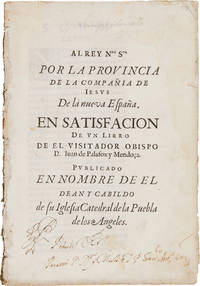
1647ref. 66747Various places likely Puebla or México City. ca. 1647-1650. Documenting a Legendary Church Feud in New Spain A group of three scarce publications relating to the acrimonious conflict between Juan Palafox y Mendoza Bishop of Puebla and the Jesuits in New Spain. Juan Palafox y Mendoza 1600-59 was born in Navarre educated at Salamanca and appointed a member of the Council of the Indies. He later became a priest and in 1639 was made Bishop of Puebla de los Angeles. Palafox arrived in Mexico in 1640 and soon butted heads with the Franciscans Dominicans and Augustinians whose many exemptions and privileges he looked upon as encroachments on his jurisdiction. In 1642 he was made Archbishop of New Spain and for a brief time that same year he was acting Viceroy during which he instituted financial reforms and made a push for indigenous conversion. Despite or perhaps thanks to that push Palafox distinguished himself as bishop in his efforts to protect the Native Americans from Spanish cruelty forbidding any methods of conversion other than persuasion. He was also a patron of the arts: under his tenure Puebla became the music center of New Spain and he established the Biblioteca Palafoxiana which continues to this day. Palafox's fortunes turned when he came into major conflict with the Jesuits over ecclesiastical jurisdiction in the mid-1640s. The legendary feud between Palafox and the Society of Jesus was fierce extended and rich in legal filings. The main point of contention between the opposing parties was the failure of the Society to submit to the authority of the bishops and archbishop of Mexico particularly in their refusal to pay tithes. The Jesuits found their strongest ally in the new viceroy García Sarmiento de Sotomayor and Palafox was eventually undermined by both the Vatican and the Spanish crown. He was ultimately recalled to Spain after fleeing Puebla to evade arrest at the hands of the Viceroy and assigned to the minor diocese of Osma in Old Castile. After his death there was a movement to make him a saint but a decade was far too short to cool ecclesiastical tempers and his canonization was blocked by Jesuit opposition. In a very late vindication Palafox's writings were several times republished in the following century and played a significant role in the expulsion of the Jesuits from Spain in 1767. The three works offered here are as follow: 1 Testimonio de una Provision del Rey Nuestro Señor en que Se Imparte Plenamente el Real Auxilio a la Legitima Jurisdiccion Apostolica de los Muy RR. PP. Iuezes Delegados Conservadores de la Compañia de Iesus caption title. Puebla. June 9 1647. Folio. 17 leaves one seven-line woodcut historiated initial. Gathered signatures unstitched. Light foxing and tanning scattered worming mostly to margins but skimming a few letters on most leaves. The earliest of these three documents is also the shortest – and the rarest. The Testimonio de una provision del rey nuestro señor. presents testimony delivered to Philip IV from a number of sources including the Viceroy mostly regarding opposition to Palafox's March 1647 decree that under pain of excommunication Jesuits must be licensed by the Bishop in order to preach or hear confession. Though technically valid under canon law the Jesuits of course took issue perceiving that Palafox meant to refuse to grant them said licenses due to their feud and the present document describes the conflict and presents their argument against him. They accuse Palafox and his advisor Juan de Merlo of sedition against the church for prohibiting the excommunicated from hearing mass and for publicly posting lists of those thus excommunicated. After relaying the reports the king promises his support for the Jesuits in their suit against Palafox. The Iberian Books project warns that "there is a heightened possibility that this work could be a bibliographical ghost" as they located "no known exemplars." We note only a single copy in auction records and OCLC records a lone copy at the Tecnológico de Monterrey though it does not appear in their own online catalogue. Not in Medina BHA or Mexico. IBERIAN BOOKS 50798. OCLC 970573404. PALAU 331123. 2 Al Rey Nuestra Señor por la Provincia de la Compañia de Iesus de la Nueva España. N.p. likely Mexico City or Puebla ca. 1650. 131 leaves woodcut initials and tailpieces. Folio. Dbd. Scattered tanning and staining faint tideline to upper edge throughout last six leaves dampstained. Contemporary inscription on titlepage a handful of contemporary marginal annotations throughout. As expected for a legal document Roxas covers the dispute comprehensively separated into discrete sections with extensive shoulder notes. This document specifically deals with the question of tithes more specifically why the Society of Jesus is exempted why it is legitimate for them to sell their surplus for profit rather than give it to the diocese and why they believe Palafox is self-serving in demanding payment. The present filing by the Society via procurador general Alonso de Roxas or Rojas is described by Sabin as a "rabid reply" to Palafox's Al Excelentissimo Señor Don Garcia de Avellaneda I Haro Conde de Castrillo Presidente en el Real y Supremo de Las Indias. published 1646 see Medina BHA 6946. This work was also printed as a small quarto without decided priority between the two – both versions are equally rare. Palau suggests a date of 1650 and a Mexico City imprint for this edition and ascribes the small quarto as printed in Madrid in 1652; Sabin puts both in Mexico circa 1646 but publication would have to fall between 1649 when Roxas became procurador general and 1652 when Palafox responded to this attack see below. "Il existe donc deux éditions de ce mémoire. Celle in-folio est plus belle come execution typographique elle est aussie plus rare.Les types nous paraissent bien être ceux employés dans les imprimeries mexicaines" – LeClerc. Not in Medina Mexico. LeCLERC 1257. MEDINA BHA 6839. OCLC 2584251 78973667. PALAU 275714. SABIN 73620. 3 Al Rey Nuestro Señor. Satisfacion al Memorial de los Religiosos de la Compañia del Nombre de Jesus de la Nueva-España por la Dignidad Episcopal de la Puebla de los Angeles. Madrid or possibly Puebla 1652. 1158 leaves i.e. 157 with errors in foliation as issued woodcut first initial. Printer's error leaving recto of leaf 31 blank. Folio. Dbd. Stitching loose in places textblock separating. Light tanning and foxing. Minor worming throughout mostly to margins but touching a letter or two on most leaves significantly heavier to final leaf with notable loss of paper but no loss of text. A rare possibly Mexican printing of Bishop Palafox's defense against the preceding work. The slightly more common edition of this text carries a 1652 Madrid imprint is paginated rather than foliated and is printed almost entirely in italic type. This version bears a 1652 date but no imprint and more closely resembles other similar works printed in Mexico though Medina suggests that this is the first edition and that it was likely printed in Madrid. Palau on the other hand suggests a Puebla imprint. EUROPEAN AMERICANA 652/156. JCB3 II:421. LeCLERC 1224. MEDINA BHA 1173. OCLC 77921786. PALAU 209717. SABIN 58280. STREIT II:1873. An excellent collection of three rare works relating to this historical feud and an important grouping of 17th-century Mexican imprints. Folio. All three works disbound. Generally light tanning and worming occasional staining and soiling. Very good overall more specific condition reports given below. unknown books
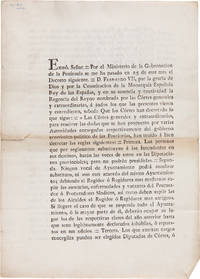
1814ref. 38083Mexico. 1814. A Spanish legal document published in Mexico in 1814 reprinting an order issued by the Córtes in Cadiz in August 1813 concerning the ayuntamientos or city councils in the various provinces. Details are provided regarding the membership of these councils particularly the process of filling vacant positions. The original 1813 Cadiz decree addresses the issue of council membership both in the Iberian peninsula and in overseas holdings; this Mexican publication includes the printed date of April 1814 and the fifteenth day of that month is provided in manuscript. OCLC records a single copy at the Bancroft Library. Folio. Signed in print "Humana" with accompanying paraph "rúbrica" additional manuscript annotation on p.3. Contemporary manuscript docket inscription on verso of p.3. Old folds with short holes and tears with some paper loss not affecting text. Two small clean tears near old fold no loss of paper or text. Moderate soiling particularly at margins and central fold. A good copy. OCLC 20403276. unknown books
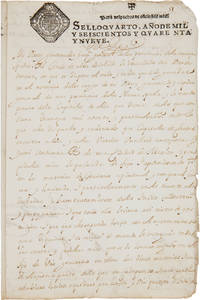
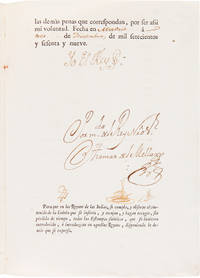
1649ref. 62712Madrid. May 27 1649. Transferring the Viceroyalty of Mexico with Special Reference to the "Good Treatment of the Indians" A manuscript royal order from Philip IV with his stamped signature "Yo el Rey" directing the Viceroy of New Spain to deliver all orders letters and other relevant papers addressed to himself as well as those addressed to all previous viceroys to his successor. The order specifies that he is to hand over everything of relevance in all "matters of spiritual and temporal government war and finances and particularly with regard to the education and good treatment of the Indians" our translation. The document is further endorsed "Por mando del Rey" and signed by the secretary for the Council of the Indies and New Spain on the verso of the first leaf. The second leaf of the bifolium contains text dated the 27th of June 1650 the day the new Viceroy arrived in Mexico City and is signed by three members of the Audienca confirming that the order has been carried out as directed. The exact reasons for Philip's specifications are unclear but it seems more than likely that we have Juan de Palafox y Mendoza to thank. Palafox known in equal parts for his interest in education efforts on behalf of indigenous Americans and his endless quarrels with the Jesuit order was Viceroy himself in 1642 and remained in the powerful position of visitador general until his recall in 1648; his influence in New Spain would have remained strong despite his recent departure. What the King could not have known when composing this order on May 27 1649 was that the incumbent Viceroy Marcos de Torres had actually died of illness just days prior. The Audienca ran the government in his stead until his replacement Luis Enríquez de Guzmán conde de Alba de Liste arrived the following year. Guzmán has his work cut out for him and was likely grateful for the particular documents delivered to him as a result of this order as he was forced to contend with a revolt of the Tarahumara people in northern Mexico immediately upon arrival. While Guzmán was able to put down the rebellion without much trouble and did not himself institute any punitive policies the struggle remained evidence that the brief peace in the mid-17th century was coming to an end and the late 16 and early 1700s would be rife with conflict between the Spanish and the indigenous people of Mexico. A noteworthy royal order regarding New Spain evidencing a brief period of friendlier relations between the Spanish crown and the native peoples of the New World. Light edge wear some very minor foxing and soiling. Very good. unknown books
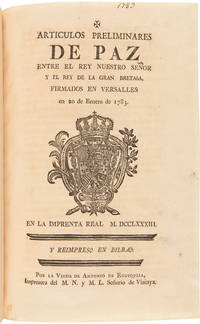
1783ref. 15744Bilbao. 1783. England Returns the Floridas to Spain A rare Spanish edition of the preliminary articles of peace between Spain and England which ended their conflict in the American Revolution. The primary impact of this treaty was to return the Floridas to Spain thus setting the stage for conflicts between the United States and Spain on its southern and western borders and ending twenty years of British control of the Floridas which had effectively been lost when Galvez seized Pensacola in 1781. Quarto. Modern half morocco and marbled boards. Very good. DAVENPORT 170. SERVIES 597 Madrid ed. hardcover books
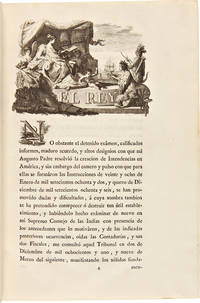
1803ref. 40396Madrid: En la imprenta de la Viuda de Ibarra 1803. The Final Reform of the Laws of the Americas Administrative regulations for Spanish colonial rule in the Americas and the Philippines. These laws represent the last-ditch efforts of the Spanish monarchy to bring reform to the administration of their colonial holdings in the Americas. Six years later in 1809 the first declaration of independence from Spanish rule would be signed in Quito in modern Ecuador which would be the first spark of the movement for independence across Spain's American colonies. With this ORDENANZA Spain hoped to restructure and reform colonial rule in such a way to prevent that from happening. A nice piece of Spanish-American history. Folio. Contemporary Spanish calf spine gilt leather label. Lightly rubbed at extremities boards lightly scuffed. Contents bright and clean. Near fine. MEDINA BHA 5971. PALAU 202973. hardcover books
1769ref. 48901Madrid. December 3 1769. Suppressing Satirical Jesuit Works in Barcelona A royal decree attempting to suppress satirical publications of the Jesuit order mentioning "San Ignacio de Loyola" the founder of the Jesuits more than two centuries earlier. Issued after the suppression of the order this is specifically aimed at illicit works printed and circulated in Barcelona. The document is stamp-signed by King Charles III and secretarially docketed. Gathered signatures stitched. Minor worming. Very good. unknown books
1520ref. 17720Augsburg 1520. With an Americana Reference Not in Harrisse "After the death of Ferdinand II Charles V succeeded to the Kingdom of Spain. In 1517 he proceeded to Spain which he left in 1520. At his departure he was very unpopular; he made this speech when he left and said 'That he did not see the happy faces with which he had been received.' He also mentions America in the following words: 'He might have been satisfied with the Spanish Empire the Balearic Islands and Sardinia the Kingdom of Sicily Italy and a large part of Germany and Gaul AND THAT OTHER GOLD-BEARING WORLD'" - Maggs. EUROPEAN AMERICANA locates only two copies at The New York Public Library and the Bibliothèque Nationale. There is also a Rome edition of which a copy is located at Harvard. The present copy appears to be the only one offered for sale in this century. Small quarto. Later plain paper boards. Marginal tears and old fold marks with slight discoloration else very good. EUROPEAN AMERICANA 520/17. MAGGS BIBLIOTHECA AMERICANA I:33 this copy. PALAU 44419. ROTHSCHILD 3137. hardcover books
ref. 15743Paris. 1783. Variant Form of the Anglo-Spanish 1783 Treaty A French printing of the treaty between Spain and England adopted as part of the general peace of September 3 1783. Through this treaty Spain reacquired the Floridas and the Mediterranean island of Minorca while Britain retained Gibraltar and acquired the Bahamas. This printing is unrecorded so far as we can discover. It seems to have been printed for the use of the French commissioners at the time of signing and is in folio form with docket printed on the side so that it could be folded and put in a file. It probably represents a printing during the later stages of the negotiation process. OCLC locates only one institutional holding at the Library and Archives of Canada. Rare. Tall folio designed to be folded with docket title sideways on last leaf. Later marbled boards leather label. Near fine. DAVENPORT 174. OCLC 1007694637. A different printing of this treaty is recorded as: SERVIES 598. SABIN 96558. PALAU 339315. hardcover books