143 Ergebnisse
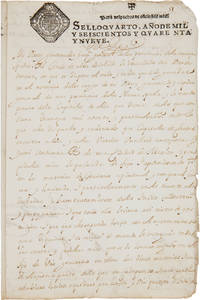
1649Best.-Nr. 62712Madrid. May 27 1649. Transferring the Viceroyalty of Mexico with Special Reference to the "Good Treatment of the Indians" A manuscript royal order from Philip IV with his stamped signature "Yo el Rey" directing the Viceroy of New Spain to deliver all orders letters and other relevant papers addressed to himself as well as those addressed to all previous viceroys to his successor. The order specifies that he is to hand over everything of relevance in all "matters of spiritual and temporal government war and finances and particularly with regard to the education and good treatment of the Indians" our translation. The document is further endorsed "Por mando del Rey" and signed by the secretary for the Council of the Indies and New Spain on the verso of the first leaf. The second leaf of the bifolium contains text dated the 27th of June 1650 the day the new Viceroy arrived in Mexico City and is signed by three members of the Audienca confirming that the order has been carried out as directed. The exact reasons for Philip's specifications are unclear but it seems more than likely that we have Juan de Palafox y Mendoza to thank. Palafox known in equal parts for his interest in education efforts on behalf of indigenous Americans and his endless quarrels with the Jesuit order was Viceroy himself in 1642 and remained in the powerful position of visitador general until his recall in 1648; his influence in New Spain would have remained strong despite his recent departure. What the King could not have known when composing this order on May 27 1649 was that the incumbent Viceroy Marcos de Torres had actually died of illness just days prior. The Audienca ran the government in his stead until his replacement Luis Enríquez de Guzmán conde de Alba de Liste arrived the following year. Guzmán has his work cut out for him and was likely grateful for the particular documents delivered to him as a result of this order as he was forced to contend with a revolt of the Tarahumara people in northern Mexico immediately upon arrival. While Guzmán was able to put down the rebellion without much trouble and did not himself institute any punitive policies the struggle remained evidence that the brief peace in the mid-17th century was coming to an end and the late 16 and early 1700s would be rife with conflict between the Spanish and the indigenous people of Mexico. A noteworthy royal order regarding New Spain evidencing a brief period of friendlier relations between the Spanish crown and the native peoples of the New World. Light edge wear some very minor foxing and soiling. Very good. unknown books
1795Best.-Nr. 689451795. Madrid 1795. Folio 11-3/4" x 8". Madrid 1795. Folio 11-3/4" x 8". King Carlos IV Organizes Spain's Lucrative Silver Mines of Potosi Spain. Real Banco de San Carlos de Potosi. Real Cedula de Incorporacion de el Banco de Potosi a la Real Hacienda y Ordenanzas Para su Regimen y Gobierno: Con Arreglo a las Leyes de Indias y Demas Reales Disposiciones que al Margen se Citan: de Orden de S.M. Madrid: En la Imprenta de Don Benito Cano 1795. xii 67 107 pp. Final 107 un-numbered pages are charts and tables 4 folding. Folio 11-3/4" x 8"; 29.84 x 20.32 cm. Contemporary tree sheep gilt fillets to boards gilt fillets to spine recased endpapers renewed. Moderate rubbing to extremities with some loss to gilding spine abraded corners bumped and lightly worn. Light toning to text somewhat heavier in places faint dampstaining to preliminaries and a few other leaves light edgewear to one of the folding tables. A handsome copy. $1250. Only edition. A vital Bourbon-era administrative imprint codifying the direct state takeover of the financial apparatus fueling Potosi's Cerro Rico "Rich Mountain"-the legendary source of the global silver trade in Upper Peru present-day Bolivia. For over two centuries Potosi generated an unprecedented influx of wealth that sustained Spanish imperial hegemony fueled European market expansion and dictated global trade dynamics with Asia. However by the late 18th century declining ore grades inefficiency and private corruption plagued production. In response to these fiscal pressures the Spanish Crown executed sweeping Bourbon reforms to modernize tax collection and streamline mining operations. Originally established as a private guild bank Gremio de Azogueros to support local miners with short-term credit and essential supplies the Banco de San Carlos was formally incorporated into the Royal Treasury Real Hacienda by King Carlos IV. This official royal decree prints both the charter of state incorporation Real Cedula de Incorporacion and the complete operational regulations Ordenanzas governing the re-organized institution. The substantial 107-page appendix contains intricate ledger formats sample audit forms and four massive folding balance tables designed to enforce strict bureaucratic oversight over colonial administrators in South America. Behind the sophist. unknown books
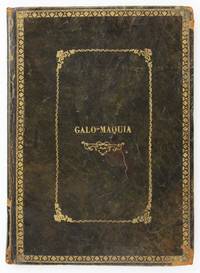
1850Best.-Nr. 5353Spain 1850. Very good. 45pp. Small quarto. Contemporary calf gilt. A few minor abrasions along spine edges and corners worn. Occasional minor dust-soiling or foxing to text. An intriguing handwritten manual on cockfighting describing different types of roosters and the rules for fighting them presumably produced in Spain in the first half of the 19th century. The subtitle of the work touts it as in English translation "a very useful work for cockfighting fans." The manuscript includes passages with headings such as "Nobleza antiguedad y utilidad del juego de Gallo" "Nobility antiquity and usefulness of the Rooster game" "De las peleas en general" "Of fights in general" "Condiciones para carear la guerra" "Conditions to face war" "Condiciones en las peleas de navaja" "Conditions in knife fights" "Observaciones acerca del acto de las peleas" "Observations about the act of fighting" "De las circumstancias del Gallero de las cosas anexas a su egercicio y de su gratificacion" "Of the circumstances of the Gallero of the things annexed to his exercise and gratification" "Sobre preparacion de los gallos para las peleas de pico" "On the preparation of roosters for beak fights" "Del modo de disponer los gallos para las peleas de navaja" "How to arrange the roosters for knife fights" as well as passages on the rules for fighting and comparing roosters by weight age and other means and more. A substantial portion of the latter part of the manual is devoted to describing about thirty different "Colores de los gallos" and color patterns which include various shades and patterns of "Indio" "Giro" "Canelo" "Blanco" "Prieto" "Pintojo" and "Tabao." The last section contains a "Regimen para curar las enformedades que mas generalmente padecen los gallos" "Regimen for curing diseases that roosters most generally suffer from". Though an undated manuscript the binding appears to emanate from the first half of the 19th century. The ownership inscription and stamp on the first flyleaf indicates the work was owned by Fermin Canella Secades of the University of Oviedo in Spain. Canella Secades lived from 1849 until 1924 so could have owned the work anywhere within those years but the manuscript was most assuredly produced earlier. Though he was a prolific author the handwriting of the ownership inscription presumably belonging to Canella Secades does not match the handwriting in the manuscript and the ownership inscription and stamp were most certainly added later. In any case the present manuscript is a fascinating collection of useful information regarding one of the more esoteric bloodsports in the world which is still legal in parts of Spain and Mexico as well as many other countries and still practiced in numerous places where it's clearly illegal. unknown books
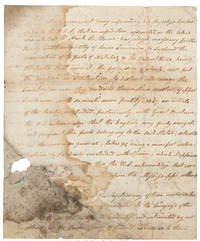
1797Best.-Nr. List2522New Orleans 1797. Three pages of a bifolium 8 x 9 ½ inches New Orleans; May 31 1797. Fair only with moisture damage and some text illegible. Fair. An interesting document from the period following the Treaty of San Lorenzo and before the eventual surrender of Natchez to the Americans in 1798 in which the governor of Louisiana and West Florida Francisco Luis Hector de Carondelet issues a statement regarding the delayed withdrawal of Spanish troops from the region. Carondelet is concerned with the British presence in the area and notes that it is a violation of "the treaty concluded with Spain" - or Pinckney's Treaty which opened up navigation rights of the Mississippi to the United States. The letter describes the possibility of escalating hostilities between the United States Great Britain and Spain as a result of an impending American mission against the Illinois the motives of which Carondelet questions as he notes that "These hostile dispositions can naturally only concern these provinces because the U.S. are in peace with all the savages." He raises the possibility of British invasion of Louisiana and potential danger to the city of New Orleans and states that the Spanish will maintain their presence at Natchez and Walnut Hills unless the American soldiers withdraw. This is a copy of Carondelet's speech in the hand of Lieutenant Piercy Smith Pope and we find no other record of it. A full transcription follows: "The Government being informed by his Majesty's Ambassador to the U.S. that an expedition assembled on the lakes was intended to attack the Illinois has judged necessary for the surety and tranquility of Lower Louisiana to suspend the evacuation of the posts of Natchez & the Walnut Hills being the posts that cover it; the possession of which will put the English in a situation to disturb and ravage the country in case they rendered themselves masters of upper Louisiana with so much more facility as by an article of the treaty concluded posteriously with Great Britain the U.S. acknowledge that the English may freely navigate and frequent the posts belonging to the said States; situated on the river in general lakes &c being a manifest contradiction to the treaty concluded with Spain which it appears. because by this the U.S. acknowledge that no other nation can navigate upon the Mississippi without the consent of Spain. . the legitimacy of these motives the .presented to the Congress of the U.S. with all the necessary veracity and intimated by our orders in the Commissary of Limits as well as to the Commandant of the Detachment of American troops now at Natchez. We are now informed that a detachment of the army of the U.S. cantoned on the Ohio are on their way by Holstein towards Natchez while the Militia of Cumberland are intimated to hold themselves ready to march at the first notice. These hostile dispositions can naturally only concern these provinces because the U.S. are in peace with all the savages the anterior menaces of the Commissary of Limits & the Commandant of the detachment of Americans now at Natchez; the immediate rupture & if the American Gazettes are to be believed already effected between France our intimate ally and the U.S. engage us to be on our guard to defend our property with that valor & energy which the inhabitants of these Provinces have manifested on all occasions with the advantage and superiority which a knowledge of our local situation will procure and that confidence which right and justice inspires. If the Congress of the U.S. had no hostile intention against these provinces they will either leave the post of Natchez or Walnut Hills the only bulwarks of Lower Louisiana that can stop the courses of the English or that they give us security against the article of the Treaty with Great Britain which exposes lower Louisiana to be pillaged and destroyed down to the Capitol. We will then deliver up the said posts and lay down our arms which they have forced us to take up by arming their Militia in time of peace and sending a considerable body of troops by round about ways to surprise us. New Orleans 31st May 1797 A copy of the Baron de Carondelet's Proclamation. P. Pope" Overall a document of significance in United States / Spanish relations in the period following Pinckney's Treaty worthy of further study for scholars of the diplomatic history of the period. unknown books
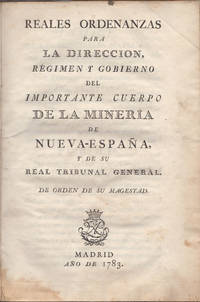
1783Best.-Nr. 44308Madrid: n.p. 1783. First edition. Full contemporary cat's paw vellum. Boards worn with some loss to the tail of the spine hinges split though firm dampstained along bottom edge some ink smudges especially to edges of frontispiece section titles in manuscript on each page otherwise contents quite sharp and overall about very good. 2 lvs xlvi 214 pp. Illus. with an engraving by Joaquin Fabregat of the Spanish arms and depicting mining implements. Folio. Signed in ink with Galvez' paraph under his printed name. First edition of this "rare and valuable compendium of the old mining laws and mineral customs printed only for the use of the parties concerned" Sabin and meant to govern the workings of silver mining in New Spain. Galvez was a special Minister of the Indies who was instructed to reform the mining laws of Mexico. In this work which could only be owned by Spanish-born miners he not only transcribed all the royal decrees concerning mining in New Spain but also provided information concerning mining operations training discovery of new mines and technology and governance. Signed in manuscript with his rubric attesting to the accuracy of the copy. Further editions were published in 1785/6 in Lima both folio and quarto and in Santiago in 1833. Sabin 56260. Palau 203088 & 251937. Medina BHA V: 5040. Maffei/Figueroa Bibl. Esp. Minerales. n.p. hardcover books
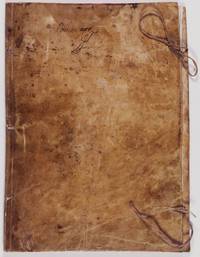
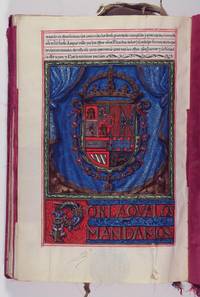
1711Best.-Nr. 50903Alagon Zaragoza Spain 1711. Hardcover. Folio. 12x9". 8 leaves the final leaf backed in paper. Manuscript bound in limp vellum. Protected with 2 paper leaves and 2 maroon silk sheets bound and encased within plain contemporary paper-backed vellum covers with cloth string ties. Contains 2 leaves with gorgeous full-page illustrations elaborately hand-colored in ink and gilt the first depicting the family arms of García the second with the royal arms of Don Felipe within decorative borders. Fine clear cursive hand in black ink within two sets of double-ruled borders 25 lines per page; 7 gold capitals superimposed on a landscape within square black borders mark the sub-sections of the text followed by initial lines in gilt letters. Text and illuminations fine and clean; vellum covers lightly soiled. Text block now loose within covers. Early eighteenth-century illuminated "carta de hidalguia" manuscript a patent of nobility for one Alonso García an inhabitant of Montejo de la Vega de la Serrezuela in the Spanish province of Segovia Castilla and León. The motto appearing on his arms reads: García De Arriba Nadie Diga May No One Speak from Above. The royal decree of King Felipe V is dated 5 May 1711; the document was notarized on 12 June 1711 in Alagón a municipality located in the Spanish province of Zaragoza. In addition to the notarial stamp of the king Yo el Rey at least four witnesses have signed the manuscript on the final page. The document concludes with the formula: "El Mgd. Majestad hace merced à Alonso García vecino y natural del lugar de Montejo de la Vega de que por los días de su Vida pueda gozar; y ser reputado en la dicha Villa y demas partes que residiere por hijodaldgo y obtener las preheminencias que por ello le tocaren." The Majesty grants Alonso García a resident and native of Montejo de la Vega that he may enjoy for the days of his life and be well-regarded as a noble in that town and other places in which he may reside and obtain the privileges to which he is entitled. References: Revista de historia y de genealogía española 1912-1931 p.102: Alonzo García is noted in a list of those ennobled in the State of Castilla Castile since the year 1710. hardcover books
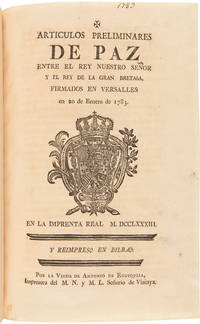
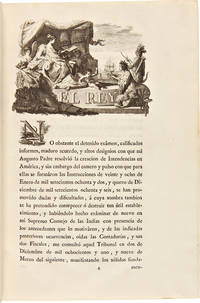
1783Best.-Nr. 15744Bilbao. 1783. England Returns the Floridas to Spain A rare Spanish edition of the preliminary articles of peace between Spain and England which ended their conflict in the American Revolution. The primary impact of this treaty was to return the Floridas to Spain thus setting the stage for conflicts between the United States and Spain on its southern and western borders and ending twenty years of British control of the Floridas which had effectively been lost when Galvez seized Pensacola in 1781. Quarto. Modern half morocco and marbled boards. Very good. DAVENPORT 170. SERVIES 597 Madrid ed. hardcover books
1803Best.-Nr. 40396Madrid: En la imprenta de la Viuda de Ibarra 1803. The Final Reform of the Laws of the Americas Administrative regulations for Spanish colonial rule in the Americas and the Philippines. These laws represent the last-ditch efforts of the Spanish monarchy to bring reform to the administration of their colonial holdings in the Americas. Six years later in 1809 the first declaration of independence from Spanish rule would be signed in Quito in modern Ecuador which would be the first spark of the movement for independence across Spain's American colonies. With this ORDENANZA Spain hoped to restructure and reform colonial rule in such a way to prevent that from happening. A nice piece of Spanish-American history. Folio. Contemporary Spanish calf spine gilt leather label. Lightly rubbed at extremities boards lightly scuffed. Contents bright and clean. Near fine. MEDINA BHA 5971. PALAU 202973. hardcover books
Best.-Nr. 15743Paris. 1783. Variant Form of the Anglo-Spanish 1783 Treaty A French printing of the treaty between Spain and England adopted as part of the general peace of September 3 1783. Through this treaty Spain reacquired the Floridas and the Mediterranean island of Minorca while Britain retained Gibraltar and acquired the Bahamas. This printing is unrecorded so far as we can discover. It seems to have been printed for the use of the French commissioners at the time of signing and is in folio form with docket printed on the side so that it could be folded and put in a file. It probably represents a printing during the later stages of the negotiation process. OCLC locates only one institutional holding at the Library and Archives of Canada. Rare. Tall folio designed to be folded with docket title sideways on last leaf. Later marbled boards leather label. Near fine. DAVENPORT 174. OCLC 1007694637. A different printing of this treaty is recorded as: SERVIES 598. SABIN 96558. PALAU 339315. hardcover books
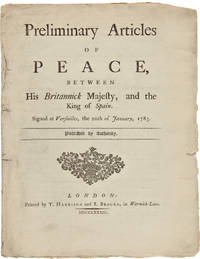
1783Best.-Nr. 20839London. 1783. England Gives Up Florida to Spain The official English publication of the preliminary articles of peace between Spain and England. By this treaty an armistice was concluded Britain gave back the Floridas to Spain and Spain restored the Bahamas to England. Small quarto. Dbd. Some old minor ink underscoring. Else very good. Untrimmed. In a half morocco box. AMERICAN CONTROVERSY 83-44. DAVENPORT 170. unknown books
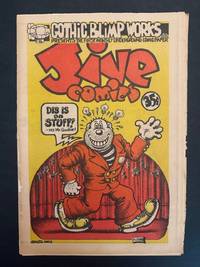
1969Best.-Nr. 13188East Village New York: Peter Leggieri and the East Village Other 1969. First Edition. Original Wraps. Very Good in Wraps. First Edition. Original Wraps. "During its eight-issue run the publication displayed comics in both color and black-and-white. The first issue was titled Gothic Blimp Works Presents: Jive Comics. Vaughn Bodé was the founding editor but soon stepped down after the first two issues. At Bodé's invitation Bhob Stewart became the publication's editor introducing a line-up of contributing artists and writers that included Larry Hama Michael Kaluta Willy Mendes George Metzger Ralph Reese Steve Stiles and Bernie Wrightson. The first two issues also featured work by Bodé Joel Beck Roger Brand Robert Crumb Kim Deitch Simon Deitch Bill Griffith Ron Haydock Jay Lynch Trina Robbins Spain Rodriguez Art Spiegelman John Thompson Larry Todd and S. Clay Wilson." While Zap Comix officially started the underground comics movement in the US Blimp Works created national readership and networks to collectively identity as a distinct comic art movement. Features the distinctive oversexualized art of Robert Crumb known for his characters as Mr. Natural and Keep on Truckin'. Important collection billed as "the first Sunday underground comic paper." Scarce complete holdings in the US. Light chipping fading fold lines one issue with dampstaining and general newsprint toning else tight bright and unmarred. Complete run of eight issues with color and b/w illustrations. fo. Var. pg. Peter Leggieri and the East Village Other unknown books
1893Best.-Nr. 236066London: Chiswick Press 1893. No. 11 of 13 copies printed on vellum there were also 88 copies printed on paper. Title with vignette numerous woodcut illustrations and large initial capitals. 1 vols. Folio 12-3/4 x 8-7/8 in.; 32.4 x 22.5 cm. Loose as issued in publisher's decorated board portfolio with maroon velvet straps in publisher's maroon morocco-backed clamshell box with printed label on upper cover; box worn a few rust marks on upper board. No. 11 of 13 copies printed on vellum there were also 88 copies printed on paper. Title with vignette numerous woodcut illustrations and large initial capitals. 1 vols. Folio 12-3/4 x 8-7/8 in.; 32.4 x 22.5 cm. This work consists of two important ordinances issued by the Spanish monarchy on November 20 1542 and June 4 1543. Under the active influence of Bartolomeo de las Casas "friend of the Indians" the new laws had the special design of ensuring better treatment of the Indians limiting the distribution of their lands and above all protecting them against enslavement by the conquering Spaniards. "Las Leyes Nuevas" are reprinted here in this fine facsimile from the copy on vellum in the British Museum and are followed by an English translation. Much of the book is taken up by the historical Introduction by Henry Stevens who denounces the Spanish mistreatment of the Indians. Ironically the Spanish crown was later forced to rescind the new laws by colonists who were outraged at having to give up their right to a quota of enslaved Indian laborers. A magnificent and impressive production by the Chiswick Press one of only 13 printed on vellum. Chiswick Press unknown books
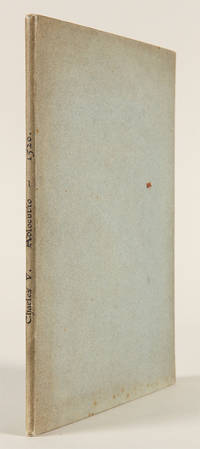
1520Best.-Nr. 17720Augsburg 1520. With an Americana Reference Not in Harrisse "After the death of Ferdinand II Charles V succeeded to the Kingdom of Spain. In 1517 he proceeded to Spain which he left in 1520. At his departure he was very unpopular; he made this speech when he left and said 'That he did not see the happy faces with which he had been received.' He also mentions America in the following words: 'He might have been satisfied with the Spanish Empire the Balearic Islands and Sardinia the Kingdom of Sicily Italy and a large part of Germany and Gaul AND THAT OTHER GOLD-BEARING WORLD'" - Maggs. EUROPEAN AMERICANA locates only two copies at The New York Public Library and the Bibliothèque Nationale. There is also a Rome edition of which a copy is located at Harvard. The present copy appears to be the only one offered for sale in this century. Small quarto. Later plain paper boards. Marginal tears and old fold marks with slight discoloration else very good. EUROPEAN AMERICANA 520/17. MAGGS BIBLIOTHECA AMERICANA I:33 this copy. PALAU 44419. ROTHSCHILD 3137. hardcover books
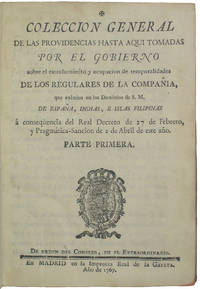
1784Best.-Nr. 44155Madrid: En la Imprenta Real de la Gazeta 1784. First edition. Contemporary mottled calf compartments decorated in gilt red morocco spine label titled in gilt sewn in green silk ribbon marbled endpapers. A very good copy head band worn with a small chip and a tiny split at the joint owner's bookplate and booksellers engraved plate on front pastedown contents quite bright and clean. 104 91 135 144 4 74 pp. 4to. Five volumes bound in one. Parts 1 2 3 set in condensed type; parts 4 and 5 in expanded type. Royal decrees from Charles III and instructions decisions and regulations issued by the Consejo en el Extraordinario and its president the Conde de Aranda and others--concerning the expulsion of the Jesuits. "These collections contain the documents relative to the expulsion of the Jesuits from the Spanish dominions and the confiscation of their property including the names of the colleges and houses of the order the application of the confiscated property &c. A complete series consists of five parts which are rarely found together. Our collation is of parts I. to III. only" Sabin 14304. Part 4 p. 75-127 contains the papal brief "Dominus ac Redemptor" by Clement XIV in Latin and Spanish. Earlier versions containing parts or all of the first three sections are not all that uncommon but those containing all five parts remain relatively rare. Other than this copy only two others have appeared in the auction records of ABPC and RBH since 1953 the first at the John B. Stetson sale at Parke Bernet and the second at Bonhams in a modern binding and dampstained. Palau 56516. See Sabin 14304. Medina BHA: IV 4228. En la Imprenta Real de la Gazeta unknown books
1814Best.-Nr. 2677Hunthill House Scotland 1814. Written in English in a small and narrow but legible italic hand with occasional corrections or additions in a different hand on wove paper watermarked Budgen & Wilmott / 1812. Four unnumbered pages of French text at front and four at back the latter dated 27 May 1814 in a different hand apparently the author’s on different paper with no visible watermark. Very good; some occasional spotting. Contemporary red straight-grained morocco gilt edges scuffed and scraped joints strained head of spine chipped. An unpublished first-hand memoir filled with searing descriptions of the horrors of war by a French army officer veteran of the terrible Peninsular War. The narrator was one of few survivors of the surrender of French forces after the Battle of Bailén in July 1808. The background to this event was Napoleon's attempt to complete the isolation of England from the continent by sending a French army into the Iberian Peninsula to occupy Portugal and Spain thereby preventing British trade with the Continent. Napoleon later referred to the Peninsular War characterized by appalling cruelty on both sides as the ‘Spanish ulcer’; it was to be one of the primary factors in his downfall. General Pierre Dupont de l'Étang was charged with securing French control of the major cities in Spain. Dupont's 20000 men had initial success but as they penetrated deeper into Spain they faced increasing resistance. This memoir by H. de Montvaillant an 18-year-old Protestant officer from Montpellier who was serving in the second Corps d’Observation of the Gironde recounts the route and experiences of Dupont's army to its furthest point of penetration into Spain: Córdoba. There after a particularly bloody and cruel occupation the army was forced to withdraw and was soon overwhelmed. Dupont surrendered his army at Bailén. Originally promised safe passage most of the French were slaughtered immediately after their surrender. Montvaillant’s account commences with the French arrival in Bayonne in November 1807. By December 22 the French troops had arrived in the town of Vittoria 50 miles west of Pamplona and by January 9 1808 they had advanced to south of Burgos. Detailed descriptions of the monuments churches libraries art and inhabitants of various localities passed through in their zigzagging progress south through French-occupied Spain enliven this first part of Montvaillant’s narrative: he describes with evident pleasure Burgos Valladolid Guadarrama and the Escorial Madrid and Toledo where the troops spent most of May. He makes the acquaintance of many Spaniards. In Toledo a young woman explains to him the contradictions of Spanish women rendered emotionally susceptible by their extreme religious devotion but whose sometimes shocking to the French frankness contrasts with a strict sexual morality. Later he deplores the time wasted in Toledo while the Spanish insurgents were building up their strength. As the French troops proceed southward the local populations exhibit increasing hostility often hidden under excessive politeness. They encounter a Frenchwoman who has fled Bailén saying that she was not safe there because of her nationality but the soldiers assume that she exaggerates. By the end of May the French pass the Sierra Morena and enter Andalusia and the truth becomes evident. It is at this point that the narrative takes on an ominous tone. Montvaillant notes that the population had abandoned the villages taking all foodstuffs. He records that the senior officers had assumed that the army would only be harassed by small bands of “brigands” a far cry from the massive resistance that it encountered: “We learned that the insurgents each day gathered strength and that the Junta of Seville was determined to stop us in our March. The following day we got to the little town Baylen in whose plains two months afterwards our destiny was decided” p. 86. The first battle was engaged at Alcoléa just upstream from Córdoba an event Montvaillant describes in a poem in French transcribed. The next day the French arrived at Córdoba where the Spanish enemy had taken refuge. A musketry attack upon their arrival so enraged General Dupont that “he gave up the town to pillage" p. 88. Allowed to run wild the French soldiers sacked the city committing hideous crimes: “Neither tears promises or humble supplications could arrest the thirst for pillage.” p. 89. Discipline was nonexistent drunkenness and looting continued for eight days. The soldiers raped the women and ransacked homes. Montvaillant presents himself as a savior of women and the elderly on several occasions but notes that some of the Spanish whom he and fellow officers placed under protection in Córdoba were later “the first to persecute the unprotected French prisoners and even those who had been their Benefactors” p. 92. While he does not detail the contents of the soldiers’ plunder it is known that the rich churches of Córdoba were heavily looted. Notwithstanding the circumstances he manages to visit and describes in amazement the great mosque-cathedral scarcely changed in a thousand years. Nine days after the French entrance into Córdoba Montvaillant and his troops were ordered back to Alcolea to guard a bridge crossing. En route there from Cordóba he discovered and graphically describes the many mutilated corpses of the French sick and wounded who had been left along the line of march while the main body of General Dupont's troops had taken Córdoba. “It is almost incredible how people calling themselves Christians could push inhumanity to such an excess” p. 96. The army moved back to Andújar near Bailén and encamped. Montvaillant records that the general staff had by now realized that the French were outnumbered and that the opposition had organized itself. Dupont's army was isolated without hope of reinforcement or re-supply defending a garrison situated on a flat plain in the scorching sun. The narrative becomes one of revenge heat troop dispositions losses tactical mistakes errors of the general staff and increasing difficulties. Dupont's surrender came on July 20 1808 and thus begins the second part of the memoir devoted to the narrator’s experiences as a prisoner of war. The officers were segregated from the defeated army before being escorted supposedly to return to France. Most of the army was slaughtered within days. Montvaillant records details of the survivors’ months-long “death march” southwards to the coast. Having finally arrived at Jerez de la Frontera near Cádiz to await embarkation to France they waited in vain. Their captors kept them in Jerez having discovered that the ruling Junta of Seville had abrogated the surrender treaty and that the inhabitants were planning to massacre them on their approach to Cádiz. Montvaillant’s account is henceforth devoted to anecdotes of captivity and of the prisoner’s horrendous treatment at the hands of their escorts and guards. He is unclear as to exact dates but it seems that the French captives were held at Jerez until mid-December and then hastily driven aboard ships to sail for the Balearic Islands. A severe storm intervened and they were blown off course to Africa finally coming to port at Gibraltar; several days later they were blown back to Andalusia at Málaga. After more storms and much sailing having been at sea 25 days for a voyage which normally took a week they finally made the Balearics. And here the worst surprise of many bad surprises awaited them: the desert island of Cabrera. Montvaillant counts some 4000 soldiers and 400 officers who were forced to survive as best they could on this scorching hot nearly waterless uninhabited island p. 148. Details of his account square with Denis Smith’s monograph on the subject. During the next four years close to 9400 French prisoners of war were exiled to this island; possibly 40% died of disease or malnutrition. The officers as usual fared much better than their soldiers. Montvaillant was one of 216 officers who were collected from this exile after a month and taken to the capital Palma p. 150; another group was sent to Mahon in Minorca. There imprisoned in better circumstances the group waited although the news from outside was threatening as the Spanish "mobs" were calling for their "sacrifice." The officers between attempting escapes were able to conjure up some distractions. The narrator passed the time translating Spanish poems and plays and spending up to eight hours at a stretch playing chess. They also freely imbibed the good Mallorcan wine danced and partied; making do without women Bacchus presided as he delicately puts it. But nearly half these officers were massacred during a riot and assault on the prison by the inhabitants of Palma described by Montvaillant in gory detail pp. 158-162. The survivors were returned to Cabrera in March 1810 as were the officers from Mahon. They found there a diminished population of half-naked walking skeletons. During the next five months spent on Cabrera Montvaillant was nonetheless able to observe a thriving “political economy” on the island where enough food was still provided that the prisoners had the energy for theater productions and dances. Describing the gender-bending that took place as the men playing female roles in the performances instinctively took on conventionally feminine attitudes even to the point of inspiring crushes bickering and jealousy among the audience members Montvaillant comments that the theatrical chronicle of Cabrera would make quite a book ”un bel in folio”- p. 170. In early August Montvaillant and the officers were removed from the island on an English ship — all unhesitatingly leaving their men to rot on the island where they remained for four more years. A diplomatic impasse kept the officers off the coast at Gibraltar for several weeks until they were finally put on ships for Portsmouth and Plymouth. Montvaillaint went on to Salisbury for a short time and then embarked again for Leith en route to his final destination in Scotland where he remained in comfortable exile until the accession of Louis XVIII in 1814. The text is written in an occasionally stilted English a translation from the author’s own French account by a family whom he had befriended at Hunthill House near Jedburgh Scotland where he stationed. Eight pages of notes in French by the author are inserted four pages at the beginning the bifolium is inserted using wax seals and four pages at the end. The French preface contains a romanticized account of the author’s Scottish sojourn including a temptress fairy and concludes with the author’s promise to never forget his friends in Scotland. The English text is preceded by the title-leaf and a one-page dedicatory poem introduced by a statement that these “`Recollections’ in an English Garb are presented by the sincerest of Friends to the Author” and dated Hunt Hill 1 January 1814. Following the narrative in a letter to his family dated from Jedburgh 27 May 1814 Montvaillant explains the history of the manuscript the remaining pages contain literary notes including translations into French of poems by Robert Burns and Sir Walter Scott. During his years of exile in Jedburgh Montvaillant had become deeply attached to the owners of Hunthill House and to their three daughters. Without them he claims he would not have survived the loneliness of his exile. In homage and gratitude he dedicated his memoir to them. His friends retained the original French version as a keepsake of their friend and an engrossing biographical narrative and presented him with this translation which he brought back to France planning to render it anew into French to share with his family and close friends. He emphasizes that he plans to keep the manuscript unpublished; perhaps the memories were too painful. Cf. Denis Smith The Prisoners of Cabrera: Napoleon's Forgotten Soldiers 1809-1814 New York 2001. unknown books
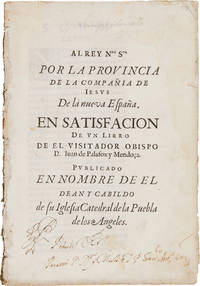
1647Best.-Nr. 66747Various places likely Puebla or México City. ca. 1647-1650. Documenting a Legendary Church Feud in New Spain A group of three scarce publications relating to the acrimonious conflict between Juan Palafox y Mendoza Bishop of Puebla and the Jesuits in New Spain. Juan Palafox y Mendoza 1600-59 was born in Navarre educated at Salamanca and appointed a member of the Council of the Indies. He later became a priest and in 1639 was made Bishop of Puebla de los Angeles. Palafox arrived in Mexico in 1640 and soon butted heads with the Franciscans Dominicans and Augustinians whose many exemptions and privileges he looked upon as encroachments on his jurisdiction. In 1642 he was made Archbishop of New Spain and for a brief time that same year he was acting Viceroy during which he instituted financial reforms and made a push for indigenous conversion. Despite or perhaps thanks to that push Palafox distinguished himself as bishop in his efforts to protect the Native Americans from Spanish cruelty forbidding any methods of conversion other than persuasion. He was also a patron of the arts: under his tenure Puebla became the music center of New Spain and he established the Biblioteca Palafoxiana which continues to this day. Palafox's fortunes turned when he came into major conflict with the Jesuits over ecclesiastical jurisdiction in the mid-1640s. The legendary feud between Palafox and the Society of Jesus was fierce extended and rich in legal filings. The main point of contention between the opposing parties was the failure of the Society to submit to the authority of the bishops and archbishop of Mexico particularly in their refusal to pay tithes. The Jesuits found their strongest ally in the new viceroy García Sarmiento de Sotomayor and Palafox was eventually undermined by both the Vatican and the Spanish crown. He was ultimately recalled to Spain after fleeing Puebla to evade arrest at the hands of the Viceroy and assigned to the minor diocese of Osma in Old Castile. After his death there was a movement to make him a saint but a decade was far too short to cool ecclesiastical tempers and his canonization was blocked by Jesuit opposition. In a very late vindication Palafox's writings were several times republished in the following century and played a significant role in the expulsion of the Jesuits from Spain in 1767. The three works offered here are as follow: 1 Testimonio de una Provision del Rey Nuestro Señor en que Se Imparte Plenamente el Real Auxilio a la Legitima Jurisdiccion Apostolica de los Muy RR. PP. Iuezes Delegados Conservadores de la Compañia de Iesus caption title. Puebla. June 9 1647. Folio. 17 leaves one seven-line woodcut historiated initial. Gathered signatures unstitched. Light foxing and tanning scattered worming mostly to margins but skimming a few letters on most leaves. The earliest of these three documents is also the shortest – and the rarest. The Testimonio de una provision del rey nuestro señor. presents testimony delivered to Philip IV from a number of sources including the Viceroy mostly regarding opposition to Palafox's March 1647 decree that under pain of excommunication Jesuits must be licensed by the Bishop in order to preach or hear confession. Though technically valid under canon law the Jesuits of course took issue perceiving that Palafox meant to refuse to grant them said licenses due to their feud and the present document describes the conflict and presents their argument against him. They accuse Palafox and his advisor Juan de Merlo of sedition against the church for prohibiting the excommunicated from hearing mass and for publicly posting lists of those thus excommunicated. After relaying the reports the king promises his support for the Jesuits in their suit against Palafox. The Iberian Books project warns that "there is a heightened possibility that this work could be a bibliographical ghost" as they located "no known exemplars." We note only a single copy in auction records and OCLC records a lone copy at the Tecnológico de Monterrey though it does not appear in their own online catalogue. Not in Medina BHA or Mexico. IBERIAN BOOKS 50798. OCLC 970573404. PALAU 331123. 2 Al Rey Nuestra Señor por la Provincia de la Compañia de Iesus de la Nueva España. N.p. likely Mexico City or Puebla ca. 1650. 131 leaves woodcut initials and tailpieces. Folio. Dbd. Scattered tanning and staining faint tideline to upper edge throughout last six leaves dampstained. Contemporary inscription on titlepage a handful of contemporary marginal annotations throughout. As expected for a legal document Roxas covers the dispute comprehensively separated into discrete sections with extensive shoulder notes. This document specifically deals with the question of tithes more specifically why the Society of Jesus is exempted why it is legitimate for them to sell their surplus for profit rather than give it to the diocese and why they believe Palafox is self-serving in demanding payment. The present filing by the Society via procurador general Alonso de Roxas or Rojas is described by Sabin as a "rabid reply" to Palafox's Al Excelentissimo Señor Don Garcia de Avellaneda I Haro Conde de Castrillo Presidente en el Real y Supremo de Las Indias. published 1646 see Medina BHA 6946. This work was also printed as a small quarto without decided priority between the two – both versions are equally rare. Palau suggests a date of 1650 and a Mexico City imprint for this edition and ascribes the small quarto as printed in Madrid in 1652; Sabin puts both in Mexico circa 1646 but publication would have to fall between 1649 when Roxas became procurador general and 1652 when Palafox responded to this attack see below. "Il existe donc deux éditions de ce mémoire. Celle in-folio est plus belle come execution typographique elle est aussie plus rare.Les types nous paraissent bien être ceux employés dans les imprimeries mexicaines" – LeClerc. Not in Medina Mexico. LeCLERC 1257. MEDINA BHA 6839. OCLC 2584251 78973667. PALAU 275714. SABIN 73620. 3 Al Rey Nuestro Señor. Satisfacion al Memorial de los Religiosos de la Compañia del Nombre de Jesus de la Nueva-España por la Dignidad Episcopal de la Puebla de los Angeles. Madrid or possibly Puebla 1652. 1158 leaves i.e. 157 with errors in foliation as issued woodcut first initial. Printer's error leaving recto of leaf 31 blank. Folio. Dbd. Stitching loose in places textblock separating. Light tanning and foxing. Minor worming throughout mostly to margins but touching a letter or two on most leaves significantly heavier to final leaf with notable loss of paper but no loss of text. A rare possibly Mexican printing of Bishop Palafox's defense against the preceding work. The slightly more common edition of this text carries a 1652 Madrid imprint is paginated rather than foliated and is printed almost entirely in italic type. This version bears a 1652 date but no imprint and more closely resembles other similar works printed in Mexico though Medina suggests that this is the first edition and that it was likely printed in Madrid. Palau on the other hand suggests a Puebla imprint. EUROPEAN AMERICANA 652/156. JCB3 II:421. LeCLERC 1224. MEDINA BHA 1173. OCLC 77921786. PALAU 209717. SABIN 58280. STREIT II:1873. An excellent collection of three rare works relating to this historical feud and an important grouping of 17th-century Mexican imprints. Folio. All three works disbound. Generally light tanning and worming occasional staining and soiling. Very good overall more specific condition reports given below. unknown books
1615Best.-Nr. 4007Ãvila and La Horcajada 1615. Manuscript on parchment 380 x 270 mm. 18. Complete. Contents: ff. 1r-4v: Regla in Spanish in 30 numbered sections inconsistent numbering on ff. 3v-4v in a rounded script in brown ink the first page slightly larger up to 27 lines. F. 1r: incipit first four lines in large lettering with very large calligraphic initial: En el nombre de dios todo poderoso padre y hijo y espiritu sancto tres personas y una esencia. Section 30 f. 4v added in a slightly later hand. The word Cruz symbolized by a red Maltese cross. Text on ff. 2r-2v underlined in red. Calligraphic initials some with marginal extensions in brown purple or red. Marginal drawings of prickly foliage some in the shapes of fantastic animals. Later marginal notes opposite many sections. Ff. 5r-5v: Heading: Este es traslado de un testimonio followed by two notarial subscriptions on f. 5v one partially in cursive signed and dated Ãvila 11 May 1527 the other in italic partly faded including the date 1615. F. 6r: A cerca de la procession de la Resurrection. After an introductory portion in a small round early 16th-century hand in brown ink the text continues from f. 4v with sections 32-37 of the Regla of which sections 33-37 are in a later sixteenth-century hand; these sections ruled through with light diagonal lines. Signatures or notes in lower margin. F. 6v: blank except for five lines heavily cancelled in red. Ff. 7r-7v: five paragraphs in a fine upright italic hand the first and third with headings in red La orden que han de tener en la procession de la Resurxection sic en la faded and illegible…; La orden que sea de tener en la procession de la Resurretion sic en el domingo de pascua es la siguente. Followed on f. 7v by a note in a different hand dated from La Horcajada 21 May 1550. Ff. 7v-8v and back inner cover: later additions some quite faded. A few later marginal annotations throughout. Rubrication and decoration: headings and line fillers in red a few ornamented line fillers or borders some passages underlined in red or light purple else ruled in dry point numerous calligraphic initials in red or brown ink opening initial with purple filigree extension filling left margin numerous foliate vegetable and zoomorphic ornamental designs in the margins in red purple and brown ink. Binding: stitched into the original parchment cover with title “Regla de la Pasion” in large letters the R with decorative extensions above a large cross in green ink entwined with the snake and in the margins apparently the instruments of the Passion. Condition: rubbing and staining vertical crease from folding causing occasional erasure of text outer edge of first page somewhat rubbed affecting legibility of text some words at line ends helpfully written over in a later hand the inks used in the last two leaves quite faded; wrapper worn and darkened with tears at top and 3 small holes in lower cover. Provenance: Confraternity of the Holy Cross of Horcajada; purchased in France with export license. An early Spanish confraternity manuscript containing the rules and statutes that governed the Confraternity of the Holy Cross referred to as the Cofradía or Hermandad de la Cruz the word Cruz being supplied by a Maltese cross in red of La Horcajada a town located in Castile y León in the province of Ãvila. As in other Roman Catholic countries confraternities or lay brotherhoods played a vital role in community life in Spain functioning as mutual aid societies and venues for laypeople to express their piety and perform charitable acts. Vernacular manuscript confraternity statutes from the Iberian peninsula surface much more rarely than for example their Italian counterparts although it appears that Spain had a larger number of confraternities proportional to the population especially in Castile y Leon than the other Catholic lands. Virtually every community including small villages had at least one confraternity. While exact numbers of confraternities in sixteenth-century Spain are unknown “studies carried out for a number of cities suggest that the number of confraternities and brotherhoods in the Hispanic kingdoms was larger than elsewhere in Catholic Europe. The reasons behind the extraordinary popularity of confraternities and brotherhoods in the Hispanic kingdoms cannot yet be established however in view of the current state of research on the topic. There has been a tendency for scholars to emphasize the confraternity as a primarily urban phenomenon a reflection perhaps of their early development in Italy where they formed an essential part of civic and urban life. In the Hispanic kingdoms however these institutions were equally important in the religious and social life of the small village. Pastoral visitations carried out by the bishops of Cuenca during the sixteenth century found that `nearly every community had at least one brotherhood’ even small villages of 500 inhabitants. A similar pattern prevailed in villages around Toledo during the late sixteenth century” Callahan pp. 18-19. In his article on Spanish confraternities William Callahan further points out their popular nature which “arose from the initiative of the laity rather than the clergy prime examples of the lay piety that began to flourish in late medieval Europe. This piety developed largely on its own uncontrolled by either local bishops or the pope both of whom regarded its manifestations with some suspicion. The resiliency of traditional confraternities and brotherhoods developed from their connection to local religious cultures. It also reflected a fact noted by scholars who have studied specific cities and regions the strongly popular character of membership. There were of course some associations that limited membership to the nobility or clergy but in most cases members were recruited from the popular classes. This was obviously true in the case of peasant villages where only one or two confraternities existed.” pp. 22-23. In spite of the centrality of confraternities to early modern religious life in Spain there is comparatively little modern scholarly literature especially on the rural confraternities. Note the absence for example of any articles on Spain or Portugal in Brill’s recently published Companion to Medieval and Early Modern Confraternities edited by Konrad Eisenbichler. This working manuscript bears witness to this central but understudied aspect of Spanish popular religious culture before the restrictions placed on confraternities by the Council of Trent and succeeding Popes. Consulted frequently and contributed to by members of the confraternity the manuscript includes abundant interlinear and marginal additions and corrections and half- or full-page later additions. The town of La Horcajada is identified in the opening page. Ff. 1r to 5v contain the introduction the first 30 statutes and a notarized testimony with heading “Este es traslado de un testimonio” which relates to the apparently recent establishment of the confraternity. The statutes cover admission of new members general rules of comportment requirements of prayer and confession for feast days and for the canonical hours charity for poorer members of the confraternity chants etc. Several paragraphs relate to processions including required habits and admission of non-members into the processions. On f. 6r a paragraph on the procession de la Resurrection is followed by six entries numbered 32 to 37 of which paragraphs 33 to 37 are in a later 16th-century hand. Several light diagonal lines through these five paragraphs may indicate that they were cancelled. The verso f.6v contains only five lines heavily cancelled in red ink and f. 7r continues discussion of the procession of the Resurrection on a feast day the name of the saint is smudged and on Easter Sunday in a different 16th-century upright cursive. This second section of which portions are difficult to read because of fading ends on f. 7v and is followed by a note in a larger hand dated from La Horcajada 21 May 1550. The final leaf and inner back cover contain later additions some quite faded. One late addition in the lower margin of f. 5v is dated 1615. The manuscript is decorated in a popular style. Some of the leafy plant designs have a thorny look that may reflect local vegetation. Animals and grotesques include a scorpion-like creature birds and possibly imaginary mammals. A witness to the central role played by religious confraternities in early modern Spain bearing the marks of its use and in original condition it is a rare survival and would repay further study. Cf. William Callahan “Confraternities and Brotherhoods in Spain 1500-1800” Confraternitas: The Newsletter of the Society for Confraternity Studies 12:1 2001 17-25. See also William A. Christian Local Religion in Sixteenth Century Spain Princeton 1981; Maureen Flynn Sacred Charity: Confraternities and Social Welfare in Spain 1400-1800 Basingstoke 1989. unknown books
1721Best.-Nr. 55346Spain: Chancellary Court of Granada 1721. Original manuscript. Hardcover. Fine. Small folio 33 by 22 cm / 11-7/8 by 7-7/8 in. Illuminated manuscript on vellum. Main text in black ink masterfully penned in fine clear Gothic style ruled and bordered in red. 82 unnumbered leaves 4 blank comprising 6 full-page miniatures and 144 pages of text generally 32 lines per page. 36 richly illuminated bands with initials appear throughout the text with occasional ornate initials in black ink. The finely detailed miniatures are painted in rich colors and decorated with metallic gold and silver. The royal seal of Philip V of Spain is stamped in black ink at the bottom margin on the recto of all text leaves as well as the final three blanks; the initials of a royal notary appear at the bottom margin of each page of text. Bound in contemporary crimson velvet lightly rubbed with decorative brocade ribbon ties worn and frayed. All edges gilt; crimson silk guards bound-in to protect the miniatures and illuminated bands. Text in Spanish. Manuscript on vellum fine and clean throughout. Overall a very well-preserved bound document. Sumptuously illustrated 18th-century manuscript nobility patent carta ejecutoria de hidalguia commissioned by the De la Barra family of Castile to memorialize the recognition of its noble status in the reign of Philip V King of Spain. As depicted in the illustrated family tree and noted at the opening of the text the family traces their noble ancestry back through five generations to Don Bartholome de la Barra y Zuñiga. "During the late medieval era many individuals received the honor of hidalgo status the lowest rank of nobility but with the passage of time this noble status was not always locally recognized. If a person or family was willing to submit a documented family history to local officials of the Chamber of Hijosdalgo of the Chancellery Court of either Valladolid of Granada they could sue for formal recognition" Neary. While few succeeded in these suits those who did would often commission luxury copies of the paperwork bound with the royal seal. While customized for each family the text and images of these nobility patents follow a standardized template which must elaborate on three key themes: religious devotion; service to the crown; and purity of blood limpieza de sangre. The latter required that the family demonstrate the absence of Jewish Muslim or "heretical" ancestry. As is commonly the case the present example opens with an image of the Virgin Mary here receiving the devotion of four members of the De la Barra family depicted on their knees before a sumptuously appointed church altar. The facing image depicts the Father the Son and the Holy Spirit in the form of a dove looking down upon the infant Jesus. The other full-page miniatures depict the De la Barra family tree; their coat of arms King Philip V; and the royal coat of arms. The richly illuminated bands contain the names of De la Barra family members or introduce key sequences in the presentation and disposition of the suit. The final four pages of text comprise an official copy of the court's final decision. Penned in an ordinary scribal hand this concluding document was usually written on paper; in the present case the declaration appears on parchment at the special request of the family. The document is signed by Santiago Alcalde y Linares royal notary escribano and dated 3 July 1721. Provenance: The engraved bookplates of C. L. F. Robinson Newport Rhode Island and Mary MacMillin Norton appear on the opening blank leaf. Charles L. F. Robinson 1874-1916 described in the auction sale catalogue of his library as "a liberal and discriminating collector of rare books" who acquired many volumes from the Hoe and Huth collections was best known as a collector of rare Americana. A clipping from the auction catalogue lot 595 describing the present manuscript is laid in; a typescript of the description is tipped in at the inner margin along with another printed catalogue description possibly from another sale. Robinson served at one time as president of the Colt Patent Firearms Manufacturing Company of Hartford Connecticut. The Anderson Galleries Catalogue of Rare Books Comprising the Valuable Library of the Late Col. Charles L. F. Robinson of Hartford Conn. lot 595 p. 136; E. A. Neary "Spanish Golden Age Nobility Documents" in: Digital Collections for the Classroom. Online via Newberry Library April 13 2023. [Chancellary Court of Granada] hardcover books