1.856 Ergebnisse
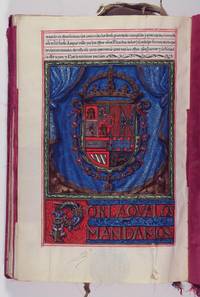
1569Best.-Nr. 5032541569. Book. A lengthy series of royal edicts / decrees / writs produced by the court under Philippe's close scrutiny in 1569 regarding financial and other obligations on the part of the persons in the area of Castro del Rio and elsewhere. 49 vellum leaves 98pp of manuscript 4 blank pages. The last page of which bears the date 18 November 1569 and the elaborate signatures and marks of the King and a number of his courtiers. Each page of the text bears 2 flourishes ie initials likely by the King and by the person responsible for the production of the document. In the original leather covers much rubbing and wear with remnants of the binding ribbons but the document still well-bound and with we think the original tri-coloured spine-cord binding the text to the cover. The first page with ornate decoration and illustrations in ink embellished with gold detailing and flourishes. Exquisite calligraphy throughout on well-preserved vellum. No seals present. 14" x 10". hardcover
1615Best.-Nr. 4007Ãvila and La Horcajada 1615. Manuscript on parchment 380 x 270 mm. 18. Complete. Contents: ff. 1r-4v: Regla in Spanish in 30 numbered sections inconsistent numbering on ff. 3v-4v in a rounded script in brown ink the first page slightly larger up to 27 lines. F. 1r: incipit first four lines in large lettering with very large calligraphic initial: En el nombre de dios todo poderoso padre y hijo y espiritu sancto tres personas y una esencia. Section 30 f. 4v added in a slightly later hand. The word Cruz symbolized by a red Maltese cross. Text on ff. 2r-2v underlined in red. Calligraphic initials some with marginal extensions in brown purple or red. Marginal drawings of prickly foliage some in the shapes of fantastic animals. Later marginal notes opposite many sections. Ff. 5r-5v: Heading: Este es traslado de un testimonio followed by two notarial subscriptions on f. 5v one partially in cursive signed and dated Ãvila 11 May 1527 the other in italic partly faded including the date 1615. F. 6r: A cerca de la procession de la Resurrection. After an introductory portion in a small round early 16th-century hand in brown ink the text continues from f. 4v with sections 32-37 of the Regla of which sections 33-37 are in a later sixteenth-century hand; these sections ruled through with light diagonal lines. Signatures or notes in lower margin. F. 6v: blank except for five lines heavily cancelled in red. Ff. 7r-7v: five paragraphs in a fine upright italic hand the first and third with headings in red La orden que han de tener en la procession de la Resurxection sic en la faded and illegible…; La orden que sea de tener en la procession de la Resurretion sic en el domingo de pascua es la siguente. Followed on f. 7v by a note in a different hand dated from La Horcajada 21 May 1550. Ff. 7v-8v and back inner cover: later additions some quite faded. A few later marginal annotations throughout. Rubrication and decoration: headings and line fillers in red a few ornamented line fillers or borders some passages underlined in red or light purple else ruled in dry point numerous calligraphic initials in red or brown ink opening initial with purple filigree extension filling left margin numerous foliate vegetable and zoomorphic ornamental designs in the margins in red purple and brown ink. Binding: stitched into the original parchment cover with title “Regla de la Pasion” in large letters the R with decorative extensions above a large cross in green ink entwined with the snake and in the margins apparently the instruments of the Passion. Condition: rubbing and staining vertical crease from folding causing occasional erasure of text outer edge of first page somewhat rubbed affecting legibility of text some words at line ends helpfully written over in a later hand the inks used in the last two leaves quite faded; wrapper worn and darkened with tears at top and 3 small holes in lower cover. Provenance: Confraternity of the Holy Cross of Horcajada; purchased in France with export license. An early Spanish confraternity manuscript containing the rules and statutes that governed the Confraternity of the Holy Cross referred to as the Cofradía or Hermandad de la Cruz the word Cruz being supplied by a Maltese cross in red of La Horcajada a town located in Castile y León in the province of Ãvila. As in other Roman Catholic countries confraternities or lay brotherhoods played a vital role in community life in Spain functioning as mutual aid societies and venues for laypeople to express their piety and perform charitable acts. Vernacular manuscript confraternity statutes from the Iberian peninsula surface much more rarely than for example their Italian counterparts although it appears that Spain had a larger number of confraternities proportional to the population especially in Castile y Leon than the other Catholic lands. Virtually every community including small villages had at least one confraternity. While exact numbers of confraternities in sixteenth-century Spain are unknown “studies carried out for a number of cities suggest that the number of confraternities and brotherhoods in the Hispanic kingdoms was larger than elsewhere in Catholic Europe. The reasons behind the extraordinary popularity of confraternities and brotherhoods in the Hispanic kingdoms cannot yet be established however in view of the current state of research on the topic. There has been a tendency for scholars to emphasize the confraternity as a primarily urban phenomenon a reflection perhaps of their early development in Italy where they formed an essential part of civic and urban life. In the Hispanic kingdoms however these institutions were equally important in the religious and social life of the small village. Pastoral visitations carried out by the bishops of Cuenca during the sixteenth century found that `nearly every community had at least one brotherhood’ even small villages of 500 inhabitants. A similar pattern prevailed in villages around Toledo during the late sixteenth century” Callahan pp. 18-19. In his article on Spanish confraternities William Callahan further points out their popular nature which “arose from the initiative of the laity rather than the clergy prime examples of the lay piety that began to flourish in late medieval Europe. This piety developed largely on its own uncontrolled by either local bishops or the pope both of whom regarded its manifestations with some suspicion. The resiliency of traditional confraternities and brotherhoods developed from their connection to local religious cultures. It also reflected a fact noted by scholars who have studied specific cities and regions the strongly popular character of membership. There were of course some associations that limited membership to the nobility or clergy but in most cases members were recruited from the popular classes. This was obviously true in the case of peasant villages where only one or two confraternities existed.” pp. 22-23. In spite of the centrality of confraternities to early modern religious life in Spain there is comparatively little modern scholarly literature especially on the rural confraternities. Note the absence for example of any articles on Spain or Portugal in Brill’s recently published Companion to Medieval and Early Modern Confraternities edited by Konrad Eisenbichler. This working manuscript bears witness to this central but understudied aspect of Spanish popular religious culture before the restrictions placed on confraternities by the Council of Trent and succeeding Popes. Consulted frequently and contributed to by members of the confraternity the manuscript includes abundant interlinear and marginal additions and corrections and half- or full-page later additions. The town of La Horcajada is identified in the opening page. Ff. 1r to 5v contain the introduction the first 30 statutes and a notarized testimony with heading “Este es traslado de un testimonio” which relates to the apparently recent establishment of the confraternity. The statutes cover admission of new members general rules of comportment requirements of prayer and confession for feast days and for the canonical hours charity for poorer members of the confraternity chants etc. Several paragraphs relate to processions including required habits and admission of non-members into the processions. On f. 6r a paragraph on the procession de la Resurrection is followed by six entries numbered 32 to 37 of which paragraphs 33 to 37 are in a later 16th-century hand. Several light diagonal lines through these five paragraphs may indicate that they were cancelled. The verso f.6v contains only five lines heavily cancelled in red ink and f. 7r continues discussion of the procession of the Resurrection on a feast day the name of the saint is smudged and on Easter Sunday in a different 16th-century upright cursive. This second section of which portions are difficult to read because of fading ends on f. 7v and is followed by a note in a larger hand dated from La Horcajada 21 May 1550. The final leaf and inner back cover contain later additions some quite faded. One late addition in the lower margin of f. 5v is dated 1615. The manuscript is decorated in a popular style. Some of the leafy plant designs have a thorny look that may reflect local vegetation. Animals and grotesques include a scorpion-like creature birds and possibly imaginary mammals. A witness to the central role played by religious confraternities in early modern Spain bearing the marks of its use and in original condition it is a rare survival and would repay further study. Cf. William Callahan “Confraternities and Brotherhoods in Spain 1500-1800” Confraternitas: The Newsletter of the Society for Confraternity Studies 12:1 2001 17-25. See also William A. Christian Local Religion in Sixteenth Century Spain Princeton 1981; Maureen Flynn Sacred Charity: Confraternities and Social Welfare in Spain 1400-1800 Basingstoke 1989. unknown
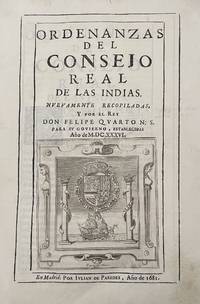
1681Best.-Nr. 2474Madrid: Por Julian de Paredes 1681. Second revised and enlarged edition. In contemporary limp vellum. Engraved device on title page. Woodcut initials throughout and a tailpiece at end of each part. Tinted edges. Stains on binding string missing panels with small damage at the outer edge. Tinted title on spine rubbed. 19th-century shelfmark on the inner front panel in ink. Contemporary notes and sings to the margins throughout the first part. Old restoration with paper tape to a few pages in the first part. Otherwise in very good condition. Second revised and enlarged edition. In contemporary limp vellum. 206 14 p. Revised and enlarged second edition of these substantial bodies of law relating to the New World and the treatment of Native Americans an important volume on the Administrative History of the Indies. One of the most important volumes of the administrative history of the Indies a fundamental collection of laws and ordinances decreed by the Council of the Indies the supreme governing body of Spain’s colonies in America during the reign of Philip IV. The first part Ordenanzas del Consejo Real de las Indias contains 245 ordinances of the Council of the Indies pp. 3–112; first published in 1636 the second part Autos acuerdos y decretos de govierno del Conseio Real y supremo de las Indias embodies an additional 190 ordinances concerning for the most part the administration of Spanish America pp. 113–206 plus 14 p. of index; first published in 1658. Any editions of these bodies of law are extremely scarce on the market RHB lists only 2 copies of the present edition within the last 70 years. Sabin 57477. Por Julian de Paredes unknown
1721Best.-Nr. 55346Spain: Chancellary Court of Granada 1721. Original manuscript. Hardcover. Fine. Small folio 33 by 22 cm / 11-7/8 by 7-7/8 in. Illuminated manuscript on vellum. Main text in black ink masterfully penned in fine clear Gothic style ruled and bordered in red. 82 unnumbered leaves 4 blank comprising 6 full-page miniatures and 144 pages of text generally 32 lines per page. 36 richly illuminated bands with initials appear throughout the text with occasional ornate initials in black ink. The finely detailed miniatures are painted in rich colors and decorated with metallic gold and silver. The royal seal of Philip V of Spain is stamped in black ink at the bottom margin on the recto of all text leaves as well as the final three blanks; the initials of a royal notary appear at the bottom margin of each page of text. Bound in contemporary crimson velvet lightly rubbed with decorative brocade ribbon ties worn and frayed. All edges gilt; crimson silk guards bound-in to protect the miniatures and illuminated bands. Text in Spanish. Manuscript on vellum fine and clean throughout. Overall a very well-preserved bound document. Sumptuously illustrated 18th-century manuscript nobility patent carta ejecutoria de hidalguia commissioned by the De la Barra family of Castile to memorialize the recognition of its noble status in the reign of Philip V King of Spain. As depicted in the illustrated family tree and noted at the opening of the text the family traces their noble ancestry back through five generations to Don Bartholome de la Barra y Zuñiga. "During the late medieval era many individuals received the honor of hidalgo status the lowest rank of nobility but with the passage of time this noble status was not always locally recognized. If a person or family was willing to submit a documented family history to local officials of the Chamber of Hijosdalgo of the Chancellery Court of either Valladolid of Granada they could sue for formal recognition" Neary. While few succeeded in these suits those who did would often commission luxury copies of the paperwork bound with the royal seal. While customized for each family the text and images of these nobility patents follow a standardized template which must elaborate on three key themes: religious devotion; service to the crown; and purity of blood limpieza de sangre. The latter required that the family demonstrate the absence of Jewish Muslim or "heretical" ancestry. As is commonly the case the present example opens with an image of the Virgin Mary here receiving the devotion of four members of the De la Barra family depicted on their knees before a sumptuously appointed church altar. The facing image depicts the Father the Son and the Holy Spirit in the form of a dove looking down upon the infant Jesus. The other full-page miniatures depict the De la Barra family tree; their coat of arms King Philip V; and the royal coat of arms. The richly illuminated bands contain the names of De la Barra family members or introduce key sequences in the presentation and disposition of the suit. The final four pages of text comprise an official copy of the court's final decision. Penned in an ordinary scribal hand this concluding document was usually written on paper; in the present case the declaration appears on parchment at the special request of the family. The document is signed by Santiago Alcalde y Linares royal notary escribano and dated 3 July 1721. Provenance: The engraved bookplates of C. L. F. Robinson Newport Rhode Island and Mary MacMillin Norton appear on the opening blank leaf. Charles L. F. Robinson 1874-1916 described in the auction sale catalogue of his library as "a liberal and discriminating collector of rare books" who acquired many volumes from the Hoe and Huth collections was best known as a collector of rare Americana. A clipping from the auction catalogue lot 595 describing the present manuscript is laid in; a typescript of the description is tipped in at the inner margin along with another printed catalogue description possibly from another sale. Robinson served at one time as president of the Colt Patent Firearms Manufacturing Company of Hartford Connecticut. The Anderson Galleries Catalogue of Rare Books Comprising the Valuable Library of the Late Col. Charles L. F. Robinson of Hartford Conn. lot 595 p. 136; E. A. Neary "Spanish Golden Age Nobility Documents" in: Digital Collections for the Classroom. Online via Newberry Library April 13 2023. [Chancellary Court of Granada] hardcover
1482Best.-Nr. 13220España posiblemente Avila 1482. 910x620mm. 35¾x24½". Manuscrito España posiblemente Avila c-1482-1492. 910 x 620mm. 1 hoja manuscrita por las dos caras. Rica orla miniada formando un rectángulo en colores y oro con el escudo de los Reyes Católicos repetido cuatro veces uno a cada lado de la orla. Magnífico ejemplo de la iluminación miniada medieval española reflejado en esta enorme hoja realizada para el cantoral de Isabel de Castilla y Fernando de Aragón reyes de España llamados los Reyes Católicos realizado para el convento dominicano de Santo Tomás en Avila entre los años 1482 y 1492 "uno de los libros de cantos más suntuosos y artísticos producidos en España" Bordona Iluminación española 1930 p.61. Iluminación: enorme orla miniada de 850 x 560mm. en oro y colores azul rojo verde rosa marrón y amarillo. Incluye cuatro escudos de los Reyes Católicos uno a cada lado de la orla y cuatro yugos con flechas a su lado; el escudo inferior que es el más grande y elaborado contiene dos ángeles a gran tamaño a cada lado del escudo. La extensa y abundante decoración incluye abundante flora y fauna monos pájaros zorros y dragones así como putti todo pintado en colores vivos y dorados. Data: El escudo de armas se puede fechar después del matrimonio de los reyes en 1469 y anterior a la toma de Granada de 1492. Ejecución: Este Gradual fue presentado a los Reyes Católicos por el convento dominicano de Santo Tomás en Avila fundado en 1478 y que aun existe. El manuscrito probablemente permaneció en Santo Tomás por más de cuatro siglos hasta que unos restos del manuscrito fueron adquiridos por Manuel Rico y Sinobias quien cortó muchas de las miniaturas y dispersó las hojas. Domínguez Bordona en su Iluminación Española afirma que este libro de cantos fue un regalo de los Reyes Católicos al convento dominico de Santo Tomás en Avila fundado recientemente. Los reyes realizaron diferentes contribuciones al convento como la construcción de la capilla donde los reyes enterraron a su único hijo varón el príncipe Juan. En el mismo lugar fue enterrado el Gran Inquisidor Tomás de Torquemada m. 1498 también promotor de la construcción del convento. Autoría: Bordona atribuye la autoría de las miniaturas posiblemente a Juan de Carrión pintor y miniaturista al servicio de los reyes quien trabajó activamente en Avila a partir de 1470 que obtuvo gran fama en su tiempo. En la catedrla de Avila se conservan algunos otros ejemplo de su trabajo. Documento realmente extraordinario y de gran rareza. Se conservan dos hojas en el Museo Arqueológico de Madrid J.D.Bordona Exposición de Códices Miniados Españoles 1929 nos. CIV-CVII. Otra hoja estuvo en la colección C.P.D. Maclagan vendida en Sotheby's lote 238 de su subasta 19 marzo 1909 adquirida por Ludwig Rosenthal cat. 155. Dos hojas fueron adquiridas por el Fitzwilliam Museum en Cambridge MS.293 y otra más se encuentra depositada en el Museo Lázaro Galdiano de Madrid. Finalmente una miniatura que perteneció al Príncipe de Liechtenstein adquirida por H.P. Kraus así como otra hoja ofrecida en su catálogo 112 1965 fueron adquisidas por Sam Fogg para la Piermont Morgan Library. Procedencia: 1. Reyes Católicos ofrecida como donación a: 2. Convento de Santo Tomás. 3. Manuel Rico y Sinobias. 4. Manuel Moreno unknown
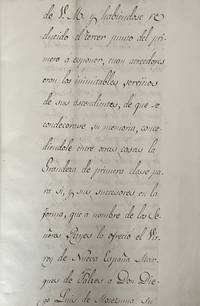
Best.-Nr. 2956Spain Early 19th century. An important 18th-century manuscript text of historical and legal interest related to the privileges and grants of the House of Moctezuma. Manuscript text in brown ink by a neat hand. Text from the second half of the 18th century a somewhat later copy. On early 19th-century laid paper watermarks: A. Romani T.; Bartolmé Costas - for the genealogy table. In contemporary green half maroquin binding gilt spine. Panels covered with marbled paper. Blank title vignette on the front panel. Binding worn and damaged at the extremities. The first leaf and the genealogical table are creased in the middle vertically. Inside clean and firm in very good condition. An important 18th-century manuscript text of historical and legal interest related to the privileges and grants of the House of Moctezuma. Manuscript text in brown ink by a neat hand. Text from the second half of the 18th century a somewhat later copy. On early 19th-century laid paper watermarks: A. Romani T.; Bartolmé Costas - for the genealogy table. In contemporary green half maroquin binding gilt spine. 214 f. and a large folding sheet of genealogical table. .An important 18th-century manuscript text of historical and legal interest related to the privileges and grants of the House of Moctezuma A very interesting text containing summaries of the important merits of the House of Moctezuma the dynasty of the descendants of Moctezuma II Emperor of the Aztec Empire during the Spanish conquest of Mexico their privileges and grants encomiendas mercedes entitled estates mayorazgos and the annuities gained and kept throughout the centuries. With references to the corresponding Royal grants declarations notes and appeals and a few credits of historical sources such as Herrera and Solís. Compiled for the VII Conde de Moctezuma de Tultengo for an appeal to the Court regarding the family’s estate. Divided into three parts the first “Señor” ff. 1–58 contains 46 paragraphs dealing mainly with the succession line and the estate; the second “Demanda del Conde de Motezuma” ff. 59–172 related mainly to the 1740–41 appeal regarding the Conde’s encomiendas mercedes mayorazgos in Mexico and later controversial affairs such as the lawsuit with the 5th Duke of Atrisco Ventura Osorio de Moscoso y Fernández de Córdoba over a grant of 8250 ducats of silver for the assets in Atlixco ff. 171v. The last part “Cedulas Reales” ff. 173–214 are copies and summaries of Royal decrees to justify the Conde’s appeal. At the end of the text a large folding family tree is attached. Jerónimo María de Oca y Nieto de Silva Jerónimo María de Oca Nieto de Silva Cisneros y Moctezuma was the 7th Count of Moctezuma de Tultengo. Son of Gaspar Antonio de Oca Sarmiento de Zúñiga y Navarro and Teresa Nieto de Silva Cisneros y Moctezuma Guzmán Cueva y Bocanegra the 6th Countess of Moctezuma de Tultengo Jerónimo was born in Murcia in 1695 and inherited the title of Count of Moctezuma in 1736. King Charles III granted him the title of Grandee of the First Class Grandeza de España de Primera Clase in 1765. He married Josefa de Mendoza Caamaño y Sotomayor at the age of twenty-five and their son Joaquín Ginés de Oca Moctezuma y Mendoza succeeded him after his death in 1778. Unique document related to the House of Moctezuma we couldn’t trace a printed version of the text. Literature: Conde y Díaz-Rubín J. I.; Sanchiz Ruiz J.: Conde de Moctezuma de Tultengo …. In: Historia genealógica de los títulos y dignidades nobiliarias en Nueva España y México. Volumen II. Casa de Austria siglos XVI–XVII. México Universidad Nacional Autónoma de México Instituto de Investigaciones Históricas 2012 fotografías y grabados Serie Historia Novohispana 90 unknown