Rodriguez, SpainBiblio.com

19.742 Ergebnisse
2008Best.-Nr. 364195London: Verso 2008. First Edition. Trade paperback. Fine. A graphic novel about the revolutionary Che Guevara. Manuel "Spain" Rodriguez 1940–2012 was born in Buffalo New York the son of a Spanish father and a second-generation Italian American mother. He went on to be one of the most acclaimed underground cartoonists of the 1960s and 1970s. 106 pages. First edition first printing with a numberline ending in a 1. A fine copy in wrappers paperback as issued. Inscribed by Spain to a prior owner with a small drawing of Che. Uncommon signed. Verso unknown
Best.-Nr. 1276775199.Gpaperback. Good. Access codes and supplements are not guaranteed with used items. May be an ex-library book. paperback
1929Best.-Nr. 12327Madrid: Direccion General Del Turisimo. Near Fine. c. 1929-1950. Ephemera. Flamenco with shallow vertical crease light soil. The Gardens of Spain on thin paper stock with light corner wear and creasing. ATESA brochure with vertical 4.5" crease on one panel.; Flamenco 16 pp. color illustrations by Angel Esteban throughout. Banco De Bilbao Touristic Map of Spain 6 x 3.5" in original printed brown envelope; folds out to two side color map 34.5 " wide by 12". Seville Spanish-American Exhibition 1929-1930 6.5 x 4" folds out to 13.5 x 12.5" with map of the exhibition bordered by photographs. Two folding maps Rutas de Espana one in Spanish one in English; both 7 x 5" folds out to 28 x 20". The Gardens of Spain folding brochure/map 9.5 x 4.5" folds out to 27 x 19" with map bordered by photographs. ATESA Motorcoach Tours of Spain 7 x 4" folding brochure with descriptions & color illustrations of destinations small map. Andalusia brochure with much descriptive text vignette illustrations in color. Three stapled booklets 7 x 4.5" Barcelona Granada seven pages including inside covers Seville four pages; all with sepia photographs and map on back . Direccion General Del Turisimo unknown
Best.-Nr. 49618London: Ospry Publishing 1996. Second Reprint edition; small 4to.; cloth covered boards hardcover; 326 pages; black and white and color photographic illustrations; very good in a very good unclipped dust jacket. London: Ospry Publishing, 1996 unknown
Best.-Nr. 162880100X.Ghardcover. Good. Access codes and supplements are not guaranteed with used items. May be an ex-library book. hardcover
1979Best.-Nr. 006122Madrid: Banco de Espana 1979. Excellent book on Spanish banknotes and currency between 1782 and 1979 TEXT IN SPANISH. 419 pages in very bright clean condition just the slightest of browning to extreme edges of pages. Many colour photographs and illustrations plus very informative text inSPANISH. HEAVY BOOK 2.5 Kg with packing EXTRA POSTAGE REQUIRED FOR OVERSEAS. NO dustwrapper outer gold decorated faux leather boards are very bright and clean a very nice copy SEE IMAGE. DETAILED IMAGES AVAILABLE ON REQUEST. First Edition. Gold Decorated Boards. Very Good/No Jacket. 11 ¼ x 9 Inches. Hardcover. Banco de Espana Hardcover
Best.-Nr. 71911 July to 29 Aug. 1885. Traveller in Spain and elsewhere and author. 2-4pp. 8vo. He discusses extensively his work on "a Handbook on Russia & Great Britain in Central Asia" giving a resume of chapters and asking for copies to be sent to various places. "No question is more important at present". FOUR ITEMS 11 July to 29 Aug. 1885 unknown
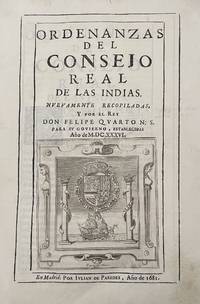
1681Best.-Nr. 2474Madrid: Por Julian de Paredes 1681. Second revised and enlarged edition. In contemporary limp vellum. Engraved device on title page. Woodcut initials throughout and a tailpiece at end of each part. Tinted edges. Stains on binding string missing panels with small damage at the outer edge. Tinted title on spine rubbed. 19th-century shelfmark on the inner front panel in ink. Contemporary notes and sings to the margins throughout the first part. Old restoration with paper tape to a few pages in the first part. Otherwise in very good condition. Second revised and enlarged edition. In contemporary limp vellum. 206 14 p. Revised and enlarged second edition of these substantial bodies of law relating to the New World and the treatment of Native Americans an important volume on the Administrative History of the Indies. One of the most important volumes of the administrative history of the Indies a fundamental collection of laws and ordinances decreed by the Council of the Indies the supreme governing body of Spain’s colonies in America during the reign of Philip IV. The first part Ordenanzas del Consejo Real de las Indias contains 245 ordinances of the Council of the Indies pp. 3–112; first published in 1636 the second part Autos acuerdos y decretos de govierno del Conseio Real y supremo de las Indias embodies an additional 190 ordinances concerning for the most part the administration of Spanish America pp. 113–206 plus 14 p. of index; first published in 1658. Any editions of these bodies of law are extremely scarce on the market RHB lists only 2 copies of the present edition within the last 70 years. Sabin 57477. Por Julian de Paredes unknown
1615Best.-Nr. 4007Ãvila and La Horcajada 1615. Manuscript on parchment 380 x 270 mm. 18. Complete. Contents: ff. 1r-4v: Regla in Spanish in 30 numbered sections inconsistent numbering on ff. 3v-4v in a rounded script in brown ink the first page slightly larger up to 27 lines. F. 1r: incipit first four lines in large lettering with very large calligraphic initial: En el nombre de dios todo poderoso padre y hijo y espiritu sancto tres personas y una esencia. Section 30 f. 4v added in a slightly later hand. The word Cruz symbolized by a red Maltese cross. Text on ff. 2r-2v underlined in red. Calligraphic initials some with marginal extensions in brown purple or red. Marginal drawings of prickly foliage some in the shapes of fantastic animals. Later marginal notes opposite many sections. Ff. 5r-5v: Heading: Este es traslado de un testimonio followed by two notarial subscriptions on f. 5v one partially in cursive signed and dated Ãvila 11 May 1527 the other in italic partly faded including the date 1615. F. 6r: A cerca de la procession de la Resurrection. After an introductory portion in a small round early 16th-century hand in brown ink the text continues from f. 4v with sections 32-37 of the Regla of which sections 33-37 are in a later sixteenth-century hand; these sections ruled through with light diagonal lines. Signatures or notes in lower margin. F. 6v: blank except for five lines heavily cancelled in red. Ff. 7r-7v: five paragraphs in a fine upright italic hand the first and third with headings in red La orden que han de tener en la procession de la Resurxection sic en la faded and illegible…; La orden que sea de tener en la procession de la Resurretion sic en el domingo de pascua es la siguente. Followed on f. 7v by a note in a different hand dated from La Horcajada 21 May 1550. Ff. 7v-8v and back inner cover: later additions some quite faded. A few later marginal annotations throughout. Rubrication and decoration: headings and line fillers in red a few ornamented line fillers or borders some passages underlined in red or light purple else ruled in dry point numerous calligraphic initials in red or brown ink opening initial with purple filigree extension filling left margin numerous foliate vegetable and zoomorphic ornamental designs in the margins in red purple and brown ink. Binding: stitched into the original parchment cover with title “Regla de la Pasion” in large letters the R with decorative extensions above a large cross in green ink entwined with the snake and in the margins apparently the instruments of the Passion. Condition: rubbing and staining vertical crease from folding causing occasional erasure of text outer edge of first page somewhat rubbed affecting legibility of text some words at line ends helpfully written over in a later hand the inks used in the last two leaves quite faded; wrapper worn and darkened with tears at top and 3 small holes in lower cover. Provenance: Confraternity of the Holy Cross of Horcajada; purchased in France with export license. An early Spanish confraternity manuscript containing the rules and statutes that governed the Confraternity of the Holy Cross referred to as the Cofradía or Hermandad de la Cruz the word Cruz being supplied by a Maltese cross in red of La Horcajada a town located in Castile y León in the province of Ãvila. As in other Roman Catholic countries confraternities or lay brotherhoods played a vital role in community life in Spain functioning as mutual aid societies and venues for laypeople to express their piety and perform charitable acts. Vernacular manuscript confraternity statutes from the Iberian peninsula surface much more rarely than for example their Italian counterparts although it appears that Spain had a larger number of confraternities proportional to the population especially in Castile y Leon than the other Catholic lands. Virtually every community including small villages had at least one confraternity. While exact numbers of confraternities in sixteenth-century Spain are unknown “studies carried out for a number of cities suggest that the number of confraternities and brotherhoods in the Hispanic kingdoms was larger than elsewhere in Catholic Europe. The reasons behind the extraordinary popularity of confraternities and brotherhoods in the Hispanic kingdoms cannot yet be established however in view of the current state of research on the topic. There has been a tendency for scholars to emphasize the confraternity as a primarily urban phenomenon a reflection perhaps of their early development in Italy where they formed an essential part of civic and urban life. In the Hispanic kingdoms however these institutions were equally important in the religious and social life of the small village. Pastoral visitations carried out by the bishops of Cuenca during the sixteenth century found that `nearly every community had at least one brotherhood’ even small villages of 500 inhabitants. A similar pattern prevailed in villages around Toledo during the late sixteenth century” Callahan pp. 18-19. In his article on Spanish confraternities William Callahan further points out their popular nature which “arose from the initiative of the laity rather than the clergy prime examples of the lay piety that began to flourish in late medieval Europe. This piety developed largely on its own uncontrolled by either local bishops or the pope both of whom regarded its manifestations with some suspicion. The resiliency of traditional confraternities and brotherhoods developed from their connection to local religious cultures. It also reflected a fact noted by scholars who have studied specific cities and regions the strongly popular character of membership. There were of course some associations that limited membership to the nobility or clergy but in most cases members were recruited from the popular classes. This was obviously true in the case of peasant villages where only one or two confraternities existed.” pp. 22-23. In spite of the centrality of confraternities to early modern religious life in Spain there is comparatively little modern scholarly literature especially on the rural confraternities. Note the absence for example of any articles on Spain or Portugal in Brill’s recently published Companion to Medieval and Early Modern Confraternities edited by Konrad Eisenbichler. This working manuscript bears witness to this central but understudied aspect of Spanish popular religious culture before the restrictions placed on confraternities by the Council of Trent and succeeding Popes. Consulted frequently and contributed to by members of the confraternity the manuscript includes abundant interlinear and marginal additions and corrections and half- or full-page later additions. The town of La Horcajada is identified in the opening page. Ff. 1r to 5v contain the introduction the first 30 statutes and a notarized testimony with heading “Este es traslado de un testimonio” which relates to the apparently recent establishment of the confraternity. The statutes cover admission of new members general rules of comportment requirements of prayer and confession for feast days and for the canonical hours charity for poorer members of the confraternity chants etc. Several paragraphs relate to processions including required habits and admission of non-members into the processions. On f. 6r a paragraph on the procession de la Resurrection is followed by six entries numbered 32 to 37 of which paragraphs 33 to 37 are in a later 16th-century hand. Several light diagonal lines through these five paragraphs may indicate that they were cancelled. The verso f.6v contains only five lines heavily cancelled in red ink and f. 7r continues discussion of the procession of the Resurrection on a feast day the name of the saint is smudged and on Easter Sunday in a different 16th-century upright cursive. This second section of which portions are difficult to read because of fading ends on f. 7v and is followed by a note in a larger hand dated from La Horcajada 21 May 1550. The final leaf and inner back cover contain later additions some quite faded. One late addition in the lower margin of f. 5v is dated 1615. The manuscript is decorated in a popular style. Some of the leafy plant designs have a thorny look that may reflect local vegetation. Animals and grotesques include a scorpion-like creature birds and possibly imaginary mammals. A witness to the central role played by religious confraternities in early modern Spain bearing the marks of its use and in original condition it is a rare survival and would repay further study. Cf. William Callahan “Confraternities and Brotherhoods in Spain 1500-1800” Confraternitas: The Newsletter of the Society for Confraternity Studies 12:1 2001 17-25. See also William A. Christian Local Religion in Sixteenth Century Spain Princeton 1981; Maureen Flynn Sacred Charity: Confraternities and Social Welfare in Spain 1400-1800 Basingstoke 1989. unknown
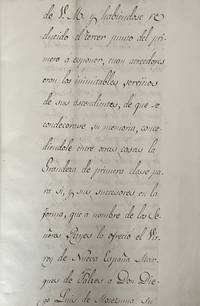
Best.-Nr. 2956Spain Early 19th century. An important 18th-century manuscript text of historical and legal interest related to the privileges and grants of the House of Moctezuma. Manuscript text in brown ink by a neat hand. Text from the second half of the 18th century a somewhat later copy. On early 19th-century laid paper watermarks: A. Romani T.; Bartolmé Costas - for the genealogy table. In contemporary green half maroquin binding gilt spine. Panels covered with marbled paper. Blank title vignette on the front panel. Binding worn and damaged at the extremities. The first leaf and the genealogical table are creased in the middle vertically. Inside clean and firm in very good condition. An important 18th-century manuscript text of historical and legal interest related to the privileges and grants of the House of Moctezuma. Manuscript text in brown ink by a neat hand. Text from the second half of the 18th century a somewhat later copy. On early 19th-century laid paper watermarks: A. Romani T.; Bartolmé Costas - for the genealogy table. In contemporary green half maroquin binding gilt spine. 214 f. and a large folding sheet of genealogical table. .An important 18th-century manuscript text of historical and legal interest related to the privileges and grants of the House of Moctezuma A very interesting text containing summaries of the important merits of the House of Moctezuma the dynasty of the descendants of Moctezuma II Emperor of the Aztec Empire during the Spanish conquest of Mexico their privileges and grants encomiendas mercedes entitled estates mayorazgos and the annuities gained and kept throughout the centuries. With references to the corresponding Royal grants declarations notes and appeals and a few credits of historical sources such as Herrera and Solís. Compiled for the VII Conde de Moctezuma de Tultengo for an appeal to the Court regarding the family’s estate. Divided into three parts the first “Señor” ff. 1–58 contains 46 paragraphs dealing mainly with the succession line and the estate; the second “Demanda del Conde de Motezuma” ff. 59–172 related mainly to the 1740–41 appeal regarding the Conde’s encomiendas mercedes mayorazgos in Mexico and later controversial affairs such as the lawsuit with the 5th Duke of Atrisco Ventura Osorio de Moscoso y Fernández de Córdoba over a grant of 8250 ducats of silver for the assets in Atlixco ff. 171v. The last part “Cedulas Reales” ff. 173–214 are copies and summaries of Royal decrees to justify the Conde’s appeal. At the end of the text a large folding family tree is attached. Jerónimo María de Oca y Nieto de Silva Jerónimo María de Oca Nieto de Silva Cisneros y Moctezuma was the 7th Count of Moctezuma de Tultengo. Son of Gaspar Antonio de Oca Sarmiento de Zúñiga y Navarro and Teresa Nieto de Silva Cisneros y Moctezuma Guzmán Cueva y Bocanegra the 6th Countess of Moctezuma de Tultengo Jerónimo was born in Murcia in 1695 and inherited the title of Count of Moctezuma in 1736. King Charles III granted him the title of Grandee of the First Class Grandeza de España de Primera Clase in 1765. He married Josefa de Mendoza Caamaño y Sotomayor at the age of twenty-five and their son Joaquín Ginés de Oca Moctezuma y Mendoza succeeded him after his death in 1778. Unique document related to the House of Moctezuma we couldn’t trace a printed version of the text. Literature: Conde y Díaz-Rubín J. I.; Sanchiz Ruiz J.: Conde de Moctezuma de Tultengo …. In: Historia genealógica de los títulos y dignidades nobiliarias en Nueva España y México. Volumen II. Casa de Austria siglos XVI–XVII. México Universidad Nacional Autónoma de México Instituto de Investigaciones Históricas 2012 fotografías y grabados Serie Historia Novohispana 90 unknown
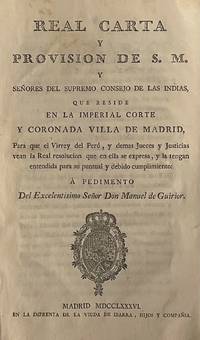
1786Best.-Nr. 2566Madrid: En la Imprenta de la Viuda de Ibarra Hijos y Compañia 1786. First edition. In later marbled paper. Binding damaged at tail of spine. Lower outer corner bumped. A dark stain to the lower outer corner of the first five quires. Otherwise clean. Overall in fine condition. First edition. In later marbled paper. 2 138 p. Scarce document related to the estate of Manuel de Guirior former Viceroy of Peru. José Antonio de Areche –1788 as the appointed visitador or royal inspector arrived in Peru in 1777. The difference between him and the Viceroy Manuel de Guirior 1708–1788 arose immediately concerning the extent of authorities. Their conflict culminated with the dismissal of Viceroy Guirior upon the charges brought by Areche. The quarrel went on after Guirior went back to Spain and eventually he was acquitted of the charges but only after his death. The present document Dated in San Ildefonso October 6 1785 is a summary of the case and it relates to Viceroy Guirior’s “residencia” taken by the Spanish colonial functionary Fernando Márquez de la Plata. Extremely scarce we could trace only 2 copies in institutional holding both in the Biblioteca Nacional de España. En la Imprenta de la Viuda de Ibarra, Hijos y Compañia unknown
Best.-Nr. 5602422Hardcover. Very good. Vol. 2 treaties 6-8 only. Text is in Spanish. Great condition. Spine and covers are worn. Cover corners are bumped. Includes pull-out military map. Inside is clean and unmarked. hardcover
1976Best.-Nr. 297208Berkeley: Print Mint 1976. Comic. 52p. includes covers 8.25x10.75 inches comics fiction essays critique signed at contents page by Griffith Spiegelman & Spain very good first printing magazine in stapled color pictorial wraps with Jay Lynch cover. Arcade was the late flowering attempt to take underground comix to national newsstands. "Cry-Baby's Blues" by Crumb. "Commedia dell' Zippy". "Some Boxes from the Salvation Army" by Spiegelman. "Gotterdammerung" by Spain. Print Mint unknown
1975Best.-Nr. 297200Berkeley: Print Mint 1975. Comic. 52p. includes covers 8.25x10.75 inches comics fiction essays critique signed on cover by Griffiths and on contents page by Art Spiegelman very good first printing magazine in stapled color pictorial wraps with R. Crumb cover. Arcade was the late flowering attempt to take underground comix to national newsstands. Lovely hand-separated color cover by R. Crumb. Centerspread by S. Clay Wilson. Kuchar on Lovecraft. Buk's "Bop Against That Curtain" illustrated by Crumb. Aline presents "The Bunch Plays With Herself Print Mint unknown
1976Best.-Nr. 297211Berkeley: Print Mint 1976. Comic. 52p. includes covers 8.25x10.75 inches comics fiction essays critique signed at contents page by Griffith very good first printing magazine in stapled color pictorial wraps with R. Crumb cover. Arcade was the late flowering attempt to take underground comix to national newsstands. T. Crumb's Secret Sketchbooks. Edgar Allan Poe: His Dying Wish by Spain. Print Mint unknown
1975Best.-Nr. 297203Berkeley: Print Mint 1975. Comic. 52p. includes covers 8.25x10.75 inches comics fiction essays critique signed at his contribution "Dollboy" by Griffiths and on contents page by Art Spiegelman very good first printing magazine in stapled color pictorial wraps with R. Crumb cover. Arcade was the late flowering attempt to take underground comix to national newsstands. Lovely hand-separated color cover by R. Crumb. Centerspread by Robert Williams. Burroughs' story "Fun City In Ba'Dan" illustrated by Wilson. Print Mint unknown
1976Best.-Nr. 297210Berkeley: Print Mint 1976. Comic. 52p. includes covers 8.25x10.75 inches comics fiction essays critique signed at contents page by Griffith & Spain very good first printing magazine in stapled color pictorial wraps with R. Crumb cover. Arcade was the late flowering attempt to take underground comix to national newsstands. "Those Cute Little Bearzie-Wearzies in Ain't It Nice" by Crumb. "Nervous Rex the Malpractice Suite" by Spiegelman. "Social problems of the Toadettes" by Griffith. "Mr. Bunch" by Aline. "Deadline" by Spain. Print Mint unknown
Best.-Nr. 25521123 Park St 26 May 1852. Three pages 12mo bifolium fold marks good condition. Text: "Dear Lady Theresa I have to thank you for the amiable note you did me the honor to write. I am indeed truly delighted to think that my paper has pleased you & yours and am very glad to have been the means of thee Quarterly Reviews making an amende honorable. Some day when we meet I will reveal to you a curious secret of the prison house in this affair. I have also reaad with much interest the articles in the Ed RW & the Times: it never rains but it pours & I trust 'after this deluge' the public will flock in to buy. Tory as I am I assure you that I was very sorry to see that Herefordshire has done its best to swell a parliament". See Image of pp.2-3. 123 Park St, 26 [May?] 1852. unknown
Best.-Nr. 25520Hevitre" Heavitree 4 March 1846. Four Pages 12mo bifolium fold marks good condition. See Image of fourth/signature page. Text: "Many thanks for the two Spanish apothegms: that of Bacon I have already introduced 1.304. The other of Boyle shall be worked into 2nd Edition which Murray publisher is beginni9ng to be talking: he has already sold between 17 & 1800 copies: so let none say that the age of miracles is past I could have wished for a longer interval in order to read some subjects up rather closer. & finish off others. I assure assure humble as Handbooking is that the trouble is great: it is a large net & catches many fish great & small nor is the pulling it cleanly out an easy job. I have a floating notion a chateau en Espagne of doing an obra grande on 'Spain & Spaniards past & present' which should run 4 vols 8o. & be a library book at least in type & illustrations: for I have portfolios full of drawings made in interesting & seldom visited localities: all the pure Starkerec book ref route details etc would be left out & the spaces filled with efragion cosas de Espana from cigars to to Cervantes; this however is an ouvrage de logue haleine & probably will never be executed to the serious detriment of men who live word not deciphered. Now you & Head must be praying for a change of Ministry! 'Sir James Graham! the Lord deliver us from Sir James Graham'! as Cromwell said of Ld. Hy Vane. call ye that barking your friend The good old tories like myself all by no means extinct although just now we seem likely to be coming to you for relief as our occupation & corn rents are gone. However if we are to be done let them do the work who have moral courage underlined & consistency underlined; Blood is better after all the cotton; & Lord John is double underlined a gentleman by birth & conduct ." He adds a postscript or addendum upside down on fisrt page: "No symptoms of famine here except in Peel's speeches: work aboudant indeed so much so that the masters scarce dare speak to their men; wages are nearly a fourth higher than a year ago." See Image of last page. Hevitre" [Heavitree], 4 March 1846. unknown
1807Best.-Nr. H3202Madrid 1807. Paperback. Good. Published 1807 quarto disbound 43 pp light wear seems to be statutes laws and decrees from the time of Philip IV of Spain. A handwritten squiggle at the bottom of each page and an unreadable signature at the end of the text old stamp to rear wrap from 1815. paperback
2022Best.-Nr. 72767Helen M. Spain 2022-03-15. paperback. Very Good. 8x0x11. a very nice copy! clean and tight pages. fast and secure shipping. Helen M. Spain paperback
Best.-Nr. 1025142063.Ghardcover. Good. Access codes and supplements are not guaranteed with used items. May be an ex-library book. hardcover
2022Best.-Nr. 87518Livermore CA: Lawrence Livermore National Laboratory Center for Global Security Research 2022. Presumed First Edition First printing. Trade paperback. Good. The format is approximately 7 inches by 10 inches. 2 50 4 pages. Decorative front cover. Footnotes. Illustrations color. Cover has some wear. Madison Hissom is a fellow at the Center for Global Security Research CGSR at Lawrence Livermore National Laboratory where his work focuses on how intelligence programs assess proliferation threats and other emerging technologies. His research interests include the history of weapons proliferation counterterrorism and illicit trade. Madison received an MA in international studies from North Carolina State University and a BA in economics and German language from the University of North Carolina at Chapel Hill. Cole Pruitt is a postdoctoral researcher in the Design Physics Division at Lawrence Livermore National Laboratory. His research interests include nuclear data and reaction theory nuclear weapons policy and science communication. Prior to joining the laboratory he co-directed/produced The Surrounding Game 2017 the first feature documentary about the game of Go. He received his Ph.D. in chemistry from Washington University in St. Louis and a Bachelor of Science in biophysics from Brown University. Wes Spain was a CGSR senior fellow from 2014 until his retirement in 2021. He joined the laboratory in 1997 and served in multiple leadership positions including director of the Office of Strategic Outcomes Intelligence program director and Z Division leader. Before joining LLNL he served with Central Intelligence Agency and the United States Army. He received an MA in international relations from Boston University. This volume addresses squarely the responsibility of scientists and technologists at this laboratory and elsewhere to create the needed bridge to the policymaker. More than that it offers practical advice on how to be effective in the policy environment. The monograph grows out of the experience of lab technical staff with programmatic activities at the Center for Global Security Research where such bridge-building is an ever-present project. It also grows out of their own professional experience serving as advisors whether formally or informally to decisionmakers in Washington DC. The authors sift through these experiences for lessons of enduring value to the bridge builders. In making their case they draw effectively on a case study—the provision of technical advice to policymakers on the threat from electromagnetic pulse weapons. The result should be of value to any member of the laboratory's technical community seeking a better understanding of how to be effective in ensuring that policy judgments are technically sound. When thrust into a policymaking environment scientific advisors—isolated from the norms and protocols of their technical fields and often without policymaking experience themselves—stand to benefit from the guideposts for advising that we identify in this paper. Rather than advocate for specific formal changes to the structure of existing policymaking institutions we explore the many roles science advisors can play when engaging on thorny national security topics. While technological progress presents new challenges many of the difficulties faced by advisors such as uncertain and limited data conflicting values and risk tolerances and potential misalignment between policymaker expectations and scientific reality have plagued scientific advising since the earliest days of American governance. To focus our exploration we recruit four idealized technical advisor roles identified by Roger Pielke Jr. in The Honest Broker. In a series of fictional dialogues rooted in actual Congressional testimony we examine the threat from high-altitude nuclear electromagnetic pulse or EMP a national security topic that lays bare many challenges for technical advisors. Lawrence Livermore National Laboratory, Center for Global Security Research paperback
1946Best.-Nr. 7442Madrid: Afrodisio Aguado 1946. as is. 392 wraps illus. appendices fr cover separated covers worn & soiled & small tears tears to spine document shaken. Afrodisio Aguado paperback
Best.-Nr. 3368111698.Ghardcover. Good. Access codes and supplements are not guaranteed with used items. May be an ex-library book. hardcover