468 résultats
réf. 201609793Zurich, Editions Silva, 1990 ; in-4, 175 pp., cartonnage de l'éditeur. Comme neuf avec sa jaquette.
réf. 201101407Santa Cruz de Tenerife, Litographia A. Romero , 1977 ; grand in-8, 574 + cartes, cartonnage de l'éditeur. Texte en espagnol - bon état - contient : geografia, geologia, flora y fauna, mundo y vida del guanche, historia, arte, lenguaje, literatura y expresion musical, psicologia y vida del actual hombre canario, descripcion y estudio de la cada isla.
1927réf. 2911927 Barcelone, Institut National d'Expansion Economique, 1927, in 8 broché de 190 pages ; nombreuses illustrations hors-texte dont de nombreuses cartes et vues panoramiques dépliantes ; couverture illustrée (petites fentes en tête et queue du dos).
réf. 3730n.d. Album in-8 oblong pleine percale verte, décors doré au premier plat, vues de Tenerife.
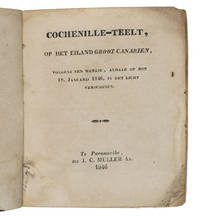
1846réf. ABC_49481Paramaribo 1846. 13.2 x 11.2 cm. J.C. Muller Contemporary blue wrappers. 49 pp. Exceptionally rare work on the cultivation of cochineal and nopal in the Canary Islands with special observations on this practice in Curaçao and Suriname. Cochineal a scale insect that lives on the nopal cactus is used for the production of carmine which is a red or purple dye depending on the production process. This dye was already produced by the Aztec and Maya peoples of North and Central America as early as the second century BC and became an important trade product after the Spanish conquest. Europeans then attempted to introduce the production to other places in the world as well but were mostly unsuccessful because of the specific conditions that are necessary to allow both the plant and insects to flourish. However in the 19th century both cochineal and nopal were successfully introduced to the Canary Islands. One of the people responsible for this was Don Santiago de la Cruz y Gonzalez dates unknown who wrote various works on the topic in order to seek support for the plan. The present work is a translation or adaptation of one of his works most likely his pamphlet Nueva instrucción sobre el cultivo del nopal y cría de la cochinilla para uso de los labradores canarios 1846 which appeared in the same year. It explains the process of the cultivation of cochineal and nopal including how to grow nopal how to harvest and dry the cochineal and how to keep the nopalry free of pests and diseases. The work both the Spanish and Dutch editions are exceptionally rare as we have only been able to trace one other copy of each.With some small worm holes in the wrappers and the first and last few leaves the back wrapper lacks a small part of the upper outer corner several water stains mainly at the end of the work and in the margins somewhat browned throughout. Otherwise in good condition.l British Library 1 copy; not in WorldCat; cf. WorldCat 57967123 1 copy Spanish ed. ABE CAT Agriculture unknown
réf. 200705133Paris, Horizons de france, 1954 ; in-8, 166 pp., broché avec jaquette.
réf. 201414697Paris, JULLIARD, 1958 ; in-8, 275 pp., br. Avec jaquette.
réf. 200612404Paris, JULLIARD, 1958 ; in-8, 275 pp., broché, couverture illustr.
1993réf. LFA-126746901N° 287 (Février 1993) : revue de 78 pages, format 215 x 285 mm, illustrée, brochée couverture couleurs, bon état
2006Las Palmas de Gran Canaria, Centro Atlántico de Arte Moderno, 2006. 134 p. Folio. Rústica editorial. Muy buen ejemplar.
2008Las Palmas de Gran Canaria, Centro Atlántico de Arte Moderno, 2008. 142 p. Folio. Rústica editorial. Muy buen ejemplar.
Madrid, La Novela Corta, 1920. 4to.; 64 pp. sin numerar. Cubiertas originales.
Las Palmas, 2007. Numerosas ilustracions en color y negro fuera texto. 70p. 4t. Rústica editorial ilustrada. Libro en castellano e inglés. Book in English. Muy buen ejemplar.
2000réf. LFA-126744029Un guide de 518 pages, format 120 x 240 mm, broché couverture couleurs rempliée, illustré, édition de 2000, bon état
2007Gran Canaria, Cabildo de Gran Canaria, 2007. 95 p. 2 f. Petit 4rt. Rústica editorial. Catálogo de la exposición celebrada en Gran Canaria en 2007.
Las Palmas. Edit. Galería Manuel Ojeda, 2001. Numerosas ilustraciones en color fuera texto. 70 p. 4º. Cartoné editorial ilustrada. Muy buen ejemplar.
196528x21. 280p. Ed. Estudio, E. Serra Ráfols y L. De la Rosa.
Las Palmas, Víctor Doreste y Navarro, 1873, 22 x 15,5 cm., 36 págs. + 2 h. + 2 estados plegados, uno de ellos algo deteriorado por el margen exterior.
Madrid-Las Palmas, Gráficas Uguina, 1974, 25 x 18 cm., láminas en papel couche, 823 págs. + 1 h. (Sumario: D. Diego de MurosII, Obispo de Canarias, por Juan Luis G. Novalín. Notas para un estudio sobre la proyección de Canarias en la conquista de América, por Analola Borges. El pleito insular, por Marcos Guimerá Peraza. Correspondencia epistolar entre Maura y Galdós, 1889-1914, por Sebastián de la Nuez...).
Las Palmas de Gran canaria, Universidad Politécnica de Las Palmas, 1981. Introducción y comentario de José Luis Gago Vaquero y José Setien Tames. Contenidos teóricos de Felix Juan Bordes. Numerosas ilustraciones en color y b/n. 79p. Folio. Rústica editorial ilustrada. Sello del antiguo propietario. Muy buen ejemplar.
Las Palmas de Gran Canaria, Centro Regional de la U.N.E.D., 1982, 24 x 17 cm., 231 págs. (Entre otras cosas contiene: Canto, drama y tragedia en la narrativa de Ciro Alegría, por Lucrecio Pérez Blanco. Una obra puente entre el periodismo y la novela de Fernández de Lizardi, por Rocío Oviedo y Pérez de Tudela.Arrecife, el Puerto de la Barilla, por Agust´´in Millares Cantero...).
San Sebastián, Edit. Noguer, 1984. Colección Tierras de España. Numerosas ilustraciones en color y b/n. 390 p. 4º. Tela editorial con sobrecubierta ilustrada. Muy buen ejemplar. ontiene: Introducción geográfica, Antonio López Gómez. Introducción histórica, Antonio Rumeu de Armas. Introducción literaria, Alfonso Armas Ayala. Arte, Jesús Hernández Perera.
Málaga, Imprenta Dardo, noviembre, diciembre 1969. Láminas f.t. con fotografía en negro. Viñetas. Unas 40 p. sin numerar. 1 h. 4º. Buen ejemplar.
(Madrid, 1910), 30,5 x 22 cm., 212 págs. (Ejemplar falto de las páginas 57 a 60, careciendo de encuadernación y con la primera hoja desprendida).
Las Palmas de Gran Canaria, 1957, 21,5 x 14,5 cm., rústica editorial, 70 págs. incluso plano, ilustraciones intercaladas y láminas - 1 h.