28 résultats
1920réf. 144981920. Archive of thirteen photographs ca. 1920s records Russian military officers participating in horse racing and mounted equestrian activity on a circular racetrack. The sequence preserves views of uniformed riders on horseback and documents the place of horsemanship and organized riding within Russian military sporting culture during the early twentieth century. Thirteen vintage photographs each approximately 3.2 x 2.3 inches formerly or currently part of an album. The images show military officers riding horses around a circular track with multiple riders appearing in the racing ground. The officers wear Russian military dress identified in the supplied information as typical of the 1920s. No regiment individual rider precise location photographer or exact date is identified. The photographs record equestrian activity during a period when mounted service remained closely associated with military training and cavalry traditions despite the increasing mechanization of warfare. Their value lies particularly in the sequence of thirteen related views which provides repeated visual evidence of riders horses uniforms and the physical arrangement of the racetrack rather than a single isolated scene. Condition not stated in the supplied description. A compact photographic record of Russian military horsemanship and organized equestrian sport during the early twentieth century. unknown books
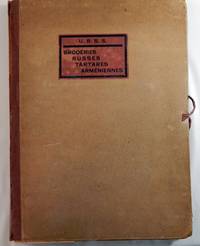
1925réf. 21763Paris: Ernst Henri Editeur 1925. Loose plates. Good. Folio 11 by 15 inches. Portfolio of 40 loose plates. Paper over boards cloth spine printed paper label cloth tie. The plates are printed in full color and mounted to a gray card with a printed black border. Portfolio well worn and the spine repaired. The text pages are soiled and chipped. The mountings for the plates are sunned along the edges but the plates are fine. Overall a good copy. These embroideries and woven printed fabrics were exhibited at the U.S.S.R. pavilion at the International Exhibition of Decorative Arts at Paris in 1925. The samples were supplied by ethnographic museums and almost all of them were produced in the 19th century. A few are from the 17th and 18th century and plates 26 and 27 are from modern Ukraine. . Ernst Henri, Editeur unknown books
1955réf. 234761955. Bratskgesstroy photo album depicting construction of the Bratsk Hydroelectric Power Plant on the Angara River between 1955 and 1964 documenting one of the Soviet Union's largest postwar industrial projects during Nikita Khrushchev's campaign to industrialize Siberia. Construction began in 1955 at the Padun narrows north of Irkutsk where the Angara's rapids and elevation drop made the river suitable for massive hydroelectric generation. The first turbine entered service in November 1961 as the Bratsk reservoir began flooding thousands of square kilometers of forest and river settlements to create what Soviet publications called the "Bratsk Sea." By the mid-1960s the station had become the largest hydroelectric plant in the world supplying electricity to aluminum smelters timber combines rail electrification and new industrial cities across eastern Siberia. Photo album of approximately 17 large format professional silver gelatin photographs Bratsk and the Angara River region 1955-1964. large format photographs with Russian printed captions identify stages of construction including "Padun narrows" "Blocking the right bank of the Angara March 1957" "Installation of wires on the Irkutsk-Bratsk 220 kV transmission line" "Completion of the main concrete trestle" "Winter 1960-61" and "June 1963." Winter construction scenes show cranes rising above frozen riverbanks trucks dumping fill into rushing water during diversion work and workers fastening electrical insulators high above snow-covered terrain. Later images depict the completed spillway releasing torrents of water beneath rows of gantry cranes along with an interior control room lined with gauges switches meters and telephone communications equipment. Several leaves contain handwritten French tourism slips describing the visitor's experience moving through the region and observing ice electrical infrastructure and the completed dam landscape. The Bratsk project formed part of the Soviet Union's postwar eastward industrial expansion which sought to shift energy production and heavy industry deep into Siberia during the Cold War. The first turbine entered service in November 1961 as the Bratsk reservoir began flooding thousands of square kilometers of forest and river settlements to create what Soviet publications called the "Bratsk Sea." By the mid-1960s the station had become the largest hydroelectric plant in the world supplying electricity to aluminum smelters timber combines rail electrification and new industrial cities across eastern Siberia. Soviet newsreels propaganda posters and foreign delegations treated Bratsk as proof that the USSR could transform remote Siberian territory into a modern industrial frontier through centralized planning hydroelectric engineering and mass labor mobilization. Light wear occasional silvering and minor surface abrasions to several photographs; album binding intact. Overall in very good condition. unknown books