DUPOUY A.Livre Rare Book

8065 risultati
rif. S4Ensemble de 14 fascicules.
rif. L10778Gallimard, 1936. In-12 br. E.O. ex. num. sur vélin pur fil (seul grand papier), n.c.
19281st edition. Original boards. 8vo. 89, 111 pages, 23 cm. In Yiddish. Title translates to "Literature-Lore. " Two parts: Ershter teyl: Elementn fun ritm un stil -- Tsveyter tley: Geboy fun Kinstlerishn verk un literarishe zshanren. Hofstein (1889-1952) was a prominent Russian-Yiddish poet. He rose to prominence through his elegies of the Jewish communities that suffered during the White pogroms of 1922, many of which were illustrated by Marc Chagall. He emigrated to Palestine in 1923 as a result of the official banning of Hebrew and subsequent persecution of Hebrew writers. He ultimately returned in 1939 and joined the Communist Party. Hofstein was executed on the Night of the Murdered Poets in 1952, along with 12 other Yiddish writers and artists (Wikipedia, 2019) . SUBJECTS: Yiddish language -- Rhetoric. Poetics. OCLC lists 16 copies worldwide (OCLC: 19306025) . Spine rebacked. Boards are worn and browning. Contents very good. (YID-33-72-EJLXGG'o)
Covers show edgewear & are tape-repaired at spine. Internally Very Good & Solid. (R-1-1); 8vo; Zheneva [i.e. Geneva], Gruppa "Khlieb i volia," 1904. Paper Wrappers, 12mo, 75 pages. 17 cm. In Russian. This is the first separate appearance of Kropotkin's important essay on the state, and also its first appearance in his native Russian (The essay first appeared as a series of articles entitled "L'Etat: son rôle historique" in Les Temps nouveaux, December 19, 1896- July 3, 1897.) It was later translated and published in English as "The State: Its Historic Role" (London: Freedom Press, 1911). Kropotkin, in exile in Western Europe, "became the best-known propagandist in the international anarchist movement" and "participated in several attempts to direct anarchist propaganda into Russia ..Kropotkin was and remains the most widely read anarchist writer, and his version of anarchist theory was the most influential contribution to the anarchist movement in Russia and elsewhere " (Nicolas Walter in Shukman, 1988, pp. 334-335) OCLC lists 3 copies worldwide (Hoover, U of Kansas, Columbia). This is Alexander Granovsky's copy with his signature & bookplate. Granovsky was a leader of the Ukranian exile community in the US and was the founder, in 1941, of the Ukrainian Scientific Institute, which had a short life but was one of the forerunners of other efforts that followed World War II. He was a also a leader of the Organization for the Rebirth of Ukraine and a world famous entomologist, activist and poet as well. From the English Translation: "First of all, let us be agreed as to what we wish to include in the term the State. There is, of course, the German school which enjoys confusing "State" with "Society". The best German thinkers, and many among the French, are guilty of this confusion because they cannot conceive of society without a concentration of the State; and because of this anarchists are usually accused of wanting to ``destroy society'' and of advocating a return to ``the permanent war of each against all.'' Yet, to argue thus is to overlook altogether the advances made in the domain of history during the last thirty-odd years; it is to overlook the fact that humans lived in Societies for thousands of years before the State had been heard of; it is to forget that so far as Europe is concerned the State is of recent origin---it barely goes back to the sixteenth century; finally, it is to ignore that the most glorious periods in history are those in which civil liberties and communal life had not yet been destroyed by the State, and in which large numbers of people lived in communes and free federations. The State is only one of the forms adopted by society in the course of history. Why then make no distinction between what is permanent and what is accidental? Then again the "State" has also been confused with "Government". Since there can be no State without government, it has been sometimes said that what one must aim at is the absence of government and not the abolition of the State. However, it seems to me that in State and government we have two concepts of a different order. The State idea means something quite different from the idea of government. It not only includes the existence of a power situated above society, but also of a "territorial concentration" as well as the "concentration of many functions of the life of societies in the hands of a few". It carries with it some new relationships between members of society which did not exist before the establishment of the State. A whole mechanism of legislation and of policing has to be developed in order to subject some classes to the domination of others. This distinction, which at first sight might not be obvious, emerges especially when one studies the origins of the State. Indeed, there is only one way of really understanding the State, and that is to study its historic development, and this is what we will try to do." OCLC lists 3 copies worldwide (Hoover, Kansas, & Columbia). (RUS-10-1)
8vo; Paris, Izd. TSentr. kom-ta P.S.-R., 1908. Red Paper Wrappers, 8vo, 241 pages. 23 cm. In Russian. At head of title: Compte-rendu de la 1re conférence du parti Social.-Révol. Russe. SUBJECT(S): Partiia sotsialistov-revoliutsionerov -- Congresses. OCLC lists 17 copies worldwide. Light wear, faded institutional stamp on front cover, brighter stamp on title page (Bund Archives), Very Good Condition. Bright red cover remains sharp, a very nice copy. (mx-30-11)
1908(FT) Original Newspaper. Folio. Issues are about 8 pages each. 30 consecutive issues present here. In Russian. Subtitle translates to English as, The Organ of the Russian Saint Petersburg and Moscow Committees RSDRP. CONTENTS INCLUDES: Bankrotstvo Konstitutsii I Nashi Put [Bankruptcy of the Constitution and Our Path] -- Revolyutsiya I Yeya Mogil'schiki [Revolution and it's Gravediggers] -- Samoderzhavie v Grazhdanskoy Voine s Narodom [Autocray in a Civil War Against the People] -- Marksizm I Vcemirnoe Dvizhenie Proletariata [Marxism and the Worldwide Movement of the Proletariat] -- Kak Obyvateli Prevraschalis' v Revolyutsionerov [How Ordinary People Became Revolutionaries] -- Ob Obmane Naroda Liberalami [The Deception of the People by Liberals] -- Studencheskoe Dvizhenie I Sovremennoe Politicheskoe Polozhenie [The Student Movement and the Present Political Situation] -- Krakh Bezsmyslennykh Mechtaniy [The Collapse of Senseless Dreams]. Includes supplements for issues: 44, 46, 47-48, and 50. Note that the final pages of Number 45 are mislabeled No. 44 by printer. Pages darkened but not fragile, with edgewear but no loss of text. Good+ condition. (RUS-11-5) xxxxxxxx
19381st Yiddish Edition. Original publishers decorated cloth, 12mo, 114 pages ; 18 cm. In Yiddish. The translator, Itzik Feffer (1900 1952) was a Soviet Yiddish poet executed on the Night of the Murdered Poets during Joseph Stalin's purges During the Second World War, he was a military reporter with the rank of colonel and was vice chairman of the Soviet Jewish Anti-Fascist Committee (JAC). He and Solomon Mikhoels traveled to the United States in 1943 in a well-documented fund-raising trip. In 1948, after the assassination of the JAC Chairman Solomon Mikhoels, Feffer, along with other JAC members, was arrested and accused of treason. Feffer had been an informer for the NKVD (predecessor of the KGB) since 1943. FeFfer reportedly cooperated with the investigation, providing false information that would lead to the arrest and indictment of over a hundred people, but at the trial, he made openly nationalistic statements and expressed pride in his Jewish identity. Feffer had also allegedly been one of the most loyal and conformist Yiddish poets, who had helped to enforce strict ideological control over other Yiddish writers, and had a history of denouncing colleagues for their nationalistic hysteria. However, in 1952, Feffer, along with other defendants, was tried at a closed JAC trial, and executed on August 12, 1952, at Lubyanka prison ..The American concert singer and actor Paul Robeson met Feffer on July 8, 1943, in New York during a Jewish Anti-Fascist Committee event chaired by Albert Einstein, one of the largest pro-Soviet rallies ever held in the United States. After the rally, Paul Robeson and his wife Eslanda Robeson, befriended Feffer and Mikhoels. Six years later, in June 1949, during the 150th anniversary celebration of the birth of Alexander Pushkin, Robeson visited the Soviet Union to sing in concert. According to David Horowitz: In America, the question "What happened to Itzik Feffer?" entered the currency of political debate. There was talk in intellectual circles that Jews were being killed in a new Soviet purge and that Feffer was one of them. It was to quell such rumors that Robeson asked to see his old friend, but he was told by Soviet officials that he would have to wait. Eventually, he was informed that the poet was vacationing in the Crimea and would see him as soon as he returned. The reality was that Feffer had already been in prison for a half year, and his Soviet captors did not want to bring him to Robeson immediately because he had become emaciated from lack of food. While Robeson waited in Moscow, Stalin's police brought Feffer out of prison, put him the care of doctors, and began fattening him up for the interview. When he looked sufficiently healthy, he was brought to Moscow. The two men met in a room that was under secret surveillance. Feffer knew he could not speak freely. When Robeson asked how he was, he drew his finger nervously across his throat and motioned with his eyes and lips to his American comrade. They're goin to kill us, he said. When you return to America you must speak out and save us. During his concert in Tchaikovsky Hall on June 14 - which was broadcast across the entire country - Robeson publicly paid tribute to Feffer and the late Mikhoels, singing the Vilna Partisan song Zog Nit Keynmol in both Russian and Yiddish .Feffer was a prolific poet who wrote almost exclusively in Yiddish, and his poems were widely translated into Russian and Ukrainian. He is considered one of the greatest Soviet poets in the Yiddish language and his poems were widely admired inside and outside Russia (Wikipedia, 2019). SUBJECT(S): Yiddish literature -- Translations from Russian. Russian literature. OCLC: 19304065. OCLC lists 15 copies worldwide, but 13 of these are in a listing which indicates Also issued online, so some (or many of these?) may be online access copies. Very Good Condition, a beautiful copy. (yid-41-82A)
rif. L16604Moscou. Éditions " Zvenia ", 2000. Format 31 x 41 cm. reliure à spirale. Publication de l'ONG Mémorial. Texte de Igor Golomshtok en russe et en anglais. 68 dessins des camps russes par Boris Sveshnikov, photos, fac-similés. « Mémorial », est une organisation non gouvernementale russe, fondée en 1989, dissoute en 2021 par décret de la cour suprême russe. E.O.
1973Advanced Uncorrected Proof. 8vo. 173 pages ; 22 cm. A rare advanced proof of Wiesels 1974 Play, which was performed on Broadway in 1976 and later made into a full-length movie. As a marketing tool, publishers provide free copies of new book titles to booksellers, stores, PR people, journalists and even celebrities.
1920rif. 144981920. Archive of thirteen photographs ca. 1920s records Russian military officers participating in horse racing and mounted equestrian activity on a circular racetrack. The sequence preserves views of uniformed riders on horseback and documents the place of horsemanship and organized riding within Russian military sporting culture during the early twentieth century. Thirteen vintage photographs each approximately 3.2 x 2.3 inches formerly or currently part of an album. The images show military officers riding horses around a circular track with multiple riders appearing in the racing ground. The officers wear Russian military dress identified in the supplied information as typical of the 1920s. No regiment individual rider precise location photographer or exact date is identified. The photographs record equestrian activity during a period when mounted service remained closely associated with military training and cavalry traditions despite the increasing mechanization of warfare. Their value lies particularly in the sequence of thirteen related views which provides repeated visual evidence of riders horses uniforms and the physical arrangement of the racetrack rather than a single isolated scene. Condition not stated in the supplied description. A compact photographic record of Russian military horsemanship and organized equestrian sport during the early twentieth century. unknown
2012New New English Original bdg. Dust wrapper. In publisher's special slip-case. Roy. 8vo. (23 x 16 cm). In Turkish. Color and b/w ills., maps and tables. 4 volumes set: ([xx], 686 p.; [xx], 504 p.; [xi], 872 p.; [xxxiv], 302 p.). A very heavy set. Avrasya'da Yeniden Çizilen Sinirlar, Insa Edilen Kimlikler Projesi. 4 volumes set: Vol. I: Bagimsizliklarinin Yirminci yilinda Orta Asya Cumhuriyetleri. Türk dilli halklar - Türkiye ile iliskiler. Vol. II: Bagimsizliklarinin Yirminci yilinda Azerbaycan, Gürcistan ve Ukrayna. Türk dilli halklar - Türkiye ile iliskiler. Vol. III: Sovyetler Birligi'nin dagilmasindan Yirmi yil sonra Rusya Federasyonu. Türk dilli halklar - Türkiye ile iliskiler. Vol. IV: Sovyet sonrasi dönemde Türk dilli halklar, dil sorunu, yeniden biçimlenen kimlikler. [Ataturk Turkish Turkey Türkei Turquie Turchia Turquía Kalkun Turkish Türkisch Turc Turque Turco Tyrkisk of the Turkish language Linguistics Linguistic study Studies Work SSCB USSR The Russian Federation Central Asia Asian culture Foreign affairs Diplomacy Diplomats Diplomat International relations Azerbaijan Georgia Georgian Azerbaijani Ukraine Ukrainian History Social Historical Politics Politica Political Policy Caucasia Kaukasus Caucase Turcology Turcologie Turkic Turkica Turcica Turk Turks Crimea Crimean Kirim].
1923Very Good Russian Paperback. Demy 8vo. (22 x 15,5 cm). In Russian. 160 p., unnumbered b/w plates. Slightly chipped on extremities of wrappers. Faded gilded ills. on cover. Several small stains interior, on several pages. Interesting ex-library trace of a Russian bookseller in Contantinople (G. L. Pakhalova) on colophon with an ownership inscription in 1924. Otherwise a very good copy. Helmuth Maximilian Böttcher was the son of the writer Maximilian Böttcher. After attending the Königsstädtischer Realgymnasium in Berlin, Helmuth Maxmilian Böttcher studied law, economics and natural sciences at the universities in Berlin and Greifswald. He worked in the Prussian War Ministry during the WW1. Böttcher married a daughter of the industrialist Paul Reuss, founder of the Kyffhäuserhütte Artern and the Hörselwerke in Eisenach, with whom he had two daughters and a son. From 1924 to 1938 Böttcher was managing director of Hörselwerke, a company in Eisenach that specializes in the production of folding rules. After the Second World War Böttcher lived in the GDR, where his literary works were published at that time, but also had a residence in the Federal Republic. Towards the end of the 1950s he went to West Germany, where he lived in Sprendlingen in Hesse. Helmuth Maximilian Böttcher was the author of novels, short stories, plays and radio plays. Since the 1960s he has mainly published non-fiction books on cultural history and medical topics. (Wikipedia). Russian Edition was published in the same year, 1923 in Berlin. Only one institutional copy located in New York Public Library System NYPL according to OCLC: 70056062.
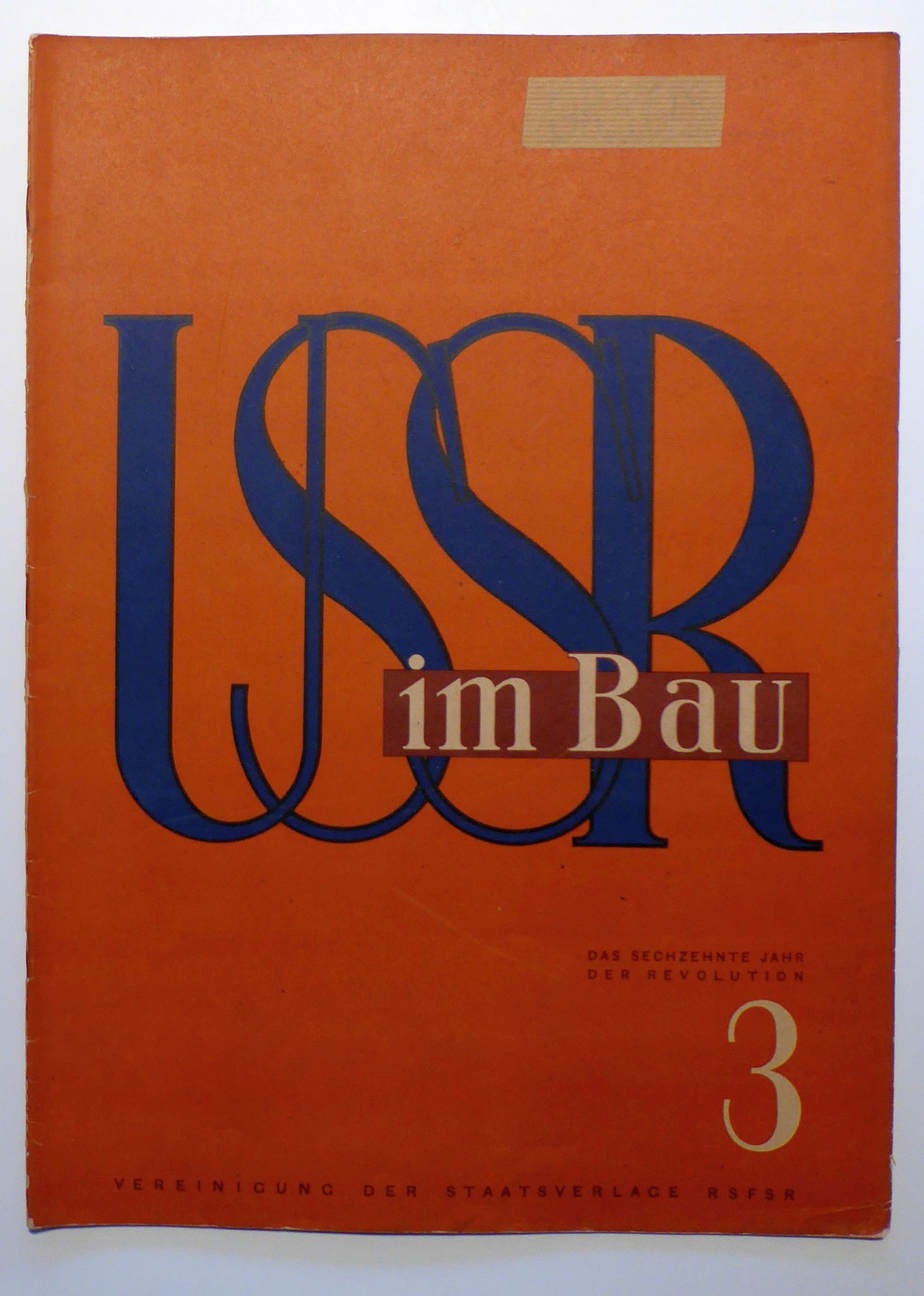
1933rif. 119518Moskau, Ogis, 1933. [20] Bll., mit zahlreichen, teils ganzseitigen Abbildungen nach Fotografien von Jurij Jeremin u.a.. Original-Broschur, 2°. Themenheft "Wolga der Sowjets". Thema und Text von Sergej Tretjakow. Ins Deutsche übertragen von A. Grossmann. Künstlerische Gestaltung von Nikolaj Troschin. Karte von Zoja Dejneka. Die Monatsschrift «USSR im Bau» erschien von 1930 bis 1941 und noch einmal 1949, in vier Sprachen (deutsch, französisch, englisch, spanisch). Zum Redaktionskollegium der von Maxim Gorkij gegründeten Zeitschrift gehörten unter anderen Georgij Pjatakov und Michail Kol?cov, einzelne Nummern erschienen unter der Leitung von Aleksandr Rod?enko oder El? Lisickij. Viele Nummern wurden von Nikolaj Stepanovi? Tro?in gestaltet. Hauptsächliches Gestaltungsmerkmal war die Fotomontage, mit Beiträgen von Fotografen wie Maks Al?pert, einem der Begründer der Fotoreportage, Arkadij ?ajchet und anderen. Jedes Heft war einem bestimmten Thema gewidmet. Softcover Aufkleber auf dem Vorderumschlag. Kleine Randeinrisse mit Tesa überklebt. UdSSR im Bau, 3, 1933
1949Very Good Armenian Original half bound leather bdg. Large demy8vo. (22 x 15,5 cm). In Armenian. 675 p. Prior to Soviet rule, the Dashnaksutiun had governed the First Republic of Armenia. The Socialist Soviet Republic of Armenia was founded in 1920. Diaspora Armenians were divided about this: supporters of the nationalist Dashnaksutiun did not support the Soviet state, while supporters of the Armenian General Benevolent Union (AGBU) were more positive about the newly founded Soviet state. From 1828 with the Treaty of Turkmenchay to the October Revolution in 1917, Eastern Armenia had been part of the Russian Empire and partly confined to the borders of the Erivan Governorate. After the October Revolution, Bolshevik leader Vladimir Lenin's government announced that minorities in the empire could pursue a course of self-determination. Following the collapse of the empire, in May 1918 Armenia, and its neighbors Azerbaijan and Georgia, declared their independence from Russian rule and each established their respective republics. After the near-annihilation of the Armenians during the Armenian Genocide and the subsequent Turkish-Armenian War, the historic Armenian area in the Ottoman Empire was overrun with despair and devastation. A number of Armenians joined the advancing 11th Soviet Red Army. Afterward, Turkey and the newly proclaimed Soviet republics in the Caucasus negotiated the Treaty of Kars, in which Turkey resigned from its claims to Batumi to Georgia in exchange for the Kars territory, corresponding to the modern-day Turkish provinces of Kars, Igdir, and Ardahan. The medieval Armenian capital of Ani, as well as the cultural icon of the Armenian people Mount Ararat, were located in the ceded area. Additionally, Joseph Stalin, then acting Commissar for Nationalities, granted the areas of Nakhchivan and Nagorno-Karabakh (both of which were promised to Armenia by the Bolsheviks in 1920) to Azerbaijan. From 12 March 1922 to 5 December 1936, Armenia was a part of the Transcaucasian SFSR (TSFSR) together with the Georgian SSR and the Azerbaijan SSR. The policies of the first Soviet Armenian government, the Revolutionary Committee (Revkom), headed by young, inexperienced, and militant communists such as Sarkis Kasyan and Avis Nurijanyan, were implemented in a highhanded manner and did not take into consideration the poor conditions of the republic and the general weariness of the people after years of conflict and civil strife. Such was the degree and scale of the requisitioning and terror imposed by the local Cheka that in February 1921 the Armenians, led by former leaders of the republic, rose up in revolt and briefly unseated the communists in Yerevan. The Red Army, which was campaigning in Georgia at the time, returned to suppress the revolt and drove its leaders out of Armenia. Convinced that these heavy-handed tactics were the source of the alienation of the native population to Soviet rule, in 1921 Moscow appointed an experienced administrator, Alexander Miasnikian, to carry out a more moderate policy and one better attuned to Armenian sensibilities. With the introduction of the New Economic Policy (NEP), Armenians began to enjoy a period of relative stability. Life under the Soviet rule proved to be a soothing balm in contrast to the turbulent final years of the Ottoman Empire. The Armenians received medicine, food, as well as other provisions from the central government and extensive literacy reforms were carried [.] Only one copy is located in OCLC: 782028953 (National Library of Israel - Jewish National Library).
1959rif. 25043Moscow U.S.S.R.: MVD Ministry of Internal Affairs USSR 1959. viii 191 pages; useful index. Very well-printed lithographed color maps and charts. With geographic maps maps and charts of the solar system physical features climate world and country-by-country maps; more than half of the atlas concerns the then-U.S.S.R; text entirely in Cyrillic. Laid-in is an article from the NY Times Jan. 28 1973: 'Chinese Names for Towns in Siberia are Eliminated.' The volume approx. 10 3/4" x 15" size; bound in red cloth gilt cover and spine titles dulled; some edge tips wear and rubbing to the boards; contents clean maps' coloring bright and in very good condition. . First Edition. Hard Cover. Very Good. MVD (Ministry of Internal Affairs USSR) hardcover books
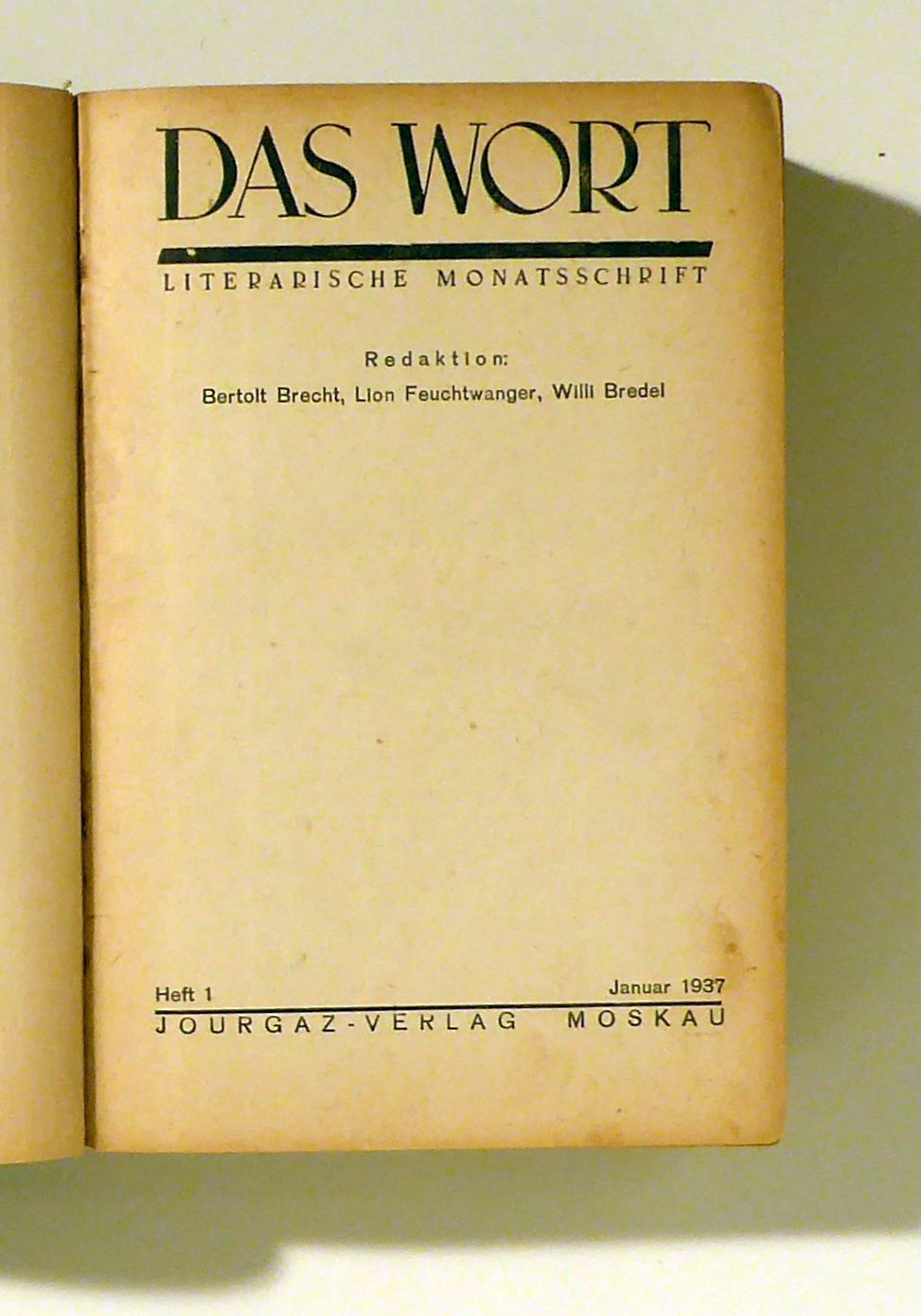
1937rif. 166991Moskau, Jourgaz, 1937. 2 Bände, je 6 Hefte, jedes Heft ca. 112 S., Halbleinwand, 8°. Maas 2, 614; 4, 197. - Seidel. 1936. Der zweite Jahrgang dieser wichiutgen Literaturzeitschrift des Exils. Sie erschien zwischen 1936 und 1939 in Moskau und stand sowohl kommunistischen als auch nichtkommunistischen Autoren offen. Mit Beiträgen von Georg Lukacs, Thomas Mann, Klaus Mann, Oskar Maria Graf, F. C. Weiskopf, Bodo Uhse, Lion Feuchtwanger, Egon Erwin Kisch, Arnold Zweig, Ernst Weiss und zahlreichen anderen. [2 Warenabbildungen] Hardcover Privater Einband mit Pappdeckeln und grünem Leinwandrücken. Die Umschläge wurden nicht mitgebunden. Einbände berieben, Kanten und Ecken bestossen. Leinwandrücken abgewetzt. Seiten vereinzelt etwas fleckig, Schnitt angestaubt. Das Wort, 2. Jahr 1937, Heft 1-12
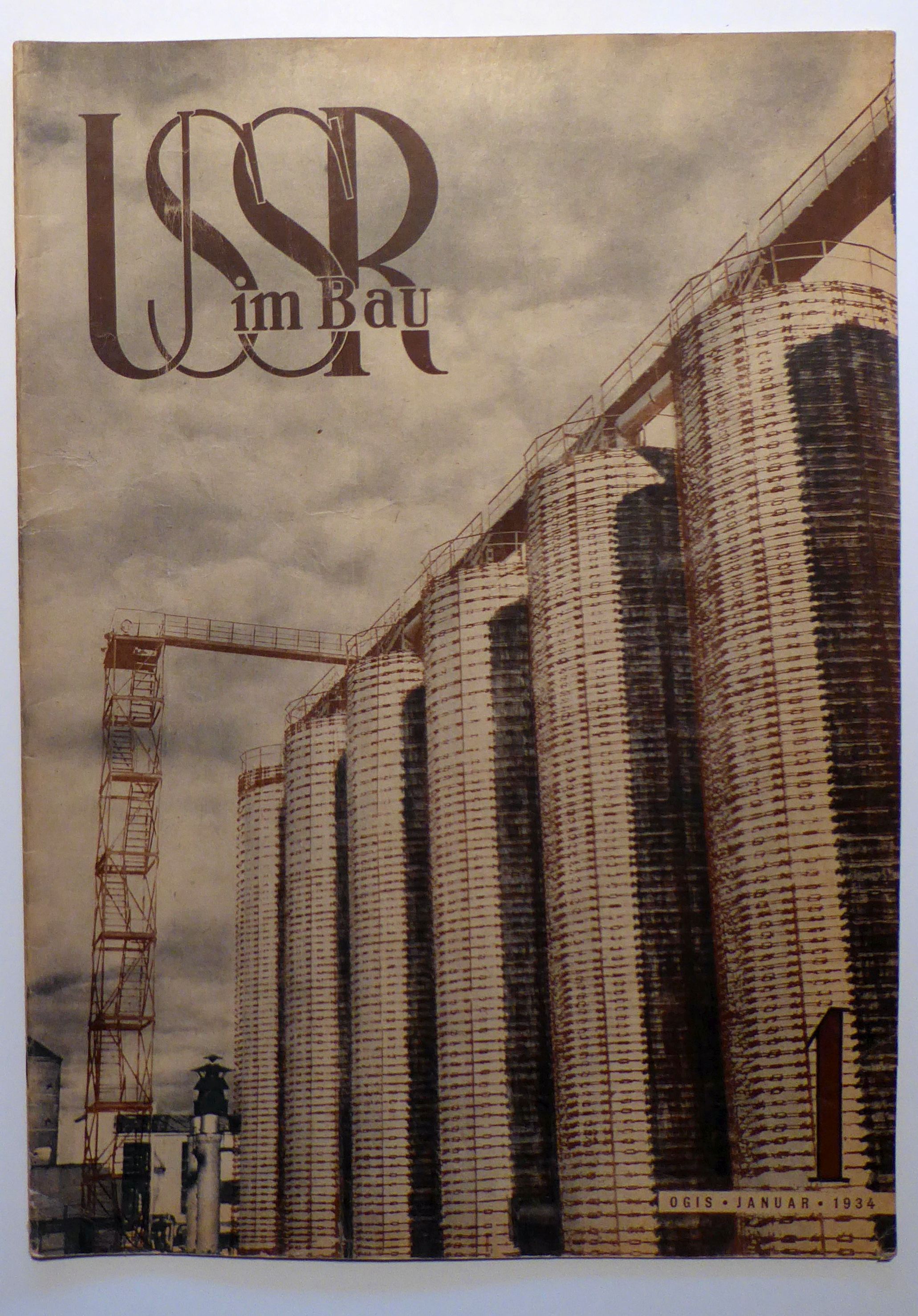
1934rif. 119537Moskau, Isogis, 1934. (18) Bll., eines ausfaltbar, mit zahlreichen, teils ganzseitigen Abbildungen nach Fotografien von Maks Alpert und anderen. Original-Broschur, 2°. Das Heft behandelt das chemische Kombinat in Bobriki. Montage von I. Urasow, Text von Nikolaj Dementjew, Übersetzung von A. Grossmann. Die Monatsschrift «USSR im Bau» erschien von 1930 bis 1941 und noch einmal 1949, in vier Sprachen (deutsch, französisch, englisch, spanisch). Zum Redaktionskollegium der von Maxim Gorkij gegründeten Zeitschrift gehörten unter anderen Georgij Pjatakov und Michail Kol?cov, einzelne Nummern erschienen unter der Leitung von Aleksandr Rod?enko oder El? Lisickij. Viele Nummern wurden von Nikolaj Stepanovi? Tro?in gestaltet. Hauptsächliches Gestaltungsmerkmal war die Fotomontage, mit Beiträgen von Fotografen wie Maks Al?pert, einem der Begründer der Fotoreportage, Arkadij ?ajchet und anderen. Jedes Heft war einem bestimmten Thema gewidmet. Softcover Hinterer Umschlag etwas berieben. UdSSR im Bau, 1, 1934
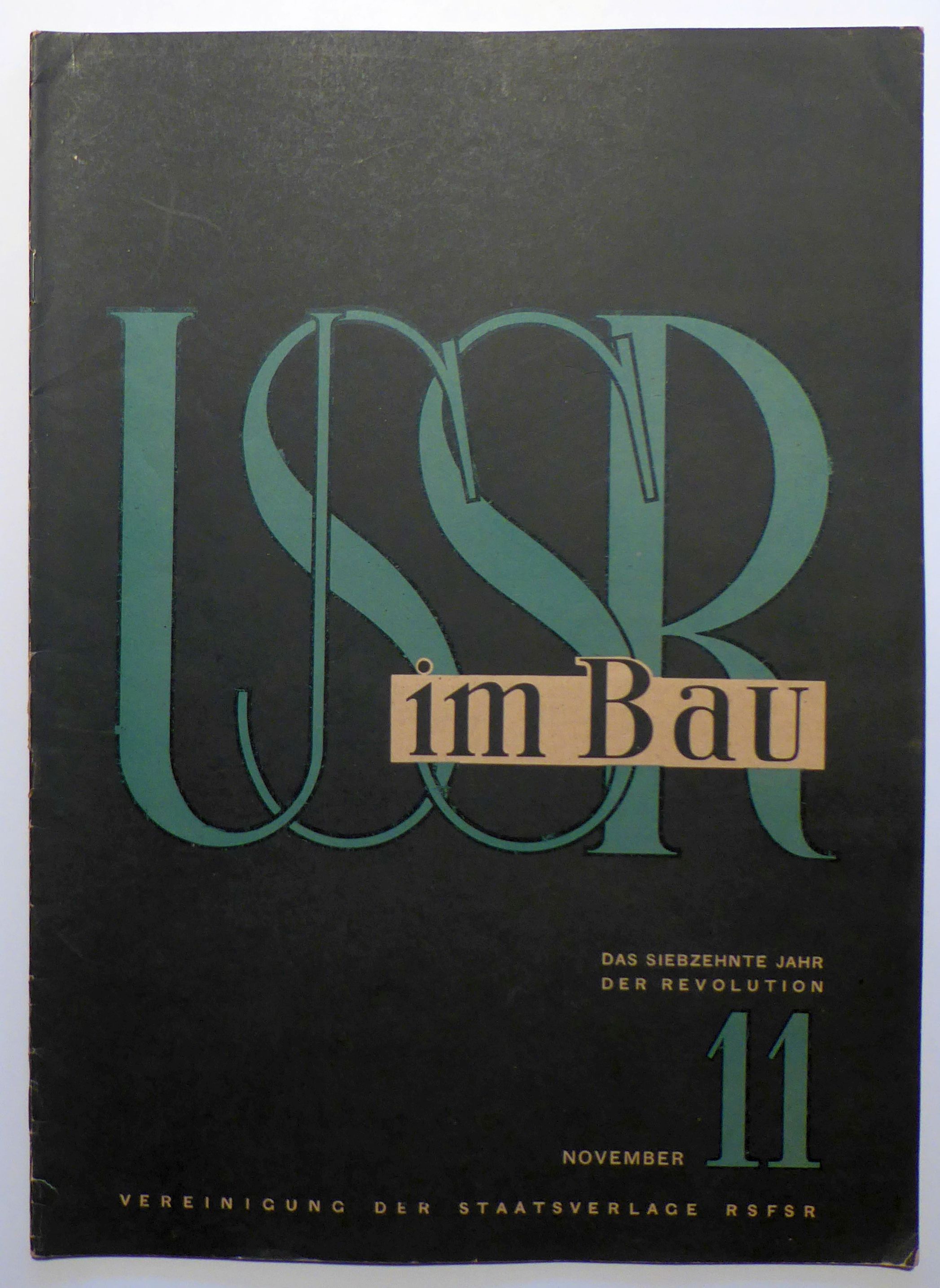
1933rif. 119532Moskau, Isogis, 1933. [20] Bll., mit zahlreichen, teils ganzseitigen Abbildungen nach Fotografien von Maks Alpert und Michail Prechner. Original-Broschur, 2°. Das Heft ist dem zehnjährigen Jubiläum Burjat-Mongoliens gewidmet. Montage von I. Urasow. Übersetzung von A. Grossmann, Die mittleren 4 Blätter nur halb hoch, sie zeigen sozursagen die Sicht aus den Flugzeugen, die oben auf den Seiten vorher und nachher abgebildet sind. Die Monatsschrift «USSR im Bau» erschien in vier Sprachen (deutsch, französisch, englisch, spanisch) von 1930 bis 1941 und noch einmal 1949, in vier Sprachen (deutsch, französisch, englisch, spanisch). Zum Redaktionskollegium der von Maxim Gorkij gegründeten Zeitschrift gehörten unter anderen Georgij Pjatakov und Michail Kol?cov, einzelne Nummern erschienen unter der Leitung von Aleksandr Rod?enko oder El? Lisickij. Viele Nummern wurden von Nikolaj Stepanovi? Tro?in gestaltet. Hauptsächliches Gestaltungsmerkmal war die Fotomontage, mit Beiträgen von Fotografen wie Maks Al?pert, einem der Begründer der Fotoreportage, Arkadij ?ajchet und anderen. Jedes Heft war einem bestimmten Thema gewidmet. Softcover Guter Zustand. UdSSR im Bau, 11, 1933
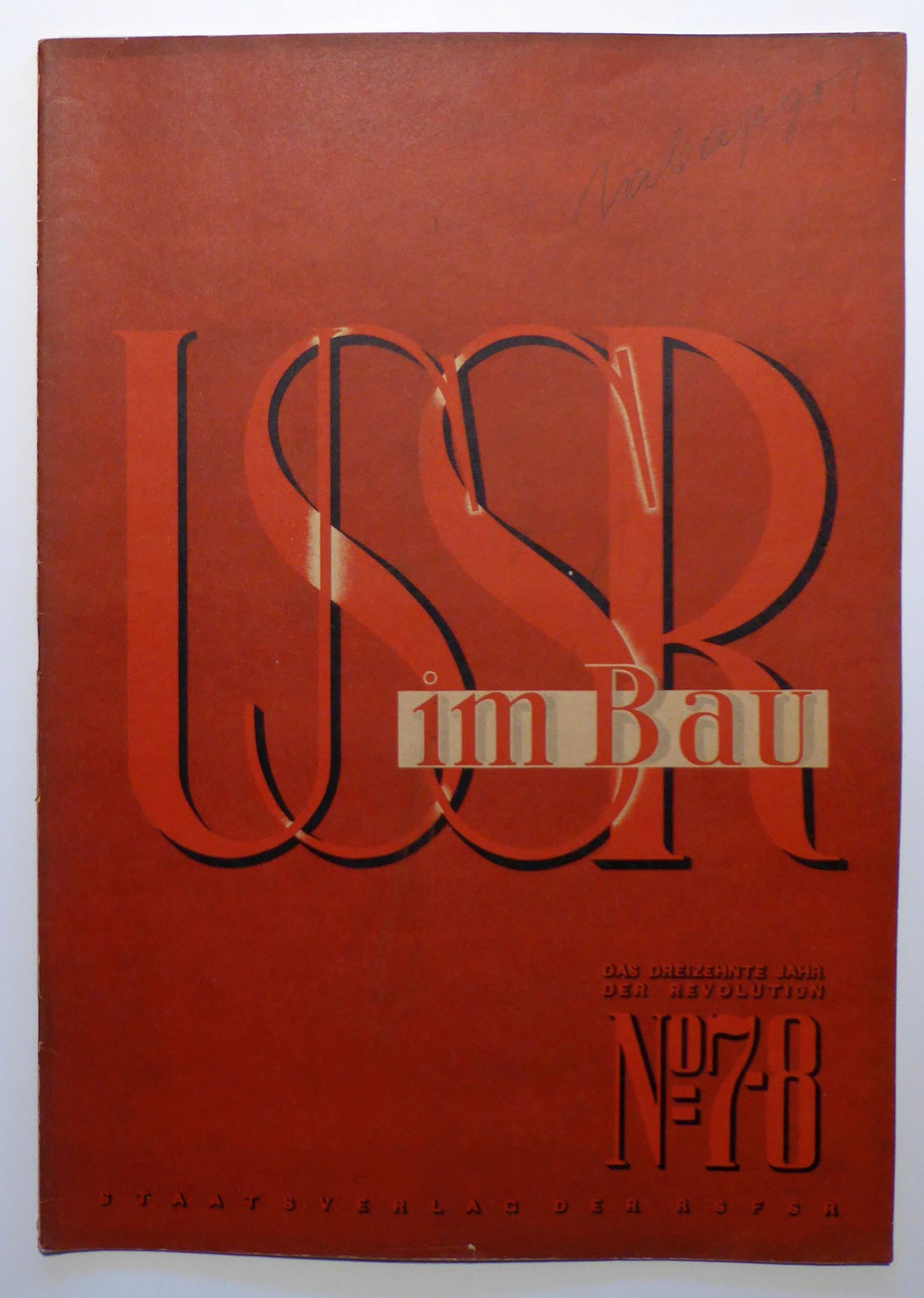
1930rif. 116795Moskau, Staatsverlag der RSFSR, 1930. 47, (1) S., mit zahlreichen s/w-Abbildungen nach Fotografien. Original-Broschur, 2°. Die Nummer 7/8 des ersten Jahrgangs beinhaltet Berichte zu den Hauptstädten der formell autonomen 7 Republiken der Sowjetunion (russische, ukrainische, weissrussische, transkaukasische, tadschikische, turkmenische, usbekische Republik) und zeigt vor allem Fotografien neuer Architektur aus Moskau, Charkow, Minsk, Tiflis, Stalinabad, Aschchabad, Samarkand. Fotos montiert von Nikolaj Troschin. Text von B. Nabatow. Die Monatsschrift «USSR im Bau» = «URSS en construction» erschien in vier Sprachen (deutsch, französisch, englisch, spanisch) von 1930 bis 1941 und noch einmal 1949. Zum Redaktionskollegium der von Maxim Gorkij gegründeten Zeitschrift gehörten unter anderen Georgij Pjatakov und Michail Kol?cov, einzelne Nummern erschienen unter der Leitung von Aleksandr Rod?enko oder El? Lisickij. Viele Nummern wurden von Nikolaj Stepanovi? Tro?in gestaltet. Hauptsächliches Gestaltungsmerkmal war die Fotomontage, mit Beiträgen von Fotografen wie Maks Al?pert, einem der Begründer der Fotoreportage, Arkadij ?ajchet und anderen. Jedes Heft war einem bestimmten Thema gewidmet. Softcover Umschlag etwas angestaubt. Kleiner Namenszug Vorderumschlag. Kleine Fehlstelle und kleiner Tintenfleck auf Hinterumschlag. UdSSR im Bau, 1930, Nr. 7-8
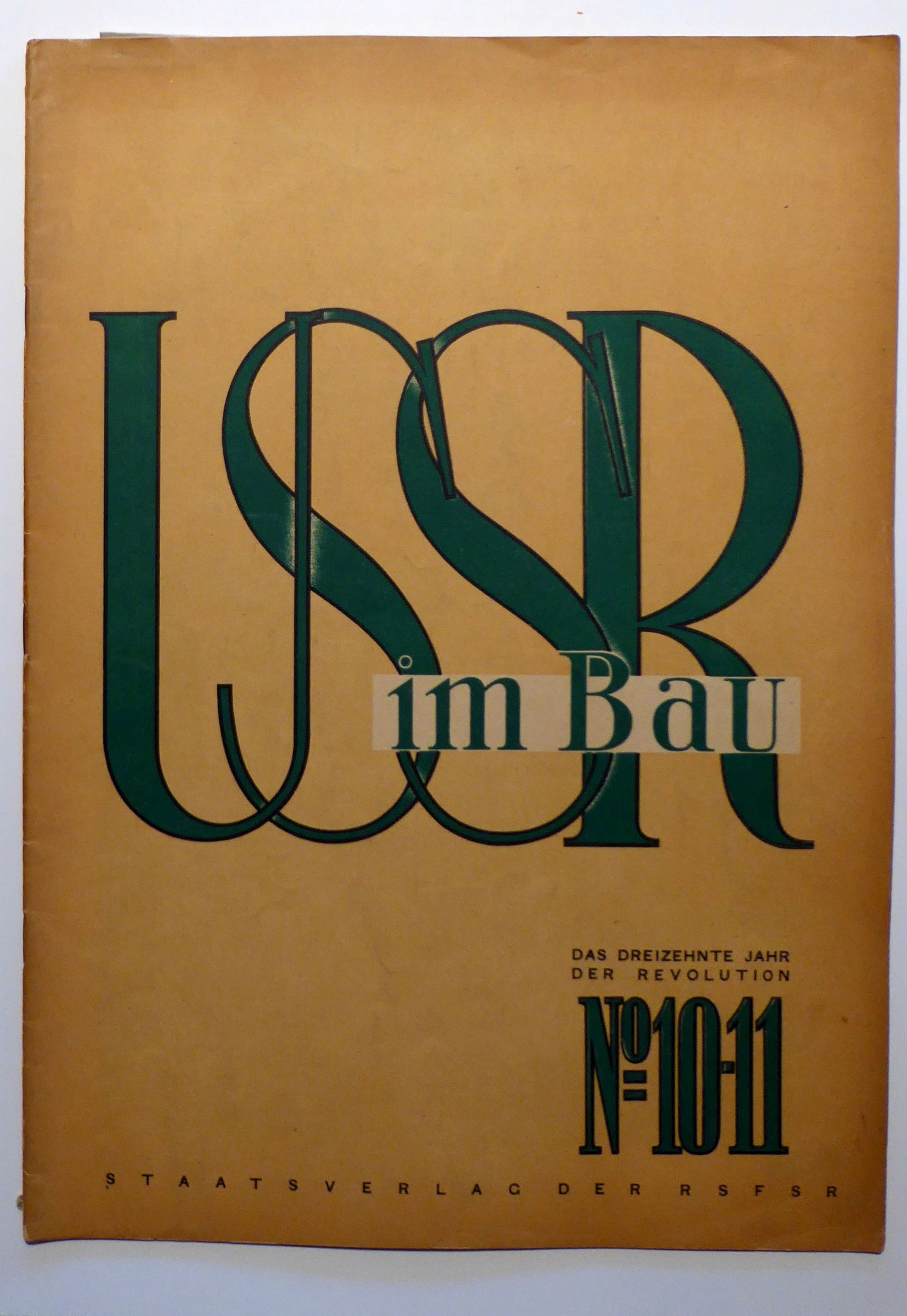
1930rif. 116793Moskau, Staatsverlag der RSFSR, 1930. 47, (1) S., mit zahlreichen, teils ganzseitigen Abbildungen nach Fotografien. Original-Broschur, 2°. Die Nummer 11 des ersten Jahrgangs behandelt die landwirtschaftliche Situation in der UdSSR, insbesondere die Mechanisierung und Kollektivisierung. Montage der Fotos Viktor Mikulin. Die Monatsschrift «USSR im Bau» = «URSS en construction» erschien in vier Sprachen (deutsch, französisch, englisch, spanisch) von 1930 bis 1941 und noch einmal 1949. Zum Redaktionskollegium der von Maxim Gorkij gegründeten Zeitschrift gehörten unter anderen Georgij Pjatakov und Michail Kol?cov, einzelne Nummern erschienen unter der Leitung von Aleksandr Rod?enko oder El? Lisickij. Viele Nummern wurden von Nikolaj Stepanovi? Tro?in gestaltet. Hauptsächliches Gestaltungsmerkmal war die Fotomontage, mit Beiträgen von Fotografen wie Maks Al?pert, einem der Begründer der Fotoreportage, Arkadij ?ajchet und anderen. Jedes Heft war einem bestimmten Thema gewidmet. Softcover Umschlag etwas angestaubt. UdSSR im Bau, 1930, Nr. 10-11
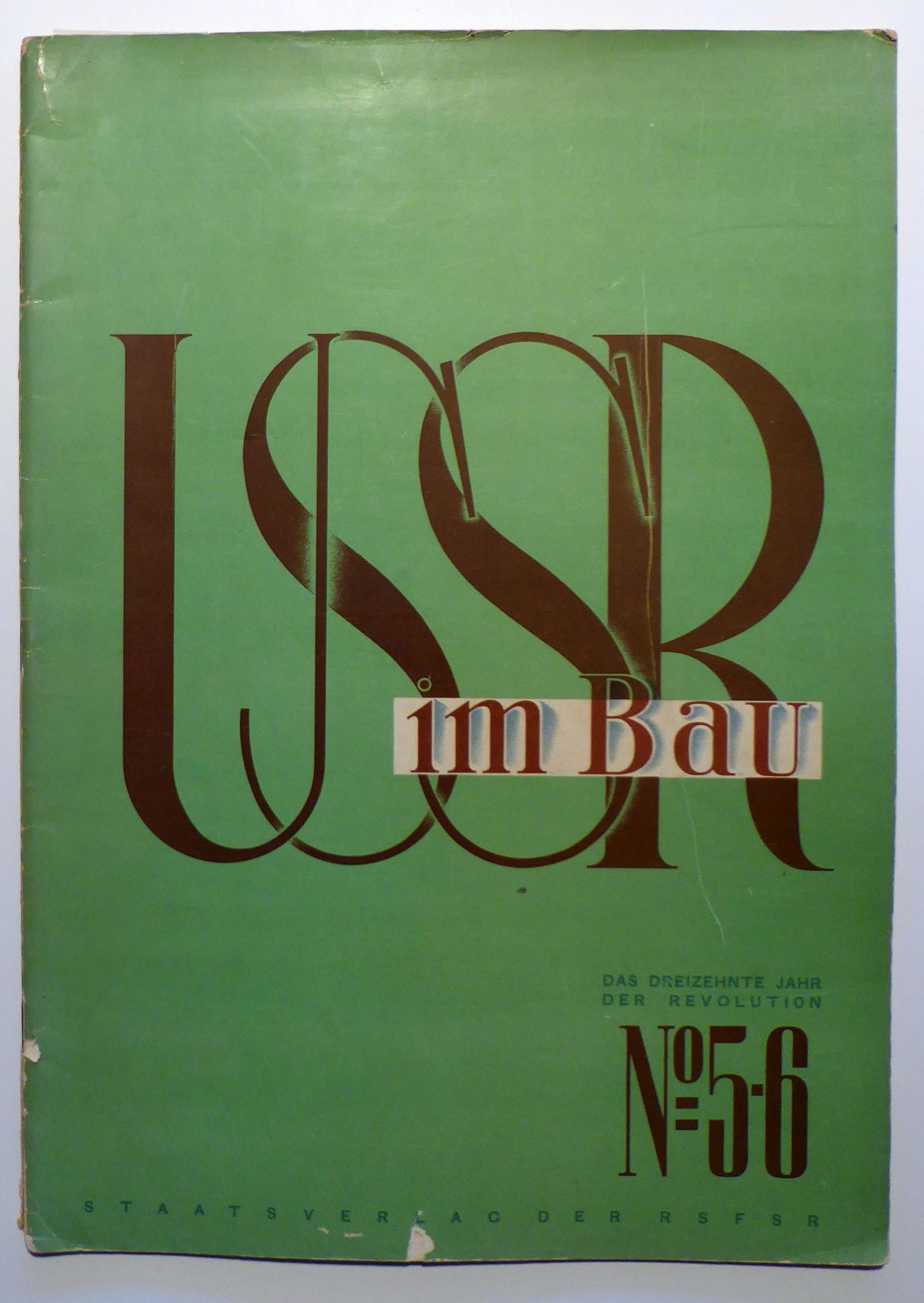
1930rif. 116792Moskau, Staatsverlag der RSFSR, 1930. 47, (1) S., mit zahlreichen, teils ganzseitigen Abbildungen nach Fotografien von Arkadij Schajchet, Georgij Petrusov und anderen. Original-Broschur, 2°. Themen von Heft 5/6 des ersten Jahrgangs sind: Metallindustrie, Mechanisierung der Landwirtschaft, Sowjet-Turkmenien und Aufbau Weissrusslands. Fotos montiert von R. Ostrowskaja. Die Monatsschrift «USSR im Bau» = «URSS en construction» erschien in vier Sprachen (deutsch, französisch, englisch, spanisch) von 1930 bis 1941 und noch einmal 1949. Zum Redaktionskollegium der von Maxim Gorkij gegründeten Zeitschrift gehörten unter anderen Georgij Pjatakov und Michail Kol?cov, einzelne Nummern erschienen unter der Leitung von Aleksandr Rod?enko oder El? Lisickij. Viele Nummern wurden von Nikolaj Stepanovi? Tro?in gestaltet. Hauptsächliches Gestaltungsmerkmal war die Fotomontage, mit Beiträgen von Fotografen wie Maks Al?pert, einem der Begründer der Fotoreportage, Arkadij ?ajchet und anderen. Jedes Heft war einem bestimmten Thema gewidmet. Softcover Rücken mit Einriss. UdSSR im Bau, 1930, Nr. 5-6
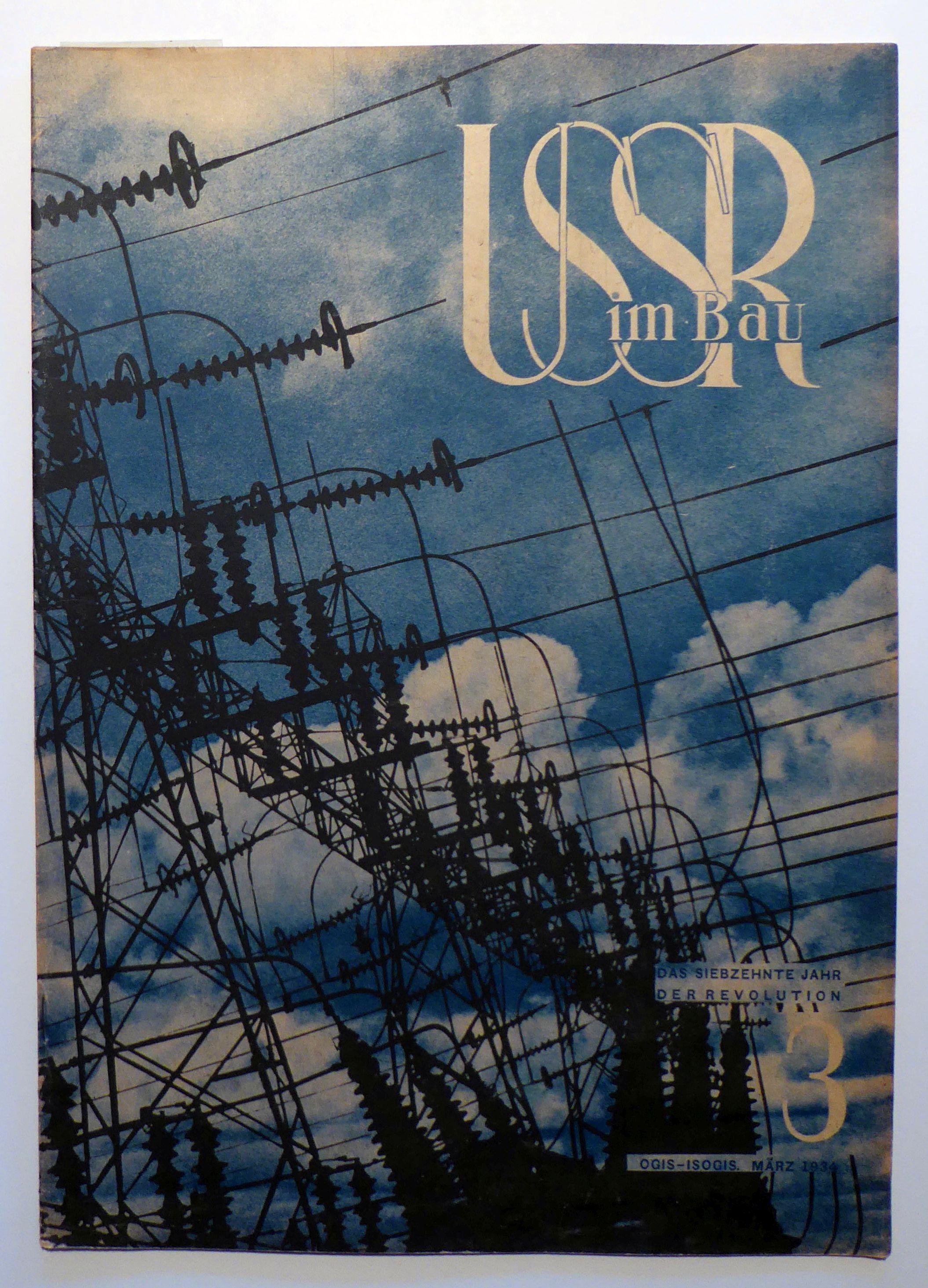
1934rif. 116788Moskau, Isogis, 1934. (18) Bll., mit zahlreichen s/w-Abbildungen nach Fotografien von Fotos von Max Alpert, Sergej Alperin und R. Ostrowskaja. 1 Blatt zweimal gefaltet (82x58 cm), 2 Böätter einmal gefaltet (41x57 cm). Original-Broschur, 2°. Themenheft Dnjeprkombinat. Plan und Text von Sergej Jantarow. Übersetzung von A. Grossmann. Montage von Nikolaj Troschin, Karte von Zoja Dejneka. Die Monatsschrift «USSR im Bau» = «URSS en construction» erschien in vier Sprachen (deutsch, französisch, englisch, spanisch) von 1930 bis 1941 und noch einmal 1949. Zum Redaktionskollegium der von Maxim Gorkij gegründeten Zeitschrift gehörten unter anderen Georgij Pjatakov und Michail Kol?cov, einzelne Nummern erschienen unter der Leitung von Aleksandr Rod?enko oder El? Lisickij. Viele Nummern wurden von Nikolaj Stepanovi? Tro?in gestaltet. Hauptsächliches Gestaltungsmerkmal war die Fotomontage, mit Beiträgen von Fotografen wie Maks Al?pert, einem der Begründer der Fotoreportage, Arkadij ?ajchet und anderen. Jedes Heft war einem bestimmten Thema gewidmet. Softcover Schönes Exemplar. UdSSR im Bau, 1934, Nr. 3
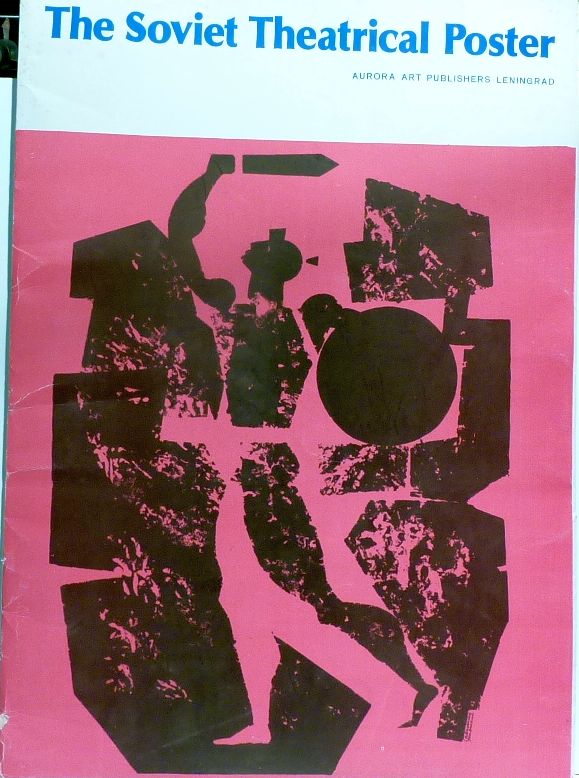
1977rif. 162016Leningrad, Avrora, 1977. 25 Bl., lose Bogen in Kartonmappe, 56x40 cm. 24 Plakate aus der Zeit von 1918 bis 1974, unter anderem von V. Majakovskij, V. Stepanova, V. Stenberg, Ju. Annenkov, den Kukryniksy, Ju. Pimenov, N. Al'tman. Begleittext in englisch und russisch. Mappe etwas angestaubt und berieben, davon abgesehen gutes Exemplar.
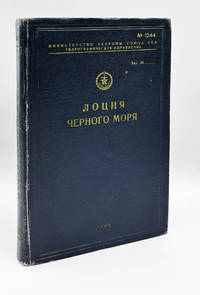
1968rif. 009699Leningrad: Hydrographic Directorate of the Ministry of Defence of the USSR 1968 4to 26 cm 440 pp with a loosely inserted pamphlet of corrections 14 pp. Publisher's cloth with gilt lettering and Soviet naval anchor-and-star emblem to upper cover binding slightly rubbed and dusted paper somewhat toned library stamps on the title. Publication No. 1244 copy No. 1433. Comprising a general survey navigational-geographical and hydrometeorological overviews and detailed coastal navigation in nine chapters covering the entire Black Sea littoral from the Kiliya mouth of the Danube to Cape Kaliakra; with a reference section including port and anchorage data distance tables and territorial waters information plus alphabetical index and correction notes. Stamped throughout “ДЛЯ СЛУЖЕБНОГО ПОЛЬЗОВАНИЯ” For Official Use Only with library stamp of the Technical Library of TsKB “Chernomorsudoproekt” Central Design Bureau for Black Sea Shipbuilding to the title page. Accompanied by the separately issued Сводная Корректура 1969 г. Consolidated Correction Supplement for 1969 copy No. 1535 a printed pamphlet with manuscript annotations in red ink updating the main volume in accordance with Notices to Mariners through September 1969. A complete and rare Soviet navigational publication for the Black Sea of considerable historical interest due to its restricted official-use classification and direct institutional provenance from a major Soviet shipbuilding design bureau. Hydrographic Directorate of the Ministry of Defence of the USSR hardcover
1959rif. 25043Moscow U.S.S.R.: MVD Ministry of Internal Affairs USSR 1959. viii 191 pages; useful index. Very well-printed lithographed color maps and charts. With geographic maps maps and charts of the solar system physical features climate world and country-by-country maps; more than half of the atlas concerns the then-U.S.S.R; text entirely in Cyrillic. Laid-in is an article from the NY Times Jan. 28 1973: 'Chinese Names for Towns in Siberia are Eliminated.' The volume approx. 10 3/4" x 15" size; bound in red cloth gilt cover and spine titles dulled; some edge tips wear and rubbing to the boards; contents clean maps' coloring bright and in very good condition. . First Edition. Hard Cover. Very Good. MVD (Ministry of Internal Affairs USSR) hardcover