8 052 résultats
réf. ARTE0101Paris L'Equerre 1979. 22 x 22 cm. 371 S. zahlreiche s/w u. etliche farbige Abb. OBrosch mit OUmschlag Umschlag angerändert sonst sehr gut erhalten. Text französisch u. italienisch. Katalog zur gleichnamigen Ausstellung im Centre Pompidou Paris 1978. Beiträge von Christian Borngräber Catherine Cook G. Gorvic Alexej Gutnov S. O. Chan-Magomedov I. Hlebnikov Anatole Kopp Vieri Quilici. Paris, L'Equerre 1979 unknown
1939réf. HALL509825Paperback. 1939. 1. BACH A. Planning Science. 2. BORIN K. Socialist farming. 3. GOLENKINA Vera. The Soviet Press. 4. GOLOSSOV I. Soviet Cities New and Renewed. 5. ILIN M. The Little Citizen of a Big Country. 6. KHAZAN D. Light Industries of the U.S.S.R. 7.KOROBOV I. How Soviet Workers Spend their Leisure. 8. KOVARDAK P. New People of the Soviet Countryside. 9. KRENKEL Camping at the Pole. 10. LOBANOV P. The State Farms of the U.S.S.R. 11. MOLYAKOV V. The Countryside Past and Present. 12. OBRAZTSOV V. The Railroads of the U.S.S.R. 13. PAPANIN I. The Soviet Wintering Station on the Drifting Ice. 14. PAPYAN M. Industrial Progress in the Soviet Republics of the Non-Russian Nationalilties. 15. PROPPER-GRASHCHENKOV N. Public Health Protection in the U.S.S.R. 16. SHABUROVA M. How Old Age is Provided For in the U.S.S.R. 17. STAROSTIN A. Sport in the U.S.S.R. 18. VYSHINSKY A. Crime Recedes in the U.S.S.R. 19. ZHEMCHUZHINA P.S. The Food Industry of the U.S.S.R. 28 to 44pp each 11cm x 14cm card covers. All published by Foreign Languages Publishing House Moscow 1939. With the exception of nos. 1 15 & 18 all have pictorial front covers. All contain black & white photograph illustrations except no 18. Nos. 4 12 & 14 have an 8-page English-Russian vocabulary loosely inserted. All very copies . paperback
1938réf. HALL094931Hardback. 1938. Verbatim Report. 685pp Moscow 1938. VG . hardcover
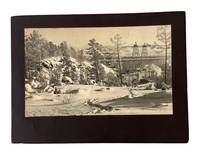
1955réf. 234761955. Bratskgesstroy photo album depicting construction of the Bratsk Hydroelectric Power Plant on the Angara River between 1955 and 1964 documenting one of the Soviet Union's largest postwar industrial projects during Nikita Khrushchev's campaign to industrialize Siberia. Construction began in 1955 at the Padun narrows north of Irkutsk where the Angara's rapids and elevation drop made the river suitable for massive hydroelectric generation. The first turbine entered service in November 1961 as the Bratsk reservoir began flooding thousands of square kilometers of forest and river settlements to create what Soviet publications called the "Bratsk Sea." By the mid-1960s the station had become the largest hydroelectric plant in the world supplying electricity to aluminum smelters timber combines rail electrification and new industrial cities across eastern Siberia. Photo album of approximately 17 large format professional silver gelatin photographs Bratsk and the Angara River region 1955-1964. large format photographs with Russian printed captions identify stages of construction including "Padun narrows" "Blocking the right bank of the Angara March 1957" "Installation of wires on the Irkutsk-Bratsk 220 kV transmission line" "Completion of the main concrete trestle" "Winter 1960-61" and "June 1963." Winter construction scenes show cranes rising above frozen riverbanks trucks dumping fill into rushing water during diversion work and workers fastening electrical insulators high above snow-covered terrain. Later images depict the completed spillway releasing torrents of water beneath rows of gantry cranes along with an interior control room lined with gauges switches meters and telephone communications equipment. Several leaves contain handwritten French tourism slips describing the visitor's experience moving through the region and observing ice electrical infrastructure and the completed dam landscape. The Bratsk project formed part of the Soviet Union's postwar eastward industrial expansion which sought to shift energy production and heavy industry deep into Siberia during the Cold War. The first turbine entered service in November 1961 as the Bratsk reservoir began flooding thousands of square kilometers of forest and river settlements to create what Soviet publications called the "Bratsk Sea." By the mid-1960s the station had become the largest hydroelectric plant in the world supplying electricity to aluminum smelters timber combines rail electrification and new industrial cities across eastern Siberia. Soviet newsreels propaganda posters and foreign delegations treated Bratsk as proof that the USSR could transform remote Siberian territory into a modern industrial frontier through centralized planning hydroelectric engineering and mass labor mobilization. Light wear occasional silvering and minor surface abrasions to several photographs; album binding intact. Overall in very good condition. unknown
1939réf. 43900Moscow: V.V Kuibyshev Military Engineering Academy. Very Good. Hardcover. 4to; 37 ff & 13 ff. plates pages; Typescript versos only of quarto sheets -- carbon. Thirteen plates which appear to be photographs of the original text's illustrations mounted to plain paper sheets. In a contemporary binder citron buckram covers metal hinges retaining leaves at the gutter margins -- pale blue endpapers. Bookplate of the former Army Map Service Library / 6500 Brooks Lane / Washington DC. This is a translation into English of a Russian publication from 1939. Originally published by the Voyenno-Inzhanernoy Akadamii imeni V.V. Kubsheva Moskva 1939. This is an English translation by an unnamed writer or writers. Part of a vast program of wartime translations of technical publications from various sources. The introduction to the text pays considerable attention to the importance placed by V. I. Lenin on military cartography and map making in general. The main text is largely historical although similar texts covering much of this same ground rarely point out the observations of Marx and Engels on the discovery and mapping of America. The first title page is a transliteration of the Russian original. On this there are Army Map Service stamps in ink and blind each cancelled with a faint blue "X". Also the familiar "Surplus Duplicate" stamp of the Library of Congress Gift and Exchange Division appears in red ink. The Army Map Service bookplate is also cancelled with a faint "X" in blue pencil as is the small shelf label entirely handwritten in black ink -- mounted to the upper left hand margin of the front cover. Both shelf label and bookplate state that this was "Copy 2." The Army Map Service formed during the Second World War has undergone several changes of name and now is absorbed into the National Geospatial-Intelligence Agency NGA. If any of these entities or the Army Corps of Engineers has retained "Copy 1" of this publication they have not shared this information with OCLC or any other gathering of records which we were able to consult. A rare and interesting "book" -- not least because the Soviet Union may have already entered into the infamous Molotov–Ribbentrop Pact when this original Russian text was published in 1939. By the time the U.S. Army Map Service was formed this pact was rendered null and void by the Nazi invasion of the USSR in Operation Barbarossa. . 1939. V.V Kuibyshev Military Engineering Academy hardcover
1964réf. 891Z49Novosibirsk : Siberian Branch of the USSR Academy of Sciences 1964. Cloth. Very Good Indeed. 10.5" by 6.5". None . A very scarce work on the October Revolution written in Cyrillic. In the publisher's original cloth. Written in Russian Cyrillic. This work provides a historical account of the October Revolution discussing the causes. The October Revolution was a revolution in Russia led by Vladimir Lenin and his 'Bolshevik Party' and eventually led to the Russian Civil War. This work is part of series that aimed to study Siberia during the period of capitalism. Library copy with stamps. In the publisher's original cloth. Externally very smart with slight bumping and rubbing to the extremities a small closed tear to the cloth to the head of the front joint library annotations to the head and tail of the spine and the odd minor mark. Library stamp to the front pastedown with age toning to the endpapers. Internally generally firmly bound with evidence of strain to the front and rear. Pages generally bright and clean with a tidemark to pp. 193 and 177. Library stamp to the title page and verso. Very Good Indeed Siberian Branch of the USSR Academy of Sciences hardcover
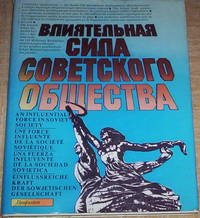
réf. c2434Profizdat Publishers All-Union Central Council of Trade Unions Moscow 1982. Cream cloth large photographs text in English Russian Spanish German and French 222pp. A good copy. Jacket - small piece missing top rear panel edge tears. A signed presentation copy from two delegates of the trade unions of the USSR to the Australian Council of Trade Unions ACTU Melbourne ACTU Congress 10/08/83. hardcover
réf. 158160081X.Gpaperback. Good. Access codes and supplements are not guaranteed with used items. May be an ex-library book. paperback
1959réf. 37820Buenos Aires: Ed. Cartago 1959.- 386 p. 1 h.; 8º mayor 20 x14 cm; Intonso; Cartulina Ed. con solapas.- Esta excelente obra da respuesta orgánica a uno de los más importantes interrogantes del materialismo histórico. Según indica en la primera solapa está escrita esta obra por un grupo de miembros del citado Instituto de Filosofía los profesores M. D. Kammari G. E. Gleserman Ts. A. Stepanian y F. V. Konstantinov. En excelente estado de conservación. Tan solo una firma y fecha en la portadilla. HISTORIA Y POLÃTICA DE LOS SIGLOS XVI-XXI E HISTORIAS GENERALES EXTRANJERAS Libro en español Ed. Cartago paperback
réf. A9783112706886Hardback. New. hardcover
1991réf. 055868Tbilisi & Moscow: Komitet Geodeziii Kartohgrafii SSSR / Tbilisskoj Kartograficheskoj Fabrikoj 1991. No Binding. Very Good. A late Soviet map of Abkhazia published in 1991 one year before it became a free republic by the Tbilisi Cartography Factory. Scarce. One of 2150 copies. Slight stains on surface slight chippings on extremities and doodles by pen on verso otherwise a good copy. The Transcaucasian Geodetic Administration of the USSR was established in Tbilisi in 1929 with a small cartographic section. Between 1930 and 1931 it compiled a map of Transcaucasia at a scale of 1:500000 which was printed in Leningrad. The printing of maps in Tbilisi began in 1932 following the receipt of some German-made equipment. The Factory itself was officially founded in 1933 and its first major project was the compilation of a topographic atlas of Transcaucasia in 44 sheets printed in Moscow between 1934 and 1935. The factory's development accelerated in 1935 with the arrival of new equipment and the expansion of staff. However in 1936-37 it faced significant sabotage. In 1938 the factory underwent a complete reorganization with young experts taking leadership roles. Among them were engineer cartographers M. A. Pevlov N. A. Suzdal'skiy V. I. Arzamastsev and S. N. Ter-Grigorian. The printing of maps in Georgian Armenian and Azerbaijani languages became a notable achievement highlighted in Soviet literature as a key accomplishment of the factory. The factory's organizational structure included departments for Map Compilation Lithography Engraving Printing and Transfer. The Tbilisi Cartographic Factory remained active even after Perestroika continuing its work into 1991. OCLC locates two copies in LoC in the US: 32549580. Komitet Geodeziii Kartohgrafii SSSR / Tbilisskoj Kartograficheskoj Fabrikoj unknown
1958réf. 055782Cairo: The USSR Embassy Press Office in the United Arab Republic UAR 1958. 1st Edition . Hardcover. Very Good. 8vo - over 7¾ - 9¾" tall. Contemporary full green cloth in Egyptian style contemporary white endpapers gilt lettering of title on front board and gilt decorations on spine. Original pictorial cover saved inside. Roy. 8vo. 24 x 17 cm. In Arabic. 88 p. 12 b/w ills. including drawings and reproduced photographic plates. Extremely rare unrecorded first issue of this Soviet propaganda organ published in Cairo the centre of the UAR by the USSR Propaganda Press Office with a striking cover design depicting the Sputniks in space celebrating the third anniversary of the Kosmicheskaya programma SSSR. The content begins with a comparison between the Soviet and American satellites. A full-paged photograph shows the Muscovites reading newspapers about the launch of the third Soviet satellite into space. In the periodical many details such as the construction processes and technical specifications of the satellites are explained as well as a striking history of the Soviet Space Program. Relations between Russia and Egypt have a long history dating back to before the 16th century. In the 1950s Gamal Abdel Nasser's independent and anti-imperialist policy earned him enthusiastic support from the Communist government of the USSR. In 1955 Egypt made a major arm deal with the Soviet Union and from then teams of Egyptian officers were trained in Eastern Bloc countries. Czechoslovak instructors also came in 1956 to train Egyptian personnel in the use of Soviet weapons. When France attacked Egypt during the Suez Crisis the USSR threatened to use destructive weapons i.e. nuclear weapons for the defence of Egypt. The degree of the Soviet approval of the Egyptian leader's policies culminated rather controversially in the award of the highest Soviet decoration the star of the Hero of the Soviet Union with the Order of Lenin to Nasser during Nikita Khrushchev's visit to the country in 1964. Kosmicheskaya programma SSSR i.e. The Soviet Space Program was the national space program of the Union of Soviet Socialist Republics USSR active from 1955 until the dissolution of the Soviet Union in 1991. After WWII the Soviet and US space programs both utilized German technology in their early efforts. Eventually the program was managed under Sergei Korolev who led the program based on unique ideas derived by Konstantin Tsiolkovsky sometimes known as the father of theoretical astronautics. Contrary to its American European and Chinese competitors who had their programs run under a single coordinating agency the Soviet space program was divided and split among several internally competing design bureaus led by Korolev Kerimov Keldysh Yangel Glushko Chelomey Makeyev Chertok and Reshetnev. The Soviet space program served as an important marker of Soviet claims to its global superpower status. Wikipedia. As of May 2024 not in OCLC and KVK. The USSR Embassy Press Office in the United Arab Republic (UAR) hardcover
1965réf. 10971Moscow: Progress Publishers. Very Good in As New dust jacket; Beige cloth covers with blue/white and . gilt spine label; DJ are not clipped; No marks or writing clean tight . binding;. 1965. Hardcover. Includes seven fold out maps; Russian text; ; Vol. 2 . Progress Publishers hardcover
1937réf. R68519Moscow: People's Commissariat of Justice of the U.S.S.R. 1937. 1st edition. Very Good. octavo. orig. boards vi 580pp. Heard before the Military Collegium of the Supreme Court of the U.S.S.R.Moscow January 23-30 1937. Verbatim Report People's Commissariat of Justice of the U.S.S.R. hardcover
1938réf. R68520Moscow: People's Commissariat of Justice of the U.S.S.R. 1938. 1st edition. Very Good. octavo. orig. boards 799pp. Heard before the Military Collegium of the Supreme Court of the U.S.S.R.Moscow March 2-13 1938. Verbatim Report People's Commissariat of Justice of the U.S.S.R. hardcover
1983réf. 042356Moscow: USSR Academy of Science N. N. Mikhulko-Maklay Institute of Ethnography 1983. Soft cover. Very Good. 8vo - over 7¾ - 9¾" tall. Paperback. Demy 8vo. 22 x 14 cm. All papers in English. 2 volumes set: 159 1 p.; 124 1 p. Studies in ethnography and anthropology. XI International Congress of Anthropological and Ethnographical Sciences. Papers presented by Soviet participants. Vancouver-Quebec August 1983. 2 volumes set. USSR Academy of Science N. N. Mikhulko-Maklay Institute of Ethnography paperback
1978réf. 042357Moscow: USSR Academy of Science N. N. Mikloucho-Maclay Institute of Ethnography 1978. Soft cover. Very Good. 8vo - over 7¾ - 9¾" tall. Paperback. Pbo. Demy 8vo. 22 x 14 cm. All papers in English. 238 1 p. General problems of anthropology and ethnography of the South Asia. X International Congress of Anthropological and Ethnographical Sciences. Papers by Soviet researchers. Delhi-India December 10-21 1978. USSR Academy of Science N. N. Mikloucho-Maclay Institute of Ethnography paperback
1978réf. 042358Moscow: USSR Academy of Science N. N. Mikloucho-Maclay Institute of Ethnography 1978. Soft cover. Very Good. 8vo - over 7¾ - 9¾" tall. Paperback. Pbo. Demy 8vo. 22 x 14 cm. All papers in English. 2 volumes set: 162 2 p.; 111 1 p. General problems of ethnology. X International Congress of Anthropological and Ethnographical Sciences. Papers by Soviet researchers. Delhi-India December 10-21 1978. USSR Academy of Science N. N. Mikloucho-Maclay Institute of Ethnography paperback
1942réf. 62487Moscow: Foreign Languages Publishing House 1942. 1st edition. Nice Copy. small octavo. wrappers 51pp. Included are speeches by 10 Deputies to the Soviet inc. those from Latvia Lithuania Estonia Ukraine & Belorussia. Some light spotting o/w a nice copy. Scarce Foreign Languages Publishing House unknown
1957réf. 57979Moscow: U. S. S. R. Foreign Ministry 1957. 1st edition. Very Good. octavo. orig. cloth 401 301pp. Volume I : Correspondence with Churchill & Atlee. Volume 1 : Correspondence with Franklin D. Roosevelt & Harry S. Truman U. S. S. R. Foreign Ministry hardcover
1957réf. 42989Moscow: U. S. S. R. Foreign Ministry 1957. 1st edition. Very Good. octavo. orig. cloth 401 302pp. Volume I : Correspondence with Churchill & Atlee. Volume 2 : Correspondence with Franklin D. Roosevelt and Harry S. Truman U. S. S. R. Foreign Ministry hardcover
1957réf. 30122Moscow: Foreign Languages Pub. House 1957. 1st edition. Very Good. octavo. chipped dust jacket 401 302pp. Vol. 1 : Correspondence with Winston S. Churchill and Clement R. Atlee. BOUND WITH Vol. 2 : Franklin D. Roosevelt & Harry S. Truman. This is original Soviet gathers bound in Britain with extra title-page stating edition as Lawrence & Wishart 1958 Foreign Languages Pub. House unknown
1972réf. R62395Moscow: Progress Publishers 1972 . 1st edition. Fine. tall octavo. dust jacket 364pp. b/w pls. This collection of papers trace the striking progress achived by science in the USSR as a whole and in the individual Union republics. Progress Publishers unknown
réf. 36751178like new. unknown
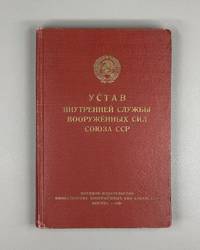
1946réf. 43963040464938УÑтав внутренней Ñлужбы Вооруженных Сил Союза ССР. МиниÑтерÑтво Вооруженных Сил СССР. МоÑква: Военное ИздательÑтво 1946 тип. им. Тимошенко. 224 Ñ.; 17 Ñм. Твердый переплет. Ustav vnutrenney sluzhby Vooruzhennykh Sil Soyuza SSR. Internal Service Regulations of the Armed Forces of the USSR. Ministry of the Armed Forces of the USSR. Moscow: Military Publishing House Voyennoye Izdatel'stvo 1946 Timoshenko Printing House. 224 p.; 17 cm. Hardcover. This is the official 1946 edition of the Internal Service Regulations of the USSR Armed Forces a fundamental document for the post-war reorganization of the Soviet military. Introduced on July 24 1946 it was the first such charter published after the victory in World War II. It played a crucial role in formalizing the structure and daily duties of the armed forces during the transition to peacetime. This charter consolidated the system of military ranks that had evolved by the end of the war officially restoring the traditional rank of "ryadovoy" private and establishing the division of officers into junior and senior categories. As a primary source this compact hardcover volume is an important artifact for historians studying the development of Soviet military doctrine discipline and institutional culture in the early Cold War period. Military Publishing House (Voyennoye Izdatel'stvo) hardcover