8 158 résultats
1991réf. 055868Tbilisi & Moscow: Komitet Geodeziii Kartohgrafii SSSR / Tbilisskoj Kartograficheskoj Fabrikoj 1991. No Binding. Very Good. A late Soviet map of Abkhazia published in 1991 one year before it became a free republic by the Tbilisi Cartography Factory. Scarce. One of 2150 copies. Slight stains on surface slight chippings on extremities and doodles by pen on verso otherwise a good copy. The Transcaucasian Geodetic Administration of the USSR was established in Tbilisi in 1929 with a small cartographic section. Between 1930 and 1931 it compiled a map of Transcaucasia at a scale of 1:500000 which was printed in Leningrad. The printing of maps in Tbilisi began in 1932 following the receipt of some German-made equipment. The Factory itself was officially founded in 1933 and its first major project was the compilation of a topographic atlas of Transcaucasia in 44 sheets printed in Moscow between 1934 and 1935. The factory's development accelerated in 1935 with the arrival of new equipment and the expansion of staff. However in 1936-37 it faced significant sabotage. In 1938 the factory underwent a complete reorganization with young experts taking leadership roles. Among them were engineer cartographers M. A. Pevlov N. A. Suzdal'skiy V. I. Arzamastsev and S. N. Ter-Grigorian. The printing of maps in Georgian Armenian and Azerbaijani languages became a notable achievement highlighted in Soviet literature as a key accomplishment of the factory. The factory's organizational structure included departments for Map Compilation Lithography Engraving Printing and Transfer. The Tbilisi Cartographic Factory remained active even after Perestroika continuing its work into 1991. OCLC locates two copies in LoC in the US: 32549580. Komitet Geodeziii Kartohgrafii SSSR / Tbilisskoj Kartograficheskoj Fabrikoj unknown
in-8°, 178 pages, abdt ill. in-t. N./coul., broche, couv. Ill. plast. Tres bel exemplaire, tres frais. [HA-109/7*][AR-1]
ISBN : 2130377513. PUF. 1982. In-8 Carré. Broché. Bon état. Couv. légèrement pliée. Dos satisfaisant. Intérieur frais. 334 pages. (Rare) 'Recherches politiques'. Notes et prés. de Jean-Yves Potel. Trad. de l'anglmais par N. Burgi, A. Brossat, A. Wallon. Couverture de WIAZ.
1988Contains color plates. 275x185 mm. 63 pages. Gilt hardcover with dust-jacket. Jacket and pages yellowing. Else in good condition.
1988Contains color plates. 275x185 mm. 63 pages. Gilt hardcover with dust-jacket. Jacket yellowing and tattered. Sticker on front inner cover. Else in good condition.
19381st Yiddish Edition. Original publishers decorated cloth, 12mo, 114 pages ; 18 cm. In Yiddish. The translator, Itzik Feffer (1900 1952) was a Soviet Yiddish poet executed on the Night of the Murdered Poets during Joseph Stalin's purges During the Second World War, he was a military reporter with the rank of colonel and was vice chairman of the Soviet Jewish Anti-Fascist Committee (JAC). He and Solomon Mikhoels traveled to the United States in 1943 in a well-documented fund-raising trip. In 1948, after the assassination of the JAC Chairman Solomon Mikhoels, Feffer, along with other JAC members, was arrested and accused of treason. Feffer had been an informer for the NKVD (predecessor of the KGB) since 1943. FeFfer reportedly cooperated with the investigation, providing false information that would lead to the arrest and indictment of over a hundred people, but at the trial, he made openly nationalistic statements and expressed pride in his Jewish identity. Feffer had also allegedly been one of the most loyal and conformist Yiddish poets, who had helped to enforce strict ideological control over other Yiddish writers, and had a history of denouncing colleagues for their nationalistic hysteria. However, in 1952, Feffer, along with other defendants, was tried at a closed JAC trial, and executed on August 12, 1952, at Lubyanka prison ..The American concert singer and actor Paul Robeson met Feffer on July 8, 1943, in New York during a Jewish Anti-Fascist Committee event chaired by Albert Einstein, one of the largest pro-Soviet rallies ever held in the United States. After the rally, Paul Robeson and his wife Eslanda Robeson, befriended Feffer and Mikhoels. Six years later, in June 1949, during the 150th anniversary celebration of the birth of Alexander Pushkin, Robeson visited the Soviet Union to sing in concert. According to David Horowitz: In America, the question "What happened to Itzik Feffer?" entered the currency of political debate. There was talk in intellectual circles that Jews were being killed in a new Soviet purge and that Feffer was one of them. It was to quell such rumors that Robeson asked to see his old friend, but he was told by Soviet officials that he would have to wait. Eventually, he was informed that the poet was vacationing in the Crimea and would see him as soon as he returned. The reality was that Feffer had already been in prison for a half year, and his Soviet captors did not want to bring him to Robeson immediately because he had become emaciated from lack of food. While Robeson waited in Moscow, Stalin's police brought Feffer out of prison, put him the care of doctors, and began fattening him up for the interview. When he looked sufficiently healthy, he was brought to Moscow. The two men met in a room that was under secret surveillance. Feffer knew he could not speak freely. When Robeson asked how he was, he drew his finger nervously across his throat and motioned with his eyes and lips to his American comrade. They're goin to kill us, he said. When you return to America you must speak out and save us. During his concert in Tchaikovsky Hall on June 14 - which was broadcast across the entire country - Robeson publicly paid tribute to Feffer and the late Mikhoels, singing the Vilna Partisan song Zog Nit Keynmol in both Russian and Yiddish .Feffer was a prolific poet who wrote almost exclusively in Yiddish, and his poems were widely translated into Russian and Ukrainian. He is considered one of the greatest Soviet poets in the Yiddish language and his poems were widely admired inside and outside Russia (Wikipedia, 2019). SUBJECT(S): Yiddish literature -- Translations from Russian. Russian literature. OCLC: 19304065. OCLC lists 15 copies worldwide, but 13 of these are in a listing which indicates Also issued online, so some (or many of these?) may be online access copies. Very Good Condition, a beautiful copy. (yid-41-82A)
DENOEL GONTHIER. 1968. In-12 Carré. Broché. Bon état. Couv. convenable. Dos satisfaisant. Intérieur frais. 221 pages COLLECTION BIBLIOTHEQUE MEDIATIONS N°57
194420 cm, rilegatura in tela, copertine originali applicate ai piatti e al dorso, p. viii, 469, la pag. 1-2 è fuori posto
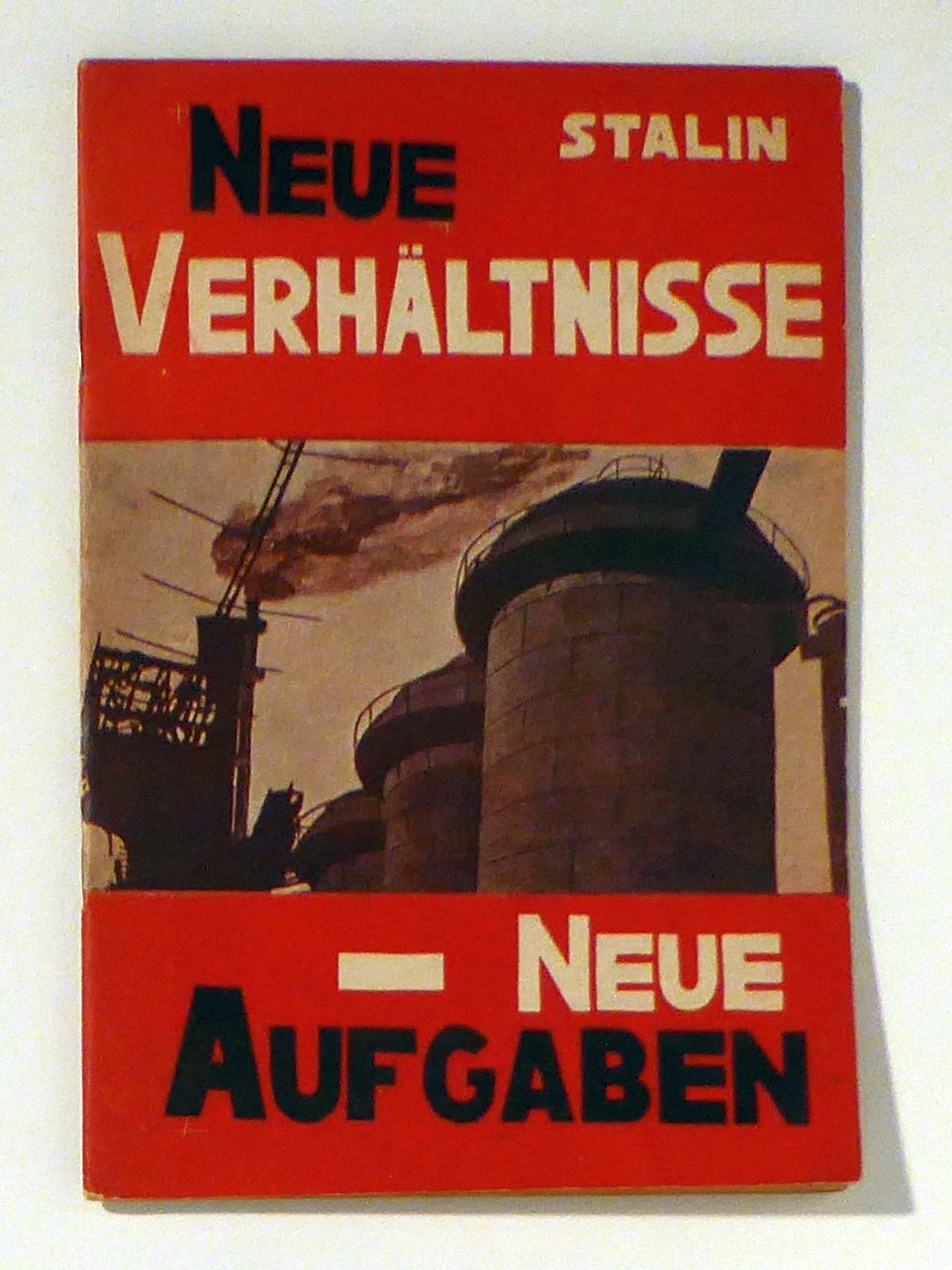
1934réf. 165353Moskau - Leningrad, Verlagsgsenschaft Ausländischer Arbeiter in der UdVSerSlRA gs(GEVNOesgsaeanrs)chaft Ausländischer Arbeiter in der UdSSR, 1934. 57, [2] S., Original-Broschur, kl.8°. Softcover Umschlag und Papier etwas gebräunt, hinterer Deckel mit kleiner Fehlstelle.
1932réf. 76404Moskau, Verlagsgenossenschaft ausländischer Arbeiter in der UdSSR, 1932. 32 S., Original-Broschur, 8°. Zweite Auflage. Softcover Papier etwas gebräunt.
1935réf. 63128Moskau; Leningrad, Verlagsgenossenschaft ausländischer Arbeiter in der UdSSR, 1935. 14, (1) S., Or.br. mit Klammerheftung, kl.8°. Erste deutsche Ausgabe. Softcover
réf. DADAX0801891825New unknown
1970n. L16 in 16°, bross. edit. ill., firma d'appartenenza
Paris, Denoël et Steele, 1934, in-8, br. editoriale con ritratto di Stalin sulla copertina anteriore, pp. VII, [1], 216, [4]. Buon esemplare.
[Roma], Edizioni del parito Comunista Italiano, 1944, in-8 piccolo, br. editoriale, pp. 36. Coll. "Piccola biblioteca marxista", n. 2. Ottimo esemplare.
1970In 8° br. fig. pp. 401, ben tenuto
Firenze, A.P.E., [dopo il 1938], in-8, br. editoriale, pp. VIII, 448. ottime condizioni. Ottimo esemplare.
19441 Vol. In-8 gr pag. 47 Interessante pubblicazione. Copia stanca PROG 42921 CATT_ATT 57
1935STALIN Lo stakhanovismo di Stalin (discorso alla prima conferenza degli stakhanovisti dell'U.R.S.S.). Roma, Società Editrice l'Unità 1935 italian, 22 ST1092B Brossura editoriale, volume in buone condizioni, segni di usura causati dal fattore tempo sulla copertina, interno in ottimo stato, legatura salda 22 pagine circa Copertina come da foto Titolo completo: Lo stakhanovismo di Stalin (discorso alla prima conferenza degli stakhanovisti dell'U.R.S.S.)
1952réf. R320010123EN LANGUES ETRANGERES - MOSCOU. 1952. In-12. Broché. Etat d'usage, Couv. convenable, Dos satisfaisant, Intérieur frais. 46 pages agraffées.. . . . Classification Dewey : 947-Europe de l'Est, URSS
1931réf. R300275388Librairie Valois. 1931. In-12. Broché. Etat d'usage, Couv. légèrement passée, Dos satisfaisant, Quelques rousseurs. XXXII + 206 pages. Ex libris à l'encre en page de titre. Trace de mouillure en coiffe de pied.. . . . Classification Dewey : 947-Europe de l'Est, URSS
1968réf. R300273298Denoël. 1968. In-12. Broché. Etat d'usage, Couv. légèrement passée, Dos satisfaisant, Intérieur frais. 221 pages.. . . . Classification Dewey : 947-Europe de l'Est, URSS
1968réf. RO80245524Denoël. 1968. In-12. Broché. Etat d'usage, Couv. partiel. décollorée, Dos satisfaisant, Intérieur acceptable. 221 pages.. . . . Classification Dewey : 947-Europe de l'Est, URSS
1974réf. R300275027Du Centenaire. 1974. In-12. Broché. Bon état, Couv. convenable, Dos satisfaisant, Intérieur frais. 142 pages - une photo en noir et blanc en frontispice.. . . . Classification Dewey : 947-Europe de l'Est, URSS
1959réf. 124620Plon, 1959, in-8°, 333 pp, traduit du russe et de l'anglais, 9 cartes, notes, broché, bon état