8 544 résultats
réf. 60739aafLausanne, Librairie Payot, 1915, gr. in-8vo, 30 p., avec une carte-postale collée a l'intérieure de la couverte de ‘Miss Edith Cavell’ avec ses chiens, Infirmière anglaise fusillé (ceci tracée et ajouteé a la main ‘assassinée oct. 1915’) à Bruxelles par les allemands... brochure originale.
réf. cROU-1925Toulouse,Privat,1951 ; grand in-8°,broché;couverture de papier gris imprimé en noir;462pp.; piqûres à la couverture et à quelques feuillets.(Gr)
réf. 74187Bruxelles, éd. Gregoir, Wouters et Cie 1839, troisème édition, 3 forts volumes in-8, demi-veau brun foncé, plats papier marbré "gouttes" vert et noir, filets, auteur, titres et tomaisons dorés sur dos lisse, tranches vertes, reliure de l'époque, T 1 : 272 + 276 pp., ill. par deux gravures en frontipices et 2 pl. cartes dépliables, avertissement pour la troisième édition, notes et pièces justificatives, table chronologique et analytique, T 2 : 280 + 268 pp., 2 gravures en frontispice et 2 pl. cartes dépliables, notes et pièces justificatives, table chonologique et analytique, T 3 : 308 + 333 pp., 2 gravures en frontispice, appendice, tables des matières, Bel ensemble des œuvres d'Augustin Thierry (1795 - 1856) qui fut un grand historien français. Belle édition belge, pas courant. Bon état général; le dos du tome 1 est abimé et bon état des 2 autres tomes; papier sans rousseurs sauf sur les cartes, les gravures et sur les toutes premières et dernières pages des trois volumes,
1869réf. cROU-8251869 Paris, Charpentier, 1869 ; 6 volumes in-12°, demi-toile ocre, dos lisse, titre et tomaison dorés (reliure légèrement postérieure); + de 400pp. par volume.
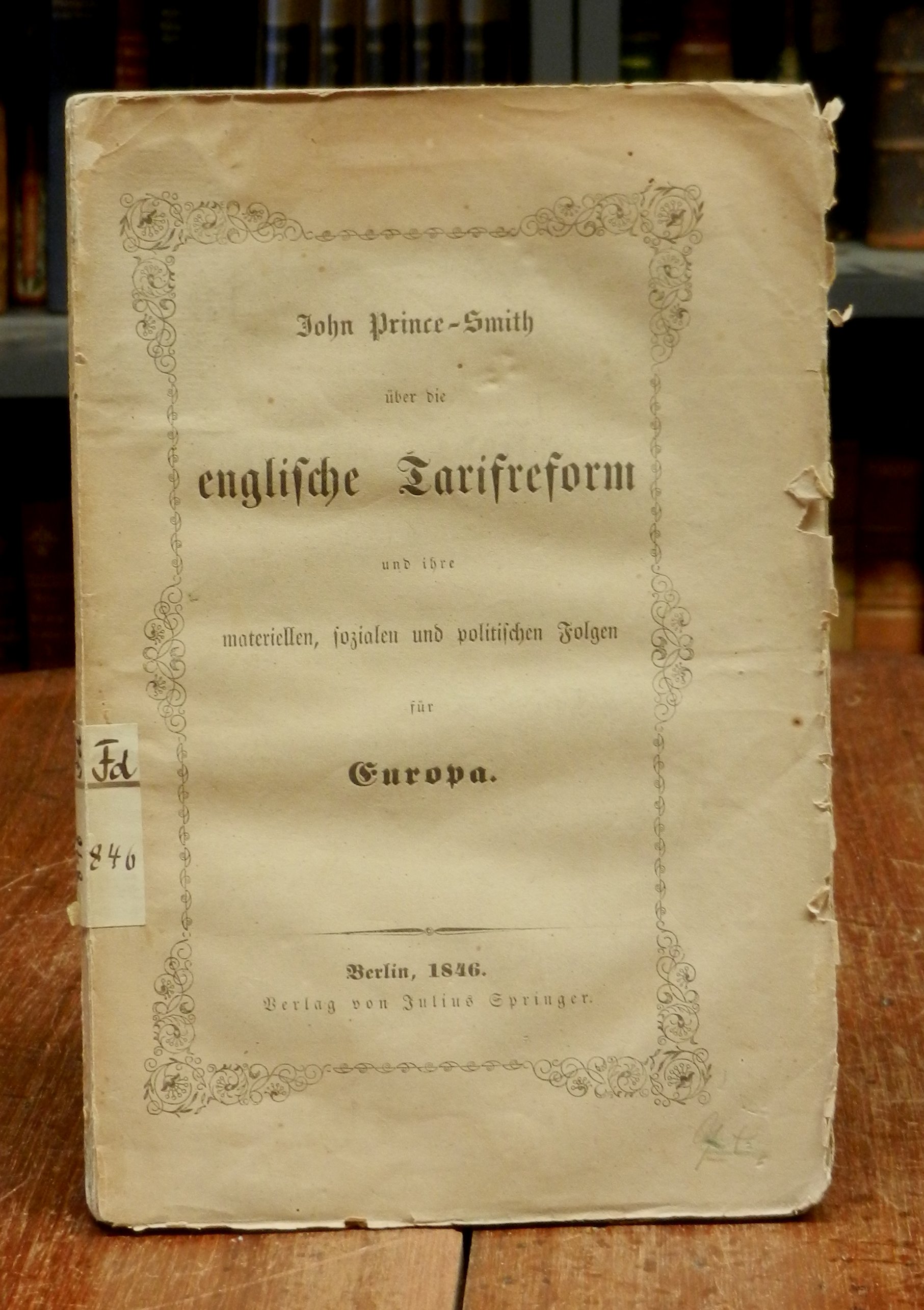
1846réf. 28709-zb5a8Berlin: Julius Springer 1846. VIII (I) und 108 Seiten. Orig. Broschur (der vordere Umschlagdeckel fast ganz lose, ein Signaturschild auf dem Rücken, der Rücken mit Fehlstellen, auf dem Widmungsblatt verso ein alter Bibliotheksstempel (Neustrelitz), angerändert, sonst ordentliches und sauberes, unbeschnittenes Exemplar). 8°. broschiert/ Taschenbuch
1929réf. 5149Paris Flammarion 1929 In-12 260 pp, Bibliothèque de Philosophie scientifique
1845réf. DZN-1573Paris, Guillaumin, 1845, 2 vol. in-8, XXXI-470 pages-(1)+(2)-433 pages-(1). Demi basane verte époque.
réf. 1334650403.Gpaperback. Good. Access codes and supplements are not guaranteed with used items. May be an ex-library book. paperback
réf. 229919Paris, A. Marescq aîné, 1882 in-8, [2] ff. n. ch., 229 pp., broché.
réf. 67761aafMaestricht, Jean-Edme Dufour, M. DCC. LXXV., (1775), in-8vo, frontispice gravé par Helman d'après Eisen + 2 ff. + 170 pp., cartonnage récent recouvert de papier marbré dans le style de l'époque, pièce de titre rouge doré au dos. Bel exemplaire.
1935réf. 31595Paris Desclée & Cie 1935 In-8 Collection "Temps et Visages" sous la direction d'André George - 267 pp, avec 5 portraits et 1 fac-similé hors-texte (non compris dans la pagination) ; quelques annotations au stylo par un professeur
1769réf. 43511ABParis, Durand 1769. 3 Bände. [2] Bll., IV, LI, 454 S., [1] Bl.; [2] Bll., XII, 480 S., [1] Bl.; [2] Bll., XII, 352 S., [3] Bll. Leder der Zeit mit reicher Rückenvergoldung. Geringf. berieben, Kapitale und Ecken teils auch etwas bestoßen.
1909réf. 21865Paris, Félix Alcan, 1909. In-8°. XIV, 282 (32) p. Reliure demi-toile, titre doré sur le dos. - Inclus: La Guerre Sud-Africaine et l'Opinion; L'Organisation du Parti ouvrier; L'Évolution du Gouvernement et de l'État. Reliure un peu frottée. 2 cachets d'une bibliothèque sur les pages préliminaires, 3 cachets sur la page de titre, 1 cachet sur la dernière page.
2015réf. 116979Albin Michel, 2015, pt in-8°, 260 pp, biblio, broché, couv. illustrée, bon état
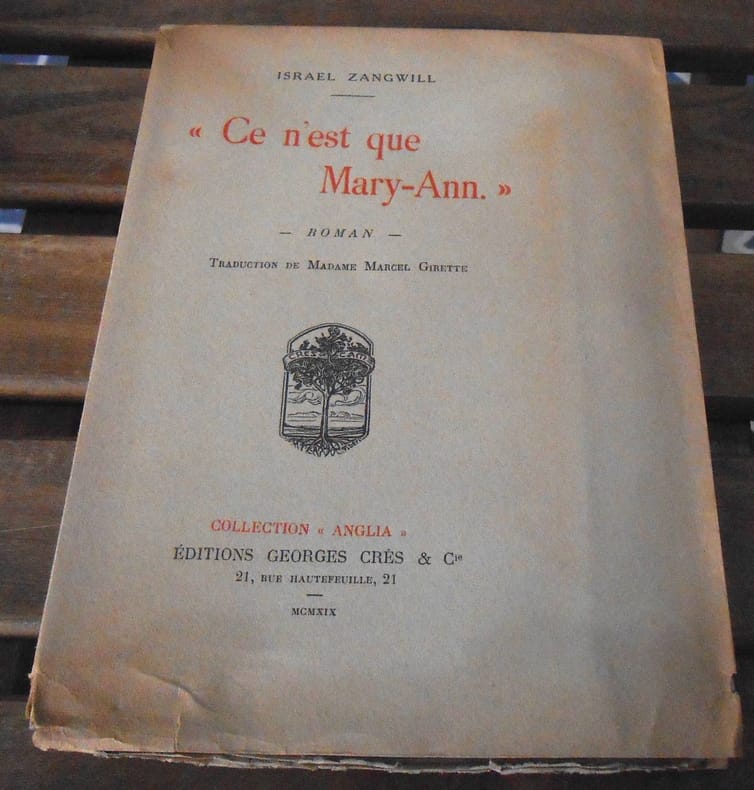
1919réf. 100074890collection « Anglia ». Paris. 15 cm x 20 cm. 1919. Broché. 247 pages. Paris Éditions Gallimard 1951 édition originale service de presse. Broché 12 cm x 19 cm 241 pages. Texte de Mouloudji bel envoi de l'auteur bien complet du prière d'insérer. Bon état Paris Éditions Georges Crès & Cie collection « Anglia » 1919 édition originale 1/35 (n°25) exemplaires sur vergé d'Arches seul grand papier. Broché 15 cm x 20 cm 247 pages - Texte de Israël Zangwill traduction de Madame Marcel Girette. Bon état
réf. 37882aafLeipzig, Duncker & Humblot, 1872, in-8°, XXIV + 288 S. / XIV + 370 S Stempel a.d. Titelbl., Original-Pappband. (Bd. 2 Kapital leicht eingerissen).
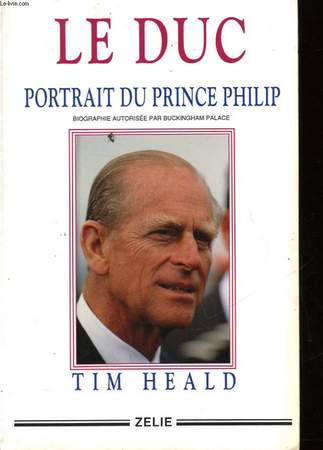
1992réf. RO30035598ZELIE. 1992. In-8. Broché. Bon état, Couv. convenable, Dos satisfaisant, Intérieur frais. 249 pages. Nombreuses photos en noir et blanc hors texte.. . . . Classification Dewey : 942-Angleterre
1960Berlin, Holle & Co Verlag, s.d. (vers 1960); in-8 oblong, 38 pp., cartonnage d'éditeur, sans jaquette. En langue allemande. Nombreuses illustrations (32) en noir et blanc. Très bon état.
réf. 609London. The Bodley Head. 1960. In-8°, reliure cartonnage rouge. 207 pages. E.O. anglaise.
réf. 611London. Corgi Books. 1966. In-12 broché. Couverture illustrée. 188 pages. 2è. édition anglaise.
1939réf. 83837London: United Kingdom Lord Privy Seal's Office 1939. Presumed First Edition First printing. Single sheet printed on both sides. Fair. Sheet is approximately 11 inches by 8.5 inches folded in half with printing on all four sides/pages. Sheet has wear soiling and some staining. Minor corner creasing. This has on the lower right corner of the last page the number 51-4154 printer's code. This is Public Information Leaflet No. 2. The contents address taking care of one's gas mask how to store it how to put it on how to take it off and how to put one's mask away. Additionally there is information relative to blackout requirements and how to mask one's windows and control interior lighting. There was a pointed reminder not to forget about skylights for those structures with them. Air Raid Precautions ARP refers to a number of organizations and guidelines in the United Kingdom dedicated to the protection of civilians from the danger of air raids. Government consideration for air raid precautions increased in the 1920s and 30s with the Raid Wardens' Service set up in 1937 to report on bombing incidents. Every local council was responsible for organizing ARP wardens messengers ambulance drivers rescue parties and liaison with police and fire brigades. From 1 September 1939 ARP wardens enforced the "blackout". Heavy curtains and shutters were required on all private residences commercial premises and factories to prevent light escaping and so making them a possible marker for enemy bombers to locate their targets. With increased enemy bombing during the Blitz the ARP services were central in reporting and dealing with bombing incidents. They managed the air raid sirens and ensured people were directed to shelters. The fear of the use of poison gas by German aircraft was one of the paramount concerns of the Second World War. Although Britain France and Germany had all renewed the Geneva Gas Protocol 1925 in September 1939 there were still concerns that the enemy might have employed gas against military or civilian personnel and ARP personnel were trained to handle gas attacks and on anti-gas measures and protection. Several arms of the ARP services were directly concerned with gas. The Decontamination Service was the first to decontaminate roads buildings and materials contaminated by liquid or jelly gases which would evaporate over time and these would have been dealt with by using a neutralizing agent against the liquid or jelly. Decontamination of people was carried out as part of first aid while later decontamination personnel were trained in rescue work as well. Depots were set up as six depots per 100000 people with two decontamination squadrons per depot each squadron consisting of six men with their equipment. The Cleansing Service was to clean people who had been exposed through showers by mobile units with special vans and lorries. Clothing had to be boiled if exposed for varying lengths of time dependent on the material. Civilian clothing was the responsibility of the Ministry of Health. Each gas presented its own problems and required special counters and the Gas Identification Service with 3 personnel per 100000 population provided where possible was to identify the gas used in an attack. United Kingdom, Lord Privy Seal's Office unknown
1939réf. 83839London: United Kingdom Lord Privy Seal's Office 1939. Presumed First Edition First printing. Single sheet printed on both sides. Fair. Sheet is approximately 11 inches by 8.5 inches folded in half with printing on all four sides/pages. Sheet has wear soiling and some staining. Some creasing noted. Contains the number 51--4382 1 which may be related to the printing. This is Public Information Leaflet No. 4. It addresses Your Food in War-Time What the Government Have Done How You Can Help Food Supplies For Evacuation National Housekeeping in War Time with a discussion of Central Control and Local Distribution and a Rationing Scheme. At the end of the leaflet enquiries about food supplies in war time were directed to the Director Food Defence Plans Department. Air Raid Precautions ARP refers to a number of organizations and guidelines in the United Kingdom dedicated to the protection of civilians from the danger of air raids. Government consideration for air raid precautions increased in the 1920s and 30s with the Raid Wardens' Service set up in 1937 to report on bombing incidents. Every local council was responsible for organizing ARP wardens messengers ambulance drivers rescue parties and liaison with police and fire brigades. From 1 September 1939 ARP wardens enforced the "blackout". Heavy curtains and shutters were required on all private residences commercial premises and factories to prevent light escaping and so making them a possible marker for enemy bombers to locate their targets. With increased enemy bombing during the Blitz the ARP services were central in reporting and dealing with bombing incidents. They managed the air raid sirens and ensured people were directed to shelters. For many people who experienced World War Two on the homefront their most vivid memories were of food. Rationing changed the way people cooked and ate - food shortages meant that home cooks often had to use their initiative to create meals out of meager rations. This led to popular dishes such as Lord Woolton Pie Vinegar Cake and Spam Hash. The government rationed food in World War Two to ensure people got an equal amount of food each week. In 1939 Britain only grew enough food to feed one person in every three and with Nazi U-boats threatening to starve the country into defeat the government had to take action to prevent a food shortage. It was also worried that as food became scarcer prices would soar and people would hoard food. On 3 April 1940 Baron Woolton became Minister of Food. He had been a social workers and former managing director of the Lewis store chain in Northern England. Woolton was the mastermind behind the recipe books and nutritional advice offered by the Ministry of Food - he knew that it wasn't enough to ration food; the government had to advise people as well. Woolton worked closely with his chief scientific advisor Jack Drummond who helped the government's rationing strategy. Woolton's method communicating with the public was effective and by 1945 housewives had a much deeper understanding of nutrition. The Ministry issued many cooking leaflets often dedicated to specific topics such as the health benefits of carrots. The Ministry of Food employed 15000 people at its height with 18 Food Officers and 1500 Food Control Committees. The Ministry became involved in every aspect of consumer life - from telling grocers where to get their supplies from in order to reduce petrol costs to advising home cooks on recipes. Unknown to the British population the Ministry of Food also created secret food depot warehouses throughout the country in which it stockpiled food in the event of invasion. The Ministry of Food issued ration books to every family. Each one contained coupons which allowed them to buy a limited amount. Petrol was the first commodity to be rationed in 1939 followed by butter sugar bacon paper and meat in early 1940. By the end of the war half of Britain's food was rationed. United Kingdom, Lord Privy Seal's Office unknown
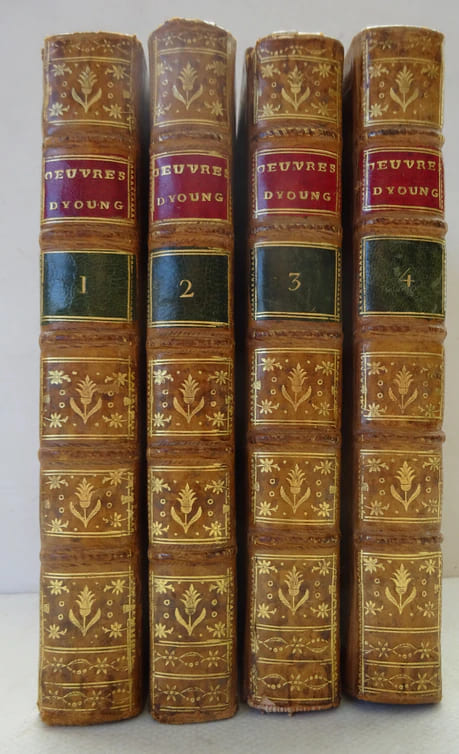
réf. GMF-1291YOUNG (Edward). Les Nuits. Traduites de l'anglois par M. le Tourneur. Seconde édition, corrigée & augmentée du Triomphe de la religion. [Suivi de: Œuvres diverses.] A Paris, chez Lejay (1769-1770). 4 volumes in-8 de lvij-363, 403, xlix-363 et 392 pages, 4 frontispices, reliures en veau havane marbré, dos à nerfs ornés, pièces de titre de maroquin rouge et de tomaison de maroquin vert, filet doré sur les coupes, tranches rouges. Seconde édition française pour les Nuits (publiée la même année que la première), et première édition française pour les Œuvres diverses. Pierre Le Tourneur traduisit les Nuits en prose plus emphatique et plus lugubre que les vers de l’original. Cette version eut un immense succès et assura, dans ce pays où elle devint un classique de l’école romantique, une réputation supérieure à celle même dont jouissait Young dans son pays. Ex-libris armorié Faulque de Jonquières aux contreplats, bibliothécaire au ministère de la Marine, mort en 1873. Un bout de papier est collé sur la page de titre du premier volume. Sur ce papier se trouve ce qui pourrait être la signature d'Edward Young selon Marguerite de Jonquières. Un coin du tome 1 abîmé, coiffes du tome 3 légèrement abîmées, très rares rousseurs. Bel exemplaire. Très frais.
réf. RO60107600City of York. Non daté. In-8. En feuillets. Bon état, Couv. convenable, Dos satisfaisant, Intérieur frais. Plaquette dépliable illustrée de plans et photos en noir et blanc, recto-verso.. . . . Classification Dewey : 942-Angleterre
2018New New Turkish Original bdg. Dust wrapper. 4to. (29 x 25 cm). In Turkish. 175 p., color and b/w ills. Yildiz Sarayi Fotograf Koleksiyonu üzerinden Osmanli-Amerika iliskileri: Karsilasmalar - kesismeler - tanismalar. Ottoman-American relations with photographs from the Yildiz Palace Photography Collection.