LA BILLARDIERE (Jacques-Julien Houton de).Livre Rare Book

1 007 résultats
1799réf. PHO-333Paris, Jansen, an VIII (1799) 2 vol. in-8 ,demi-veau havane, dos lisse orné (rel. Légt post., mors usagés et rongés) et un atlas in-folio en seconde édition (1817) brochure moderne en papier marbré. Texte :Tome I : xvi pp. (dont faux-titre et titre), 440 pp.Tome II : 332 pp. (dont le faux-titre et le titre), 109 pp., (1)f. Atlas : titre gravé, grande carte sur double page (Mer des Indes et une partie de celle du Sud, par Darbié du Bocage - volante) et 43 planches (vues, scènes, costumes, portraits et types, faune et flore) gravées sur cuivre par Dien, Copia, Pérée, etc., d'après Piron, Redouté, Audebert, etc. représentant des personnages, des scènes de vie, des armes, des vues, la faune et la flore. Nombreuses piqûres et taches d'humidité, mais papier solide, à bonnes marges.
réf. PE70Oblong Folio ca. 33 x 24 cm or 13 x 9 ¼ in. 26 card stock leaves 12 blank. With 35 mounted original gelatin silver photographs from ca. 175x125 cm 7 x 5 in to 5x8 cm 2x3 in. At least fourteen images with period pencil/ink captions in Dutch on verso; at least ten images with ink stamps “Ontvangen Received - Beantwoord Answered” and dates from 1907 to 1909 on verso. Period brown half sheep album with green cloth boards; spine and boards with gilt-tooled borders; all edges coloured; decorative endpapers. Binding slightly rubbed on extremities; two photos detached and loosely inserted a few photos mildly faded but overall a very good album of interesting photos. Historically significant collection of original photographs documenting the construction and early operations of a factory in the Dutch East Indies – most likely the sugar factory complex in Djatiroto Jatiroto Lumajang Regency in East Java. Built and owned by the Dutch “Handelsvereeniging Amsterdam” company HVA in ca. 1905-1910 the complex covered the “area of approximately 215 hectares” with “the actual factory surrounded by the factory office the repair workshop and the large warehouse <…> the marshalling yard with the locomotive shed and the field for the trains of the company that transports sugar cane from the fields which includes coal and water reservoirs weighbridges and central switch control” in translation See: Een suikerfabriek op Java// Neerlandia: Organ van het Algemeen Nederlandsch Verbond. Vol. 13 No. 8 Aug. 1909 p. 183. The factory buildings housed the mill and boiler installations laboratory and sugar storage juice processing equipment centrifuges and sugar dryer. The complex also included residences for European officials dwellings for the Javanese workers a hospital a club and a hotel. Sugar cane was brought from the enterprise fields by small trains; the final product left the facility via the specially constructed train station See: Een suikerfabriek op Java… pp. 183-186. The complex was considered one of the most modern sugar factories in the Dutch East Indies see also: Geuns M. van. De suikeronderneming Djatiroto en de regeling van het werkcontract op Java. Soerabaya 1908. The album opens with a portrait of European administrators posing on a train platform driven by a small locomotive through a sugar cane field. Similar locomotives were used on the Djatiroto complex. Six images show the interior of the factory buildings machinery and workers. There are also images of an unfinished rail track earthworks a dam construction with a pencil caption “Dam rechteroever Djatiroto” and an ink-stamped date “18 Nov. 1907” European administrators posing in a partly-cleared forest area a side of a settlement for Javanese workers note a waving Dutch flag on a decorated pole and a railway station which looks very similar to the Djatiroto station see a photo from a 1917 keepsake album available online. The album also includes several portraits or scenes with Javanese people and the compiler and his family. Three photos at the rear are captioned “Portsmouth Dominica” and “Bridgetown Barbados” – they were possibly taken on the compiler’s educational trip to the Caribbean undertaken to study the local sugar cane industry and technologies. Overall an interesting collection of original photos of a Dutch sugar-processing facility in East Java in the early 20th century. hardcover
réf. 98301London Printed for T. Becket and P. A. Dehondt 1762. 8vo. XV 1 blank 341 1 s. 11 engraved plates of which one folding of Batavia. Finely bound in brown full calf richly gilt spine in six compartments. A little foxing. . unknown
First edition, 3 vols., comprising 2 volumes of text, 8vo (202 x 125 mm) xv, 423, [3]; 348, [2], with final errata leaf to each volume, wanting the half-titles, plus 4to atlas volume (305 x 220 mm), title, 1 leaf description of the plates and maps, 18 mostly large folding engraved maps and plates, all very clean and bright, text volumes in contemporary speckled calf, double gilt fillet to covers, spine gilt, Marchioness of Downshire monogram with crown above in top compartment of each volume, minor rubbing, otherwise attractively bound text volumes in near fine condition, the atlas in the original blue paper covered boards with original printed title label on upper cover, also in fine clean condition. Rare account of a voyage to the East Indies and a description of French possessions in the Indian Ocean (Mauritius and Reunion) and of Java including Batavia, now Jakarta, which was then ruled by France. The atlas volume contains 7 maps all engraved by Tardieu and it includes a fine large map of Java (380 x 630 mm). The 11 other plates show costumes, native inhabitants etc. and include 3 fine folding views of Batavia and a view of the Dutch settlement of Keppen on the island of Timor. Volume 2 includes a substantial vocabulary of the Malay language. Provenance: Mary Hill (n?e Sandys, 1764-1836), Marchioness of Downshire and Baroness Sandys; the library of the Second Baron Hesketh of Ombersley Court, Worcestershire.
réf. 7437Paris - Bruxelles, Editions G. Van Oest, Librairie Nationale d'Art et d'Histoire, 1914-1935. 18 volumes in folio, reliure moderne uniforme plein cuir (sauf pour le Volume II, en reliure cartonnée éditeur), très bon état.
1839réf. 66473Berlin, Gedruckt in der Druckerei der Königlichen Akademie der Wissenschaften, 1836-1839. 4°. Mit 17 doppelt gefalt. Tabellen u. 11 meist gefalt. lithogr. Tafeln (davon eine in Rot u. Schwarz). XXIV S., 1 Bl., CCCCXXX, 312 S., 1 Bl. (Errata); 2 Bll., XXXIV S., 1 Bl., 424, 97 S.; 3 Bll., S. (425-)1028, Lwd. d. Zt. m. goldgepr. Rückentitel (Bd. 1) bzw. OKart.-Bde. (Interimsumschläge) m. gedruckten Rückenschildern (Bde. 2 u. 3).
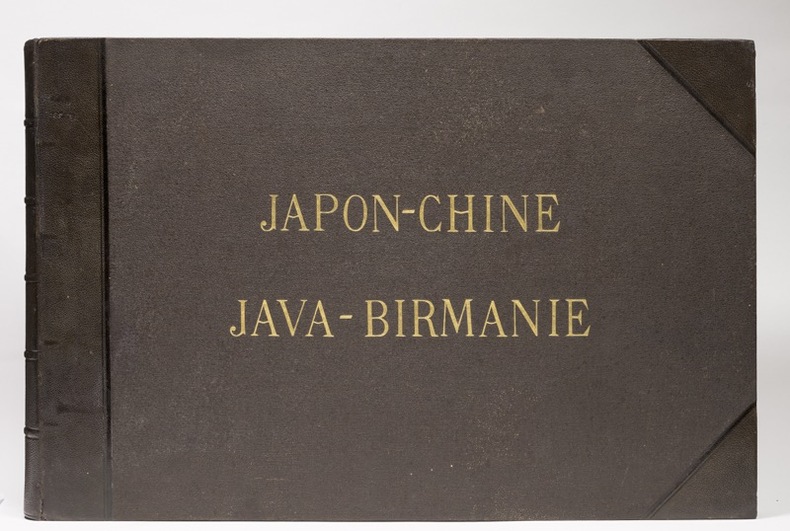
1868réf. 22674Vers 1868 in-4 oblong demi-chagrin havane, tranches dorées [Rel. de l'époque], qqs piqûres, marginales pour la plupart