2 761 résultats
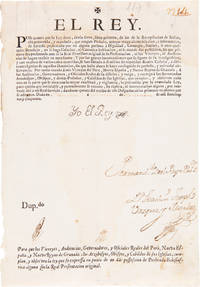
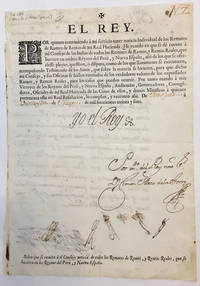
1737réf. 36284Madrid. 1737. A rare broadside proclamation by Philip V King of Spain demanding that news of all business closings and information regarding revenues in the viceroyalties of Peru and New Spain be transmitted to the Council of the Indies. Printed in Madrid and distributed to royal officials in both Spain and the New World the document is addressed to the viceroys officials of the treasury and other officials whose duties are concerned with executing this order. This copy accomplished at Aranjuez on May 22 1737 is signed by Simon Alonso de la Torre as representative of the King of Spain with the inscription: "Yo el Rey." A manuscript note on the verso written in the city of Santiago de Chile on November 14 1738 describes the distribution of this copy and reiterates the content of the printed broadside. A rare broadside concerned with royal finances in both the viceroyalties of Peru and New Spain with a contemporary manuscript inscription recording the enforcement of the proclamation. Not in Medina BHA nor on OCLC. Dbd. Accomplished in manuscript at Aranjuez Spain on May 22 1737 signed by Simon Alonso de la Torre with additional contemporary manuscript notations. Manuscript inscription on verso see below. Two-inch slit on left side of recto not affecting text. A very good copy. unknown books
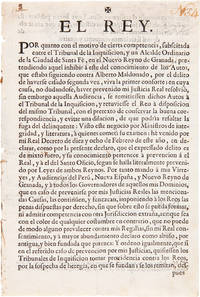
1754réf. 36509Madrid. 1754. Spain Prosecutes Polygamists in the Americas A rare proclamation by Ferdinand VI King of Spain who declares that criminals tried for polygamy are to be prosecuted by both the Tribunal of the Inquisition and the Royal Magistrates. This particular decree refers to a case against one Alberto Maldonado who was tried in the city of Santa Fé in New Granada for the crime of marrying a second time while his first wife was still alive. The King confirms that such a crime pertains to both religious and civil jurisdictions and such acts are to be prevented by the laws of both realms. This proclamation was to be sent to the viceroys of Peru New Spain and New Granada as well as governors in those domains. This copy accomplished in manuscript in Buen Retiro Spain on March 19 1754 is signed by Joachim Joseph Vazquez y Morales as representative of the King of Spain with the inscription "Yo El Rey" and the annotation "Por mandado del Rey." Five separate manuscript inscriptions on the recto and verso of the additional leaf written in Santiago de Chile in June 1755 document the dissemination of the text to various local authorities. A rare proclamation concerning criminal proceedings against polygamy in the New World. Not in Medina BHA nor on OCLC. 2pp. plus one leaf with contemporary inscription on recto. Folio. Dbd. Sign of the cross printed at head of title. Contemporary manuscript annotations in ink later annotations in pencil. Accomplished in manuscript with additional manuscript annotations. Manuscript inscription on blank leaf written on March 20 1756 in Santiago de Chile. Extremely light dampstaining on top margin. Very good. unknown
1756réf. 36504Madrid. 1756. A rare proclamation by Ferdinand VI King of Spain demanding that in the Spanish Indies the appeals of lawsuits pertaining to the Royal Exchequer be diligently observed and that the results of these court proceedings with economic ramifications be transmitted to the Crown. This particular decree regarding legal decisions related to the business of the Real Hacienda was issued following a case before the Real Audiencia of the Island of Española which concerned prizes that some Spanish Corsairs from that island had obtained. This proclamation was to be sent to the Viceroys of New Spain Peru and New Granada as well as officials of the Royal Exchequer and judges in those provinces. This copy accomplished in manuscript in Buen Retiro on Feb. 7 1756 is signed by Joachim Joseph Vazquez y Morales as representative of the King of Spain with the inscription "Yo El Rey" and the annotation "Por mandado del Rey." A brief manuscript note on the integral leaf was endorsed on April 15 1758 in Buenos Aires . A rare proclamation concerning Spanish legal proceedings in the New World. Not in Medina BHA nor on OCLC. 2pp. plus integral leaf. Folio. Dbd. Maltese cross printed at head of titlepage. Contemporary manuscript annotations in ink later annotation on first page in pencil. Accomplished in manuscript at Buen Retiro Spain on Feb. 7 1756 signed by Joachim Joseph Vazquez y Morales with additional manuscript annotations. Brief inscription on integral leaf see below. Extremely light dampstaining in margins. A very good copy. unknown
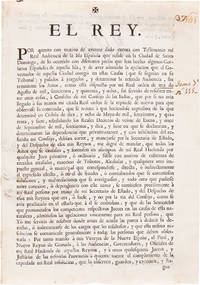
1750réf. 36499Madrid. 1750. Spain Regulates Ecclesiastical Stipends in the Americas A rare broadside proclamation by Ferdinand VI King of Spain demanding that archbishops bishops and other church officials in Peru New Spain and New Granada observe the law that prohibits them from possessing or obtaining an ecclesiastical prebend without first presenting themselves to royal authority. Printed in Madrid and distributed to royal officials in the New World this copy accomplished at San Lorenzo Spain on Nov. 1 1750 is signed by Joachim Joseph Vazquez y Morales as representative of the King of Spain with the inscription "Yo El Rey" and the additional manuscript annotation "Por mandado del Rey." A rare broadside concerned with ecclesiastical offices in Peru New Spain and New Granada. Not in Medina BHA nor on OCLC. Accomplished in manuscript see below with additional contemporary manuscript notations. Maltese cross printed at head of title. Dbd. Light dampstaining and soiling. A good copy. unknown
1754réf. 36509Madrid. 1754. Spain Prosecutes Polygamists in the Americas A rare proclamation by Ferdinand VI King of Spain who declares that criminals tried for polygamy are to be prosecuted by both the Tribunal of the Inquisition and the Royal Magistrates. This particular decree refers to a case against one Alberto Maldonado who was tried in the city of Santa Fé in New Granada for the crime of marrying a second time while his first wife was still alive. The King confirms that such a crime pertains to both religious and civil jurisdictions and such acts are to be prevented by the laws of both realms. This proclamation was to be sent to the viceroys of Peru New Spain and New Granada as well as governors in those domains. This copy accomplished in manuscript in Buen Retiro Spain on March 19 1754 is signed by Joachim Joseph Vazquez y Morales as representative of the King of Spain with the inscription "Yo El Rey" and the annotation "Por mandado del Rey." Five separate manuscript inscriptions on the recto and verso of the additional leaf written in Santiago de Chile in June 1755 document the dissemination of the text to various local authorities. A rare proclamation concerning criminal proceedings against polygamy in the New World. Not in Medina BHA nor on OCLC. 2pp. plus one leaf with contemporary inscription on recto. Folio. Dbd. Sign of the cross printed at head of title. Contemporary manuscript annotations in ink later annotations in pencil. Accomplished in manuscript with additional manuscript annotations. Manuscript inscription on blank leaf written on March 20 1756 in Santiago de Chile. Extremely light dampstaining on top margin. Very good. unknown books
1756réf. 36504Madrid. 1756. A rare proclamation by Ferdinand VI King of Spain demanding that in the Spanish Indies the appeals of lawsuits pertaining to the Royal Exchequer be diligently observed and that the results of these court proceedings with economic ramifications be transmitted to the Crown. This particular decree regarding legal decisions related to the business of the Real Hacienda was issued following a case before the Real Audiencia of the Island of Española which concerned prizes that some Spanish Corsairs from that island had obtained. This proclamation was to be sent to the Viceroys of New Spain Peru and New Granada as well as officials of the Royal Exchequer and judges in those provinces. This copy accomplished in manuscript in Buen Retiro on Feb. 7 1756 is signed by Joachim Joseph Vazquez y Morales as representative of the King of Spain with the inscription "Yo El Rey" and the annotation "Por mandado del Rey." A brief manuscript note on the integral leaf was endorsed on April 15 1758 in Buenos Aires . A rare proclamation concerning Spanish legal proceedings in the New World. Not in Medina BHA nor on OCLC. 2pp. plus integral leaf. Folio. Dbd. Maltese cross printed at head of titlepage. Contemporary manuscript annotations in ink later annotation on first page in pencil. Accomplished in manuscript at Buen Retiro Spain on Feb. 7 1756 signed by Joachim Joseph Vazquez y Morales with additional manuscript annotations. Brief inscription on integral leaf see below. Extremely light dampstaining in margins. A very good copy. unknown books
1750réf. 36499Madrid. 1750. Spain Regulates Ecclesiastical Stipends in the Americas A rare broadside proclamation by Ferdinand VI King of Spain demanding that archbishops bishops and other church officials in Peru New Spain and New Granada observe the law that prohibits them from possessing or obtaining an ecclesiastical prebend without first presenting themselves to royal authority. Printed in Madrid and distributed to royal officials in the New World this copy accomplished at San Lorenzo Spain on Nov. 1 1750 is signed by Joachim Joseph Vazquez y Morales as representative of the King of Spain with the inscription "Yo El Rey" and the additional manuscript annotation "Por mandado del Rey." A rare broadside concerned with ecclesiastical offices in Peru New Spain and New Granada. Not in Medina BHA nor on OCLC. Accomplished in manuscript see below with additional contemporary manuscript notations. Maltese cross printed at head of title. Dbd. Light dampstaining and soiling. A good copy. unknown books
1742réf. 5756Paris, Par la compagnie des libraires, 1742. 2 vol. in-12 de XL-360p. + VIII-479-[1] pages, plein veau marbré, dos lisses ornés de filets et fleurons dorés, pièces de titre et tomaison de maroquin rouge et vert, une coiffe et deux coins légèrement frottés.
1947réf. ZB705797Callao: 1947. first edition #285-290 297-305 309-320 327-332 349-404 all complete issues or complete years in ten bindings text darkened ex library good working collection. - If you are reading this this item is actually physically in our stock and ready for shipment once ordered. We are not bookjackers. Buyer is responsible for any additional duties taxes or fees required by recipient's country. Photos available upon request. Callao: unknown
réf. 14594Les Incas ou la destruction de l’Empire du Pérou ; Deux tomes en deux volumes in 12 plein cuir raciné, dos lisse, titre, roulette, filet, caissons, tomaison dorés. Filet doré sur coupes. Tome premier faux titre, titre, XLVIII 311 pages. Tome second faux –titre, titre, 366 pages. Deux ex-libris. A Paris chez LACOMBE libraire 1777. Très bon état. Edition originale parue avant l’édition illustrée la même année.
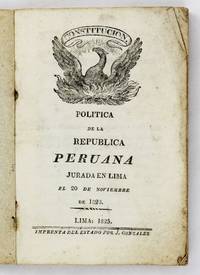
1825réf. 5658Lima 1825. Very good. CXII523pp. Original blue wrappers. Lightly worn spine worn but sound. Minor foxing to title page internally clean. The second edition of the first constitution of Peru and the first to include the "Discurso con Que la Comision de Constitucion Presento el Proyecto de Ella al Congreso Constituyente." Peru declared its independence from Spain in 1821 in a period in which many of Spain's American colonies threw off the colonial yoke. We locate only a handful of copies in OCLC. unknown
1825réf. 5658Lima 1825. Very good. CXII523pp. Original blue wrappers. Lightly worn spine worn but sound. Minor foxing to title page internally clean. The second edition of the first constitution of Peru and the first to include the "Discurso con Que la Comision de Constitucion Presento el Proyecto de Ella al Congreso Constituyente." Peru declared its independence from Spain in 1821 in a period in which many of Spain's American colonies threw off the colonial yoke. We locate only a handful of copies in OCLC. unknown books
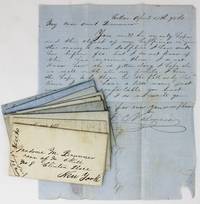
1861réf. 4525Lima and Callao Peru 1861. Very good. Thirteen autograph letters signed totaling twenty-six pages. Original mailing folds minor wear some fold separations and short tears to a few letters. An informative collection of manuscript letters sent back to the United States by John C. Valencia a businessman working in Peru just before the Civil War. John is writing to his wife Josefina and his Aunt Brunner in New York City and Yorkville New York over roughly a two-year period between February 27 1859 and January 14 1861. Apparently Josefina and their children were living with Aunt Brunner in New York at least for a time while John was trying to conclude business related to Peruvian real estate held by his deceased brother and now owned by his sister-in-law. In one letter he mentions that he working in the sea port in order to raise some amount of money to send home. John misses his wife and family and writes with longing about returning to his wife often mentions the money he is sending back with each letter or plans to send soon sometimes reports on his business activities urges patience from his wife while he tries to make money and more. From his first letter John is not having a pleasant time in Peru. Writing from Lima on February 27 1859 John comments that "I am sorry of having proposed such a thing for this country is very corrupt no moral of no kind in those People.I am afraid to be contaminated with the influence of the wicked." He again bemoans the state of Peru in his next letter from Callao: "I hope the Lord will help me in coming home as soon as I can. I am disgusted with the costume of this country. They are so deprived that I can not be happy in this land but with your advice I will remain till I get some money even if I have to stay longer." John would stay almost two more years in the space of the present letters and his business was not concluded when the present letters end. While in Peru John spends some time "in the House of a friend of my Father" which may indicate John was a native Peruvian or Peruvian-American with roots in the country; reports on the process of the mail and his work in the port of Callao; details his deceased brother's real estate holdings and frequently mentions the difficulty he is having with his brother's widow he reports in one of his two short letters to his aunt that he is in a "Law Suit" with the widow. In one letter John makes it perfectly clear how he sees himself among the people of Peru: "I am tired already of this country. There is nothing but rebolution sic that is the principal business of the Perubians sic. As for my part I am American and I am always with them." The conflict John mentions may be a reference to the Ecuadorian-Peruvian War which took place between 1857 and 1860; this may also help explain why real estate issues inside Peru were difficult to conclude at this time. In his penultimate letter John states that he plans to be back in New York by May 1861 but in his last letter he sadly reports that he must remain in Peru longer in order to conclude his business affairs. unknown books
1750réf. PHO-538Les deux ouvrages reliés en un vol. in-4(245x200) Demi veau, dos à 5 nerfs orné avec pièce-de-titre , tranches rouges. (Reliure moderne). Ouvrage orné de vignettes et de 32(sur 34) cartes et planches gravés dont des cartes dépliantes. [1 f blanc], XXIV-363 pp / [2 ff n. ch], XVI-185 - xivpp (table des matières), [1 f blanc]. Exemplaire en bel état intérieur carte et texte.
1671réf. PHO-1819Paris, Veuve Nicolas de la Coste, 1671 ,1 volume in-4° de 14 ff., 9ff-790pp., Troisième décade en plein basane, ex-libris manuscrit au titre, coiffes arasées, coins usés, frottements et griffures, manque l’index.
1730réf. PHO-1747A Amsterdam, chez P. Mortier,1730-1731. Trois tomes en un volume in-8, [3] f., 314 p., [5] f. ; [6] f., 227 p. ; [1] f., 192 p., [1] f., vélin ivoire pastiche, dos à nerfs, pièce de titre maroquin brun, tranches jaspées (mouillures aux 3 premiers f. puis sporadique en marge, rousseurs), manque le frontispice.
1869réf. 41235Paris, Librairie L. Hachette et Cie, 1869. 2 vol. in-4 de (4)-704 pp., frontispice et 6 cartes hors texte ; (4)-519 pp. 14 cartes hors texte, demi-vélin à coins, dos lisse orné, pièces de titre et de tomaison en maroquin rouge, tranches rouges (reliure de l'époque).
réf. 180321Lima, J. M. Monterola, 1847 in-8, [4]-229 pp., [2] ff. n. ch. (table et errata), demi-chevrette violine, dos lisse orné de filets et guirlandes dorés, tranches mouchetées de rouge, gardes de papier azur (reliure de l'époque). Bon exemplaire.
1777In 8° (19,5x10,2 cm); 4 tomi: (2), XXX, 362 pp. e 1 grande c. di tav. fuori testo più volte ripiegata (Golfo del Messico ed paesi adiacenti), (4), 516 pp. e 1 grande c. di tav. fuori testo più volte ripiegato (America Meridionale) un piccolo restauro rinforzo al margine superiore della tavola a restaurare piccolo strappo senza perdita di carta, 552 pp. e una c. di tav. più volte ripiegata (Carta dei paesi sopra il mare meridionale) un piccolo alone al margine bianco superiore delle prime 10 carte ininfluente, 412 pp. e due grandi c. di tav. più volte ripiegate (la tavola con i disegni aztechi è solitamente inserita nel terzo volume, l'altra invece contiene Messico e Nuova Spagna, piccolo strappetto senza perdita di carta). Legatura coeva in tutta pergamena maculata con titolo e numero del volume impresso su pecette in pelle al dorso, strofinature e qualche lieve difetto alle cerniere del secondo volume che però si presenta in ogni caso solido e ben legato. Esemplare ancora in barbe. Prima non comune edizione italiana completa dei quattro volumi e delle tavole fuori testo. All'interno a parte i due strappetti senza perdita di carta a due delle tavole fuori testo, l'opera si presenta in buone-ottime condizioni di conservazione, priva delle tipiche bruniture presenti solitamente nelle altre copie e dovute alla qualità della carta utilizzata. L'opera ebbe subito grande successo e una nuova edizione uscì già nel 1778, una terza nel 1794. William Robertson nacque a Borthwick nel Midlothian nel 1721. E' considerato con Hume e Gibbon uno dei tre grandi storici inglesi del XVIII° secolo. Figlio di un ministro presbiteriano e risiedette a lungo a Gladsmuir nell'East Lothian (1743-59). Dopo aver preso parte alle rivolte contro i giacobiti che infiammarono la Scozia negli anni quaranta del settecento. Nel 1751 divenne capo del partito moderato in seno all'assemblea generale dellea Chiesa scozzese. Iniziò anche ad interessarsi attivamente alla storiografia pubblicando varie opere che ottennero subito un grande successo. Nel 1777 pubblicò il primo volume della History of America ma i moti che precedettero lo scoppio della Rivoluzione Americana lo indussero a rinunciare temporaneamete a terminare l'opera che fu completata solo posteriormente. La prima edizione italiana, contemporanea alla prima inglese, oltre a descrivere la storia dell'America, sia meridionale, centrale che settentrionale, ne analizza anche lo sviluppo economico, commerciale, gli usi e costumi, la situazione demografica, le cure tradizionali ecc. ecc. Prima rara edizione italiana.
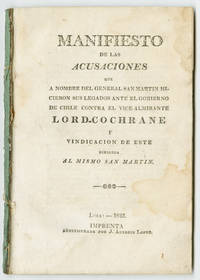
1823réf. 54967Lima: Imprenta Administrada por J. Antonio Lopez 1823. Cochrane Defends His Actions in the Fight for Peruvian Independence A scarce Peruvian imprint in which the Earl of Dundonald defends himself against accusations made by his own military commander Gen. José San Martin during the Peruvian war for independence. The first section contains San Martin's allegations against Cochrane followed by the Admiral's refutation of the various charges. Admiral Thomas Cochrane 10th Earl of Dundonald 1775-1860 fought for South American independence after being dismissed from the British navy. He served as a vice admiral in the Chilean navy and his blockade played an important role in securing Peruvian independence. After helping Chile achieve independence a dispute arose between Cochrane and San Martin over rewards and other spoils of war. It was not the first time nor would it be the last that Cochrane accused those he had served of failing to adequately compensate him. Still he was a brilliant naval officer who was later reinstated into the British navy and served with distinction until his death in 1860. His legendary worldwide naval adventures influenced both C.S. Forester and Patrick O'Brian in their respective Horatio Hornblower and Jack Aubrey series of historical naval fiction. OCLC records nine copies of this work over five separate entries. Small quarto. Dbd. Moderate dampstaining. Very good. MEDINA LIMA 3756. PALAU 148961. VARGAS UGARTE 5038. STEVENS NUGGETS 579. SABIN 14078. unknown
1823réf. 54967Lima: Imprenta Administrada por J. Antonio Lopez 1823. Cochrane Defends His Actions in the Fight for Peruvian Independence A scarce Peruvian imprint in which the Earl of Dundonald defends himself against accusations made by his own military commander Gen. José San Martin during the Peruvian war for independence. The first section contains San Martin's allegations against Cochrane followed by the Admiral's refutation of the various charges. Admiral Thomas Cochrane 10th Earl of Dundonald 1775-1860 fought for South American independence after being dismissed from the British navy. He served as a vice admiral in the Chilean navy and his blockade played an important role in securing Peruvian independence. After helping Chile achieve independence a dispute arose between Cochrane and San Martin over rewards and other spoils of war. It was not the first time nor would it be the last that Cochrane accused those he had served of failing to adequately compensate him. Still he was a brilliant naval officer who was later reinstated into the British navy and served with distinction until his death in 1860. His legendary worldwide naval adventures influenced both C.S. Forester and Patrick O'Brian in their respective Horatio Hornblower and Jack Aubrey series of historical naval fiction. OCLC records nine copies of this work over five separate entries. Small quarto. Dbd. Moderate dampstaining. Very good. MEDINA LIMA 3756. PALAU 148961. VARGAS UGARTE 5038. STEVENS NUGGETS 579. SABIN 14078. unknown books
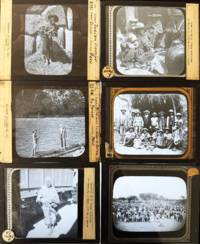
1900réf. 232171900. Peru glass lantern slide archive documenting Indigenous and rural life in the Perené and Cuzco during a period where the political economy shaped was by export agriculture regional extraction and foreign institutional interest. In this period Peru was governed by a coastal elite tied to export markets and to the expansion of state and commercial control into the interior and images of carriers river craft family groups and gathered communities register how Indigenous people were affected by that process through incorporation into frontier economies while also being recast for North American educational audiences as ethnographic subjects. Photo archive of 6 black and white glass lantern slide photographs each 3.25" x 4" Peru early 1900s. Issued as lecture materials for the Philadelphia Museum. The group includes a family or community portrait posed before a thatched structure with adults and children wearing brimmed hats layered garments shawls and patterned skirts; a closer seated group of women and children gathered around large ceramic vessels; also includes a large outdoor crowd scene showing a densely gathered public space filled with adults and children; a posed family and community portrait before a rustic structure with men women and children wearing layered garments shawls and broad-brimmed hats; a closer domestic scene centered on seated women and children gathered around large ceramic vessels; a river crossing in the Rio Perené region showing an adult and child standing on a balsa or log raft using poles to navigate the current; an "Indian Carrier" posed beside a railroad car linking Indigenous labor and movement to expanding transportation networks; and a closer portrait of an Indigenous man framed by a larger crowd gathered behind him. Several slides retain typed or manuscript labels including references to "Rio Perene" and "Hutchins Indian in Balsa" while institutional labels read "The Philadelphia Museums" and "Negative by E. Tyson Hutchins / Use restricted to school lectures in museum" establishing the archive as part of a formal educational and interpretive program rather than private travel photography alone. The archive is particularly effective because it balances portraiture with broader communal documentation. The large crowd scene family grouping and market or gathering views shift the photographs away from isolated ethnographic "types" and toward visible social environments populated by children laborers families and community members. The railroad image and river crossing additionally place Indigenous Peruvians within the transportation and frontier systems increasingly tied to trade extraction regional movement and outside institutional observation in the early twentieth century. During the late nineteenth and early twentieth centuries regions such as the central selva and Perené valley were increasingly bound to colonization schemes plantation agriculture and extractive enterprise while Indigenous communities faced land pressure labor demands and outside scrutiny from state agents missionaries traders and foreign observers. No cracks or chipping; crowd image lacking its original frame with glass and matte border loose; otherwise very good condition. A concise record of how Indigenous and local Peruvians were photographed within overlapping systems of frontier incorporation and museum interpretation. unknown
1900réf. 232171900. Peru glass lantern slide archive documenting Indigenous and rural life in the Perené and Cuzco during a period where the political economy shaped was by export agriculture regional extraction and foreign institutional interest. In this period Peru was governed by a coastal elite tied to export markets and to the expansion of state and commercial control into the interior and images of carriers river craft family groups and gathered communities register how Indigenous people were affected by that process through incorporation into frontier economies while also being recast for North American educational audiences as ethnographic subjects. Photo archive of 6 black and white glass lantern slide photographs each 3.25" x 4" Peru early 1900s. Issued as lecture materials for the Philadelphia Museum. The group includes a family or community portrait posed before a thatched structure with adults and children wearing brimmed hats layered garments shawls and patterned skirts; a closer seated group of women and children gathered around large ceramic vessels; also includes a large outdoor crowd scene showing a densely gathered public space filled with adults and children; a posed family and community portrait before a rustic structure with men women and children wearing layered garments shawls and broad-brimmed hats; a closer domestic scene centered on seated women and children gathered around large ceramic vessels; a river crossing in the Rio Perené region showing an adult and child standing on a balsa or log raft using poles to navigate the current; an "Indian Carrier" posed beside a railroad car linking Indigenous labor and movement to expanding transportation networks; and a closer portrait of an Indigenous man framed by a larger crowd gathered behind him. Several slides retain typed or manuscript labels including references to "Rio Perene" and "Hutchins Indian in Balsa" while institutional labels read "The Philadelphia Museums" and "Negative by E. Tyson Hutchins / Use restricted to school lectures in museum" establishing the archive as part of a formal educational and interpretive program rather than private travel photography alone. The archive is particularly effective because it balances portraiture with broader communal documentation. The large crowd scene family grouping and market or gathering views shift the photographs away from isolated ethnographic "types" and toward visible social environments populated by children laborers families and community members. The railroad image and river crossing additionally place Indigenous Peruvians within the transportation and frontier systems increasingly tied to trade extraction regional movement and outside institutional observation in the early twentieth century. During the late nineteenth and early twentieth centuries regions such as the central selva and Perené valley were increasingly bound to colonization schemes plantation agriculture and extractive enterprise while Indigenous communities faced land pressure labor demands and outside scrutiny from state agents missionaries traders and foreign observers. No cracks or chipping; crowd image lacking its original frame with glass and matte border loose; otherwise very good condition. A concise record of how Indigenous and local Peruvians were photographed within overlapping systems of frontier incorporation and museum interpretation. unknown books
1915Abundant black and white illustrations and reproductions of photos. Features: Volcanic Eruption on Ambrim Island in the New Hebrides in 1913 - article with spectacular photos; The Mad Mule - a mine mule turns murderer at the Blue Mountain Mine in Butte, Montana; The Mystery of Crowhurst Aylmer - a remarkable romance from 1890 is narrated by a life insurance manager; Whale-Hunting With A Camera - A fascinating account of the work of scientific naturalist-photographer H.J. Shepstone - the first man to secure a complete set of striking photographs of the various species of whales 'at home' in the water, and being harpooned, at a time when they were already facing extinction; An Accessory After the Fact - An English mining engineer's queer experience in Mexico; Down the Amazon From Source to Mouth - Part I - J. Campbell Besley and his expedition discover the source of the mighty Amazon high in the mountains of Peru and follow it down to the Atlantic, time and again fighting for their lives against savages and forces of nature; The Buried Treasure - the extraordinary experience of travelling salesman R.D. Morrison in North Carolina; The Hermits of the Alps - The lonely life of herdsmen who take their herds and flocks to high mountain pastures each summer - article with great photos; In Search of Adventure - Part III - The Story of a Chequered Cruise; Fighting a Giant Saw-Fish - James Willoughby describes a monster catch and the battle he put up - article with great photo of the fish, 14.5 feet long; A Capture of Dacoits - an account of an exciting day's work in the Punjab; and more. pp. 6 [ads], 482-576, 7-24 [ads]. Clean and unmarked with moderate wear. A sound vintage copy. Book
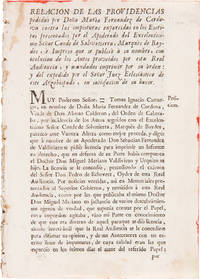
1773réf. 41258Lima. 1773. A Peruvian Widow Goes on Offense An argument presented on behalf of Doña Maria Fernandez de Cordova widow of Don Alonso Calderon by Tomas Ignacio Camargo in response to Miguel Mariano Fernandez Valdivieso's LA JUSTICIA ESCLARECIDO POR MEDIO DE LA VERDAD Lima 1773. One copy on OCLC at the John Carter Brown Library. Folio. Dbd. Minor scattered foxing. Paper repair on one leaf affecting five words of text. Very good. MEDINA LIMA 1376. VARGAS UGARTE 2073. OCLC 81035779. unknown