[Peru]. [Military]Biblio.com
2 806 résultats
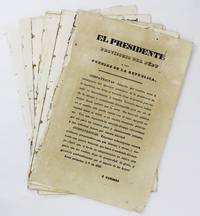
1830réf. 5862Various places in Peru 1830. Good. Seven broadsides and bifolia totaling 14pp. with each sheet measuring approximately 11.5 x 7.5 inches. Previously bound with stabholes and residue at left margin. Moderate worming affecting some text but not sense. Minor tanning and soiling. A group of seven highly ephemeral and seemingly unrecorded military broadsides and bifolia reports from Peru dating to the country's war with Gran Colombia from 1828 to 1829 and just after. The conflict stemmed from a border dispute after independence was gained in 1820 and 1821 with the boundary left relatively undefined. The Armistice of Piura formally agreed in September 1829 recognized Guayaquil and its surrounding area as a part of Gran Colombia and accorded Peru recognition of its modern-day northern provinces. The documents present here include an exhortation by Peruvian President Agustin Gamarra to support the prospective peace a report on the state of the Peruvian treasury in Trujillo during the midst of the conflict a bulletin concerning military developments in April 1829 addressed to the armed forces a patriotic broadside printed in Arequipa and a congratulatory address to the army printed on the day of armistice. The titles of these works none of which are individually recorded in OCLC are as follows: 1 Gamarra Agustin. El Presidente Provisoria del Peru a los Pueblos de la Republica. Lima: September 1 1829. 2 Peru. Estado Que Manifiesta las Cantidades Acopiadas por Esta Administracion Pral. del Tesoro Público del Departamento de la Libertad en el Presente Mes de Junio. Trujillo: June 20 1829. 3 Bermudez Pedro. Ejercito Peruano. Boletin No. IV. Piura: April 1 1829. 4 Gamarra Agustin. El Presidente de la Republica a los Pueblos. Lima: September 5 1830. 5 Peru. Queja Que Interpone ante el Respetable Tribunal de la Opinion Pública el Ciudadano Evaristo Encina Capitan Graduado de Ejercito Cóntra José Policarpos Hernandes. Trujillo: Imprenta de la Municipalidad 1829. 6 Peru. Gratis. Desahogo Patriotico. Arequipa: Imprenta Libre 1829. 7 Cerdeña Blas. El Comandante en Jefe al Ejercito. Piura: September 9 1829. unknown
1830réf. 5862Various places in Peru 1830. Good. Seven broadsides and bifolia totaling 14pp. with each sheet measuring approximately 11.5 x 7.5 inches. Previously bound with stabholes and residue at left margin. Moderate worming affecting some text but not sense. Minor tanning and soiling. A group of seven highly ephemeral and seemingly unrecorded military broadsides and bifolia reports from Peru dating to the country's war with Gran Colombia from 1828 to 1829 and just after. The conflict stemmed from a border dispute after independence was gained in 1820 and 1821 with the boundary left relatively undefined. The Armistice of Piura formally agreed in September 1829 recognized Guayaquil and its surrounding area as a part of Gran Colombia and accorded Peru recognition of its modern-day northern provinces. The documents present here include an exhortation by Peruvian President Agustin Gamarra to support the prospective peace a report on the state of the Peruvian treasury in Trujillo during the midst of the conflict a bulletin concerning military developments in April 1829 addressed to the armed forces a patriotic broadside printed in Arequipa and a congratulatory address to the army printed on the day of armistice. The titles of these works none of which are individually recorded in OCLC are as follows: 1 Gamarra Agustin. El Presidente Provisoria del Peru a los Pueblos de la Republica. Lima: September 1 1829. 2 Peru. Estado Que Manifiesta las Cantidades Acopiadas por Esta Administracion Pral. del Tesoro Público del Departamento de la Libertad en el Presente Mes de Junio. Trujillo: June 20 1829. 3 Bermudez Pedro. Ejercito Peruano. Boletin No. IV. Piura: April 1 1829. 4 Gamarra Agustin. El Presidente de la Republica a los Pueblos. Lima: September 5 1830. 5 Peru. Queja Que Interpone ante el Respetable Tribunal de la Opinion Pública el Ciudadano Evaristo Encina Capitan Graduado de Ejercito Cóntra José Policarpos Hernandes. Trujillo: Imprenta de la Municipalidad 1829. 6 Peru. Gratis. Desahogo Patriotico. Arequipa: Imprenta Libre 1829. 7 Cerdeña Blas. El Comandante en Jefe al Ejercito. Piura: September 9 1829. unknown books
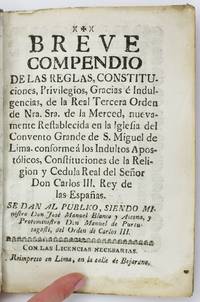
1804réf. 4200Lima 1804. About very good. 66pp. Small quarto. Contemporary limp vellum. Small library label at lower left front wrap; institutional bookplate and small ink stamp to front pastedown. Vellum lightly soiled and curled. Minor worming at lower right corner of text block not affecting text. Otherwise lighting soiling and toning internally. St. Peter Nolasco founded the Order of the Blessed Virgin Mary i.e. the Order of Mercy or Mercedarians in 1218. It was quickly successful in its goal of ransoming Christian prisoners from the Crusades and other religious conflicts and the order expanded to other charitable work. A third order of Mercedarians was founded for lay male and female supporters in 1260 and the first Mercedarian convent was established in Lima in 1535 the year of the Spanish founding of the city. This work gives the rules constitutions privileges and indulgences of the third order in Lima on the occasion of its re-establishment at the conventual church of St. Michael. A fine woodcut of the arms of the Mercedarian order surrounded by a typographic border graces the verso of the title page. This is the first edition; the work was reprinted in 1870. OCLC locates four copies at Yale Indiana the BNC and the BNE. unknown
1804réf. 4200Lima 1804. About very good. 66pp. Small quarto. Contemporary limp vellum. Small library label at lower left front wrap; institutional bookplate and small ink stamp to front pastedown. Vellum lightly soiled and curled. Minor worming at lower right corner of text block not affecting text. Otherwise lighting soiling and toning internally. St. Peter Nolasco founded the Order of the Blessed Virgin Mary i.e. the Order of Mercy or Mercedarians in 1218. It was quickly successful in its goal of ransoming Christian prisoners from the Crusades and other religious conflicts and the order expanded to other charitable work. A third order of Mercedarians was founded for lay male and female supporters in 1260 and the first Mercedarian convent was established in Lima in 1535 the year of the Spanish founding of the city. This work gives the rules constitutions privileges and indulgences of the third order in Lima on the occasion of its re-establishment at the conventual church of St. Michael. A fine woodcut of the arms of the Mercedarian order surrounded by a typographic border graces the verso of the title page. This is the first edition; the work was reprinted in 1870. OCLC locates four copies at Yale Indiana the BNC and the BNE. unknown books
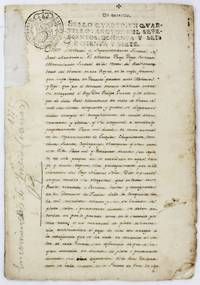
1787réf. 5761Lima 1787. Very good. 23pp. Folio. Light soiling and minor wear. Small worm hole through lower center of text block occasionally affecting a word. Accomplished in a neat secretarial script. Certified copy of a document relating to 13200 ducats due to the monks of the Escorial in Spain promised to them in perpetuity by Philip IV in 1654 and paid from duties collected in colonial Peru. In exchange for this annual subsidy of proceeds from encomiendas in Huaylas Chuquitanta Conchucas and other regions in Peru the monks promised to say masses and to do other certain religious acts for the crown. This document contains specific and detailed accounting numbers for the years 1781 to 1785 inclusive. unknown
1787réf. 5761Lima 1787. Very good. 23pp. Folio. Light soiling and minor wear. Small worm hole through lower center of text block occasionally affecting a word. Accomplished in a neat secretarial script. Certified copy of a document relating to 13200 ducats due to the monks of the Escorial in Spain promised to them in perpetuity by Philip IV in 1654 and paid from duties collected in colonial Peru. In exchange for this annual subsidy of proceeds from encomiendas in Huaylas Chuquitanta Conchucas and other regions in Peru the monks promised to say masses and to do other certain religious acts for the crown. This document contains specific and detailed accounting numbers for the years 1781 to 1785 inclusive. unknown books
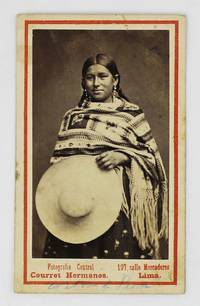
1880réf. 5806Lima: Fotografia Central Courret Hermanos 1880. Very good. Carte-de-visite photo 4.25 x 2.75 inches. Minor soiling pencil notation at foot of card. Handsome image of a young Peruvian woman in traditional dress. Pictured in three-quarter length she holds a wide straw hat a printed skirt peeking out of the bottom of the photos beneath a traditional shawl wrapped around her shoulders. Her hair is in two braids and she wears elaborate earrings. The pencil notation at the bottom reads "Native of Peru." The photographer Eugene Courret was a French native who moved to Lima in 1860 to work in a photography studio; he opened his own studio with his brother in 1863 and returned to France in the 1890s. Fotografia Central Courret Hermanos unknown
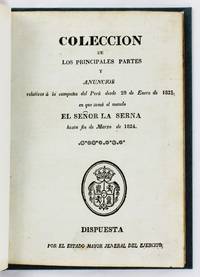
1824réf. 5668Lima 1824. Good plus. 271pp. Modern paper boards printed spine label. Moderate tanning. Light worming to final leaves repaired slightly affecting text. Scarce printing of correspondence relating to the royalist military campaigns in Peru under Viceroy José de la Serna from the beginning of 1821 to early 1824. La Serna was installed as Viceroy in January 1821 following a petition of top royalist officers. He evacuated Lima and moved the colonial capital inland to Cuzco where he set about rebuilding his army and campaigning to recapture the territory lost by his predecessors. In this he was quite successful and by the beginning of 1824 he had recaptured almost all of Peru and penned in Bolivar at Trujillo. The correspondence included here follows this successful portion of his generalship and provides an important first hand accounting of events. Following this period however La Serna suffered his own military rebellion and was sufficiently weakened until he lost the Battle of Ayacucho and thereby all of Peru in December 1824. OCLC locates only two copies at U.S. institutions Harvard and the JCB. Medina Lima 3779. Vargas Ugarte 5174. unknown
1824réf. 5668Lima 1824. Good plus. 271pp. Modern paper boards printed spine label. Moderate tanning. Light worming to final leaves repaired slightly affecting text. Scarce printing of correspondence relating to the royalist military campaigns in Peru under Viceroy José de la Serna from the beginning of 1821 to early 1824. La Serna was installed as Viceroy in January 1821 following a petition of top royalist officers. He evacuated Lima and moved the colonial capital inland to Cuzco where he set about rebuilding his army and campaigning to recapture the territory lost by his predecessors. In this he was quite successful and by the beginning of 1824 he had recaptured almost all of Peru and penned in Bolivar at Trujillo. The correspondence included here follows this successful portion of his generalship and provides an important first hand accounting of events. Following this period however La Serna suffered his own military rebellion and was sufficiently weakened until he lost the Battle of Ayacucho and thereby all of Peru in December 1824. OCLC locates only two copies at U.S. institutions Harvard and the JCB. Medina Lima 3779. Vargas Ugarte 5174. unknown books
1880réf. 5806Lima: Fotografia Central Courret Hermanos 1880. Very good. Carte-de-visite photo 4.25 x 2.75 inches. Minor soiling pencil notation at foot of card. Handsome image of a young Peruvian woman in traditional dress. Pictured in three-quarter length she holds a wide straw hat a printed skirt peeking out of the bottom of the photos beneath a traditional shawl wrapped around her shoulders. Her hair is in two braids and she wears elaborate earrings. The pencil notation at the bottom reads "Native of Peru." The photographer Eugene Courret was a French native who moved to Lima in 1860 to work in a photography studio; he opened his own studio with his brother in 1863 and returned to France in the 1890s. Fotografia Central Courret Hermanos unknown books
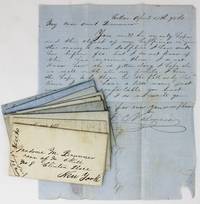
1861réf. 4525Lima and Callao Peru 1861. Very good. Thirteen autograph letters signed totaling twenty-six pages. Original mailing folds minor wear some fold separations and short tears to a few letters. An informative collection of manuscript letters sent back to the United States by John C. Valencia a businessman working in Peru just before the Civil War. John is writing to his wife Josefina and his Aunt Brunner in New York City and Yorkville New York over roughly a two-year period between February 27 1859 and January 14 1861. Apparently Josefina and their children were living with Aunt Brunner in New York at least for a time while John was trying to conclude business related to Peruvian real estate held by his deceased brother and now owned by his sister-in-law. In one letter he mentions that he working in the sea port in order to raise some amount of money to send home. John misses his wife and family and writes with longing about returning to his wife often mentions the money he is sending back with each letter or plans to send soon sometimes reports on his business activities urges patience from his wife while he tries to make money and more. From his first letter John is not having a pleasant time in Peru. Writing from Lima on February 27 1859 John comments that "I am sorry of having proposed such a thing for this country is very corrupt no moral of no kind in those People.I am afraid to be contaminated with the influence of the wicked." He again bemoans the state of Peru in his next letter from Callao: "I hope the Lord will help me in coming home as soon as I can. I am disgusted with the costume of this country. They are so deprived that I can not be happy in this land but with your advice I will remain till I get some money even if I have to stay longer." John would stay almost two more years in the space of the present letters and his business was not concluded when the present letters end. While in Peru John spends some time "in the House of a friend of my Father" which may indicate John was a native Peruvian or Peruvian-American with roots in the country; reports on the process of the mail and his work in the port of Callao; details his deceased brother's real estate holdings and frequently mentions the difficulty he is having with his brother's widow he reports in one of his two short letters to his aunt that he is in a "Law Suit" with the widow. In one letter John makes it perfectly clear how he sees himself among the people of Peru: "I am tired already of this country. There is nothing but rebolution sic that is the principal business of the Perubians sic. As for my part I am American and I am always with them." The conflict John mentions may be a reference to the Ecuadorian-Peruvian War which took place between 1857 and 1860; this may also help explain why real estate issues inside Peru were difficult to conclude at this time. In his penultimate letter John states that he plans to be back in New York by May 1861 but in his last letter he sadly reports that he must remain in Peru longer in order to conclude his business affairs. unknown
1861réf. 4525Lima and Callao Peru 1861. Very good. Thirteen autograph letters signed totaling twenty-six pages. Original mailing folds minor wear some fold separations and short tears to a few letters. An informative collection of manuscript letters sent back to the United States by John C. Valencia a businessman working in Peru just before the Civil War. John is writing to his wife Josefina and his Aunt Brunner in New York City and Yorkville New York over roughly a two-year period between February 27 1859 and January 14 1861. Apparently Josefina and their children were living with Aunt Brunner in New York at least for a time while John was trying to conclude business related to Peruvian real estate held by his deceased brother and now owned by his sister-in-law. In one letter he mentions that he working in the sea port in order to raise some amount of money to send home. John misses his wife and family and writes with longing about returning to his wife often mentions the money he is sending back with each letter or plans to send soon sometimes reports on his business activities urges patience from his wife while he tries to make money and more. From his first letter John is not having a pleasant time in Peru. Writing from Lima on February 27 1859 John comments that "I am sorry of having proposed such a thing for this country is very corrupt no moral of no kind in those People.I am afraid to be contaminated with the influence of the wicked." He again bemoans the state of Peru in his next letter from Callao: "I hope the Lord will help me in coming home as soon as I can. I am disgusted with the costume of this country. They are so deprived that I can not be happy in this land but with your advice I will remain till I get some money even if I have to stay longer." John would stay almost two more years in the space of the present letters and his business was not concluded when the present letters end. While in Peru John spends some time "in the House of a friend of my Father" which may indicate John was a native Peruvian or Peruvian-American with roots in the country; reports on the process of the mail and his work in the port of Callao; details his deceased brother's real estate holdings and frequently mentions the difficulty he is having with his brother's widow he reports in one of his two short letters to his aunt that he is in a "Law Suit" with the widow. In one letter John makes it perfectly clear how he sees himself among the people of Peru: "I am tired already of this country. There is nothing but rebolution sic that is the principal business of the Perubians sic. As for my part I am American and I am always with them." The conflict John mentions may be a reference to the Ecuadorian-Peruvian War which took place between 1857 and 1860; this may also help explain why real estate issues inside Peru were difficult to conclude at this time. In his penultimate letter John states that he plans to be back in New York by May 1861 but in his last letter he sadly reports that he must remain in Peru longer in order to conclude his business affairs. unknown books
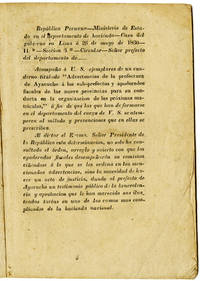
1830réf. 51823Lima: Imprenta del Estado por J. Gonzalez 1830. Keeping Tabs on Unruly Taxmen A Peruvian government imprint warning its prefects and tax collectors in the province of Ayacucho about their behavior. The taxmen in a remote province of a newly independent Peru apparently did not always conduct themselves according to their instructions. Not in OCLC. Dbd. Corners worn a few small chips. Tanned with an occasional fox mark. Very good. unknown
1830réf. 51823Lima: Imprenta del Estado por J. Gonzalez 1830. Keeping Tabs on Unruly Taxmen A Peruvian government imprint warning its prefects and tax collectors in the province of Ayacucho about their behavior. The taxmen in a remote province of a newly independent Peru apparently did not always conduct themselves according to their instructions. Not in OCLC. Dbd. Corners worn a few small chips. Tanned with an occasional fox mark. Very good. unknown books
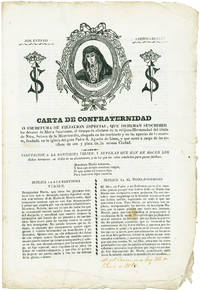
1843réf. 41042Lima: José Maria Concha 1843. Recruiting Devotees to the Confraternity of Our Lady of Mercy Pamphlet encouraging subscription to the Confraternidad de Nuestra Senora de la Misericordia a charitable fraternal organization. No copies in OCLC though the National Library of Chile does have a similar item dated circa 1810. 4pp. Folded folio sheet. Old fold lines light soiling and foxing heavier on final page. Later manuscript annotations at foot of first and last pages. Good. unknown
1843réf. 41042Lima: José Maria Concha 1843. Recruiting Devotees to the Confraternity of Our Lady of Mercy Pamphlet encouraging subscription to the Confraternidad de Nuestra Senora de la Misericordia a charitable fraternal organization. No copies in OCLC though the National Library of Chile does have a similar item dated circa 1810. 4pp. Folded folio sheet. Old fold lines light soiling and foxing heavier on final page. Later manuscript annotations at foot of first and last pages. Good. unknown books
1772réf. 58485Lima: En la Oficina de la Calle de S. Jacinto 1772-1773. Dispersing Jesuit Property After Their Expulsion from Peru An important collection of documents on the Jesuit order in Peru which primarily discusses the dispersal of the Order's property after their expulsion from America. The Jesuits were expelled from Peru as well as other Spanish and Portuguese possessions in 1767. Also included here are the constitutions of several schools which were under their provision. Published in two parts both of which are present here. Two volumes. 562075pp. plus 14 leaves which appear between sections; 1583063pp. plus 5 leaves which appear between sections. Small quarto. Contemporary limp vellum lettered on spine. Bookplate on front pastedowns. Several ex-lib. ink stamps on titlepages one of which has been cut away from text and the page subsequently backed with paper. Some light foxing. About very good. MEDINA LIMA 1338 1358. VARGAS UGARTE 2056 2078. hardcover
1772réf. 58485Lima: En la Oficina de la Calle de S. Jacinto 1772-1773. Dispersing Jesuit Property After Their Expulsion from Peru An important collection of documents on the Jesuit order in Peru which primarily discusses the dispersal of the Order's property after their expulsion from America. The Jesuits were expelled from Peru as well as other Spanish and Portuguese possessions in 1767. Also included here are the constitutions of several schools which were under their provision. Published in two parts both of which are present here. Two volumes. 562075pp. plus 14 leaves which appear between sections; 1583063pp. plus 5 leaves which appear between sections. Small quarto. Contemporary limp vellum lettered on spine. Bookplate on front pastedowns. Several ex-lib. ink stamps on titlepages one of which has been cut away from text and the page subsequently backed with paper. Some light foxing. About very good. MEDINA LIMA 1338 1358. VARGAS UGARTE 2056 2078. hardcover books
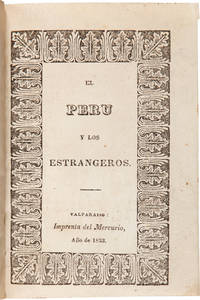
1833réf. 20981Valparaiso: Imprenta del Mercurio 1833. Peruvian Nativism A defense of Peruvian patriotism and of Peru's policies toward Chile and Bolivia. The unnamed author confronts the issue of Peruvian hatred of foreigners and resulting aggression towards Chile and Bolivia. At the time the three nations were in a near constant state of revolutionary turmoil characterized by rebel factions and intermittent power struggles. This work is critical of the leadership of Agustin Gamarra whose term as president was drawing to a close in 1833. A rare and early Valparaiso imprint. Not in Palau nor the NUC. 47pp. Small octavo. Later 19th-century Spanish marbled sheep spine with raised bands leather labels. Unobtrusive private library stamp on front free endpaper. A very good copy. hardcover
1833réf. 20981Valparaiso: Imprenta del Mercurio 1833. Peruvian Nativism A defense of Peruvian patriotism and of Peru's policies toward Chile and Bolivia. The unnamed author confronts the issue of Peruvian hatred of foreigners and resulting aggression towards Chile and Bolivia. At the time the three nations were in a near constant state of revolutionary turmoil characterized by rebel factions and intermittent power struggles. This work is critical of the leadership of Agustin Gamarra whose term as president was drawing to a close in 1833. A rare and early Valparaiso imprint. Not in Palau nor the NUC. 47pp. Small octavo. Later 19th-century Spanish marbled sheep spine with raised bands leather labels. Unobtrusive private library stamp on front free endpaper. A very good copy. hardcover books
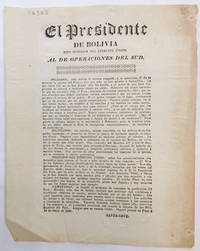
1836réf. 16365Puno. 1836. A scarce Bolivian imprint issued by the great revolutionary leader Santa Cruz calling on citizens to continue the struggle for liberty. In translation: ".we shall defeat the rebels and posterity will respect the history of the Pacificators of Peru." Broadside 26½ x 21 cm. Two unobtrusive binding holes else very good. unknown
1836réf. 16365Puno. 1836. A scarce Bolivian imprint issued by the great revolutionary leader Santa Cruz calling on citizens to continue the struggle for liberty. In translation: ".we shall defeat the rebels and posterity will respect the history of the Pacificators of Peru." Broadside 26½ x 21 cm. Two unobtrusive binding holes else very good. unknown books
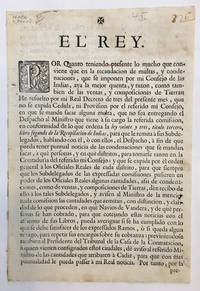
1736réf. 36286Madrid. 1736. A rare broadsheet proclamation by Philip V King of Spain ordering the officials of the treasury of the viceroyalty of Peru to observe due diligence in collecting and recording taxes and to remit funds derived from fines and the sale and composition of lands. Printed in Madrid and distributed to royal officials in Spain and the viceroyalty of Peru this copy is signed by Prudencio de Cruz as representative of the King of Spain with the inscription: "Yo el Rey." Cruz composed an additional note written in Madrid on Oct. 18 1737 regarding the text. A manuscript inscription on the integral leaf written in the city of Santiago on Nov. 14 1738 describes an instance of the distribution of the text in Chile. Rare. Not in Medina BHA or OCLC. Folio. Dbd. Maltese cross printed at head of title. Accomplished in manuscript with additional contemporary manuscript annotations and inscription on integral leaf see below. Light dampstaining and soiling in margins. Very good. unknown
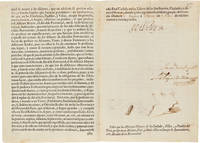
1738réf. 36292Madrid. 1738. Regarding Local Governance in Peru A rare proclamation by Philip V King of Spain declaring that major lieutenants Alfereces Mayores of the cities towns and villages of Peru are to be recognized over the unpaid local judges los Alcaldes of the Holy Brotherhood Santa Hermandad. Numerous local brotherhoods had served as municipal peacekeeping organizations in Spain since the Middle Ages. The Holy Brotherhood was established by Ferdinand and Isabella to suppress the original municipal leagues and guarantee personal security and public order and local brotherhoods were organized in New Spain and Peru. An attempt to regulate the power of the brotherhoods this decree was printed in Madrid and distributed to royal officials in all the provinces of the viceroyalty of Peru. This copy accomplished at Aranjuez on April 11 1738 is signed by Miguel de Villanueva as representative of the King of Spain with the inscription: "Yo el Rey." A manuscript note on the verso of the last printed page written in the city of Santiago on Nov. 14 1738 describes an instance of the distribution of the text in Chile. An important proclamation regarding local governance in the viceroyalty of Peru with a contemporary manuscript inscription regarding the text's distribution in Chile. Not in Medina BHA or OCLC. Folio. Dbd. Maltese cross printed at head of title. Accomplished in manuscript at Aranjuez Spain on April 11 1738 signed by Miguel de Villanueva. Manuscript inscription on verso of last printed page written on November 14 1738 in Santiago de Chile. Contemporary annotation on first page light dampstaining in margins. A very good copy. unknown
1738réf. 36292Madrid. 1738. Regarding Local Governance in Peru A rare proclamation by Philip V King of Spain declaring that major lieutenants Alfereces Mayores of the cities towns and villages of Peru are to be recognized over the unpaid local judges los Alcaldes of the Holy Brotherhood Santa Hermandad. Numerous local brotherhoods had served as municipal peacekeeping organizations in Spain since the Middle Ages. The Holy Brotherhood was established by Ferdinand and Isabella to suppress the original municipal leagues and guarantee personal security and public order and local brotherhoods were organized in New Spain and Peru. An attempt to regulate the power of the brotherhoods this decree was printed in Madrid and distributed to royal officials in all the provinces of the viceroyalty of Peru. This copy accomplished at Aranjuez on April 11 1738 is signed by Miguel de Villanueva as representative of the King of Spain with the inscription: "Yo el Rey." A manuscript note on the verso of the last printed page written in the city of Santiago on Nov. 14 1738 describes an instance of the distribution of the text in Chile. An important proclamation regarding local governance in the viceroyalty of Peru with a contemporary manuscript inscription regarding the text's distribution in Chile. Not in Medina BHA or OCLC. Folio. Dbd. Maltese cross printed at head of title. Accomplished in manuscript at Aranjuez Spain on April 11 1738 signed by Miguel de Villanueva. Manuscript inscription on verso of last printed page written on November 14 1738 in Santiago de Chile. Contemporary annotation on first page light dampstaining in margins. A very good copy. unknown books