2911 resultados
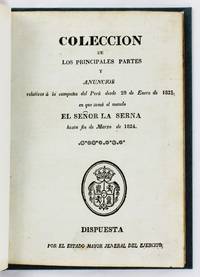
1824ref. 5668Lima 1824. Good plus. 271pp. Modern paper boards printed spine label. Moderate tanning. Light worming to final leaves repaired slightly affecting text. Scarce printing of correspondence relating to the royalist military campaigns in Peru under Viceroy José de la Serna from the beginning of 1821 to early 1824. La Serna was installed as Viceroy in January 1821 following a petition of top royalist officers. He evacuated Lima and moved the colonial capital inland to Cuzco where he set about rebuilding his army and campaigning to recapture the territory lost by his predecessors. In this he was quite successful and by the beginning of 1824 he had recaptured almost all of Peru and penned in Bolivar at Trujillo. The correspondence included here follows this successful portion of his generalship and provides an important first hand accounting of events. Following this period however La Serna suffered his own military rebellion and was sufficiently weakened until he lost the Battle of Ayacucho and thereby all of Peru in December 1824. OCLC locates only two copies at U.S. institutions Harvard and the JCB. Medina Lima 3779. Vargas Ugarte 5174. unknown books
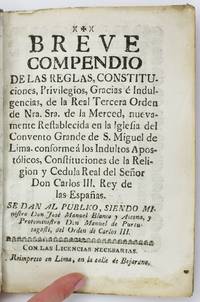
1804ref. 4200Lima 1804. About very good. 66pp. Small quarto. Contemporary limp vellum. Small library label at lower left front wrap; institutional bookplate and small ink stamp to front pastedown. Vellum lightly soiled and curled. Minor worming at lower right corner of text block not affecting text. Otherwise lighting soiling and toning internally. St. Peter Nolasco founded the Order of the Blessed Virgin Mary i.e. the Order of Mercy or Mercedarians in 1218. It was quickly successful in its goal of ransoming Christian prisoners from the Crusades and other religious conflicts and the order expanded to other charitable work. A third order of Mercedarians was founded for lay male and female supporters in 1260 and the first Mercedarian convent was established in Lima in 1535 the year of the Spanish founding of the city. This work gives the rules constitutions privileges and indulgences of the third order in Lima on the occasion of its re-establishment at the conventual church of St. Michael. A fine woodcut of the arms of the Mercedarian order surrounded by a typographic border graces the verso of the title page. This is the first edition; the work was reprinted in 1870. OCLC locates four copies at Yale Indiana the BNC and the BNE. unknown books
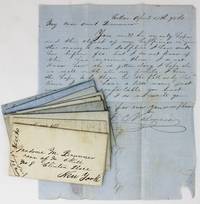
1861ref. 4525Lima and Callao Peru 1861. Very good. Thirteen autograph letters signed totaling twenty-six pages. Original mailing folds minor wear some fold separations and short tears to a few letters. An informative collection of manuscript letters sent back to the United States by John C. Valencia a businessman working in Peru just before the Civil War. John is writing to his wife Josefina and his Aunt Brunner in New York City and Yorkville New York over roughly a two-year period between February 27 1859 and January 14 1861. Apparently Josefina and their children were living with Aunt Brunner in New York at least for a time while John was trying to conclude business related to Peruvian real estate held by his deceased brother and now owned by his sister-in-law. In one letter he mentions that he working in the sea port in order to raise some amount of money to send home. John misses his wife and family and writes with longing about returning to his wife often mentions the money he is sending back with each letter or plans to send soon sometimes reports on his business activities urges patience from his wife while he tries to make money and more. From his first letter John is not having a pleasant time in Peru. Writing from Lima on February 27 1859 John comments that "I am sorry of having proposed such a thing for this country is very corrupt no moral of no kind in those People.I am afraid to be contaminated with the influence of the wicked." He again bemoans the state of Peru in his next letter from Callao: "I hope the Lord will help me in coming home as soon as I can. I am disgusted with the costume of this country. They are so deprived that I can not be happy in this land but with your advice I will remain till I get some money even if I have to stay longer." John would stay almost two more years in the space of the present letters and his business was not concluded when the present letters end. While in Peru John spends some time "in the House of a friend of my Father" which may indicate John was a native Peruvian or Peruvian-American with roots in the country; reports on the process of the mail and his work in the port of Callao; details his deceased brother's real estate holdings and frequently mentions the difficulty he is having with his brother's widow he reports in one of his two short letters to his aunt that he is in a "Law Suit" with the widow. In one letter John makes it perfectly clear how he sees himself among the people of Peru: "I am tired already of this country. There is nothing but rebolution sic that is the principal business of the Perubians sic. As for my part I am American and I am always with them." The conflict John mentions may be a reference to the Ecuadorian-Peruvian War which took place between 1857 and 1860; this may also help explain why real estate issues inside Peru were difficult to conclude at this time. In his penultimate letter John states that he plans to be back in New York by May 1861 but in his last letter he sadly reports that he must remain in Peru longer in order to conclude his business affairs. unknown books
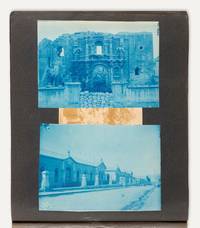
1918ref. List2982Peru and Panama 1918. Approximately 364 photos; album and unmounted photos silver prints cyanotypes and printing-out-paper prints. Photos measure 3 x 4 to 8 x 10 inches with about half measuring 3 x 5 ½ inches. Some with photographer’s hand-stamp or credit in pencil; others with manuscript notations verso or recto; some captions to album pages. Offered in partnership with Daniel / Oliver. Rich and extensive photographic archive of Walton T. Burres of Stockton California showing his time in Peru c. 1904 as an amateur explorer and doctor for the Inca Mining and Rubber Company and his later work in Panama c. 1918 with the Rockefeller Foundation’s International Health Division.The collection consists of a large number of loose photos acquired by the gallery in 2021 and a recently discovered photo album showing some of the same subjects and containing a few duplicate images some printed in different sizes or formats as well as hundreds of previously unseen prints. Together this material makes up the largest extant archive of Burres’s photographic work. Though his work was published at the time both in Peruvian and American publications much of it was lost when he dropped it in a river that he was attempting to ford. Burres was educated at California’s Cooper Medical College the first school of medicine on the West Coast and was a prominent member of the Stockton community before sojourning to Peru around 1900 to help the Inca Mining and Rubber Company address the deadly diseases endemic to the region such as malaria and yellow fever. To encourage economic infrastructure in remote areas the Peruvian government began granting land concessions to any company that would build roads bridges or river ports. As a result the Inca Mining Company an American outfit based in Tirapata purchased the rights to mine gold along the upper Inambari River in 1896 and soon became the richest gold producer in Peru. A large portion of Burres’s Peruvian images document his 1903–1904 excursion from Arequipa 150 miles into “rubber country.” The journeys were well-recounted in U.S. papers and a number of the anecdotes described in print are seen in the present images. There are many dynamic views of Burres and his party trekking through the dense jungle and summiting the high mountains as well as shots of flora fauna and native Peruvians. Burres’s travel companions for this trip included the famed adventurer Harriet Chalmers Adams later dubbed “America’s greatest woman explorer” by the New York Times. Adams and her husband Frank both fellow Stocktonians joined up with Burres during their own multi-year expedition through South America. There are a number of portraits of a woman who bears a striking resemblance to Adams though it is possibly another person. Other Peruvian material includes numerous views of Cusco Arequipa and the surrounding environs including a beautiful interior of a chapel a Martin Chambi-esque detail shot of a stone wall and portraits of local townspeople some identified as Quechua people. There are a number of lush large-format cyanotypes rich printing-out-paper views and many handsome small-format panoramas. These were printed on Inca Mining Company surplus stationary which speaks to the makeshift nature of photo-development under the circumstances. One particularly striking image shows the top of Misti volcano barely visible above the clouds. This image was reproduced in Burres's account of his travels published in 1909 in Outing magazine. The photographs from Burres’s time in Panama document his more serious work as a virologist and health administrator in the area. One interesting photo shows a pair of recently-shot iguanas with a caption noting that “blood of these reptiles was found infected with Haemogregarina.” Another image is that of a new style of privy built from concrete and wire-mesh designed to better keep out rain water. There are also keenly-shot views of main streets and local culture in Los Santos Chiriquí and elsewhere including a number of humanistic group portraits taken at a girl’s school. unknown books
ref. 174577paperback. many color plates many b/w text illus. 4to pr. wrs.; bottom of spine worn. Lausanne: Fondation de l'Hermitage 1988. Exhibition of Inca gold sculpture. unknown books
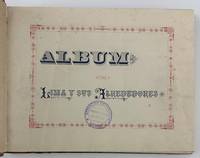
1900ref. 4112Lima 1900. Very good. 210pp. Oblong quarto. Contemporary three-quarter calf and marbled paper-covered boards. Minor rubbing and scuffing to edges and boards. Handsome bookplate to front pastedown occasional very minor foxing. A delightful viewbook and commercial directory of Peru published in Lima at the turn of the 20th century. The monotone and sepia-toned photographs and photocollages picture numerous buildings interiors street scenes storefronts and more mostly in Lima but also in Callao Chorrillos Barranco and Miraflores. An Index of the "Vistas de Lima" provides a description for the photographs though almost all of the photographs are captioned beneath the image. The photographs are printed on the rectos of the work while most of the versos of each leaf contain full-page advertisements for a wide variety of businesses in the various cities including banks mercantile firms importers breweries milers and numerous others. A healthy percentage of the versos are printed with a commercial directory of Lima as well as the membership list of the Bolsa Comercial providing a snapshot of the economic life of Peru at the time. No copies in American institutions. OCLC records just two copies worldwide one in Peru and the other in France. unknown books
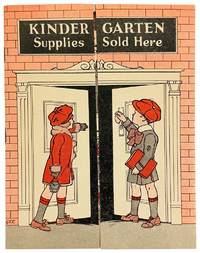
1928ref. 31878N.p.: s.i. 1928. Very Good. N.p.: s.i. 1928. First Edition. 12mo 16cm.; publisher's pictorial staple bound wrappers signed in image "GEL"; illustrated throughout including photograph of a kindergarten class in Lima. Very light wear to margins brief tape repair inside upper left-hand panel else a Very Good example. Transformation fund-raising pamphlet for American kindergarten students to raise money for supplies at a kindergarten in Lima Peru. The front wrappers open like a pair of doors into a kindergarten supply store "For we're buying with the money / Juniors give o'er all this land / For the Lima Kindergarten. / They already have the land." Through another door leads to a photograph of the students at the Lima Kindergarten sitting expectantly in a classroom for their Froebel school supplies: "There are balls and books and pictures / To be colored and cut out; / Blocks and shining letters on them / Pencil crayons. Hear that shout" Unrecorded in OCLC as of January 2025. s.i. unknown books
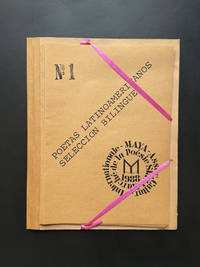
1988ref. 1866Nine folded leaves with texts in Spanish and French some are illustrated. 4to 21 x 29.5 cm. Very good. Numbered series with fascicles loose inside a lavender folder front cover is faded to tan with pink ribbon ties. 1866 Issued on the occasion of the 1988 Marché de la Poésie a major international poetry festival held every year in Saint Sulpice Square in Paris this series of bilingual broadsides showcase the talents of Latin American participants. Poets in the sequence include Orlando Jimeno-Grendi Chile José Rosas-Ribeyro Peru Elena Galván United States Jorge Nájar Peru Rubén Bareiro-Saguier Paraguay Carlos Sahakian Uruguay Luisa Futoransky Argentina Gustavo Mujica Chile and Robert Armijo El Salvador. Unrecorded. Internationale - MAYA - Assoc. Cultur. / Marché de la Poésie books
2026ref. __3689501474Splitter Verlag 2026. Hardcover. New. 296 pages. German language. 9.13x1.22x12.72 inches. Splitter Verlag hardcover
ref. DADAX124151206XNew unknown
ref. SONG0714124915Used: Good unknown
2026ref. x-1032803215Taylor & Francis Ltd 2026. Hardcover. New. 260 pages. 9.18x6.12x9.21 inches. Taylor & Francis Ltd hardcover
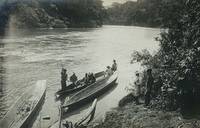
ref. PF138 loose gelatin silver photographs from ca. 17.5 x 12 cm 6 ¾ x 4 ¾ in to 10.5 x 8 cm 4 x 3 in. 21 images captioned in pencil on recto; 11 images captioned in ink on recto; four images captioned in ink on recto. a few photos mildly faded or with mild creasing on edges but overall a very good collection of interesting photos. An interesting collection of photographs showing mining activities in the South American Andes in the early 20th century. 6 photographs show the mines of Santo Domingo in Peru. Santo Domingo was a gold mine located in southeastern Peru and in operation sometime between 1890 and 1920. The photographs show the offices miner dormitories and general views of the site. 9 photographs show the mines of Concordia possibly the Concordia Tin Mine in western Bolivia. The Concordia Tin Mine is most well known for being where notorious American outlaws Butch Cassidy 1866-1908 and the Sundance Kid 1867-1908 allegedly worked after fleeing the United States in the early 1900s. The photographs include views of the site the route the compiler took up to the mine including a “station” being constructed and “Carnival Day” festivities showing dancers at the mine and a photograph of the compiler and his colleagues. Also included are 10 photographs from a river tour on the “West” and “Mayo” rivers the compiler went on showing him and his party led by indigenous South Americans in canoes on the river; at a campsite; and in a constructed house with two views from the compiler’s “balcony.” Other photographs in the collection include views of La Paz Bolivia National Day/La Paz Day parade; Santiago Chile Santa Lucía Hill and the public gardens on top; Arequipa Peru outdoor church service before a crucifix; Cusco Peru; and Incan palace ruins in Peru. Overall an interesting collection showing South America during the early 20th century. unknown
ref. SONG1469643529Used: Good unknown
2007ref. R59017J.-C. Ledoux 2007. 468 distribution maps. . PB. 4to orig. wrappers. From the library of David R. Nellist British arachnologist with his name to endpaper. Revue Arachnologique Tom. 16. Text French. A checklist of French spiders. Includes distribution maps for 1569 species. J.-C. Ledoux unknown
ref. PC612 albumen photos each ca. 12 x 16.5cm 4.5 x 6.5 in. All mounted recto and verso on 6 original beige card leaves and all captioned in manuscript black ink on mounts. Some very mild fading of a couple of the images but overall a very good collection of strong sharp and interesting images. This collection of photographs with 11 photos of Peru and 1 of Ecuador includes images of: City of Guayaquil Ecuador; Boatsman at Paita Peru; Paita Peru from the boat landing with the Hotel Pacifico in the foreground; Street in Paita Peru; Paita Peru from the steamer; Unloading passengers in boat at Eten Peru; Peruvian Balsa Paita Peru; Pacasmayo Peru; Adios San Lorenzo Island Peru; Tomb of Pizarro – Alcove of Cathedral Lima; Exposition Grounds – Lima; The Palma al Champeriso Passenger Steamship. unknown
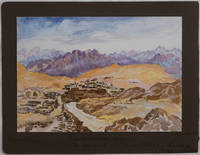
ref. M56Watercolours on paper ca. 175x255 cm 7x10 in. Mounted on a period album leaf ca. 235x30 cm 9 ¼ x 12 in captioned in period ink on the mount. With another watercolour of the same size mounted on verso the second watercolour is also captioned in period ink on the mount. Overall beautiful bright watercolours. Attractive early watercolour view of the Pachacamac archaeological site near Lima drawn by a British or American tourist in the early 20th century. The watercolour shows Pachacamac looking northeast towards the Andes. The site was settled before the Inca conquest and dedicated to the “Earth Maker” creator god Pacha Kamaq. It was utilized by the Incas and flourished for about 1300 years until the Spanish invasion. Modern-day excavations in Pachacamac started in the 1890s. The watercolour on verso taken during a ride on the Peruvian Southern Railway Ferrocarril del Sur depicts the sand dunes of the Arequipa desert with the Andean foothills in the background. The ink caption on the mount reads “From the train between Mollendo & Arequipa Peru 7550 ft. March 1.” Overall a collection of two attractive early watercolour views of Peru. unknown
ref. DADAX1138535524New unknown
ref. DADAX0415529824New unknown
ref. DADAX113866524XNew unknown
ref. DADAX1138097640New unknown
ref. DADAX1477317317New unknown
ref. DADAX0367338475New unknown
ref. DADAX0367170299New unknown
ref. SONG0544454308Used: Good unknown