6 resultados
ref. DADAX124150430XNew unknown
ref. 0666093938.Ghardcover. Good. Access codes and supplements are not guaranteed with used items. May be an ex-library book. hardcover
ref. 18-1477Delaware: Orinoco Development Company 1926. Single page. 12 x 8 inches. Printed both sides. Very Good. Issued to Henry C. Gibson. Dated 1926. Signed by President and Treasurer. Delaware: Orinoco Development Company, 1926. unknown
ref. 0366380303.Gpaperback. Good. Access codes and supplements are not guaranteed with used items. May be an ex-library book. paperback
1994ref. SKU1064294Fundacion Cultural Orinoco 1994-01-01. hardcover. Good. 0x0x0. Caracas Venezuela 1994; some wear sun fading on cover edges corners and spine; illustrated endpapers; Interior clean and unmarked; black & white charts maps illustrations throughout; text in Spanish; 4to - over 9 3/4" - 12" tall; 270 pages. Fundacio?n Cultural Orinoco hardcover
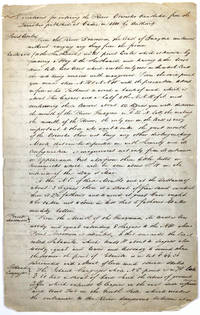
ref. FRE100Folio bifolium ca. 323x202cm 12 ¾ x 8 in. 3 pp. of manuscript text in English. Brown ink on yellowish watermarked laid paper. Docketed on the last page. Tears at the edges and fold marks but otherwise a very good document written in a legible hand. A rare English manuscript translation of the official Spanish sailing directions for the Boca Grande the main navigable mouth of the Orinoco received from Col. James Towers English and apparently intended for vessels carrying British volunteers upriver to Angostura today's Ciudad Bolívar Bolívar's headquarters during the Venezuelan War of Independence. The manuscript was likely supplied to the master of one of these transports who relied on it to navigate the treacherous approach and bring his vessel safely into the river. Following military reversals that forced Bolívar to retreat from Venezuela he established his provisional capital and military base at the remote Orinoco outpost of Angostura. From 1817 his agents in London recruited volunteers — many of them veterans of the Napoleonic Wars — to join the British Legions. Among their organizers was James Towers English who had served with Bolívar in 1818 before returning to Britain where he raised more than a thousand men. They began arriving at Angostura late that year. For the merchant vessels transporting them the approach to the Orinoco was especially hazardous: its low featureless delta was obstructed by a shallow bar and flanking shoals. Reliable sailing directions were therefore essential for reaching the river mouth where a local pilot could take the vessels safely upriver. English apparently provided this translation for precisely that purpose. The manuscript opens with the title “Directions for entering the River Orinoko translated from the Derrotero published at Cadiz in 1810 by Authority.” Despite extensive research we have been unable to locate the Cadiz edition to which this refers. The translator almost certainly meant the Derrotero de las islas Antillas de las costas de Tierra Firme y de las del seno Mexicano compiled by the Dirección de Trabajos Hidrográficos and printed in Madrid by the Imprenta Real in 1810. The manuscript translates the section on the Guiana coast pp. 49–51 dealing with the approach to the Boca Grande the principal mouth of the Orinoco. Following the coast westward from the Pomeroon River the directions give compass courses distances in leagues and soundings in fathoms. They guide the navigator by the few visible landmarks and by changes in the seabed from loose mud and small shells to hard sand “the colour of ground Coffee.” The directions explain how to cross the bar while keeping to the muddy bottom and avoiding the shoal off Cangrejos Crab Island ending at a sheltered anchorage where vessels were to await a local pilot since “any little vessel of the Country can supply a Pilot.” The translation ends with a table of latitudes for the principal points. A text-to-text comparison with the Spanish original shows a close and faithful translation which even reproduces most of the Spanish margin headings. Apart from a few minor slips and omissions and one doubtful compass bearing the principal alteration is the table which has been abbreviated and supplemented by an additional entry for the Great Mouth itself. Overall a rare navigational document from the British volunteer effort in Bolívar's war of independence and a careful English version of the Spanish directions for entering the Orinoco passed on by one of the British Legion's own organizers. unknown