1 266 résultats
1863réf. 2943Bogotá 1863. About very good. Small broadside 8.75 x 5.25 inches. Small closed tear at lower left. The author Manuel Fernandez Saavedra denounces the Bishop of Bogotá for claiming that the Colombian constitution ironed out at the convention of Rio Negro as "atheistic." Not in OCLC. unknown books
1846réf. 2942Bogotá 1846. Good plus. 3411pp. Small quarto stitched as issued. Some wear and biopredation in margins causing minor losses but not affecting text. Light tanning and scattered dampstaining. Scarce early proposal for a canal across the Isthmus of Panama to be financed and at least partially funded by "major foreign nations" including Great Britain France Spain and the United States. The pamphlet provides an extensive discussion of potential routes possible research and exploration economic advantages of such a canal and the need for support and financing from the Colombian government. Five copies in OCLC; the present copy has a leaf of endnotes not catalogued in those examples. unknown books
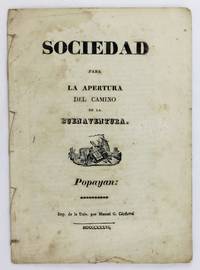
1836réf. 2936Popayan: Manuel G. Córdova 1836. Good plus. 17pp. Small quarto stitched as issued. Small chip at foot of title page. Light dust soiling and some dampstaining. An unrealized proposal to build an early railroad in Colombia from the Cauca Valley to the port of Buenaventura on the Pacific coast. Two families the Borreros and the Sanders formed the company to fund the construction of the line in Cali in 1836. Because of the legal intricacies of the federal system in Colombia at the time the central government could only subsidize interoceanic transportation and it fell to individual states and private companies to build infrastructure. The first railroad in Colombia which crossed the isthmus of Panama was completed almost twenty years later in 1855. Not in OCLC. Manuel G. Córdova unknown books
1863réf. 5642Bogota: Imprenta de la Nacion 1863. Very good. 286vii pp. Later plain wrappers; removed from a sammelband. Ownership mark eradicated from title page. Light tanning. The mid-19th century in Colombian politics was characterized by swings in power between Liberal and Conservative factions until the Liberals ascended to power in the early 1860s and ruled relatively unchallenged for the next two decades. The present work contains a very early printing of their new Constitution of 1863 as ratified by the Ríonegro Convention as well as most of the other legislation adopted there. The constitution incorporated many anti-clerical measures including official separation of church and state; full freedom of worship including non-Catholics; suppression of the religious orders; prohibition of corporate i.e. church ownership of real property; and governmental supervision of worship. The document also thoroughly decentralized power and made each state a virtual law unto itself. In an attempt to curb the authority of its leading politician-general Tomás de Mosquera the liberals made the presidency a two-year office with no immediate re-election. Imprenta de la Nacion unknown books
1957réf. 165321957. Women voting in Colombia 1957 documents Colombian women exercising national suffrage for the first time during the December 1 plebiscite that approved constitutional reforms inaugurating the political settlement known as the National Front. Women had formally received the right to elect and be elected through Legislative Act No. 3 of 1954 but the 1957 plebiscite provided their first opportunity to exercise that right in a nationwide vote. The photograph therefore records two interconnected developments in modern Colombian history: women's entry into the national electorate and a popular vote intended to establish a new constitutional and political arrangement after the fall of General Gustavo Rojas Pinilla and years of violent Liberal Conservative conflict. The plebiscite overwhelmingly approved reforms associated with the National Front under which the Liberal and Conservative parties would share political power; although conceived partly as a means of containing partisan conflict the settlement did not immediately terminate the violence that had marked Colombia since the 1940s. Gelatin silver press photograph with two images. Bogotá Colombia December 4 1957. Approximately 7 x 9 inches. The original caption printed above the photographs states in part: "Women voting for the first time in Colombian history turned out in large numbers in the 12/1 national plebiscite. Many mothers carried children in their arms as they arrived at polling places." The paired images emphasize women's physical participation in the electoral process: mothers are shown arriving to vote with children while at right a woman raises an ink-stained finger which the caption identifies as evidence that she has cast her ballot. These details make the photograph particularly useful as a record of suffrage as lived civic practice rather than merely legislative achievement preserving women's presence at polling places and the visible procedures surrounding their incorporation into the electorate. Colombia's national electoral authority confirms December 1 1957 as the first occasion on which Colombian women voted nationally while Banco de la República sources place that vote within the longer campaign for women's political rights and the constitutional transition leading into the National Front. The photograph was issued only three days after the plebiscite placing its production within the immediate press coverage of an election that altered both Colombian electoral participation and the organization of national political power. The vote followed the period conventionally known as La Violencia a prolonged conflict rooted principally in Liberal Conservative political antagonism; Colombia's Truth Commission identifies major phases extending from 1946 through the Rojas Pinilla dictatorship of 1953 to 1957 and notes continuing violence thereafter. As an original press photograph prepared for newspaper use the print also survives as material evidence of the visual news culture through which images of Colombia's new female electorate circulated contemporaneously. Minor handling and age wear consistent with press use; very good condition. A compelling contemporary visual record of the first nationwide exercise of women's suffrage in Colombia and of female voters' participation in the plebiscite that established the constitutional basis for the National Front. unknown books
1854réf. 2945Bogotá: Imprenta de Echeverría Hermanos 1854. About very good. 64pp. Slightly later plain wrappers stapled. Light soiling and wear to wraps. Scattered later manuscript marginalia. Light toning. Scarce pamphlet in which the author Francisco Zaldua strenuously defends himself and his actions as judge in a case brought against the Governor of Cartagena Juan José Nieto while in office. The back matter includes numerous documents relating to the case. OCLC locates only two copies at the Pontifical University of Bogotá and the National Library of Chile. Imprenta de Echeverría Hermanos unknown
1863réf. 5642Bogota: Imprenta de la Nacion 1863. Very good. 286vii pp. Later plain wrappers; removed from a sammelband. Ownership mark eradicated from title page. Light tanning. The mid-19th century in Colombian politics was characterized by swings in power between Liberal and Conservative factions until the Liberals ascended to power in the early 1860s and ruled relatively unchallenged for the next two decades. The present work contains a very early printing of their new Constitution of 1863 as ratified by the Ríonegro Convention as well as most of the other legislation adopted there. The constitution incorporated many anti-clerical measures including official separation of church and state; full freedom of worship including non-Catholics; suppression of the religious orders; prohibition of corporate i.e. church ownership of real property; and governmental supervision of worship. The document also thoroughly decentralized power and made each state a virtual law unto itself. In an attempt to curb the authority of its leading politician-general Tomás de Mosquera the liberals made the presidency a two-year office with no immediate re-election. Imprenta de la Nacion unknown
1854réf. 2944Bogotá: Imprenta del Neo-Granadino 1854. Very good plus. 1242pp. Original printed wrapper stitched. Minor creasing and dust soiling. Light tanning. Scarce mid-19th-century report on the Republic of Ecuador from a Colombian perspective. Ecuador during this period was under the liberal anticlerical regime of General José María Urbina and was dogged by strife between the ruling party and not only conservative but also monarchical groups as well as by in-fighting amongst liberal factions. The present work by nineteen-year-old Secretary of War !!! Felipe Perez who was appointed in the same year as publication by President José María Obando attempts to analyze the situation in neighboring Ecuador so that its perceived ills might be avoided in Colombia. OCLC locates a half dozen copies only three in U.S. institutions. Imprenta del Neo-Granadino unknown
1863réf. 2939Bogota Colombia 1863. Very good. Large broadside approximately 17 x 11 inches. Previously folded. Small chip at right edge not affecting text. A large and unrecorded broadside dated June 12 1863 printed in two columns and addressed to Manuel Suarez Fortoul the chief magistrate of Bogota regarding the recently passed law on the property of religious orders. The law which allowed for taxes on such property caused much consternation in Colombia as did similar laws elsewhere in Latin America during the mid-19th century. Here the author Manuel I. Narvaez offers a detailed extensive and outraged sixteen-point rebuttal of the magistrate's arguments for the constitutionality of the law. Not in OCLC. unknown
1827réf. 40117Bog. Bogotá: Imp. de P. Cubides 1827. First edition. Contemporary calf raised bands gilt florets on spine paper label in manuscript. A very good copy with two tiny wormholes in spine scuffing to boards partial label on spine minor dampstaining to rear leaves last leaf soiled. 2 539 1 lxxxvii 1 pp. Sm. 8vo. The second collection of laws after the 1823-1824 edition there being no session in 1822. Provenance: signed by Agustín Guerrero on the front pastedown. Agustín Guerrero 1817-1902 was President of the Provisional government of the Republic of Ecuador from 14 January 1883 to 5 October 1883 along with three others after the overthrow of the dictatorship established by General Veintemilla. Sabin 14565n. Posada Bibliografía bogotana v. II: 1030. Imp. de P. Cubides hardcover
1827réf. 40117Bog. Bogotá: Imp. de P. Cubides 1827. First edition. Contemporary calf raised bands gilt florets on spine paper label in manuscript. A very good copy with two tiny wormholes in spine scuffing to boards partial label on spine minor dampstaining to rear leaves last leaf soiled. 2 539 1 lxxxvii 1 pp. Sm. 8vo. The second collection of laws after the 1823-1824 edition there being no session in 1822. Provenance: signed by Agustín Guerrero on the front pastedown. Agustín Guerrero 1817-1902 was President of the Provisional government of the Republic of Ecuador from 14 January 1883 to 5 October 1883 along with three others after the overthrow of the dictatorship established by General Veintemilla. Sabin 14565n. Posada Bibliografía bogotana v. II: 1030. Imp. de P. Cubides hardcover books
1957réf. 165321957. Women voting in Colombia 1957 documents Colombian women exercising national suffrage for the first time during the December 1 plebiscite that approved constitutional reforms inaugurating the political settlement known as the National Front. Women had formally received the right to elect and be elected through Legislative Act No. 3 of 1954 but the 1957 plebiscite provided their first opportunity to exercise that right in a nationwide vote. The photograph therefore records two interconnected developments in modern Colombian history: women's entry into the national electorate and a popular vote intended to establish a new constitutional and political arrangement after the fall of General Gustavo Rojas Pinilla and years of violent Liberal Conservative conflict. The plebiscite overwhelmingly approved reforms associated with the National Front under which the Liberal and Conservative parties would share political power; although conceived partly as a means of containing partisan conflict the settlement did not immediately terminate the violence that had marked Colombia since the 1940s. Gelatin silver press photograph with two images. Bogotá Colombia December 4 1957. Approximately 7 x 9 inches. The original caption printed above the photographs states in part: "Women voting for the first time in Colombian history turned out in large numbers in the 12/1 national plebiscite. Many mothers carried children in their arms as they arrived at polling places." The paired images emphasize women's physical participation in the electoral process: mothers are shown arriving to vote with children while at right a woman raises an ink-stained finger which the caption identifies as evidence that she has cast her ballot. These details make the photograph particularly useful as a record of suffrage as lived civic practice rather than merely legislative achievement preserving women's presence at polling places and the visible procedures surrounding their incorporation into the electorate. Colombia's national electoral authority confirms December 1 1957 as the first occasion on which Colombian women voted nationally while Banco de la República sources place that vote within the longer campaign for women's political rights and the constitutional transition leading into the National Front. The photograph was issued only three days after the plebiscite placing its production within the immediate press coverage of an election that altered both Colombian electoral participation and the organization of national political power. The vote followed the period conventionally known as La Violencia a prolonged conflict rooted principally in Liberal Conservative political antagonism; Colombia's Truth Commission identifies major phases extending from 1946 through the Rojas Pinilla dictatorship of 1953 to 1957 and notes continuing violence thereafter. As an original press photograph prepared for newspaper use the print also survives as material evidence of the visual news culture through which images of Colombia's new female electorate circulated contemporaneously. Minor handling and age wear consistent with press use; very good condition. A compelling contemporary visual record of the first nationwide exercise of women's suffrage in Colombia and of female voters' participation in the plebiscite that established the constitutional basis for the National Front. unknown
1886réf. 35424Bogotá: Imprenta de Echeverria Hermanos 1886. One of at least three "official editions" of the Colombian constitution printed in Bogota in 1886 all with different paginations. The constitution was completed August 41886 and approved by the delegates and the national executive committee the following day. This edition includes transciptions of three speeches celebrating this constitution. Original printed wrappers. Wrappers torn and chipped spine and covers repaired with tape. Titlepage and verso has small ownership stamps and markings titlepage torn with slight loss of text. Pages loose in binding some leaves folded. Internally clean. A good copy. OCLC 10987000. unknown
1863réf. 5640Cali: Imprenta de Nicolas Hurtado 1863. Very good. 50pp. Original printed wrappers stitched. Untrimmed. Contemporary and later ownership inscriptions on front wrap; later private library stamp on first two leaves of text. Light wear at edges. A few scattered small stains; even toning. The political pendulum swung to the Liberals in Colombia in 1863 and a new constitution was promulgated at Rionegro which was to last until 1886. It renamed the nation the United States of Colombia gave too the states all powers not reserved to the central government contained fully defined individual liberties and guarantees and guaranteed Colombians full religious freedom. This printing was authorized in Cali shortly after the document's approval and official printing in Bogotá in May 1863. A contemporary ownership inscription of "B. Nuñez" on the front wrapper notes his purchase date as August 11 1863. OCLC notes two copies of the Bogotá imprint and one copy of a Medellin imprint but none of the present issue from Cali. Imprenta de Nicolas Hurtado unknown
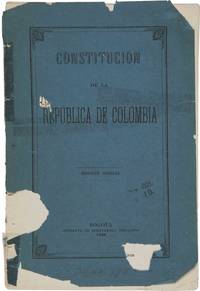
1886réf. 5649Bogota 1886. Very good. 484pp. Contemporary brown cloth stamped in black and gilt. Light wear to corers and spine ends. Ownership ink stamps on front pastedown and title page. Light foxing and toning. "Edicion Oficial." After Gran Colombia was dissolved in 1830 the countries of modern-day Colombia Venezuela and Ecuador took shape. Colombia then known as New Granada suffered two years of civil war ending in 1863 with the founding of the United States of Colombia. It was reestablished as the Republica de Colombia in 1886. This is the official edition of the constitution acknowledging the establishment of that entity. The front cover is stamped in gilt with the name of Fernando Cortes the title page also bearing his ownership stamp. unknown
1871réf. 4205Bogota 1871. Very good. 45pp. 12mo. Contemporary purple quarter cloth and marbled boards gilt initials on front cover. Light wear spine sun faded. Contemporary ownership inscription on verso of title page. Text lightly toned. "Edicion oficial revisada por una comision de la Camara de Representantes compuesta de un miembro por cada estado." In 1863 the political pendulum swung liberal and a new constitution was established which lasted until 1886. The new constitution renamed the country the United States of Colombia gave the states all powers not reserved for the central government contained fully defined individual liberties and guaranteed Colombians full religious freedom. Fewer than ten copies in OCLC. unknown
1886réf. 5649Bogota 1886. Very good. 484pp. Contemporary brown cloth stamped in black and gilt. Light wear to corers and spine ends. Ownership ink stamps on front pastedown and title page. Light foxing and toning. "Edicion Oficial." After Gran Colombia was dissolved in 1830 the countries of modern-day Colombia Venezuela and Ecuador took shape. Colombia then known as New Granada suffered two years of civil war ending in 1863 with the founding of the United States of Colombia. It was reestablished as the Republica de Colombia in 1886. This is the official edition of the constitution acknowledging the establishment of that entity. The front cover is stamped in gilt with the name of Fernando Cortes the title page also bearing his ownership stamp. unknown books
1871réf. 4205Bogota 1871. Very good. 45pp. 12mo. Contemporary purple quarter cloth and marbled boards gilt initials on front cover. Light wear spine sun faded. Contemporary ownership inscription on verso of title page. Text lightly toned. "Edicion oficial revisada por una comision de la Camara de Representantes compuesta de un miembro por cada estado." In 1863 the political pendulum swung liberal and a new constitution was established which lasted until 1886. The new constitution renamed the country the United States of Colombia gave the states all powers not reserved for the central government contained fully defined individual liberties and guaranteed Colombians full religious freedom. Fewer than ten copies in OCLC. unknown books
1863réf. 5640Cali: Imprenta de Nicolas Hurtado 1863. Very good. 50pp. Original printed wrappers stitched. Untrimmed. Contemporary and later ownership inscriptions on front wrap; later private library stamp on first two leaves of text. Light wear at edges. A few scattered small stains; even toning. The political pendulum swung to the Liberals in Colombia in 1863 and a new constitution was promulgated at Rionegro which was to last until 1886. It renamed the nation the United States of Colombia gave too the states all powers not reserved to the central government contained fully defined individual liberties and guarantees and guaranteed Colombians full religious freedom. This printing was authorized in Cali shortly after the document's approval and official printing in Bogotá in May 1863. A contemporary ownership inscription of "B. Nuñez" on the front wrapper notes his purchase date as August 11 1863. OCLC notes two copies of the Bogotá imprint and one copy of a Medellin imprint but none of the present issue from Cali. Imprenta de Nicolas Hurtado unknown books
1826réf. 5639Bogota: Imp. de la República; por Nicomedes Loro 1826. Very good. 255pp. Disbound. Light toning and dust soiling heavier to outer leaves. Simon Bolivar and his Vice President Francisco Santander attempt to bring up to date the Colombian Congress on the country's debt crisis in 1826. In that year the country defaulted on its foreign debt in great part due to the worldwide financial panic that began the previous year. The English bank B.A. Goldschmidt which provided large loans to the Colombian government collapsed because of the panic and left Colombia unable to finance its debt. The present work provides documents regarding the situation the problems now facing the nation and the dire international banking crisis. Fascinating first-hand documentation of the first international debt crisis of developing countries and quite scarce; OCLC locates two copies at Stanford and Texas. Posada Bibliografia Bogotana 893. Imp. de la República; por Nicomedes Loro unknown
1826réf. 5639Bogota: Imp. de la República; por Nicomedes Loro 1826. Very good. 255pp. Disbound. Light toning and dust soiling heavier to outer leaves. Simon Bolivar and his Vice President Francisco Santander attempt to bring up to date the Colombian Congress on the country's debt crisis in 1826. In that year the country defaulted on its foreign debt in great part due to the worldwide financial panic that began the previous year. The English bank B.A. Goldschmidt which provided large loans to the Colombian government collapsed because of the panic and left Colombia unable to finance its debt. The present work provides documents regarding the situation the problems now facing the nation and the dire international banking crisis. Fascinating first-hand documentation of the first international debt crisis of developing countries and quite scarce; OCLC locates two copies at Stanford and Texas. Posada Bibliografia Bogotana 893. Imp. de la República; por Nicomedes Loro unknown books
1853réf. 2933Bogota 1853. Good. Broadside approximately 13.5 x 9 inches.Previously folded. A few small chips and short closed tears at edges; short separations along old folds. Later small ink stamp in top margin. Moderate dust soiling and toning. A strong worded anonymous attack on the government of General José María Obando twice president of Colombia. This 1853 broadside criticizes the president general and his army goon squads for attacking members of congress their defenders and some of the "ciudadanos de los mas intelijentes y patriotas de Bogotá." With the small ownership stamp of Colombian historian and bibliographer Eduardo Posada; not in OCLC. unknown
1853réf. 2933Bogota 1853. Good. Broadside approximately 13.5 x 9 inches.Previously folded. A few small chips and short closed tears at edges; short separations along old folds. Later small ink stamp in top margin. Moderate dust soiling and toning. A strong worded anonymous attack on the government of General José María Obando twice president of Colombia. This 1853 broadside criticizes the president general and his army goon squads for attacking members of congress their defenders and some of the "ciudadanos de los mas intelijentes y patriotas de Bogotá." With the small ownership stamp of Colombian historian and bibliographer Eduardo Posada; not in OCLC. unknown books
1855réf. 2946Bogotá: Imprenta del Neo-Grandina 1855. Good. 65pp. Large octavo. Original printed wrappers rear lacking. Final leaf detached; Moderate creasing and wear at edges. Contemporary bookseller's ink stamp inside front wrapper. Light tanning and scattered foxing. In this scarce pamphlet the suspended governor of Cartagena Juan Jose Nieto defends himself against charges that he failed to do his duty with regard to directing the military forces at his disposal during the Golpe de Mela in 1854. An appendix contains numerous supporting documents. OCLC locates three copies at Harvard Library of Congress and the British Library. Imprenta del Neo-Grandina unknown
1822réf. 5737Medellin: Manuel Maria Viller Calderon 1822. About very good. 4pp. on a bifolium. Folio. Previously folded. Light wear at edges. Four small worm holes of which two in text and slightly affecting a few letters. Minor foxing and soiling. A decree dated September 21 1821 and first promulgated at Rosario de Cúcuta that imposes taxes for the maintenance of the army and other specified branches of the government. The present edition is reprinted in Medellin in 1822 evidently as a reminder to citizens that the first payment is due on June 22 1822. The entire decree consists of three preliminary paragraphs and thirty-eight numbered articles and is a production of the first printer to work in the Antioquia province Manuel María Viller-Calderón who established a press in Rio Negro in 1814 and moved it to Medellin in the same year. This work is one of a small handful of items printed there in the first quarter of the 19th century. OCLC does not locate any copies though we know of one in the National Library of Colombia. Manuel Maria Viller Calderon unknown