1 225 résultats
1822Cm. 21, 2 volumi, belle legature in piena pelle verde con fregi in oro al dorso e ai piatti, tasselli in pelle con titolo, pag. CXXIV, 707 (2 carte bianche) più ritratto e grande carta geografica ripiegata; VI, 782 (2 carte bianche) più ritratto. I ritratti sono del Presidente Bolivar e di Zea. MANCA l'occhiello al primo volume. PRIMA edizione di questo importante e dettagliato trattato sul paese sudamericano, con importanti notizie di aspetto economico con specifici paragrafi sulle estrazioni minerarie, le coltivazioni di Tabacco e Caffe' e la pesca delle perle. Interessante la descrizione accurata delle popolazioni indigene, con usi e costumi. Sabin, 101033.
1967452 p. Hardcover Ex-library, Very good condition
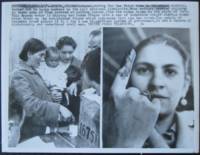
1957réf. 165321957. Women voting in Colombia 1957 documents Colombian women exercising national suffrage for the first time during the December 1 plebiscite that approved constitutional reforms inaugurating the political settlement known as the National Front. Women had formally received the right to elect and be elected through Legislative Act No. 3 of 1954 but the 1957 plebiscite provided their first opportunity to exercise that right in a nationwide vote. The photograph therefore records two interconnected developments in modern Colombian history: women's entry into the national electorate and a popular vote intended to establish a new constitutional and political arrangement after the fall of General Gustavo Rojas Pinilla and years of violent Liberal Conservative conflict. The plebiscite overwhelmingly approved reforms associated with the National Front under which the Liberal and Conservative parties would share political power; although conceived partly as a means of containing partisan conflict the settlement did not immediately terminate the violence that had marked Colombia since the 1940s. Gelatin silver press photograph with two images. Bogotá Colombia December 4 1957. Approximately 7 x 9 inches. The original caption printed above the photographs states in part: "Women voting for the first time in Colombian history turned out in large numbers in the 12/1 national plebiscite. Many mothers carried children in their arms as they arrived at polling places." The paired images emphasize women's physical participation in the electoral process: mothers are shown arriving to vote with children while at right a woman raises an ink-stained finger which the caption identifies as evidence that she has cast her ballot. These details make the photograph particularly useful as a record of suffrage as lived civic practice rather than merely legislative achievement preserving women's presence at polling places and the visible procedures surrounding their incorporation into the electorate. Colombia's national electoral authority confirms December 1 1957 as the first occasion on which Colombian women voted nationally while Banco de la República sources place that vote within the longer campaign for women's political rights and the constitutional transition leading into the National Front. The photograph was issued only three days after the plebiscite placing its production within the immediate press coverage of an election that altered both Colombian electoral participation and the organization of national political power. The vote followed the period conventionally known as La Violencia a prolonged conflict rooted principally in Liberal Conservative political antagonism; Colombia's Truth Commission identifies major phases extending from 1946 through the Rojas Pinilla dictatorship of 1953 to 1957 and notes continuing violence thereafter. As an original press photograph prepared for newspaper use the print also survives as material evidence of the visual news culture through which images of Colombia's new female electorate circulated contemporaneously. Minor handling and age wear consistent with press use; very good condition. A compelling contemporary visual record of the first nationwide exercise of women's suffrage in Colombia and of female voters' participation in the plebiscite that established the constitutional basis for the National Front. unknown
réf. 0656366966.Ghardcover. Good. Access codes and supplements are not guaranteed with used items. May be an ex-library book. hardcover
réf. 1330982878.Gpaperback. Good. Access codes and supplements are not guaranteed with used items. May be an ex-library book. paperback
2001415pp.richly illustrated in colour, hardcover (editor's cloth), illustrated dustwrapper, text in English, small stamp at verso of titlepage, 32cm., very good condition, S79093
2001réf. S79093, Villegas editores 2001 415pp.richly illustrated in colour, hardcover (editor's cloth), illustrated dustwrapper, text in English, small stamp at verso of titlepage, 32cm., very good condition, S79093
1957réf. 165321957. Women voting in Colombia 1957 documents Colombian women exercising national suffrage for the first time during the December 1 plebiscite that approved constitutional reforms inaugurating the political settlement known as the National Front. Women had formally received the right to elect and be elected through Legislative Act No. 3 of 1954 but the 1957 plebiscite provided their first opportunity to exercise that right in a nationwide vote. The photograph therefore records two interconnected developments in modern Colombian history: women's entry into the national electorate and a popular vote intended to establish a new constitutional and political arrangement after the fall of General Gustavo Rojas Pinilla and years of violent Liberal Conservative conflict. The plebiscite overwhelmingly approved reforms associated with the National Front under which the Liberal and Conservative parties would share political power; although conceived partly as a means of containing partisan conflict the settlement did not immediately terminate the violence that had marked Colombia since the 1940s. Gelatin silver press photograph with two images. Bogotá Colombia December 4 1957. Approximately 7 x 9 inches. The original caption printed above the photographs states in part: "Women voting for the first time in Colombian history turned out in large numbers in the 12/1 national plebiscite. Many mothers carried children in their arms as they arrived at polling places." The paired images emphasize women's physical participation in the electoral process: mothers are shown arriving to vote with children while at right a woman raises an ink-stained finger which the caption identifies as evidence that she has cast her ballot. These details make the photograph particularly useful as a record of suffrage as lived civic practice rather than merely legislative achievement preserving women's presence at polling places and the visible procedures surrounding their incorporation into the electorate. Colombia's national electoral authority confirms December 1 1957 as the first occasion on which Colombian women voted nationally while Banco de la República sources place that vote within the longer campaign for women's political rights and the constitutional transition leading into the National Front. The photograph was issued only three days after the plebiscite placing its production within the immediate press coverage of an election that altered both Colombian electoral participation and the organization of national political power. The vote followed the period conventionally known as La Violencia a prolonged conflict rooted principally in Liberal Conservative political antagonism; Colombia's Truth Commission identifies major phases extending from 1946 through the Rojas Pinilla dictatorship of 1953 to 1957 and notes continuing violence thereafter. As an original press photograph prepared for newspaper use the print also survives as material evidence of the visual news culture through which images of Colombia's new female electorate circulated contemporaneously. Minor handling and age wear consistent with press use; very good condition. A compelling contemporary visual record of the first nationwide exercise of women's suffrage in Colombia and of female voters' participation in the plebiscite that established the constitutional basis for the National Front. unknown books
UNICLAM. 1975. In-12 Carré. Broché. Etat d'usage. Couv. convenable. Dos frotté. Intérieur acceptable. 205 pages. Illustré de nombreux dessins et photos en noir et blanc, dans et hors texte. Avec une carte dépliante et volante en noir et blanc (annotée). Tranche salie. Collection 'Découverte de l'Amérique latine'.
réf. QWA-4450Revue Europe / E.F.R., 1964, 347 p., in-8 br., numéro 423-424 de juillet-août 1964, illustré de planches photos, quelques marques au stylo, sinon bon état
réf. cROU-1982Paris, La Bibliothèque des Arts, 1976 ; 1 volume in-4°, pleine toile rouge de l'éditeur, titre doré aux 1er plat et dos, jaquette illustrée en couleurs, reproductions de cartes anciennes illustrant les gardes et intérieurs des plats ;163pp.
1975réf. RO30382042Uniclam. 1975. In-12. Broché. Etat d'usage, Coins frottés, Dos plié, Papier jauni. 205 pages, nombreuses photos, cartes et illustrations en noir et blanc dans et hors texte.. . . . Classification Dewey : 986-Colombie, Panama, Equateur
1971réf. R160187761SEUIL. 1971. In-12. Broché. Bon état, Couv. convenable, Dos satisfaisant, Intérieur frais. 189 Pages - Nombreuses photos et dessins en noir et blanc dans et hors texte. . . . Classification Dewey : 986-Colombie, Panama, Equateur
1991réf. R200034651IMP. EDITORIAL NOMOS. 1991. In-8. Broché. Bon état, Couv. convenable, Dos satisfaisant, Intérieur frais. 56 pages. Quelques photos en couleurs dans le texte.. . . . Classification Dewey : 986-Colombie, Panama, Equateur
1973réf. RO30142802LA BIBLIOTHEQUE DES ARTS. 1973. In-4. Relié. Bon état, Couv. convenable, Dos satisfaisant, Intérieur frais. 163 pages augmentées de nombreuses photos et illustrations en noir et blanc et en couleurs dans et hors texte - jaquette en bon état. Avec Jaquette. . . Classification Dewey : 986-Colombie, Panama, Equateur
2013réf. R300321409Nouvelles éditions de l'Université. 2013. In-8. Broché. Bon état, Couv. convenable, Dos satisfaisant, Intérieur frais. 432 pages. . . . Classification Dewey : 986-Colombie, Panama, Equateur
1982réf. R100074815Centre français du commerce extérieur. 1982. In-8. Broché. Bon état, Couv. convenable, Dos satisfaisant, Intérieur frais. 83 pages - une carte en noir et blanc hors texte dépliante.. . . . Classification Dewey : 986-Colombie, Panama, Equateur
1976réf. 88459Paris La Bibliothèque des Arts 1976 1 vol. relié in-4, cartonnage sous jaquette illustrée, 163 pp., nombreuses photos en noir et en couleurs de Felipe Ferré. Préface de Jacques Soustelle. Très bon état.
réf. 5069les édition de l atelier 2001 In8 broché 121 pages
réf. R200058030NON PRECISE. NON DATE. In-4. Broché. Etat d'usage, Couv. légèrement passée, Dos satisfaisant, Intérieur frais. 1 PLAQUETTE de 4 pages illustrées en noir et blanc dans le texte. . . . Classification Dewey : 986-Colombie, Panama, Equateur
1976réf. R320167249Bibliothèque des Arts. 1976. In-4. Relié toilé. Bon état, Couv. convenable, Dos satisfaisant, Intérieur frais. 163 pages - jaquette en bon état - nombreuses photos en couleurs et en noir et blanc dans et hors texte - sous emboitage cartonné souple brut en état d'usage.. Avec Jaquette. Sous Emboitage. . Classification Dewey : 986-Colombie, Panama, Equateur
grand in-4° 163 pages, abdt illustre en noir et en couleurs, relie pleine toile edition, jaquette illustree plastifiee. Tres bel exemplaire, tres frais. [P-37]