ArgentinaABAA
3.515 Ergebnisse
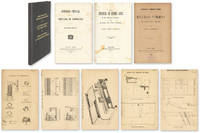
1873Best.-Nr. 589331873. 3 titles all rare; the last with 5 plates. 3 titles all rare; the last with 5 plates. Three Rare Argentinean Items Argentina. Codigo Penal de la Provincia de Corrientes. Buenos Aires: Imprenta de Pablo E. Coni 1878. 110 pp. Bound with Llerena Juan. La Provincia de Buenos Aires y su Nueva Capital. Buenos Aires: Establecimiento Tipografico 1881. 54 pp. And Stegmann Carlos. Construccion y Disposicion Interior de las Escuelas Publicas en Relacion con la Higiene. Buenos Aires: Imprenta de Pablo E. Coni 1878. 24 pp. Five plates two folding. Octavo 9-1/4" x 6-1/4". Later cloth gilt titles to spine. Light shelfwear some toning to text final three leaves of Construccion detached internally clean. $950. Only editions located. The first item is the penal code for Corrientes one of the provinces of Argentina. The second title which is not legal in nature is an essay defending the establishment of Buenos Aires as the national capital in 1880. Illustrated with plates depicting classrooms and school furniture the final title is a book of regulations governing the construction of schools and the furnishing of classrooms. All of these titles are rare. OCLC locates 1 copy each of Corrientes and Provincia both in Germany no copies of Construccion. See Borchard Guide to the Law and Legal Literature of Argentina Brazil and Chile 115-116. unknown books
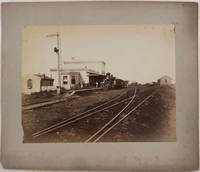
Best.-Nr. PC67Sixteen loose original albumen photos all ca. 16x22 cm 6 ¼ x 8 ½ in or slightly smaller. Each photo is mounted on the original card ca. 235x28 cm 9 ¼ x 11 in. All but one photo with period pencil captions in English on verso several photos also dated 1882 on verso. Mounts slightly age-toned and waved several mounts with minor tears or chipping on extremities several photos mildly faded but overall a very good collection of early large rare photos. Historically significant collection of early large rare original albumen photos of the British-owned East Argentine Railway built in 1871 to connect Concordia Entre Rios Argentina and the port of Ceibo on the right bank of the Uruguay River. The railway passed Gualeguaycito Federacion Estancia Philippi Chajari Mocoreta Naranjito and Monte Caseros before reaching Ceibo which developed as the starting point of the navigation on the Upper Uruguay River. The railway company owned the Scotish-built “Mensajero” steamer which took passengers and cargo as far up as Santo Tome Corrientes Argentina. Due to financial difficulties the railway was sold to another British-owned company the Argentine North Eastern Railway in 1907. According to the pencil captions the photos were taken in 1882 and include seven general and street views of Concordia photos of railway stations in Gualeguaycito and Monte Caseros a four-span bridge in Mandisovi between Federacion and Chajari Ceibo River and nearby ranchos Monte Caseros “Mensajero” steamer in Ceibo with a visible name sign and a smaller railway bridge with the two-car train on its right side. Overall a nice collection of early original photographs of the starting point stations bridges and the steamer of the East Argentine Railway. A list of captions: View in Concordia; View of Concordia two different views; Principal street Concordia; Street in Concordia; Plaza Concordia 1882; Plaza Concordia/82; A station on E.A. Railway Gualeguaycito; Monte Caserne station; … Grande bridge E.A. Railway/82; Mandisovi bridge/82; Monte Caseros 1882; Ceibo River; Raches on the banks of Ceibo; Mensagero in Ceibo; Mensajero steamer. unknown
1850Best.-Nr. 23730Paris Guillaumin et Cie 1850 in-8 br., couv. beige impr., non rogné, qqs rouss
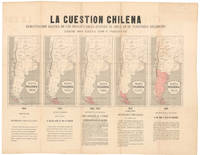
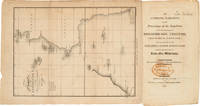
1878Best.-Nr. NL-02415Argentinian propaganda map of Chile's advance into Patagonia. This is an anonymous and undated propaganda map prepared by Argentina's Foreign Ministry for dissemination among potential allies on the American continents. It regards the conflict known as the "East Patagonia Tierra del Fuego and Strait of Magellan dispute" or "Patagonia Question" which was a territorial dispute between Chile and Argentina during most of the 19th century for more context see section below. The sheet centers on five maps which are distinguished only by the varying size of the swathe of red that is meant to outline Chile's encroachment into Argentine Patagonia. The expansion process began in 1843 with only a few small islands and tiny peninsulas in the western part of the Strait of Magellan but by 1847 Chile was claiming the entire Strait as its own. The expansion continues in three subsequent phases each documented with its own map until 1876 when the territory in dispute consists of virtually all of Patagonia or the southern half of Argentina. Each of the intermediary stages in the quintet of displayed maps is dated and the territories in question are highlighted in red. Under each phase are noted the years in question as well as a brief explanation of the particulars of each phase of the expansionall of it from an Argentine perspective of course. The Argentinian Foreign Ministry designed the map as a means of visualizing what Argentina considered the ongoing encroachment by Chile on Argentine territory. The broadsheet highlighted the blatant nature of Chilean territorial claims. Because of this background and purpose the sheet was only distributed in limited circles making it a rarity today. The only institutional example of this map in the United States was presented to the US Minister to Argentina Thomas Ogden Osborn by the Argentine Minister of Foreign Affairs to serve precisely the purpose for which it was designed. The United States did indeed get involved and played a key role in the ensuing treaty negotiations 1879-1881. Census This sheet is rare likely because it was never produced in large quantities to begin with. There is only a single example of this sheet in US institutions. This document is located in the National Archives NAID: 5675669 and is the same sheet that Thomas Ogden Osborn sent to US Secretary of State William M. Evarts in 1880 following his role as US mediator in the negotiations for the 1881 Boundary Treaty that ended the conflict. The only other institutional example we have been able to identify is held in the Biblioteca Nacional de España OCLC no. 431564806. Context is Everything The Strait of Magellan dispute and the "Patagonia Question" 18421881 The "Patagonia Question" was a nineteenth-century sovereignty dispute between Chile and Argentina over the southernmost lands of South America i.e. East Patagonia the Isla Grande de Tierra del Fuego and the strategically vital Strait of Magellan. Its roots lay in the messy inheritance of Spanish colonial jurisdictions and centuries of imprecise royal decrees that left overlapping claims along the entire Andean-to-Atlantic sweep. Both countries gradually sought to translate old legal claims into an effective national occupation: Chile concentrated on the Pacific channels and the Strait. At the same time Argentina pushed settlement eastward across the pampas and into Chubut. Tensions hardened during the mid-1800s. Chile's deliberate occupation of the Strait of Magellan symbolized by the 1843 expedition that founded Fuerte Bulnes and formally took possession of the strait alarmed Buenos Aires and was the source of repeated diplomatic protests. Argentina in turn fostered new settlements established informal alliances with indigenous leaders and ensured a significant naval presence to assert influence on the Atlantic coast. By the 1870s both states were populating adjacent zones and commissioning maps and legal arguments to buttress their claims. This map is one such example from the Argentine side. The trigger for a negotiated containment and ultimately a resolution of the conflict came in December 1878 when Chile and Argentina signed the FierroSarratea agreement. This was an interim pact that postponed a final delimitation and established arbitration procedures to avoid a fully fledged armed conflict. Chile quickly ratified the agreement but Argentina's Congress never gave its final approval causing it to collapse as a comprehensive settlement. The outbreak of the War of the Pacific 18791884 in which Chile fought Peru and Bolivia made rapid de-escalation with Argentina diplomatically urgent. Chile wished to avoid a second front. At the same time Argentina was engaged in the "Conquest of the Desert" on its southern frontier pushing it to resolve this old conflict as well. The crisis was finally resolved by the Boundary Treaty of 23 July 1881. The treaty adopted a practical formula: north to the 52°S parallel the boundary would follow the highest Andes watershed; south of 52°S the agreement recognized Chilean sovereignty over the Strait of Magellan and assigned islands and Tierra del Fuego between the two states according to specified meridians and channels. Crucially the treaty neutralized the Strait of Magellan and guaranteed free navigation to all nations; a provision that allowed international passage through the strait and prevented any single power from controlling it. US involvement in the dispute was modest. Washington did not act as an official guarantor or principal mediator in the 1881 settlement. However diplomatic records and dispatches confirm that the situation was under close observation and US diplomats regularly reported to their superiors on the crisis's development and its regional implications especially for shipping routes. Formal third-party arbitration and boundary adjudications were carried out by various state actors notably Britain or by various bilateral protocols. In short the U.S. was an interested observer rather than a decisive actor in both the dispute and its resolution. The conflict illustrates how colonial legal ambiguities competing settlement policies and the strategic value of a single waterway combined to produce a long fraught boundary contest. The 1881 Boundary Treaty negotiated under the shadow of other regional wars and mediated by pragmatism rather than legality integrated competing claims into a workable frontier and ensured the neutrality of the Strait of Magellan for international shipping. Condition Description Good. Wear and toning along fold lines. Foreign Ministry of Argentina
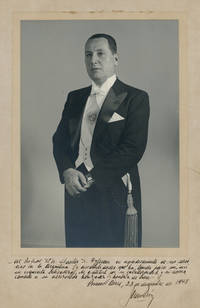
1948Best.-Nr. 231092Buenos Aires 1948. Three quarter-length frontal pose in tuxedo with presidential sash and necktie. Gelatin silver print. 1 vols. Image 28.5 x 20 cm. 11-1/4 x 8 inches; approximately 16-1/2 x 12-1/2 inches overall. With embossed stamp "Sub secretaria de informacione" lower right. Tipped to larger sheet and mounted. Small tear in margin of mount image fine. Three quarter-length frontal pose in tuxedo with presidential sash and necktie. Gelatin silver print. 1 vols. Image 28.5 x 20 cm. 11-1/4 x 8 inches; approximately 16-1/2 x 12-1/2 inches overall. Inscribed on the mount by Perón in Spanish on December 23 1948 to the internationally renowned dentist Dr. Stanley D. Tylman "in gratitude for his services to Argentina and the friendliness he has shown me with his exquisite delicacy . " "Born in 1893 dentist Stanley D. Tylman not only taught more than 1000 students at the University of Illinois at Chicago College of Dentistry in his long career as a Professor of Dentistry 1920-1962 and head of the Department of Fixed Partial Prosthodontics but he influenced countless dentists internationally as well. "Tylman was particularly effective as a global educational force because he spoke four languages. His international lecture schedule took him to Asia Europe the Caribbean and South America--including Argentina where he performed dental work for President Juan Peron and First Lady Evita Peron. Dentists worldwide traveled to Chicago for personal consultations with Dr. Tylman . Tylman died in 1982." -- Wikipedia 8/3/06. unknown
1948Best.-Nr. 231092Buenos Aires 1948. Three quarter-length frontal pose in tuxedo with presidential sash and necktie. Gelatin silver print. 1 vols. Image 28.5 x 20 cm. 11-1/4 x 8 inches; approximately 16-1/2 x 12-1/2 inches overall. With embossed stamp "Sub secretaria de informacione" lower right. Tipped to larger sheet and mounted. Small tear in margin of mount image fine. Three quarter-length frontal pose in tuxedo with presidential sash and necktie. Gelatin silver print. 1 vols. Image 28.5 x 20 cm. 11-1/4 x 8 inches; approximately 16-1/2 x 12-1/2 inches overall. Inscribed on the mount by Perón in Spanish on December 23 1948 to the internationally renowned dentist Dr. Stanley D. Tylman "in gratitude for his services to Argentina and the friendliness he has shown me with his exquisite delicacy . " "Born in 1893 dentist Stanley D. Tylman not only taught more than 1000 students at the University of Illinois at Chicago College of Dentistry in his long career as a Professor of Dentistry 1920-1962 and head of the Department of Fixed Partial Prosthodontics but he influenced countless dentists internationally as well. "Tylman was particularly effective as a global educational force because he spoke four languages. His international lecture schedule took him to Asia Europe the Caribbean and South America--including Argentina where he performed dental work for President Juan Peron and First Lady Evita Peron. Dentists worldwide traveled to Chicago for personal consultations with Dr. Tylman . Tylman died in 1982." -- Wikipedia 8/3/06. unknown books
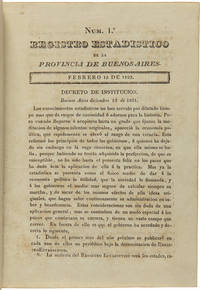
1822Best.-Nr. 36918Buenos Aires: Imprenta de la Independencia 1822-1823. Very Rare and Early Argentinian Government Publication The extremely rare initial twelve issues of the first statistical register for the province of Buenos Aires. The publication was created by government decree on December 13 1821 reprinted here in the first issue published on February 15 1822. The REGISTRO ESTADISTICO. was charged with publishing statistics documenting conditions throughout the province with additional causes notes and observations. The issues are a fascinating compilation of facts and figures regarding all aspects of life in Buenos Aires in the early period of independence. On a regular basis data concerning geography meteorology the movement of populations and hospitals were recorded. Other areas documented in these issues include commerce means of production and education including courses taught at the university. The first eleven numbers were issued monthly February through December 1822; the twelfth issue was published March 1823. An extremely rare government publication documenting the political economy of Buenos Aires in the early 1820s. OCLC lists nine locations for the register but only Cornell for the earliest issues. Contemporary diced sheep black leather label stamped in gilt. Outer joints and spine worn. Minor foxing and dampstaining. Very good. SABIN 68831. PALAU 253761. hardcover
1822Best.-Nr. 36918Buenos Aires: Imprenta de la Independencia 1822-1823. Very Rare and Early Argentinian Government Publication The extremely rare initial twelve issues of the first statistical register for the province of Buenos Aires. The publication was created by government decree on December 13 1821 reprinted here in the first issue published on February 15 1822. The REGISTRO ESTADISTICO. was charged with publishing statistics documenting conditions throughout the province with additional causes notes and observations. The issues are a fascinating compilation of facts and figures regarding all aspects of life in Buenos Aires in the early period of independence. On a regular basis data concerning geography meteorology the movement of populations and hospitals were recorded. Other areas documented in these issues include commerce means of production and education including courses taught at the university. The first eleven numbers were issued monthly February through December 1822; the twelfth issue was published March 1823. An extremely rare government publication documenting the political economy of Buenos Aires in the early 1820s. OCLC lists nine locations for the register but only Cornell for the earliest issues. Contemporary diced sheep black leather label stamped in gilt. Outer joints and spine worn. Minor foxing and dampstaining. Very good. SABIN 68831. PALAU 253761. hardcover books
1963Best.-Nr. 28756A Paris, chez Michel Cassé / Coll. ''Une Voix Un Geste'', 1963. Un vol. au format pt in-4 carré (288 x 265 mm) non paginé, en feuilles, sous couverture lithographiée à rabats rempliés et étui de pleine percaline satinée olive, dos lisse, titre frappé à l'oser amande.
1942Best.-Nr. 005575Buenos Aires Editions de l'Aigle 1942 In-4 Broché, couverture rempliée Edition originale
1928A wonderful gem of a livre d'artiste, illustrated with SIX ORIGINAL BURIN ENGRAVINGS BY HECTOR BALDASUA, hand-colored by Jean SaudÈ. 49 pp. Edition limited to 300 numbered copies printed on extremely fine Arches mouldmade wove paper. THIS COPY PRINTED FOR LEON PICHON, WHO PRINTED THE BOOK. Preface by Eugeni d'Ors. As issued in printed wraps. FINE AND BRIGHT, in the original board chemise and (lightly worn) slipcase.
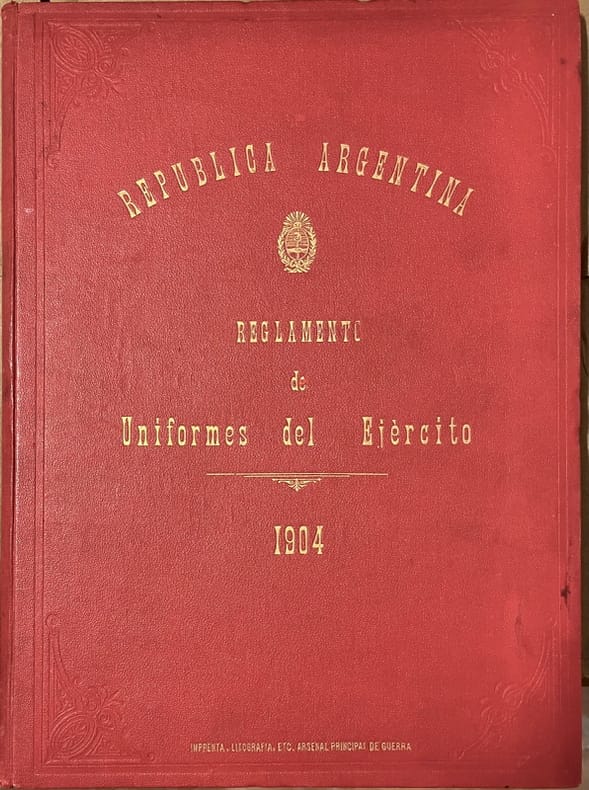
Best.-Nr. 239569Buenos Aires, Arsenal principal de guerra, 1904 in-4, 29 pp. de texte, un f. n. ch., et 70 planches en chromolithographie, toile chagrinée cerise, dos lisse muet, encadrements à froid sur les plats, titre poussé en lettres dorées sur le plat supérieur, tranches mouchetées (reliure de l'éditeur).
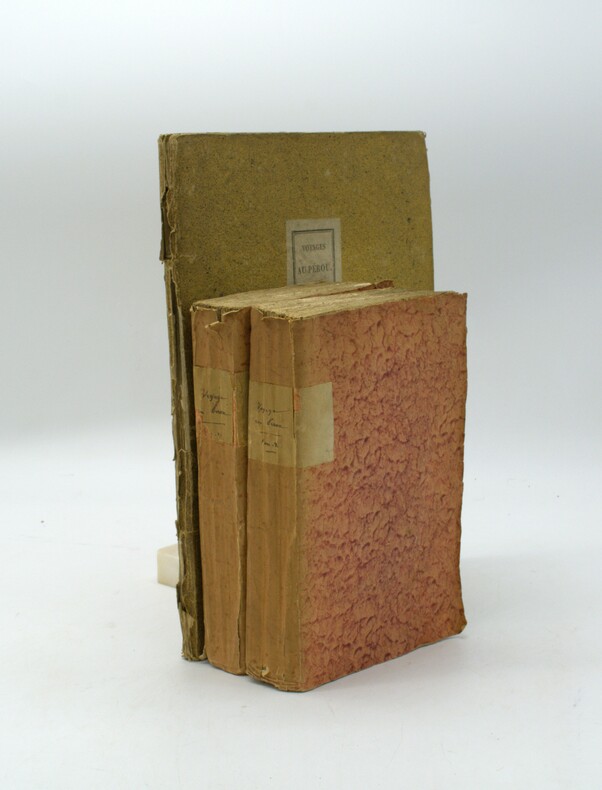
1809Best.-Nr. PHO-1737Paris, J.G. Dentu, 1809. 3 volumes TEXTE, 2 vol. in-8°,[2]-xii-385, [2]-427 pp. , brochage d’attente orange, étiquette avec titre au dos, quelques frottement. ATLAS, 1 vol. in-4° (290x225),12 planches sous serpente en couleurs et une carte de Lapie, reliure d’attente, titre sur le plat, dos manquant, coutures apparentes, la carte est volante et datée de 1829, elle provient d’un autre ouvrage
Best.-Nr. awd-650Gouache sur papier signée en orange en bas à droite et datée 1971 (50/65 cm). Bon état.
Due voll. in 4° gr., legatura Piena Tela edit. con titoli e fregi a secco, tagli rossi; pp. 389 + 27 tavole (di cui 15 col.), pp. 388 + 26 tavole (di cui 12 col.). Testo in lingua spagnola. Edizione a tiratura limitata, ogni esemplare con la firma del curatore e direttore dell'Istituto Lillo, H. Descole. Esemplare molto buono.
1732Best.-Nr. PHO-2447A Paris : chez Nyon, Didot, Quillau, 1732, in-4 ° (25x20cm). Pages [2], XIV, 298, [2], 63, [1] vierges + 37 planches H.T., dont dépliantes, demi basane et coins, dos à nerfs avec pièce de titre et auteur, tranches rouges. Frottements au dos, coiffes abimées avec petits manque, coupes et coins dénudés, réparation à 2 feuillets, petites rousseurs.
1823Best.-Nr. 46583Buenos Aires. May 5 1823. The United States Recognizes Argentina In this message to Congress Rivadavia Interior Secretary and Garcia Treasury Secretary announce the recognition of Argentine independence by the United States and discuss relations with other South American countries. They also report to Congress on the condition of internal security and defense the treasury taxes debt medical sciences etc. Rivadavia later served as the first president of the Provinces of Rio de la Plata from 1826-27. Rare with one copy in OCLC at the British Library. Folded folio sheet. Minor wear to top edge. Very good plus. unknown
1823Best.-Nr. 46583Buenos Aires. May 5 1823. The United States Recognizes Argentina In this message to Congress Rivadavia Interior Secretary and Garcia Treasury Secretary announce the recognition of Argentine independence by the United States and discuss relations with other South American countries. They also report to Congress on the condition of internal security and defense the treasury taxes debt medical sciences etc. Rivadavia later served as the first president of the Provinces of Rio de la Plata from 1826-27. Rare with one copy in OCLC at the British Library. Folded folio sheet. Minor wear to top edge. Very good plus. unknown books
1890Best.-Nr. c2311100201xbvkParis, imprimé par autorisation de M. le Garde de Sceaux, à L'Imprimérie National, M DCCC XC.(1890); Lithograph printed by L. Léchaudel. 26 singleside printed large-paper cardboard-sheets, incl. 1 coloured plate; large-4to.(ca. 32 x 25 cm, few plates slightly smaller ca. 31 x 24 cm).
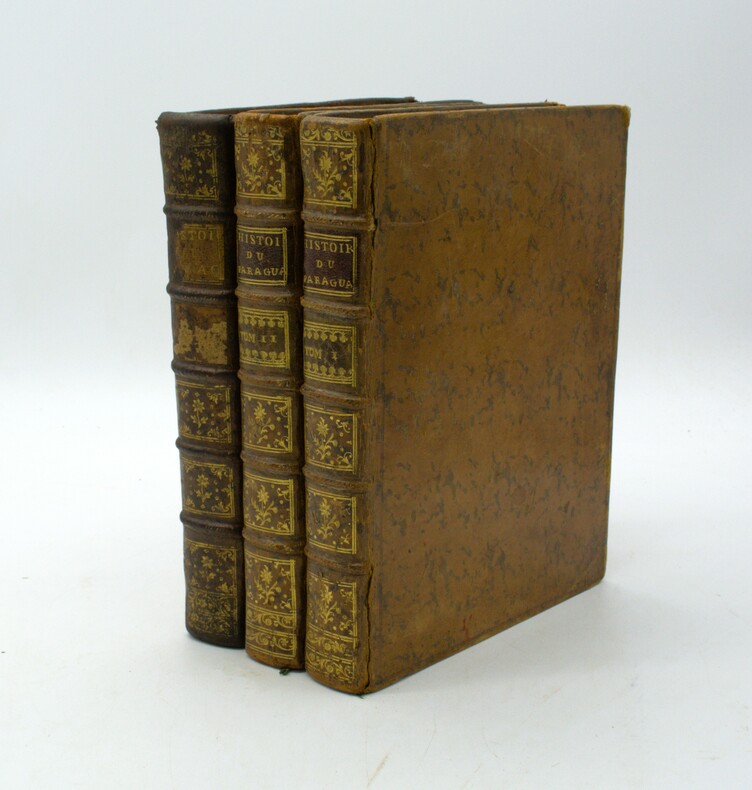
1756Best.-Nr. PHO-1895Paris, Didot, Giffart et Nyon, 1756. 3 vol. in-4 (260x200) de (5) ff., 489, xxxiii, (4) pp. ; (2) ff., 356, clviii, (2) pp. , 285pp ,cccxv,2ff .Veau marbré, dos à nerfs ornés, p. de titre et de tom., tranches rouges (reliure de l'époque),bien complets de leurs 7 cartes dépliantes dont le plan de Buenos Aires. Reliure tome 3 légèrement différente, avec pièce de tomaison absente, pièce de titre avec manque, coins usés, petit accroc.
1883Quaderno manoscritto a penna e matita in 8, pp. (30) in parte scritte e in parte bb. con gora centrale non deturpante. Indicazione ms. all'ultima p.: quaderno delle sue casse porto Dseato (sic). Importante e raro autografo di questo Capitano ed esploratore al servizio del governo argentino. Di origini chiavaresi, dopo aver viaggiato al comando di un brigantino per i mari dell'estremo oriente, fu al servizio tra il 1875 e il 1885 del governo argentino nell'attivita' dell'eslporazione e dello sfruttamento delle sue terre australi. Nel 1883, su sua proposta, venne organizzata una missione esplorativa nell'area di Porto Deseado che duro' tra l'11 aprile e il 14 novembre. In questo periodo vennero effettuate tutte le misurazioni e i rilievi finalizzati allo stabilimento di una colonia, fatto che avvenne l'anno successivo. Questo importantissimo brogliaccio risale proprio agli ultimi giorni di questa missione, come testimoniano le date apposte a margine delle 4 liste dei materiali caricati alla volta di Buenos Aires sul piroscafo Bahia Blanca comandato dal Capitano Ferro (11, 12, 13 e 14 novembre 1883). Di grande interesse l'esame delle liste dei materiali, che vanno da materiale geodeico e da rilevamento a tende, letti e coperte, tende, arnesi da lavoro ecc. Le pagine iniziali, dedicate ad una sommaria descrizione della localita', riflettono quanto pubblicato nella relazione a stampa edita nel 1884 e qui acclusa. Nel manoscritto poi, compaiono ampie annotazioni a matita di altra mano e che potrebbero attribuirdi a tal Luis Marzano, uomo al servizio dello stesso Oneto. Occore anche annotare che Antonio Oneto si reco' l'anno successivo, con 24 famiglie di coloni, al fine di fondare la citta'. La raggiunse il 15 luglio 1884 ma il 21 giugno 1885 mori' senza veder completata la sua opera. Attualmente, ogni 15 luglio, la citta' rende omaggio alla memoria dell'Oneto con cortei alla sua tomba ed al suo monumento. C. De Negri, L'attivita' geografica di Antonio Oneto in: Annali di ricerche e studi di geografia. Marzo 1955.
Best.-Nr. awd-998Huile sur toile signée en bas à gauche, Ktre et date au dos (1984), bagueqe de l’encadrement peinte par l’arKste. PeKts accrocs (81/54 cm).
1808Best.-Nr. 41553London. 1808. Detailed Account of the British Invasion of Argentina In 1807 Gen. John Whitelocke was sent to the Rio de la Plata with a large force. His goal was to reinforce British troops already operating there and in Argentina and to seize Buenos Aires a move designed to open up the markets of South America to British commerce and replace those lost on the Continent by Napoleon's blockade. Despite his large force Whitelocke proceeded cautiously and ineptly further hampered by bad weather. The assault on Buenos Aires was met by civilian as well as military resistance when the British had expected local merchants to welcome them with open arms. Craufurd commanded a light brigade which led the attack on Buenos Aires and successfully achieved its objectives. However a large part of the attacking force was cut off and forced to surrender while Whitelocke napped in his tent and Craufurd's brigade was ordered to surrender with the rest of the British force. Santiago Liniers the Spanish commander proposed a truce if the British would promise to withdraw in two months but said he could not answer for the safety of the prisoners if the attack was renewed. Feeling that the object of the expedition was now untenable Whitelocke accepted those terms. The British withdrew to Montevideo and then to England losing what might have been a foothold in South America. Whitelocke was the subject of the greatest scorn on returning to England where he was court-martialed and cashiered. Though this work is sometimes attributed to Gen. Whitelocke the accusatory and wounded tone of the narrative makes that unlikely. viii2161pp. plus four folding maps. Antique-style three-quarter calf and marbled boards. Minor offsetting and foxing on titlepage and other leaves facing maps. Old library stamps on first two leaves; contemporary ownership inscription on titlepage. Errata slip pasted to verso of titlepage. Very good. Untrimmed. SABIN 103672. PALAU 375051. HALKETT & LAING I p.164. DNB online. hardcover
1808Best.-Nr. 41553London. 1808. Detailed Account of the British Invasion of Argentina In 1807 Gen. John Whitelocke was sent to the Rio de la Plata with a large force. His goal was to reinforce British troops already operating there and in Argentina and to seize Buenos Aires a move designed to open up the markets of South America to British commerce and replace those lost on the Continent by Napoleon's blockade. Despite his large force Whitelocke proceeded cautiously and ineptly further hampered by bad weather. The assault on Buenos Aires was met by civilian as well as military resistance when the British had expected local merchants to welcome them with open arms. Craufurd commanded a light brigade which led the attack on Buenos Aires and successfully achieved its objectives. However a large part of the attacking force was cut off and forced to surrender while Whitelocke napped in his tent and Craufurd's brigade was ordered to surrender with the rest of the British force. Santiago Liniers the Spanish commander proposed a truce if the British would promise to withdraw in two months but said he could not answer for the safety of the prisoners if the attack was renewed. Feeling that the object of the expedition was now untenable Whitelocke accepted those terms. The British withdrew to Montevideo and then to England losing what might have been a foothold in South America. Whitelocke was the subject of the greatest scorn on returning to England where he was court-martialed and cashiered. Though this work is sometimes attributed to Gen. Whitelocke the accusatory and wounded tone of the narrative makes that unlikely. viii2161pp. plus four folding maps. Antique-style three-quarter calf and marbled boards. Minor offsetting and foxing on titlepage and other leaves facing maps. Old library stamps on first two leaves; contemporary ownership inscription on titlepage. Errata slip pasted to verso of titlepage. Very good. Untrimmed. SABIN 103672. PALAU 375051. HALKETT & LAING I p.164. DNB online. hardcover books
Best.-Nr. 226885Paris, A. Cadart, s.d. (vers 1875) in-4, titre et 40 planches gravées à l'eau-forte, signées, en partie numérotées et généralement légendées, demi-chagrin olive, dos lisse orné de filets dorés, tranches mouchetées de rouge (reliure moderne).