[Argentina]:Biblio.com
3.609 Ergebnisse
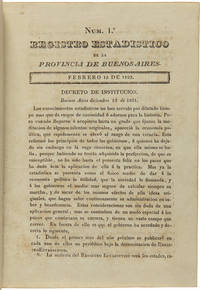
1822Best.-Nr. 36918Buenos Aires: Imprenta de la Independencia 1822-1823. Very Rare and Early Argentinian Government Publication The extremely rare initial twelve issues of the first statistical register for the province of Buenos Aires. The publication was created by government decree on December 13 1821 reprinted here in the first issue published on February 15 1822. The REGISTRO ESTADISTICO. was charged with publishing statistics documenting conditions throughout the province with additional causes notes and observations. The issues are a fascinating compilation of facts and figures regarding all aspects of life in Buenos Aires in the early period of independence. On a regular basis data concerning geography meteorology the movement of populations and hospitals were recorded. Other areas documented in these issues include commerce means of production and education including courses taught at the university. The first eleven numbers were issued monthly February through December 1822; the twelfth issue was published March 1823. An extremely rare government publication documenting the political economy of Buenos Aires in the early 1820s. OCLC lists nine locations for the register but only Cornell for the earliest issues. Contemporary diced sheep black leather label stamped in gilt. Outer joints and spine worn. Minor foxing and dampstaining. Very good. SABIN 68831. PALAU 253761. hardcover
1822Best.-Nr. 36918Buenos Aires: Imprenta de la Independencia 1822-1823. Very Rare and Early Argentinian Government Publication The extremely rare initial twelve issues of the first statistical register for the province of Buenos Aires. The publication was created by government decree on December 13 1821 reprinted here in the first issue published on February 15 1822. The REGISTRO ESTADISTICO. was charged with publishing statistics documenting conditions throughout the province with additional causes notes and observations. The issues are a fascinating compilation of facts and figures regarding all aspects of life in Buenos Aires in the early period of independence. On a regular basis data concerning geography meteorology the movement of populations and hospitals were recorded. Other areas documented in these issues include commerce means of production and education including courses taught at the university. The first eleven numbers were issued monthly February through December 1822; the twelfth issue was published March 1823. An extremely rare government publication documenting the political economy of Buenos Aires in the early 1820s. OCLC lists nine locations for the register but only Cornell for the earliest issues. Contemporary diced sheep black leather label stamped in gilt. Outer joints and spine worn. Minor foxing and dampstaining. Very good. SABIN 68831. PALAU 253761. hardcover books
1963Best.-Nr. 28756A Paris, chez Michel Cassé / Coll. ''Une Voix Un Geste'', 1963. Un vol. au format pt in-4 carré (288 x 265 mm) non paginé, en feuilles, sous couverture lithographiée à rabats rempliés et étui de pleine percaline satinée olive, dos lisse, titre frappé à l'oser amande.
1942Best.-Nr. 005575Buenos Aires Editions de l'Aigle 1942 In-4 Broché, couverture rempliée Edition originale
1928A wonderful gem of a livre d'artiste, illustrated with SIX ORIGINAL BURIN ENGRAVINGS BY HECTOR BALDASUA, hand-colored by Jean SaudÈ. 49 pp. Edition limited to 300 numbered copies printed on extremely fine Arches mouldmade wove paper. THIS COPY PRINTED FOR LEON PICHON, WHO PRINTED THE BOOK. Preface by Eugeni d'Ors. As issued in printed wraps. FINE AND BRIGHT, in the original board chemise and (lightly worn) slipcase.
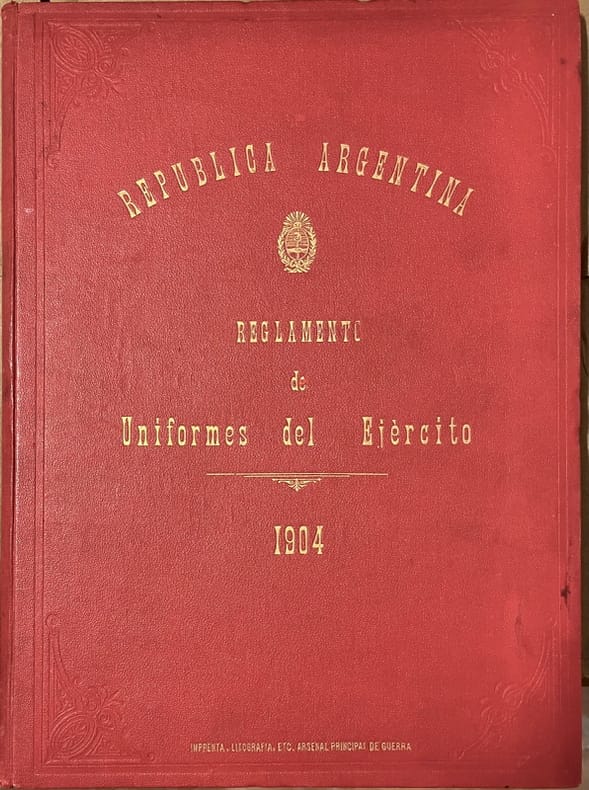
Best.-Nr. 239569Buenos Aires, Arsenal principal de guerra, 1904 in-4, 29 pp. de texte, un f. n. ch., et 70 planches en chromolithographie, toile chagrinée cerise, dos lisse muet, encadrements à froid sur les plats, titre poussé en lettres dorées sur le plat supérieur, tranches mouchetées (reliure de l'éditeur).
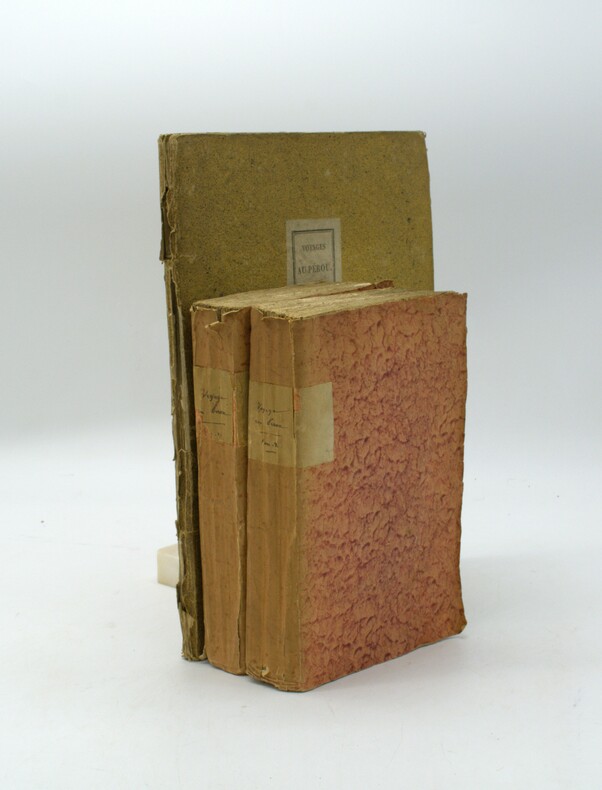
1809Best.-Nr. PHO-1737Paris, J.G. Dentu, 1809. 3 volumes TEXTE, 2 vol. in-8°,[2]-xii-385, [2]-427 pp. , brochage d’attente orange, étiquette avec titre au dos, quelques frottement. ATLAS, 1 vol. in-4° (290x225),12 planches sous serpente en couleurs et une carte de Lapie, reliure d’attente, titre sur le plat, dos manquant, coutures apparentes, la carte est volante et datée de 1829, elle provient d’un autre ouvrage
1977Best.-Nr. SBBI-mon0000051538Elías Quejereta. 1977. library. Good. Our good condition books are generally good for reading but not for gifting or collecting. They could have imperfections such as creasing fanning inscriptions margin notes yellowing staining on edge or cover or pages bumps scuffs etc etc sometimes multiple of these. It's a wide category that encompasses anything that isn't almost-new down to anything that is slightly better than poor. We would NOT recommend gifting Good books - these should be considered reading copies. Our books are dispatched from a Yorkshire former cotton mill. We list via barcode/ISBN so please note that the images are stock images and may not be the exact copy you receive furthermore the details about edition and year might not be accurate as many publishers reuse the same ISBN for multiple editions and as we simply scan a barcode or enter an ISBN we do not check the validity of the edition data when listing. If you're looking for an exact edition please don't order at least not without checking with us first although we don't always have time to check. We aim to dispatch prompty the service used will depend on order value and book size. We can ship to most countries see our shipping policies. Payment is via Abe only. Elías Quejereta. unknown
Best.-Nr. awd-650Gouache sur papier signée en orange en bas à droite et datée 1971 (50/65 cm). Bon état.
Due voll. in 4° gr., legatura Piena Tela edit. con titoli e fregi a secco, tagli rossi; pp. 389 + 27 tavole (di cui 15 col.), pp. 388 + 26 tavole (di cui 12 col.). Testo in lingua spagnola. Edizione a tiratura limitata, ogni esemplare con la firma del curatore e direttore dell'Istituto Lillo, H. Descole. Esemplare molto buono.
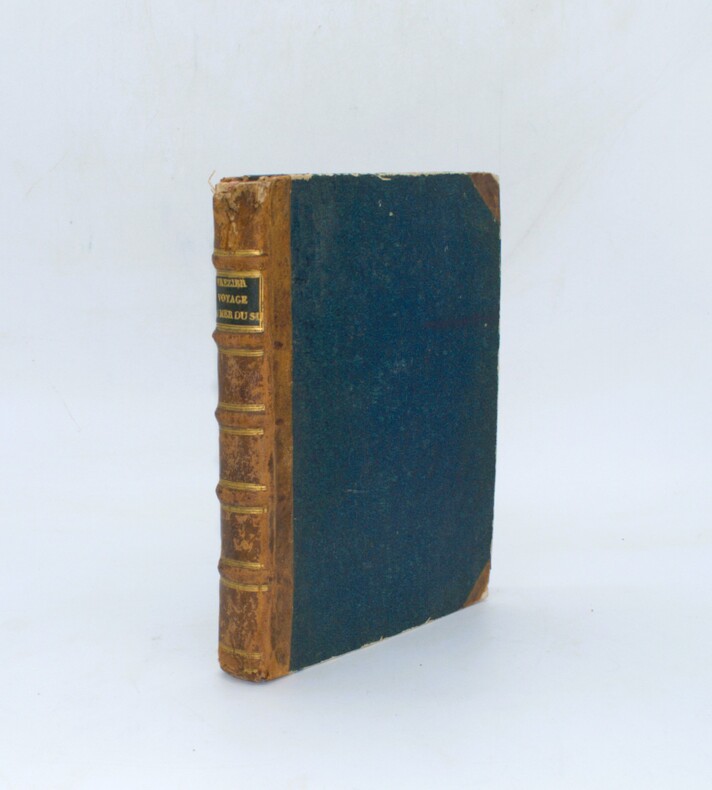
1732Best.-Nr. PHO-2447A Paris : chez Nyon, Didot, Quillau, 1732, in-4 ° (25x20cm). Pages [2], XIV, 298, [2], 63, [1] vierges + 37 planches H.T., dont dépliantes, demi basane et coins, dos à nerfs avec pièce de titre et auteur, tranches rouges. Frottements au dos, coiffes abimées avec petits manque, coupes et coins dénudés, réparation à 2 feuillets, petites rousseurs.
1823Best.-Nr. 46583Buenos Aires. May 5 1823. The United States Recognizes Argentina In this message to Congress Rivadavia Interior Secretary and Garcia Treasury Secretary announce the recognition of Argentine independence by the United States and discuss relations with other South American countries. They also report to Congress on the condition of internal security and defense the treasury taxes debt medical sciences etc. Rivadavia later served as the first president of the Provinces of Rio de la Plata from 1826-27. Rare with one copy in OCLC at the British Library. Folded folio sheet. Minor wear to top edge. Very good plus. unknown
1823Best.-Nr. 46583Buenos Aires. May 5 1823. The United States Recognizes Argentina In this message to Congress Rivadavia Interior Secretary and Garcia Treasury Secretary announce the recognition of Argentine independence by the United States and discuss relations with other South American countries. They also report to Congress on the condition of internal security and defense the treasury taxes debt medical sciences etc. Rivadavia later served as the first president of the Provinces of Rio de la Plata from 1826-27. Rare with one copy in OCLC at the British Library. Folded folio sheet. Minor wear to top edge. Very good plus. unknown books
1890Best.-Nr. c2311100201xbvkParis, imprimé par autorisation de M. le Garde de Sceaux, à L'Imprimérie National, M DCCC XC.(1890); Lithograph printed by L. Léchaudel. 26 singleside printed large-paper cardboard-sheets, incl. 1 coloured plate; large-4to.(ca. 32 x 25 cm, few plates slightly smaller ca. 31 x 24 cm).
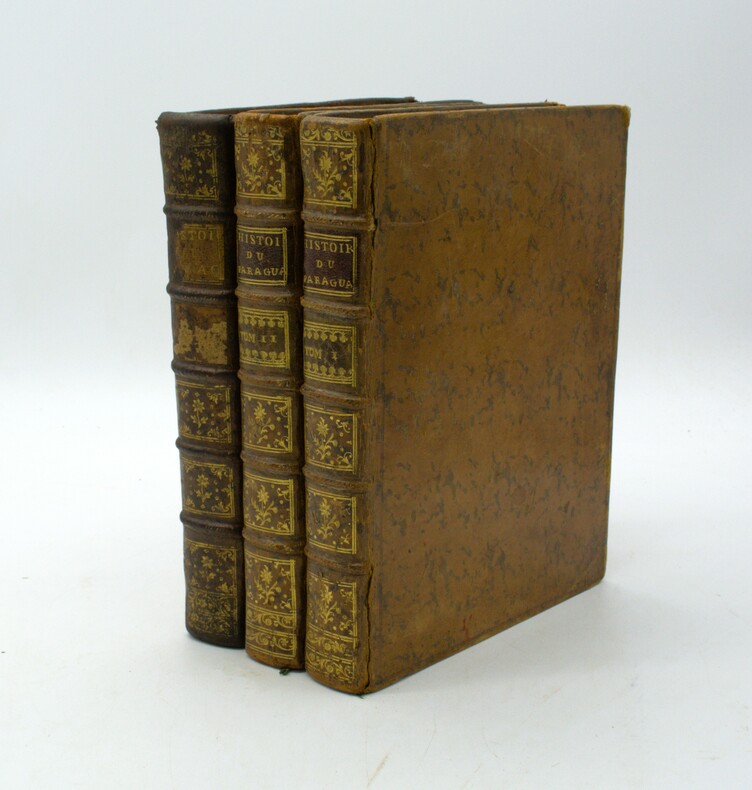
1756Best.-Nr. PHO-1895Paris, Didot, Giffart et Nyon, 1756. 3 vol. in-4 (260x200) de (5) ff., 489, xxxiii, (4) pp. ; (2) ff., 356, clviii, (2) pp. , 285pp ,cccxv,2ff .Veau marbré, dos à nerfs ornés, p. de titre et de tom., tranches rouges (reliure de l'époque),bien complets de leurs 7 cartes dépliantes dont le plan de Buenos Aires. Reliure tome 3 légèrement différente, avec pièce de tomaison absente, pièce de titre avec manque, coins usés, petit accroc.
1883Quaderno manoscritto a penna e matita in 8, pp. (30) in parte scritte e in parte bb. con gora centrale non deturpante. Indicazione ms. all'ultima p.: quaderno delle sue casse porto Dseato (sic). Importante e raro autografo di questo Capitano ed esploratore al servizio del governo argentino. Di origini chiavaresi, dopo aver viaggiato al comando di un brigantino per i mari dell'estremo oriente, fu al servizio tra il 1875 e il 1885 del governo argentino nell'attivita' dell'eslporazione e dello sfruttamento delle sue terre australi. Nel 1883, su sua proposta, venne organizzata una missione esplorativa nell'area di Porto Deseado che duro' tra l'11 aprile e il 14 novembre. In questo periodo vennero effettuate tutte le misurazioni e i rilievi finalizzati allo stabilimento di una colonia, fatto che avvenne l'anno successivo. Questo importantissimo brogliaccio risale proprio agli ultimi giorni di questa missione, come testimoniano le date apposte a margine delle 4 liste dei materiali caricati alla volta di Buenos Aires sul piroscafo Bahia Blanca comandato dal Capitano Ferro (11, 12, 13 e 14 novembre 1883). Di grande interesse l'esame delle liste dei materiali, che vanno da materiale geodeico e da rilevamento a tende, letti e coperte, tende, arnesi da lavoro ecc. Le pagine iniziali, dedicate ad una sommaria descrizione della localita', riflettono quanto pubblicato nella relazione a stampa edita nel 1884 e qui acclusa. Nel manoscritto poi, compaiono ampie annotazioni a matita di altra mano e che potrebbero attribuirdi a tal Luis Marzano, uomo al servizio dello stesso Oneto. Occore anche annotare che Antonio Oneto si reco' l'anno successivo, con 24 famiglie di coloni, al fine di fondare la citta'. La raggiunse il 15 luglio 1884 ma il 21 giugno 1885 mori' senza veder completata la sua opera. Attualmente, ogni 15 luglio, la citta' rende omaggio alla memoria dell'Oneto con cortei alla sua tomba ed al suo monumento. C. De Negri, L'attivita' geografica di Antonio Oneto in: Annali di ricerche e studi di geografia. Marzo 1955.
Best.-Nr. awd-998Huile sur toile signée en bas à gauche, Ktre et date au dos (1984), bagueqe de l’encadrement peinte par l’arKste. PeKts accrocs (81/54 cm).
1808Best.-Nr. 41553London. 1808. Detailed Account of the British Invasion of Argentina In 1807 Gen. John Whitelocke was sent to the Rio de la Plata with a large force. His goal was to reinforce British troops already operating there and in Argentina and to seize Buenos Aires a move designed to open up the markets of South America to British commerce and replace those lost on the Continent by Napoleon's blockade. Despite his large force Whitelocke proceeded cautiously and ineptly further hampered by bad weather. The assault on Buenos Aires was met by civilian as well as military resistance when the British had expected local merchants to welcome them with open arms. Craufurd commanded a light brigade which led the attack on Buenos Aires and successfully achieved its objectives. However a large part of the attacking force was cut off and forced to surrender while Whitelocke napped in his tent and Craufurd's brigade was ordered to surrender with the rest of the British force. Santiago Liniers the Spanish commander proposed a truce if the British would promise to withdraw in two months but said he could not answer for the safety of the prisoners if the attack was renewed. Feeling that the object of the expedition was now untenable Whitelocke accepted those terms. The British withdrew to Montevideo and then to England losing what might have been a foothold in South America. Whitelocke was the subject of the greatest scorn on returning to England where he was court-martialed and cashiered. Though this work is sometimes attributed to Gen. Whitelocke the accusatory and wounded tone of the narrative makes that unlikely. viii2161pp. plus four folding maps. Antique-style three-quarter calf and marbled boards. Minor offsetting and foxing on titlepage and other leaves facing maps. Old library stamps on first two leaves; contemporary ownership inscription on titlepage. Errata slip pasted to verso of titlepage. Very good. Untrimmed. SABIN 103672. PALAU 375051. HALKETT & LAING I p.164. DNB online. hardcover
1808Best.-Nr. 41553London. 1808. Detailed Account of the British Invasion of Argentina In 1807 Gen. John Whitelocke was sent to the Rio de la Plata with a large force. His goal was to reinforce British troops already operating there and in Argentina and to seize Buenos Aires a move designed to open up the markets of South America to British commerce and replace those lost on the Continent by Napoleon's blockade. Despite his large force Whitelocke proceeded cautiously and ineptly further hampered by bad weather. The assault on Buenos Aires was met by civilian as well as military resistance when the British had expected local merchants to welcome them with open arms. Craufurd commanded a light brigade which led the attack on Buenos Aires and successfully achieved its objectives. However a large part of the attacking force was cut off and forced to surrender while Whitelocke napped in his tent and Craufurd's brigade was ordered to surrender with the rest of the British force. Santiago Liniers the Spanish commander proposed a truce if the British would promise to withdraw in two months but said he could not answer for the safety of the prisoners if the attack was renewed. Feeling that the object of the expedition was now untenable Whitelocke accepted those terms. The British withdrew to Montevideo and then to England losing what might have been a foothold in South America. Whitelocke was the subject of the greatest scorn on returning to England where he was court-martialed and cashiered. Though this work is sometimes attributed to Gen. Whitelocke the accusatory and wounded tone of the narrative makes that unlikely. viii2161pp. plus four folding maps. Antique-style three-quarter calf and marbled boards. Minor offsetting and foxing on titlepage and other leaves facing maps. Old library stamps on first two leaves; contemporary ownership inscription on titlepage. Errata slip pasted to verso of titlepage. Very good. Untrimmed. SABIN 103672. PALAU 375051. HALKETT & LAING I p.164. DNB online. hardcover books
Best.-Nr. 226885Paris, A. Cadart, s.d. (vers 1875) in-4, titre et 40 planches gravées à l'eau-forte, signées, en partie numérotées et généralement légendées, demi-chagrin olive, dos lisse orné de filets dorés, tranches mouchetées de rouge (reliure moderne).
A livre d'artiste published in conjunction with an exhibition of Julio Hector Silva's work at the Galerie A.G. in Paris. A long poem by Juin, illustrated with 2 original full-page hors-texte prints by Silva, an Argentine artist with marked affinity for COBRA and abstract expressionism. The cover is a third original print. From a total edition of 61 numbered copies, this is ONE OF ONLY TEN COPIES, printed on extremely fine, textured French wove paper, WITH AN ORIGINAL SIGNED GOUACHE BY THE ARTIST LAID IN. This copy, moreover, features--although not called for--THREE ADDITIONAL COLOR ETCHINGS BY THE ARTIST, each signed and numbered in pencil. Additionally signed in the justification by both the author and the artist. 4to. Loose as issued in original wraps, board chemise, and slipcase. FINE AND BRIGHT, with no defects. OF THE GREATEST RARITY.
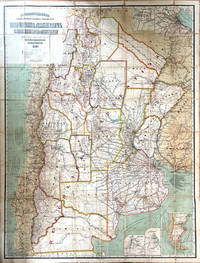
1919Best.-Nr. 63043Buenos Aires Argentina: Officina Cartografica de Pablo Ludwig 1919. Immense triple Atlas Folio dissected colour-lithographed map backed in linen sized 96 x 72 in. on sheet 100 x 76 in. in 64 panels which folds down into 13 x 10 in. offset toning from blue on versos of some panels age toning to fold creases minor edgewear slight occasional dustsoiling & very light foxing mounted w/in original plum-coloured cloth portfolio gilt lettering stamped on front cover wear & scuffing to spine remnants of attached label on back cover minor sunning to fore-edges & dustsoiling still a VG bright map preserved in G- original case. Second edition of this immense Pablo Ludwig commercial map of Argentina following World War I intended to aid in promoting and reviving the fast economic growth evident just before the outbreak of the Great War during the initial expansion of railroads urban trolley systems and infrastructure. Just prior to the War Argentina was one of the 10 largest economies in the World comparable with France & Germany and dwarfing Italy and Spain. Unfortunately following the WWI even though Argentina continued to expand and grow at a fairly fast clip during the Roaring 20’s the impact of the opening of the Panama Canal the decline of foreign investment in Argentina with most pouring into Europe for rebuilding or the United States the lack of industrialization severely hampered its future growth in the depths of the Great Depression. Inset maps provide close-ups of Tucuman Buenos Aires Chubut Santa Cruz and the cities of Mendoza and Rosario and the map claims the disputed Falkland Islands notes railroads proposed railroad lines trolley lines telegraph lines undersea cables wetlands salt flats and more. Ludwig fl. 1890-1962 was an active cartographer and mapmaker in Buenos Aires from the late 19th- through 20th-Century and first issued this map in 1910 at less than half the size of this one and Worldcat locates only 1 copy in the Library of Congress. Officina Cartografica de Pablo Ludwig, hardcover
Best.-Nr. 13982764Montevideo: Imprenta del Nacional, 1846 in-8 (19,5 x 12,5 cm), titre, (2 ff)-ciii-84 pp-(2 ff). Reliure d'époque, pleine basane noire, dos lisse orné, filets d'encadrement dorés sur les plats (couverture non conservée). Bel exemplaire de l'édition originale de ce texte fondamental du développement institutionnel de l'Argentine. Contient: Dedicatoria -- Ojeada retrospectiva sobre el movimiento intelectual en el plata desde el año 37 -- Dogma socialista de la Asociación de Mayo. Esteban Echeverría est un poète et un écrivain argentin né le 2 septembre 1805 à Buenos Aires et mort le 19 janvier 1851 à Montevideo. Il a joué un rôle important dans le développement de la littérature argentine et est l'un des plus importants auteurs romantiques de l'Amérique latine. Une des principales figures de la génération 37, il fonde en 1838 l'Asociacion Mayo, une institution opposée au gouvernement de Juan Manuel de Rosas.
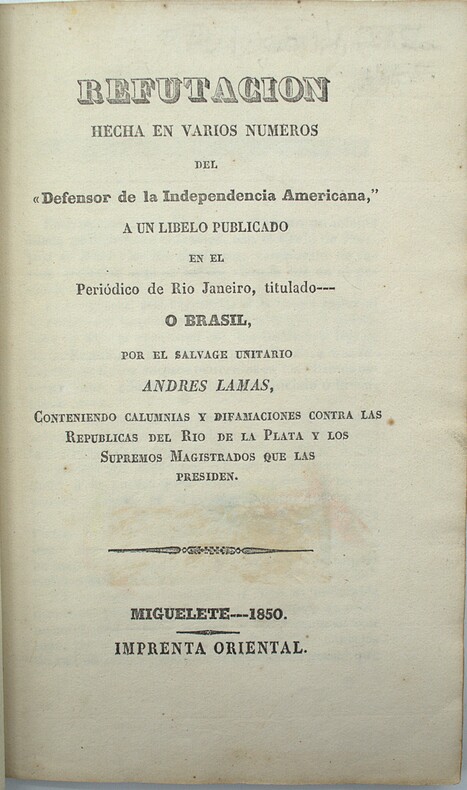
1850Best.-Nr. PHO-2494Miguelete, Imprenta oriental, 1850, in-12 (20x13,5cm), 147pp., brochage papier postérieur, étiquette de titre manuscrit au plat.
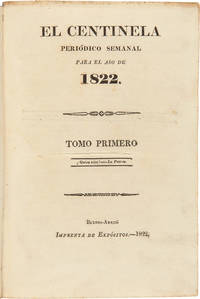
1822Best.-Nr. 36917Buenos Aires: Imprenta de los Expósitos 1822. Important Periodical from Newly-Independent Argentina An extremely rare copy of the complete first volume of the most important Argentinean periodical of the early independence period. Edited by Florencio Varela Juan Cruz Varela and Ignacio Núñez the issues include news miscellaneous notices and short literary pieces in verse and in prose. CENTINELA was published weekly and then biweekly in 1822 and 1823. The two years of the periodical consist of seventy-two numbers and three supplements. This first volume is complete with twenty-three numbers and one supplement. Extremely rare. OCLC records four copies at New York Public the John Carter Brown Library the British Library and the Ibero-Amerikanisches Institute in Germany. 5397pp. Nos. 1-23 plus supplement to No. 22 paged continuously. Quarto. Contemporary three-quarter sheep and marbled boards spine gilt. Outer joints and corners worn. A few pencil annotations. Occasional minor foxing. A very good copy. PALAU 51467. OCLC 50151967. hardcover