16 229 résultats
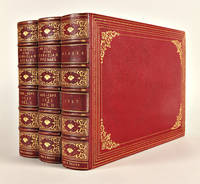
1937réf. WRCAM54535Alaska & Canada 1937. Three albums with 601 photographs each approximately 3 3/4 x 5 3/4 inches with additional ephemera such as news clippings and a hunting license. Oblong folio. Contemporary full red morocco gilt tooled by the Harcourt Bindery. Photos mounted directly on stiff grey album leaves. Very light wear to hinges and spine ends. Contents generally fine. Very good overall. Two volumes in red cloth slipcases. A magnificent and massive collection of over 600 photographs compiled by William N. Beach famed big game hunter and author of IN THE SHADOW OF MOUNT McKINLEY. The first two albums here document a journey made by Beach through the Canadian Rockies in August and September 1933. The third album focuses on his excursion through Alaska in 1937. All three postdate the publication of MOUNT McKINLEY which established Beach as an important figure in the world of big game hunting. According to one of the contemporary newspaper clippings tipped into the album Beach's hunting party on his second trip documented here "was after specimens of Alaskan wild life to be placed in the Smithsonian" with W.L. Brown curator of the Institute accompanying the party. Shortly after the trip an article by Beach entitled "With Moose and Caribou in Alaska" was published in EXPLORATION AND FIELD-WORK OF THE SMITHSONIAN INSTITUTION IN 1937 and featured photography from the "Alaska" album present here. These expertly captured images of the Denali wilderness and the Rockies offer a rare and extraordinary glimpse not only into big game hunting but also into remote and pristine landscapes of these areas in the 1930s. An outstanding and impressive group of photographs. hardcover books
1626réf. 851271626. First Edition. VAUGHAN William. The Golden Fleece Divided into Three Parts under which are discovered the Errours of Religion the Vices and Decayes of the Kingdome and lastly the Wayes to get Wealth and to restore Trading so much complayned of. Transported from Cambrioll Colchos out of the southermost Part of the Iland sic commonly called the Newfoundland by Orpheus Junior for the generall and perpetuall Good of Great Britaine. London Francis Williams 1626. Square octavo contemporary limp vellum recased hand-lettered spine title later endpapers. Housed in a custom clamshell box. $15000.Scarce first edition of this early allegorical promotion of settlements in Newfoundland ""one of the earliest contributions to English literature from America Baer.""Deeply concerned about the poor economic conditions prevailing in Wales"" William Vaughan ""became interested in overseas colonization as a means for improving the lot of his countrymen. As a result he decided to try to plant a colony in Newfoundland largely because it was easily accessible and also because it possessed an established fishery. In 1616 he purchased from the Newfoundland Company the part of the Avalon Peninsula to the south of a line from Caplin Bay across to Placentia Bay and decided to name the colony 'New Cambriol.' In the following year Vaughan set out a few ill-prepared colonists to the harbour of Aquaforte where they spent the winter huddled in cabins built by migratory fishermen for summer use. In 1618 Vaughan hired Richard Whitbourne to bring colonists and provisions to the settlement and appointed him governor moving it to a better location at Renews but in the end only six colonists spent the winter of 1619 at Renews and the settlement was abandoned in the following year Vaughan did his best to promote Newfoundland settlement by publication of his somewhat fanciful book The Golden Fleece"" Howgego. ""The work is one of the earliest contributions to English literature from America and was intended to advertise Vaughan's colony. It is a queer fantasy in prose and verse in which a succession of historical characters present complaints against the evils of the age in the court of Apollo and finally find the Golden Fleece in Newfoundland"" Baer. ""Vaughan's treatise was divided into three parts the first concerned with religion the second with the 'Vices and Decayes of the Kingdome' and the third with 'wayes to get wealth and to restore Trading. The third part focused on colonization he created a unique text by bringing into this dialogue the central figures of contemporary Jacobean and Elizabethan colonization including John Guy Captain John Mason Richard Whitbourne Francis Drake and Martin Frobisher"" McDiarmid & Collinson. The Golden Fleece is an extraordinary work in vivid contrast to the more prosaic and practical propagandist tracts on Newfoundland which Whitbourne and Mason had written. Its purpose was simple enough: Vaughan was anxious to promote the island as a place for settlement. Success he believed would relieve overpopulation at home treble England's present income from the fishery which he estimated to be 20000 pounds and generally increase trade Vaughan provided us with some of the earliest English literature on North America"" Gillian Cell. Lacking the extraordinarily rare map by John Mason which ""is very rarely found with the book"" Church. STC 2460. Sabin 98693. Church 409. Howgego V18. Interior generally fine blank leaves between parts V4 Oo2 and blanks at both front and rear excised. Scarce. hardcover
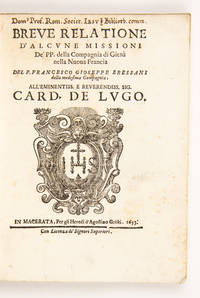
1653réf. 2969Macerata: : Heirs of Agostino Grisei 1653. FIRST EDITION. . Quarto: . 21.5 x 15.5 cm. 4 8 pp. 9-10 ll. 11-127 1 pp. Collation: π2 A4 B4 ±B1.2 C-Q4 Bound in 17th c. limp sheepskin parchment. With a large woodcut Jesuit device on the title page woodcut initial and a factotum built up from fleurons. There is a neatly written contemporary inscription of a Roman Jesuit library on the title page; some leaves foxed or lightly browned; there is a minor ink stain on two leaves. In all a nice genuine copy with generous margins. FIRST EDITION of one of the most important eyewitness accounts of 17th-century Canada devoted primarily to the Huron Indians but also with accounts of other groups including the Jesuit author’s captivity and mutilation under the Iroquois. He also devotes 25 pages to a 1643 letter written by his Jesuit colleague Isaac Jogues 1607-1646 who was killed by the Mohawks. Bressani 1612-1672 an Italian Jesuit travelled to Canada as a missionary in 1642. After two years in Quebec and with the Algonquins on the St. Lawrence River he set off for the most distant outposts the missions on Lake Huron’s Georgian Bay deep in the interior. He was captured by the Iroquois who cut off his fingers and eventually sold him to the Dutch who helped him reach France. He returned to Canada in 1645 participated in peace talks with the Iroquois and finally reached the Huron missions where he remained until the Iroquois destroyed them in 1649 killing most of the Hurons and missionaries. On his return to Europe in 1650 he wrote the present Italian account. A riveting eyewitness account of Canadian Indians and Jesuits in the 1640s. Alden & Landis 653/15; De Backer & Sommervogel II col. 133; Walter Jesuit relations 43; Church 524; James Ford Bell Lib. B-407; JCB II p. 428; Lande Canadiana 57; McCoy Jesuit relations 82; Sabin 7734; not in Eberstadt; Streeter. Heirs of Agostino Grisei, unknown books
1956réf. 1125558196Montreal : Published for the McGill Poetry Series by Contact Press 1956. Book. Near Fine. Hardcover. 1st Edition. 8vo - over 7¾ - 9¾" tall. black cloth silver spine lettersdust jacket79 pages illustrated five full page line drawings by Freda Guttman with some minor wear to dust jacket at top of spine with very small loss and at top corners of d.j.very slight tone to spine of d.j in protective mylar jacket. a fine example of the author's first book of which approximately 400 copies were printed. part of the McGill Poetry Series operated by Louis Dudek.First published in 1956 when he was twenty-two years old Let Us Compare Mythologies is Leonard Cohen's first collection of poetry. It is an accomplished and passionate collection which demonstrates Cohen's remarkably assured voice even as a young man. An unprecedented debut published to immediate acclaim. [Published for the McGill Poetry Series by Contact Press] Hardcover
1995réf. SBBI-L-BIL00322-RAG-20230Government of Canada 1995. paperback. Good. Our good condition books are generally good for reading but not for gifting or collecting. They could have imperfections such as creasing fanning inscriptions margin notes yellowing staining on edge or cover or pages bumps scuffs etc etc sometimes multiple of these. It's a wide category that encompasses anything that isn't almost-new down to anything that is slightly better than poor. We would NOT recommend gifting Good books - these should be considered reading copies. Our books are dispatched from a Yorkshire former cotton mill. We list via barcode/ISBN so please note that the images are stock images and may not be the exact copy you receive furthermore the details about edition and year might not be accurate as many publishers reuse the same ISBN for multiple editions and as we simply scan a barcode or enter an ISBN we do not check the validity of the edition data when listing. If you're looking for an exact edition please don't order at least not without checking with us first although we don't always have time to check. We aim to dispatch prompty the service used will depend on order value and book size. We can ship to most countries see our shipping policies. Payment is via Abe only. Government of Canada paperback
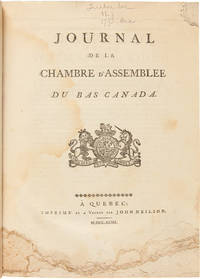
1793réf. 32892Quebec. 1793-1817. Extensive Run of Early Canadian Legislative Journals A large and impressive archive of Canadian laws. In an effort to pacify the disparate French and British populations of Canada the Constitutional Act of 1791 divided Canada in two. Upper Canada was primarily populated by Loyalist emigrants of the American Revolution while the citizenry of Lower Canada which included Quebec was mostly of French descent. These are the laws of Lower Canada printed in English and French. Though the first volume appeared in 1793 it includes material from the first session of the first Parliament held in December 1792. The series continued till 1836. "Public accounts are included in the early numbers of the Journals and from 1809 to 1835-36 Sessional papers are published as appendices to the Journals" - TPL. Present here is a complete run from its inception to 1813 with an additional volume for 1817. The twenty-third twenty-fourth and twenty fifth volumes are lacking. Scarce. OCLC locates only six complete runs. A prime resource for the study of Canadian legal history. Later brown cloth red and black gilt morocco labels. Printed in alternating English and French. Slight wear to and moderate soiling on covers. Occasional foxing. First view leaves of first volume torn along lower blank margin. Occasional old institutional markings. Overall very good. TPL 640. SABIN 10491. OCLC 11820245 48957532. TRÉMAINE 835. hardcover
1817réf. WRCAM32892Quebec 1817. Twenty-four volumes. Later brown cloth red and black gilt morocco labels. Printed in alternating English and French. Slight wear to and moderate soiling on covers. Occasional foxing. First view leaves of first volume torn along lower blank margin. Occasional old institutional markings. Overall very good. A large and impressive archive of Canadian laws. In an effort to pacify the disparate French and British populations of Canada the Constitutional Act of 1791 divided Canada in two. Upper Canada was primarily populated by Loyalist emigrants of the American Revolution while the citizenry of Lower Canada which included Quebec was mostly of French descent. These are the laws of Lower Canada printed in English and French. Though the first volume appeared in 1793 it includes material from the first session of the first Parliament held in December 1792. The series continued till 1836. "Public accounts are included in the early numbers of the Journals and from 1809 to 1835-36 Sessional papers are published as appendices to the Journals" - TPL. Present here is a complete run from its inception to 1813 with an additional volume for 1817. The twenty- third twenty-fourth and twenty fifth volumes are lacking. Scarce. OCLC locates only six complete runs. A prime resource for the study of Canadian legal history. TPL 640. SABIN 10491. OCLC 11820245 48957532. TRÉMAINE 835. hardcover books
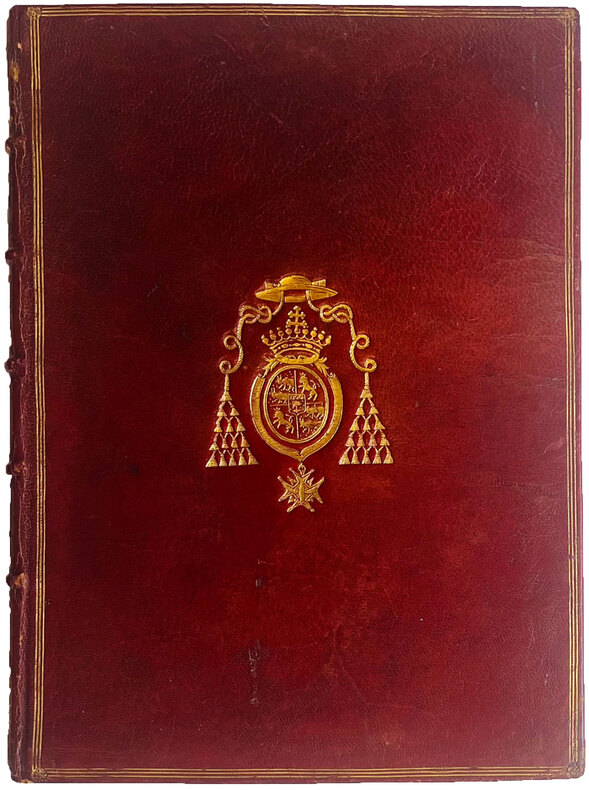
1784réf. LBW-9055Paris, Imprimerie Royale, 1784. In-4 de (2) ff., xxiv-80-26-32-28 pp. ; maroquin rouge, dos à nerfs orné, pièce de titre de maroquin vert, filets dorés encadrant les plats, armes au centre, tranches dorées (reliure de l'époque).
réf. 15440A La Haye, Chez Pierre de Hondt, 1739. Titles printed in red and black, with folding table on two sheets and 1 engraved plate. 6 volumes in 3. (2), 204 pp.; (2), 312 pp.; (2), 208 pp.; (2), 286 pp.; (14), 294 pp.; (18), 246 pp. Small 8vo. Modern overlapping vellum, red morocco labels. Kress 4447; Goldsmiths 7712; Einaudi 3728; INED 1553; Mattioli, 2247; Conlon 39:427; JFBL M162; European Americana, 739/191; not in Sabin. The only edition of this important work. An account of the financial operations of John Law and his 'Compagnie des Indes', including a great number of important memoirs, letters patent, decrees, declarations, etc. Barthélemy Marmont du Hautchamp (1682 - ab. 1760) was an admirer of John Law's system and his book is not written without partiality but has yet been recognized as the best contemporary history of the system and its most precious source. John Law's operations began with the foundation in 1716 of the 'Banque Générale', soon afterwards renamed 'Banque Royale'. This was followed by the scheme of colonization known as 'Mississippi scheme' in the 'Compagnie des Indes' which, by absorbing various other chartered companies, acquired the monopoly on the trade to America, Africa and China. Moreover, the company obtained the monopoly of tobacco, the control of the mint, the payment of the national debt, and the farm of the taxes. Within a few years Law's companies thus got almost complete control over France's overseas trade, its currency and public finances, to the extend that Law's companies at one point owned more than half of the then known United States. In 1719 the 'Compagnie des Indes' and the 'Banque Royale' were united, and the promising outlooks of the new company lead to an unprecedented speculation in its shares. As known the bubble burst in 1720, cash payments were suspended and Law fled from the country, leaving behind ruined many of his former supporters.The last 2 volumes contain the full texts of the 'mémoires', 'letters patentes', 'édits', 'déclarations', 'arrêts', etc., mostly by the Conseil d'État, as well as many other documents of which many are dealing with the 'Compagnie d'Occident', and the 'Compagnie des Indes Orientales et de la Chine', on which documents the author based this thorough and important history.Marmont du Hautchamp was born in Orléans and fermier des domaines in Flanders. He was also the author of the famous and very rare Histoire générale et particulière du visa (also published in The Hague, in 1743) which also dealt with the activities of John Law and the Mississippi bubble.
réf. elala6117Ottawa: Printed By Brown Chamberlin 1891. First Edition of this collection of the actual texts of First Nations treaties land cessions numbered treaties and surrenders relating to land and governance up until 1890 including the names of the signing Crown officials and First Nations representatives. Volume 1 contains an extensive index to the documents in the two volumes arranged alphabetically by First Nation township and the name of the Crown's representative in the transaction. The documents in the book are arranged chronologically. Also included are reproductions of the original maps used in the negotiation of the settlements. A third volume not present here was published in 1912. This is the main reference used by the Canadian government to deny and reject native Canadian land claims completely ignoring the oral tradition of the First Nations and also neglecting to include other important pertinent written accounts including information contained in the records of the Department of Indian Affairs. The documents “do not represent the entire spectrum of Treaties between the Aboriginal people and the Crown's representatives which were supposed to have been signed and negotiated under the Royal Proclamation of 1763 in a public meeting Review Article 141 or assembly held for that specific purpose. The St. Anne Island Treaty of 1796 is a case in point. The Treaty meeting was held at a public gathering on St. Anne Island in Lake St. Clair on August 30 1796. The Crown promised a large Reserve of the size of one Township then 92160 acres as well as free trade border crossing and other rights yet the record of this meeting is not in the Treaties and Surrenders book. There is only the surrender document Surrender #7 dated eight days later which implies erroneously that the Aboriginal people had surrendered or relinquished the land which at the Treaty negotiation they had agreed that they would in fact retain. This example is replicated throughout the history of Canada.” David T.McNab on the Brandon University website. 2 Volumes in 1. pp. 1 p.l. lxii 4 325; 1 p.l. 318. index. 66 plans 39 folding. modern calf. ownership entry of A.Dingman Indian Department Nov. 23rd 1894. elala6117 Ottawa: Printed By Brown Chamberlin, 1891 unknown
réf. elala3241Ottawa: 1889. The information regarding the extent and boundaries of the numerous Indian reservations in Manitoba and the North-West Territories allotted under Treaties 4 6 and 7 and part of Treaty 2 was gathered for the guidance of Indian Agents and other employees of the Department of Indian Affairs and for the use of the public especially settlers desirous of taking up lands in the vicinity of the reserves. The descriptions and accompanying plans were prepared by direction of Edgar Dewdney Indian Commissioner from the original records of the Department under the supervision of John C. Nelson in charge of Indian Reserve Surveys. Each description provides details on area situation and general features the number of Indian families in the band the name of the Chief the name of the surveyor by whom the reserve was laid out and the date of the survey. Peel 1765. folio. pp. 113. 1 leaf of errata tipped in. 83 folding colour lithographed plans. new quarter calf [Ottawa: 1889]
réf. elala6215Montreal: Printed By William Gray 1817. First Edition. Rare. The Society was formed in 1812 at York to provide relief to injured veterans and those who suffered losses and distress as a result of the war with the United States. Subscribers committed a tenth of their income to the benevolent fund and soon other Districts and the wealthier cities of Quebec and Montreal followed suit. A subscription was opened in London by Lieutenant Governor Gore encouraged by the patronage of the Duke of Kent and Nova Scotia and Jamaica then also provided assistance. Officers of the Society included Chief Justice Thomas Scott Chairman Alexander Wood Secretary and Justice William Dummer Powell Justice William Campbell Reverend John Strachan Dr. William Warren Baldwin Thomas Ridout D’Arcy Boulton John Beverley Robinson John Small William Allan and William Chewett Directors. This detailed report which was probably edited by John Strachan who president and treasurer of the society contains minutes of meetings accounts and other records dating from 1812 to 1816. Dionne III 98. Gagnon I 3511. TPL 1099. Vlach 741. 8vo. pp. 419 1. 1 folding table. An uncut copy in later half leather spine ends chipped outer edges of last leaf chipped some foxing to outer leaves. elala6215 Montreal: Printed By William Gray, 1817 hardcover
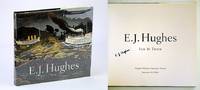
2002réf. 547H0222Canada: Douglas & McIntyre / Vancouver Art Gallery. Fine in Fine dust jacket. 2002. First Printing. Hardcover. 1550548999 . Signed by E.J. Hughes upon title page. 226 pages. Index of works. Chronology. Selected bibliography. Oblong 11" x 12". "Lavishly illustrated with 100 full colour and 25 black-and-white reproductions of prints drawings and paintings this is the first full-scale volume to honour the artistic life and work of E.J. Hughes from the start of his long career in the 1930s to the present. His unique talent for depicting the landscape in a way that both he and viewers believe it should be rather than the way it actually is enables us to experience and understand place and nature in new and deeper ways." - from dust jacket. Clean bright and unmarked with very light wear. Dust jacket now preserved in glossy new archival-grade Brodart. A marvelous gift for any devotee of E.J. Hughes and his magnificent art.; 4to - over 9¾" - 12" tall; E.J. Hughes British Columbia Canadian Artists Painters Landscape Painting Vancouver Island Signed; Signed by Authors . Douglas & McIntyre / Vancouver Art Gallery hardcover
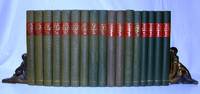
1937réf. 617G1246Victoria British Columbia: The Archives of British Columbia/British Columbia Historical Association. Good. 1937. First Edition. Hardcover. Seventeen volumes individually and uniformly bound in green cloth with with red labels and gilt lettering upon backstrips. Index in each volume. Fold-out maps. Black and white plates. Includes all issues from 1937 through 1945 and 1947 through 1954. Bindings tight. Unmarked. Moderate wear. A magnificent repository of early British Columbia history. Very heavy. Special shipping considerations may apply.; 8vo - over 7¾" - 9¾" tall; British Columbia Quarterly History . The Archives of British Columbia/British Columbia Historical Association hardcover
1691réf. 15632Paris, chez Amable Auroy, 1691. In-12 de (28)-572-(4) pp., table, veau brun, dos orné à nerfs, pièce de titre en maroquin rouge, tranches rouges (reliure de l'époque).
1798réf. PHO-1092Deuxième reliure de la première édition. Édition originale in-4 sur grand papier, remise en circulation en 1841 avec un nouveau titre avec la mention fictive "nouvelle édition" (quelques exemplaires imprimés en 1798 n'avaient toujours pas trouvé preneur). Une édition octavo en six volumes a également été publiée. in-4 ,y compris l'atlas. Avec 16 (10 dépliantes) dont 15 cartes gravées, 1 planche gravée et table dépliante. - Beau demi-cuir contemp , dos lisse avec titre et tomaison , petits manques au dos , quelques mouillures intermittentes et vieille trace d’humidité (T1), déchirure carte hydrographique sans manque. xii, cxliv, 628, [3] ; xvi, 676, [2] ;[xi], 431, [1];[2],viii, 158pp.
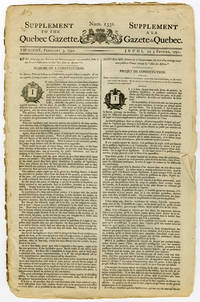
1791réf. WRCAM12536Quebec: Samuel Nielson 1791. Four issues. 2; 2; 4; 4pp. Printed in double-column format in parallel English and French. Folio. Slightly ragged on left margin. Very good. This extraordinary series of supplements to the QUEBEC GAZETTE demonstrates the extent to which feeling for the French Revolution had permeated the French population of Canada and the degree to which the British government was prepared to tolerate the expression of such Revolutionary sentiments. Most of the text of each issue all of the first two and part of the third and fourth is devoted to a long "Scheme of a Constitution" extracted from a late French publication entitled "Les Actes des Apotres." While recognizing monarchy as the necessary executive branch the text calls for a balance of power between the courts legislatures and executive. A surprising and interesting series to find published in Canada at this time in the same year that the Constitutional Act granted the first representative government to Canada. Not listed separately by Tremaine nor are supplements recorded in the appendix devoted to the .GAZETTE; however she notes two runs which include "almost all" of the supplements. Samuel Nielson unknown books
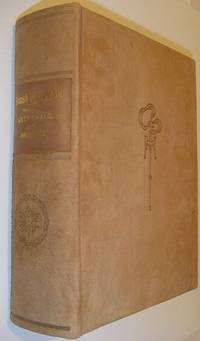
Unread. As new. Number 216 of limited edition of 350 copies. Signed by co-author R.E. Gosnell. "Few publications, if any, of similar size and excellence have been produced in Canada." - From Editor's Foreword. Part I includes 210 pages and eighteen chapters which constitute "a survey of events from the earliest times down to the Union of the Crown Colony of British Columbia with the Dominion of Canada." Part II is "a history, mainly political and economic, of the Province since Confederation up to the present time." Part I is preceded and followed by dozens of tissue-protected black and white portraits of individuals influential in the early history of the province, complete with their brief biographies upon the tissue. Part II comprises eighteen chapters over 226 pages plus 5 pages of addenda followed by dozens of tissue protected portraits of "some of the men conspicuous as present day factors in development." Top edge gilt. Gilt lettering upon backstrip. Marbled endpapers. Exceptionally clean, bright, and unmarked with zero wear. Brown suede exterior appears as fresh as the day it was applied over 100 years ago. This majestic fourteen pound tome measures 13" x 10.5" x 4". A magnificent acquisition for any serious collector of British Columbia history. A better copy will not be found. [Lowther 1607, Hale 2523, Edwards & Lort 3177, Strathern 495] Book
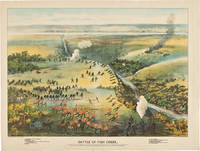
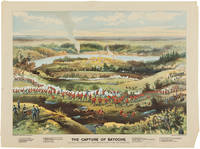
1885réf. 54034Toronto: Toronto Lithographing Co. ca.1885. Large Chromolithographs of the Riel Rebellion A trio of rare battlefield views depicting three of the major skirmishes fought during the North-West Rebellion in Saskatchewan in 1885. This series of battles is also known by several other names including the Saskatchewan Rebellion the Northwest Uprising and the Second Riel Rebellion the first Riel Rebellion occurred near Manitoba in 1869 and is also known as the Red River Rebellion. Both the 1869 and 1885 actions were led by Louis Riel the leader of the Métis people. Chronologically the lithographs are as follows: 1 "Battle of Fish Creek." This battle occurred on April 24 1885 and resulted in a stunning victory when around 200 Métis soldiers overcame a superior force of 900 government soldiers and temporarily halted an advance on Batoche. 2 "Battle of Cut Knife." On May 2 1885 a force of Cree warriors held off a superior group of Canadian army units. 3 "The Capture of Batoche." Effectively the end of the rebellion the Métis were soundly defeated in the second week of May after they ran out of ammunition on the third day of fighting. This action forced Riel to surrender on May 15. The Métis are one of the recognized aboriginal groups in Canada who trace their roots to the first interaction between First Nations people and the earliest European settlers usually French and largely as a result of the fur trade. The Métis are among the earliest mixed-race people in Canada and developed a separate distinct culture based on their ancestral origins usually stemming from the coupling of an indigenous woman and a male European settler. By the 19th century the Métis were well-assimilated into French-Canadian culture and many worked as fur traders for the North-West Company or Hudson's Bay Company or supplied furs as independent trappers. When those companies pulled out of the Red River and Saskatchewan regions in the mid-to-late 1800s the Canadian government took over the land and began to enforce their will on the Métis people. The first armed conflict between the Métis and the Canadian provincial government occurred in 1869 in the Red River region where Louis Riel led an unsuccessful rebellion. Some fifteen years later the Métis formed their own provincial government in western Saskatchewan after hearing that the Canadian government was sending mounted police to enforce Canadian law in the region. This Second Riel Rebellion occurred in a series of skirmishes between the Métis and the Canadian armed forces between March 26 and May 12 1885. Though led by Louis Riel the Métis ultimately lost again to the Canadian government. Still both rebellions helped the Métis gain some measure of recognition and respect from the Canadian government that they would very likely not have earned otherwise. The lithographs were produced by the Toronto Lithographing Company purveyors of patriotic views of famous Canadian wars. In this case the company assigned W.D. Blatchly to paint the scenes for the 1885 conflicts; Blatchly was at the time one of the leading artists in all of Canada. An excellent series of lithographs illustrating three important events in the famous rebellion with outstanding display appeal. Cut Knife and Fish Creek trimmed about ¾ inch along the top margin and about 1¼ inches along left margin. Capture at Batoche trimmed slightly more but evenly in each margin and adhered to backing board. Overall good plus. unknown
réf. 43587HUDSON'S BAY Company. Return to an Address of the Honourable The House of Commons dated 26 May 1842; - for Copy of the existing Charter or Grant by the Crown to the Hudson's Bay Company; together with Copies or Extracts of the Correspondence which took place at the last Renewal of the Charter between the Government and the Company or of Individuals on behalf of the Company; also the Dates of all former Charters or Grants to that Company. Ordered by The House of Commons to be Printed 8 August 1842. folio 34.5cm 322p. docketed ; removed; text clean and untrimmed; docket leaf little torn at margin without any loss very scarce.cgc. T.P.L. 2526. Peel 210. This work includes letters from the Governor of the Hudson 's Bay Company. unknown
1885réf. WRCAM54034Toronto: Toronto Lithographing Co. 1885. Three color lithographs. Cut Knife and Fish Creek: approximately 20 1/4 x 26 3/4 inches; Capture at Batoche: approximately 19 1/2 x 26 1/4 inches. Cut Knife and Fish Creek trimmed about 3/4 inch along the top margin and about 1 1/4 inches along left margin. Capture at Batoche trimmed slightly more but evenly in each margin and adhered to backing board. Overall good plus. A trio of rare battlefield views depicting three of the major skirmishes fought during the North-West Rebellion in Saskatchewan in 1885. This series of battles is also known by several other names including the Saskatchewan Rebellion the Northwest Uprising and the Second Riel Rebellion the first Riel Rebellion occurred near Manitoba in 1869 and is also known as the Red River Rebellion. Both the 1869 and 1885 actions were led by Louis Riel the leader of the Métis people. Chronologically the lithographs are as follows: 1 "Battle of Fish Creek." This battle occurred on April 24 1885 and resulted in a stunning victory when around 200 Métis soldiers overcame a superior force of 900 government soldiers and temporarily halted an advance on Batoche. 2 "Battle of Cut Knife." On May 2 1885 a force of Cree warriors held off a superior group of Canadian army units. 3 "The Capture of Batoche." Effectively the end of the rebellion the Métis were soundly defeated in the second week of May after they ran out of ammunition on the third day of fighting. This action forced Riel to surrender on May 15. The Métis are one of the recognized aboriginal groups in Canada who trace their roots to the first interaction between First Nations people and the earliest European settlers usually French and largely as a result of the fur trade. The Métis are among the earliest mixed-race people in Canada and developed a separate distinct culture based on their ancestral origins usually stemming from the coupling of an indigenous woman and a male European settler. By the 19th century the Métis were well- assimilated into French-Canadian culture and many worked as fur traders for the North-West Company or Hudson's Bay Company or supplied furs as independent trappers. When those companies pulled out of the Red River and Saskatchewan regions in the mid-to-late 1800s the Canadian government took over the land and began to enforce their will on the Métis people. The first armed conflict between the Métis and the Canadian provincial government occurred in 1869 in the Red River region where Louis Riel led an unsuccessful rebellion. Some fifteen years later the Métis formed their own provincial government in western Saskatchewan after hearing that the Canadian government was sending mounted police to enforce Canadian law in the region. This Second Riel Rebellion occurred in a series of skirmishes between the Métis and the Canadian armed forces between March 26 and May 12 1885. Though led by Louis Riel the Métis ultimately lost again to the Canadian government. Still both rebellions helped the Métis gain some measure of recognition and respect from the Canadian government that they would very likely not have earned otherwise. The lithographs were produced by the Toronto Lithographing Company purveyors of patriotic views of famous Canadian wars. In this case the company assigned W.D. Blatchly to paint the scenes for the 1885 conflicts; Blatchly was at the time one of the leading artists in all of Canada. An excellent series of lithographs illustrating three important events in the famous rebellion with outstanding display appeal. Toronto Lithographing Co. unknown books
1913réf. 559a9589British Columbia: British Columbia Historical Association 1913. Book. Fine. Hardcover. Signed by Authors. First Edition. Folio - over 12" - 15" tall. Unread. As new. Number 216 of limited edition of 350 copies. Signed by co-author R.E. Gosnell. "Few publications if any of similar size and excellence have been produced in Canada." - From Editor's Foreword. Part I includes 210 pages and eighteen chapters which constitute "a survey of events from the earliest times down to the Union of the Crown Colony of British Columbia with the Dominion of Canada." Part II is "a history mainly political and economic of the Province since Confederation up to the present time." Part I is preceded and followed by dozens of tissue-protected black and white portraits of individuals influential in the early history of the province complete with their brief biographies upon the tissue. Part II comprises eighteen chapters over 226 pages plus 5 pages of addenda followed by dozens of tissue protected portraits of "some of the men conspicuous as present day factors in development." Top edge gilt. Gilt lettering upon backstrip. Marbled endpapers. Exceptionally clean bright and unmarked with zero wear. Brown suede exterior appears as fresh as the day it was applied over 100 years ago. This majestic fourteen pound tome measures 13" x 10.5" x 4". A magnificent acquisition for any serious collector of British Columbia history. A better copy will not be found. Lowther 1607 Hale 2523 Edwards & Lort 3177 Strathern 495. British Columbia Historical Association Hardcover
1905réf. 3149821905. Illustrated with photographs mounted usually 2-4 on a page each captioned with over 80 leaves approximately 200 images. Printed recto only. 1 vols. Oblong 4to. Laid into a modern half green morocco backed clamshell dropbox. Illustrated with photographs mounted usually 2-4 on a page each captioned with over 80 leaves approximately 200 images. Printed recto only. 1 vols. Oblong 4to. unknown books
280 pages. Signed and inscribed upon front free endpaper by author to Roman Fast in June of 1949. Gouzenko was the Soviet embassy cipher clerk whose defection in 1945 marked the beginning of the Cold War. His revelations resulted in major investigations and dozens of arrests. Above-average wear to red boards. Binding intact. Unmarked. What appears to be a clipping from the dust jacket of a Second Printing copy is neatly affixed at half-title page. Said clipping provides major contemporary media reviews of this work. A treasure for your Espionage or Cold War collection. Book
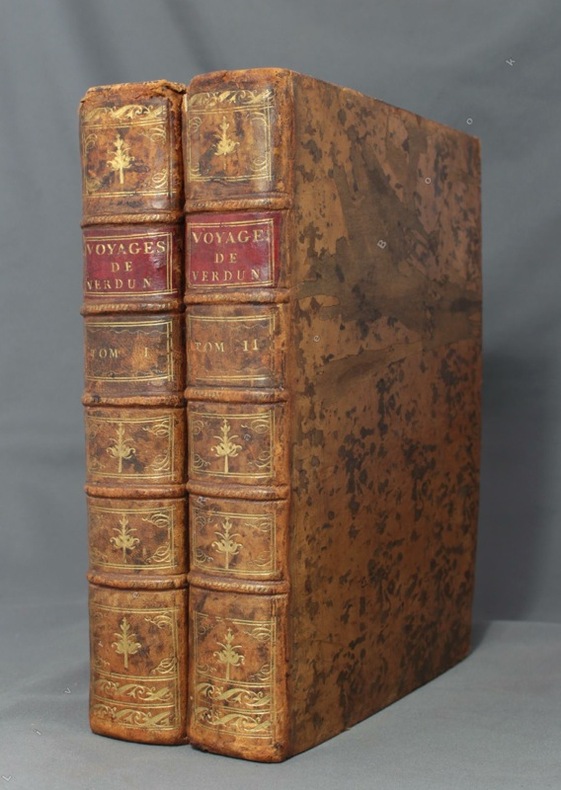
1778réf. 8670Paris, de l'Imprimerie Royale, 1778. 2 volumes in-4 de [4]-389-[1]-XIX-[3]; [8]-500-XXXII pages, plein veau marbré brun, dos à nerfs ornés de filets et fleurons dorés, pièces de titre en maroquin rouge, tranches mouchetées, petits accrocs aux coiffes supérieures, épidermures, coupes et coins frottés, tampon sur les pages de titre, quelques pâles rousseurs.