2 135 résultats
1997réf. DADAX0926842617Rowman & Littlefield Publishers 1997-01-01. First Edition. paperback. New. 7.00x0.75x10.00. Buy with confidence. Excellent Customer Service & Return policy. Rowman & Littlefield Publishers paperback
1949réf. 62289New York: Farrar Straus and Company 1949. First Edition. SpiralBound. Nr. Fine Dust Soil At Rear Cover. Octavo. B & W Illustrations. 8.5 6.25 1.0 A Charming Production With Blue Cover Lettering and Yellow Accents Blue Spiral Comb Binding Is Complete and Undamaged; Entire Book is in Hand Written Script Farrar, Straus and Company unknown
réf. ria9780357796375_inpPaperback / softback. New. New Book; Fast Shipping from UK; Not signed; Not First Edition; N/A paperback
réf. ria9780357946305_inpPaperback / softback. New. New Book; Fast Shipping from UK; Not signed; Not First Edition; N/A paperback
réf. ria9798214405919_inpPaperback / softback. New. New Book; Fast Shipping from UK; Not signed; Not First Edition; N/A paperback
réf. ria9781119801320_inpPaperback / softback. New. New Book; Fast Shipping from UK; Not signed; Not First Edition; N/A paperback
réf. SONG147580508XR&L Education 2014-01-30. hardcover. Used: Good. 6.39x0.71x9.46. Buy with confidence. Excellent Customer Service & Return policy. R&L Education hardcover
réf. DADAX1630946214Mometrix 2014-08-22. Study Guide. paperback. New. 8.00x0.50x10.90. Buy with confidence. Excellent Customer Service & Return policy. Mometrix paperback
réf. SONG1498505724Lexington Books 2017-03-24. paperback. Used: Good. 5.85x0.53x9.09. Buy with confidence. Excellent Customer Service & Return policy. Lexington Books paperback
réf. DADAX1442268883Rowman & Littlefield Publishers 2017-11-17. Sixth. paperback. New. 2.00x15.00x10.00. Buy with confidence. Excellent Customer Service & Return policy. Rowman & Littlefield Publishers paperback
2000réf. DADAX0877276048Southeast Asia Program Publications 2000-01-01. Annotated. paperback. New. 7.00x1.17x10.00. Buy with confidence. Excellent Customer Service & Return policy. Southeast Asia Program Publications paperback
1993réf. DADAX087727603XCornell University Press 1993-01-01. Annotated. paperback. New. 7.00x0.94x10.00. Buy with confidence. Excellent Customer Service & Return policy. Cornell University Press paperback
réf. DADAX0897669576Brand: New York Academy of Sciences 0000-00-00. hardcover. New. 6.50x1.00x9.50. Buy with confidence. Excellent Customer Service & Return policy. Brand: New York Academy of Sciences hardcover
2002réf. SONG0742516393Rowman & Littlefield Publishers 2002-12-17. paperback. Used: Good. 5.74x0.63x9.02. Buy with confidence. Excellent Customer Service & Return policy. Rowman & Littlefield Publishers paperback
réf. ria9781324119203_inpPaperback / softback. New. New Book; Fast Shipping from UK; Not signed; Not First Edition; A real-music approach to integrating aural skills and theory paperback
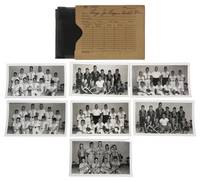
1951réf. 237921951. Largo Florida photograph archive taken by George Fulmer c. 1951 documenting education youth culture housing commerce religion and recreation as a citrus and farming community entered the first phase of its postwar transformation into a suburban city. Largo's population and physical landscape changed rapidly after World War II as groves and grazing land gave way to housing and industrial development; within the wider Pinellas County school system enrollment rose from roughly 16000 students in 1946 to about 69000 in 1962 requiring the construction of 64 new schools between 1948 and 1965. The photographs concentrate unusually closely on the generation educated during this transition recording Largo High School athletics Future Farmers of America Future Homemakers of America youth baseball school music and other organized activities at the moment when the occupational and domestic assumptions of an agricultural community were meeting the demographic and economic conditions of suburban Florida. Photo archive of approximately 87 items including 38 silver gelatin photographs and approximately 38 corresponding large format negatives photograph prints ranging from 4.5 x 2.5 to 5 x 4 inches and each negative about 4 x 5 inches all retained in 11 original numbered photographic job envelopes bearing client subject and occasional date notations Largo Florida principally 1951. The photographs and negatives were made by George Fulmer the longtime Clearwater commercial and civic photographer whose surviving files document decades of local institutional life in central Pinellas County. The original job envelopes preserve Fulmer's assignment structure linking negatives and prints to named Largo clients and subjects rather than leaving the photographs as unidentified local views. The school material includes a large Largo High School Future Homemakers of America group posed beneath the organization's emblem; young women displaying and examining patterned skirts and clothing outdoors; a group identified on its envelope as "Largo High School Boys Girls FFA & FHA"; and children and adolescents posed beneath a sign reading "Largo Chapter Future Farmers of America Department of Vocational Agriculture" some holding hoes shovels and other agricultural implements. Football assignments show night games under field lights players running tackling and breaking through defensive lines referees moving through plays crowded grandstands cheerleaders and a large uniformed marching band packed into the bleachers. Other files document Largo Junior League baseball teams posed with bats gloves coaches and locally lettered uniforms; a Largo Baptist Church choir arranged in the sanctuary; Sinclair gasoline station employees receiving a trophy beside an HC gasoline pump; new residential and commercial buildings; and modern domestic interiors furnished with low upholstered seating lamps paneled walls and contemporary cabinetry. Most negatives duplicate surviving prints. The Largo recorded here was still closely identified with agriculture. Citrus cattle and dairy had dominated the local economy through much of the early twentieth century and Largo had developed into one of Florida's major citrus centers after the arrival of the railroad; within a few years of these photographs freezes in 1957 and 1962 damaged the citrus economy while population growth increased demand for residential and commercial land. Largo High School embodied that transition directly. Its own history recalls an educational culture in which young men studied agriculture tractor repair wood shop and animal science while young women took home economics a gendered vocational division visible here in the paired presence of Future Farmers and Future Homemakers. The Future Homemakers photographs record an educational ideal that treated domestic labor clothing food preparation and household management as formal preparation for female adulthood while the FFA material trained boys for an agricultural economy whose physical basis was already beginning to contract. Largo's accelerating growth soon made the older educational infrastructure inadequate: in 1957 a new Largo High School opened taking 37 acres of land. Postwar industrialization accelerated this transformation as Honeywell and General Electric facilities helped move Largo from an agricultural center toward a suburban economy; housing and trailer parks replaced groves and grazing land and by 1970 the city counted roughly 22300 residents up from 5302 in 1960. The apparently all white school organizations also belong to Pinellas County's segregated educational structure: after the 1954 Brown v. Board of Education decision the county nevertheless built nine additional all Black schools between 1954 and 1963 and only about 200 Black students attended desegregated county schools in 1964. The photographs show some curling but remain in very good condition. Some negatives show fading; original paper job envelopes show handling wear. Overall in very good condition. unknown
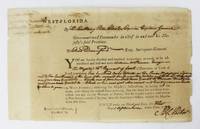
1772réf. 6523West Florida: September 1 1772. About very good. Broadside 7.5 x 12 inches. Lightly tanned old fold lines. Some light chipping at edges slight splitting at some folds. Docketed on verso. A partially-printed form directing Elias Durnford as Surveyor General to survey a tract acquired by William McPherson a British soldier. The parcel in West Florida was to contain "Six hundred acres situate on the River Mississippi adjoining to the southward line of the reserved land near the Natches and between" three other tracts delineated herein. The order is signed by Peter Chester and dated September 1 1772. The docketing on the verso reads "1st September 1772 Warrant of Survey for William Macpherson 600 acres Mississippi." This printed document on watermarked paper is the output of the British press in Pensacola. Peter Chester 1720-1799 was the last British governor of West Florida 1770-1781 and he sought to strengthen British control in the area by offering large land grants to encourage immigration and settlement. Elias Durnford 1739-1794 was a British army officer and civil engineer. He surveyed the town of Pensacola which served as the capitol of British West Florida until the Spanish takeover in 1781. He was also lieutenant governor of West Florida from 1769-1778 and also performed numerous private surveys to supplement his income. A wonderful and early imprint from Pensacola and colonial Florida. September 1 unknown
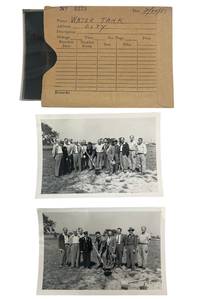
1950réf. 238291950. The evolution of public and civic ceremonies in Clearwater Florida 1951 to 1954 documenting the ceremonies political activity public institutions youth programs infrastructure projects and residential life through which served critical and symbolic functions in the rapid expansion of Sunbelt cities. George Fulmer photographed Clearwater near the beginning of an extraordinary demographic transformation when the city grew from 15581 residents in 1950 to 34653 in 1960 an increase of 122.4 percent. His assignments record that expansion at street level where campaigns elections welfare organizations public works graduations parades and civic gatherings supplied the institutional framework of a developing Sunbelt community. Photo archive of approximately 94 items comprising 46 silver gelatin photograph prints with 46 corresponding large negatives housed in 12 numbe"red commercial photo studio envelopes bearing manuscript assignment captions Clearwater Florida principally 1951 to 1954. Silver gelatin photograph prints ranging from 4.5 x 2.5" to 5" x 4" and each negative about 4 x 5 inches. Fulmer's photographs show crowds of both men and women registering or voting among curtained booths; men breaking ground for a city water tank; officials planting a camellia at the county courthouse; a large men's banquet and presentation ceremony; a high school graduation with students filling a decorated auditorium stage; young women in performance costumes; and children and teenagers posed outside a local theater. Political assignments include a 1952 Alto Adams gubernatorial campaign rally outside the Bank of Clearwater with women wearing "Alto Adams" hats campaign posters surrounding the speaker's platform and spectators lining the sidewalk; Republican gatherings beneath American flags and a portrait of Abraham Lincoln; and Eisenhower campaign volunteers holding "Eisenhower" and "I like Ike" placards outside a Clearwater business. Another series follows a street parade with marching participants balloons decorated vehicles storefronts and spectators while the envelope is captioned "Youth parade." Fulmer also photographed the Clearwater Welfare Center at 612 where a sign identifies the facility as "Sponsored by the Seventh day Adventist Church" recording a public ceremony at its entrance before an audience of adults and children. The studio envelopes retain captions including "Election day voting" "County court house camellia planting" "Alto Adams for Gov" "Eisenhower for Pres" and "Republican speaker" connecting individual negatives and prints to the assignments under which Fulmer produced them. Clearwater's postwar expansion belongs to the larger redistribution of American population and political influence toward Florida and the Sunbelt but Fulmer's assignments establish that transformation through municipal and community activity. Elections are particularly prominent. In 1952 Dwight D. Eisenhower carried Florida with 544036 votes 55 percent of the statewide total becoming part of a changing political landscape in a state long dominated by Democrats. The gubernatorial photographs belong to the same election year: Alto Adams campaigned for the Democratic nomination in a contest ultimately won by Dan McCarty who became governor in January 1953 while contemporary Florida photographic collections similarly record rallies and campaign activity surrounding that election. Fulmer's numbered envelopes demonstrate the process by which such events entered the local photographic record placing presidential and gubernatorial politics beside voting rooms welfare work school ceremonies youth recreation courthouse landscaping water infrastructure parades and residential scenes. Light handling wear and occasional curling; studio envelopes with expected toning handling wear creasing and manuscript notations. Overall in good condition. unknown
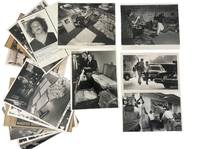
1970réf. 231661970. Narcotics raids arrests rehabilitation scenes and evidence displays across Florida in press photographs and magazine pages. Photograph archive spanning Miami Fort Lauderdale Pasco County and related Florida sites from 1970 to the early 1990s establishing how drug control operated through police action newspaper circulation and treatment institutions during the War on Drugs. Produced for press use by newspaper staff photographers wire services and law enforcement publicity channels the group shows the public face of narcotics enforcement at the point when South Florida had become a major corridor in the national drug economy and anti drug policy was being made newly visible through staged photographs official briefings and widely circulated arrest imagery. Named figures included such as Bob Gladden Larry Csonka Jim Kiick Admiral Rickover Carl Mingo and several rehab subjects identified by hand on the versos. The photographs depict suspects detained searched paraded identified displayed beside seized contraband and in other cases shown within rehabilitation settings revealing how law enforcement courts newsrooms and treatment programs handled the same crisis through different institutional forms. Photo archive of 18 press photographs including 16 silver gelatin press photographs and 2 wire photos approximately 8 x 10 inches Florida 1970 to early 1990s. The core images show narcotics policing in action: a helmeted officer beside a paddy wagon crowded with detainees; a bench filled with young men under detention in an interior holding space; two handcuffed men led from a courthouse or station entrance; a police-released mugshot with typed caption identifying former New England Patriots running back Bob Gladden after arrest in Fort Lauderdale on a marijuana charge; and a street arrest with an armed officer escorting a suspect between parked cars. Several photographs center on the staged display of evidence including tables covered with packets of drugs stacked currency pistols taped "cookie sheets" and open suitcases packed with bricks or cutting materials. One image shows a narcotics dog inspecting rows of luggage; another shows officials at microphones before a sign for the Vice President's National Narcotics Border Interdiction System; another records cocaine seized from a concealed boat compartment. The group also includes rehabilitation scenes with young adults identified en verso in cursive extending the archive beyond arrest photography into treatment culture. Versos carry a dense record of press handling and editorial use including Miami Herald staff photo stamps dated Dec. 15 1970 and Jan. 5 1971 a St. Petersburg Times credit and clipping backing for a Pasco County drug ring case dated May 29 1974 typed bureau captions circled editorial notations such as "cocaine" "marijuana" "drug raid" and "Operation Crackdown" plus handwritten shot descriptions and date-used stamps. The earliest prints fall at the threshold of the modern War on Drugs while later additions carry the record forward into the crack era and the more theatrical seizure photography of the 1980s and early 1990s. Florida is central to that story not only as a site of smuggling and interdiction but as a place where narcotics enforcement became highly visual with press conferences celebrity linked arrests tactical raids canine inspections and rehabilitation coverage all translated into newspaper images for public consumption. The present grouping combines an earlier core of related press photographs with later additions and it preserves a strong visual record of how narcotics control was communicated to the public through local papers wire distribution and agency captioning. Light surface wear minor edge and corner handling editorial markings and stamps to versos scattered adhesive residue and toning; overall very good condition. A concentrated Florida press record of the machinery publicity and human management of drug enforcement across two decades. unknown
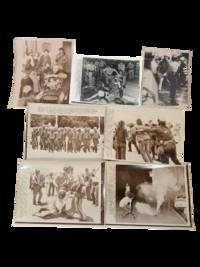
1972réf. 234431972. Florida antiwar protest press archive documenting demonstrations in Miami Beach during the 1972 Republican National Convention when activists targeted President Richard Nixon's renomination after years of bombing troop deployments and stalled peace negotiations in Vietnam. Protesters gathered outside convention sites government buildings and public streets to oppose the war challenge Nixon's reelection campaign and confront the heavy police and military security presence surrounding the convention. Photo archive of 7 Large silver gelatin press photographs each approx 8 x 10" Miami Beach Florida 1972. Military police march toward convention stations carrying riot clubs and wearing helmets and flak suits; demonstrators are pushed back by uniformed personnel; a seated protester is restrained on the grass by police; and tear gas fills a street as a demonstrator crouches near a smoking canister. Additional scenes show antiwar organizers seated indoors with signs reading "Stop the War Now" helmeted police standing over demonstrators in the street and a protester being taken away during a confrontation. Captions identify Miami Beach the Republican National Convention police preparations arrests and disruption threats tied to convention proceedings. The archive records the 1972 convention as a flashpoint in the late Vietnam War when Nixon campaigned on strength abroad while antiwar activists challenged the bombing of North Vietnam the mining of Haiphong Harbor and the continuation of U.S. military policy despite troop withdrawals. Miami Beach became a controlled political theater where nomination ceremonies unfolded behind lines of police National Guard and military personnel while demonstrators used sit-ins marches and street actions to force the war into public view. Press stamps caption slips editorial envelopes and agency markings preserve the photographs as working news files from the confrontation. Light handling wear caption attachments editorial markings toning and minor edge wear. Overall in good condition. unknown
1960réf. 230921960. Cuban Refugees Caravan of Sorrow Miami Herald press photograph archive 1960 to 1966 documents Cuban exile political organizing refugee displacement and United States federal response in South Florida across the critical period between the Cuban Revolution and the Cuban Adjustment Act of 1966. The archive follows a defined sequence of events beginning with the September 1960 Caravan of Sorrow protest a demonstration organized by Cuban exile women traveling from Miami to New York to confront Fidel Castro's appearance at the United Nations and continues through the January 5 1961 closure of the Cuban consulate in Miami following the United States' severance of diplomatic relations on January 3. Subsequent photographs document the Kennedy administration's February 1961 Cuban Refugee Assistance Program centered at Miami's Freedom Tower the March 10-12 1962 Bayfront Park hunger strike in which 152 Cuban exiles demanded arms rather than humanitarian aid the October 1965 Key West arrivals during the Camarioca boatlift initiated on October 10 and the beginning of the federally organized Freedom Flights on December 1 1965. Produced by Miami Herald staff photographers Albert Coya and John Pineda both active documentarians of the Cuban exile community the archive establishes a continuous visual record of exile political life and federal refugee policy during the early Cold War. Archive of 12 Large silver gelatin press photographs Miami Herald South Florida 1960 to 1966 Each 10 x 8 inches to 9 x 7 inches with original verso annotations including dates photographer credits editorial markings crop notations and attached newspaper clippings consistent with Miami Herald press photo processing practices. Verso credits identify Albert Coya and John Pineda as staff photographers. Documented subjects include the Caravan of Sorrow bus and assembled Cuban women protesters; the January 5 1961 Cuban consulate closure; refugee intake and processing operations; the Bayfront Park hunger strike accompanied by a clipped headline reading "Exiles Seek Arms Not Aid; 152 Hunger Strikers Freed" dated March 14 1962; police arrests of demonstrators; October 1965 Key West refugee arrivals; and anti-Castro protests. Two photographs dated March 14 1962 document Cuban exiles being forcibly removed by police including one image in which a protester is carried by multiple officers and another showing an individual being thrown into a police van by armed officers providing direct visual evidence of state enforcement against exile demonstrators. One photograph depicts Costa Rican diplomat Gonzalo Facio addressing or attending a Cuban exile rally in April 1964 situating the archive within a broader hemispheric diplomatic context. Additional images show a speaker addressing a large crowd police escorting a detained protester Cuban women aboard a vessel and interior scenes of stacked materials in a processing facility including a sign reading "Se Prohiben Terminantemente." Verso notations such as "Cuban Prisoners Released 1962" "Cuban Refugees" "Anti-Castro Demonstration" and "Cuban Consulate" reflect contemporaneous editorial classification. The six-year span of the archive crosses three presidential administrations and documents multiple defining events in Cuban American history through photographs produced on assignment at the moment of occurrence. The Caravan of Sorrow images carry particular research value given later declassification of United States involvement through the Cuban Revolutionary Council placing these photographs among the few contemporaneous visual records outside government archives. The March 1962 Bayfront Park hunger strike occurring after the Bay of Pigs prisoner negotiations and before the Cuban Missile Crisis is documented with attached newspaper evidence confirming both the number of participants and their political demands providing direct insight into divisions within the exile community over United States policy. Light handling wear edge silvering and areas of foxing are present across prints; verso clippings show toning and occasional edge loss consistent with newsroom use. Overall good to very good condition. A cohesive photographer-attributed press archive documenting the development of Cuban exile political identity and United States refugee policy in South Florida during the formative early Cold War period. unknown
2010réf. DADAX1167011694Kessinger Publishing 2010-09-10. paperback. New. 6.00x0.81x9.00. Buy with confidence. Excellent Customer Service & Return policy. Kessinger Publishing paperback
2010réf. DADAX1167127897Kessinger Publishing 2010-09-10. hardcover. New. 6.00x1.00x9.00. Buy with confidence. Excellent Customer Service & Return policy. Kessinger Publishing hardcover
réf. SONG1475838964Rowman & Littlefield Publishers 2019-04-05. hardcover. Used: Good. 6.32x0.65x9.02. Buy with confidence. Excellent Customer Service & Return policy. Rowman & Littlefield Publishers hardcover
réf. SONG1475830130Rowman & Littlefield Publishers 2017-05-24. hardcover. Used: Good. 6.28x0.68x9.31. Buy with confidence. Excellent Customer Service & Return policy. Rowman & Littlefield Publishers hardcover