[TYSSOT DE PATOT, Simon]Biblio.com
68,636 results
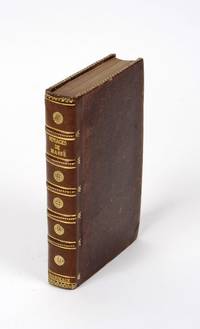
1717ref. 3201143Bordeaux" actually Rouen: chez Jacques l'Aveugle 1717. Extremities slightly rubbed rebacked corners reinforced a very good copy. Duodecimo with woodcut device on title; original sprinkled calf binding. First edition Rosenberg edition 'A' of this important imaginary voyage to Australia: a "landmark" in the development of the French voyage novel Atkinson. Friederich comments that the importance of mining and irrigation to the Australians makes it the only work "to foreshadow what has actually come to pass in modern Australia". This is an attractive copy of this precursor to Defoe set on the Australian continent among people obsessed with mining and the problems of irrigation: "the detailed account of the adventurer's camp in the Austral continent the building of a raft and the descriptions of plants and trees may be compared favourably to similar passages in Robinson Crusoe." Atkinson. The author Tyssot de Patot was a remarkable figure an English-born Huguenot and self-taught philosopher with a background in mathematics who at the impressive age of 72 suddenly scandalized his Dutch community and was run out of town as a dangerous heretic. He wrote two wonderfully inventive imaginary voyages both well ahead of their time: one was an account of a journey deep underground into a hollow earth while the present work tells the story of a veteran sailor called Jacques Massé who shipwrecks in the far southern reaches of the Indian Ocean not far from what is now Kerguelen Island. Delighted with the new world he discovers Massé denounces his European heritage only to be betrayed and have to flee to the coast where he is besieged for 12 years before being finally rescued by a Portuguese ship. The work was a modest bestseller of the era and the question of editions has been thoroughly investigated by Aubrey Rosenberg no small task given that all four major editions are dated 1710 on the title-page. Rosenberg argues that this edition 'A' in his list with an armillary sphere device on the title with its base pointing to the left was probably published between 1714 and 1717 and is the true first edition of the work. As Rosenberg points out this series of editions dispels the notion that interest in Tyssot quickly died out: in fact the staggered publications argue a sustained interest in the work throughout the eighteenth century. Tyssot de Patot's writings were a continual source of scandal: Voltaire thought that he had "carried the torch of discord into their homeland". Certainly the antagonistically anti-religious stance of this novel created much ill-feeling. Atkinson comments that because "open criticism of the Bible is so frequent" he will have to content himself with listing just a few of the more extreme examples. Nonetheless Atkinson's positive summary gives a good sense of the importance of the work: "a close following of accounts of real travellers such as Dellon Tavernier Mocquet and Lahontan. There is nothing fantastic unbelievable or overdrawn in the descriptions of the Austral continent.". The story has Massé shipwrecking on the Southern continent at "44 South latitude almost at the point where Kerguelen Island will be found to be on modern maps" Atkinson. Whilst most of the survivors of the wreck are content to maintain a large presence on the coast Massé and his friend Moret travel inland where they settle in an enormous and well-organised utopia "a plentiful fruitful country a land of blessing and peace . where human blood is sacred and safe from the rage and tyranny of great men". They become so enamoured of their Australian hosts that they abjure their faith and their European heritage and it is only when Moret is betrayed by his liaison with a treacherous queen that they reluctantly flee escaping rather fortuitously by a subterranean river which deposits them close by the original settlement. They remain besieged in the camp for another twelve years before they are finally picked up by a Portuguese ship. . Provenance: James Hustler "of Acklam in Cleveland in the North Riding of the Country of York Esq." engraved armorial bookplate dated 1730; Bernard Gore Brett Melbourne book collector. chez Jacques l'Aveugle unknown
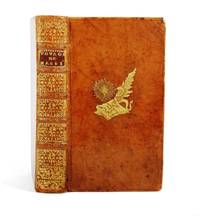
1734ref. 3006519Cologne: Jaques Kainkus 1734. Slight wear to top and tail of spine otherwise fine. Duodecimo frontispiece title-page printed in black and red; contemporary sprinkled calf spine gilt in compartments. A handsome copy of the third edition Rosenberg edition 'C' with frontispiece portrait of Massé and title-page vignette of Mercury. Friederich comments that the importance of mining and irrigation to the Australians makes it the only work 'to foreshadow what has actually come to pass in modern Australia'. Tyssot de Patot was a well-known Huguenot free-thinker whose writings were a continual source of scandal: Voltaire thought that he had 'carried the torch of discord into their homeland'. Certainly the antagonistically anti-religious stance of this novel created much ill-feeling. Atkinson comments that because 'open criticism of the Bible is so frequent' he will have to content himself with listing just a few of the more extreme examples. Massé shipwrecks on the Southern continent at '44 South latitude almost at the point where Kerguelen Island will be found to be on modern maps' Atkinson. Whilst most of the survivors of the wreck are content to maintain a large presence on the coast Massé and his friend Moret travel inland where they settle in an enormous and well-organised utopia 'a plentiful fruitful country a land of blessing and peace . where human blood is sacred and safe from the rage and tyranny of great men'. They become so enamoured of their Australian hosts that they abjure their faith and their European heritage and it is only when Moret is betrayed by his liaison with a treacherous queen that they reluctantly flee escaping rather fortuitously by a subterranean river which deposits them close by the original settlement. They remain besieged in the camp for another twelve years before they are finally picked up by a Portuguese ship. Rosenberg argues for a date of around 1734 for this edition to coincide with the renewed interest in Tyssot's work at the time he cites 1733 English and 1737 German editions. His theory is that this renewal of interest 'arose because it was confused with Mandeville's Fable of the Bees which by 1730 had achieved considerable notoriety'. . Provenance: Frédéric Lachèvre 1855-1943 writer and bibliographer with his romantic bookplate and armorial gilt stamp on front board. Oddly enough the National Library of Australia has Lachèvre's copy of a later edition of this work Special Colelctions SR 913. Jaques Kainkus unknown
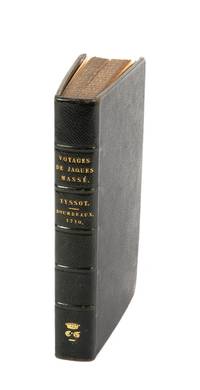
1717ref. 3211648Bordeaux" actually Rouen: chez Jacques l'Aveugle 1717. A fine copy. Duodecimo woodcut device on title; 19th-century grained morocco gilt gauffred edges. First edition Rosenberg edition 'A' of this important imaginary voyage to Australia: a "landmark" in the development of the French voyage novel Atkinson. Friederich comments that the importance of mining and irrigation to the Australians makes it the only work "to foreshadow what has actually come to pass in modern Australia". This is an attractive copy of this precursor to Defoe set on the Australian continent among people obsessed with mining and the problems of irrigation: "the detailed account of the adventurer's camp in the Austral continent the building of a raft and the descriptions of plants and trees may be compared favourably to similar passages in Robinson Crusoe." Atkinson. The author Tyssot de Patot was a remarkable figure an English-born Huguenot and self-taught philosopher with a background in mathematics who at the impressive age of 72 suddenly scandalized his Dutch community and was run out of town as a dangerous heretic. He wrote two wonderfully inventive imaginary voyages both well ahead of their time: one was an account of a journey deep underground into a hollow earth while the present work tells the story of a veteran sailor called Jacques Massé who shipwrecks in the far southern reaches of the Indian Ocean not far from what is now Kerguelen Island. Delighted with the new world he discovers Massé denounces his European heritage only to be betrayed and have to flee to the coast where he is besieged for 12 years before being finally rescued by a Portuguese ship. The work was a modest bestseller of the era and the question of editions has been thoroughly investigated by Aubrey Rosenberg no small task given that all four major editions are dated 1710 on the title-page. Rosenberg argues that this edition 'A' in his list with an armillary sphere device on the title with its base pointing to the left was probably published between 1714 and 1717 and is the true first edition of the work. As Rosenberg points out this series of editions dispels the notion that interest in Tyssot quickly died out: in fact the staggered publications argue a sustained interest in the work throughout the eighteenth century. Tyssot de Patot's writings were a continual source of scandal: Voltaire thought that he had "carried the torch of discord into their homeland". Certainly the antagonistically anti-religious stance of this novel created much ill-feeling. Atkinson comments that because "open criticism of the Bible is so frequent" he will have to content himself with listing just a few of the more extreme examples. Nonetheless Atkinson's positive summary gives a good sense of the importance of the work: "a close following of accounts of real travellers such as Dellon Tavernier Mocquet and Lahontan. There is nothing fantastic unbelievable or overdrawn in the descriptions of the Austral continent.". The story has Massé shipwrecking on the Southern continent at "44 South latitude almost at the point where Kerguelen Island will be found to be on modern maps" Atkinson. Whilst most of the survivors of the wreck are content to maintain a large presence on the coast Massé and his friend Moret travel inland where they settle in an enormous and well-organised utopia "a plentiful fruitful country a land of blessing and peace . where human blood is sacred and safe from the rage and tyranny of great men". They become so enamoured of their Australian hosts that they abjure their faith and their European heritage and it is only when Moret is betrayed by his liaison with a treacherous queen that they reluctantly flee escaping rather fortuitously by a subterranean river which deposits them close by the original settlement. They remain besieged in the camp for another twelve years before they are finally picked up by a Portuguese ship. . Provenance: This copy from the British Museum with the stamp on verso of title and the 1831 duplicate release stamp; also the crowned cipher "C.G." on spine. chez Jacques l'Aveugle unknown
1714ref. 39159A Bourdeaux ie. The Hague: James L'Aveugle 1714. First Edition. 12mo pp. viii 508. Bound in contemporary calf neatly rebacked in antique style little rubbed some minor foxing soiling a very good tight copy. Rosenberg "A" Gove 217-219; Cioranescu 62587; Barbier IV 1103; Atkinson 'The Extraordinary Voyage in French Literature' p. 70; Rosenberg pp. 84-5. The genuine first edition falsely dated. An important imaginary journey to Australia called a "landmark" by Atkinson. Based on a variety of real voyages the descriptions are believable and realistic. The author offers a detailed account of making a camp building a raft. While the book did not range much beyond the confines of the traditional Utopias of the times it did however include "living fossils" giant birds and strange flora that survived from prehistoric eras arguably making it one of the first modern Lost World novels. After being shipwrecked on the continent the narrator and a friend pressed on and developed a farm in "a plentiful fruitful country" until forced to flee by a treacherous woman. Tyssot de Patot 1655-1727 was a Huguenot who lived most of his life in Holland where he pursued a career as professor of Mathematics at the Athenaeum Illustre in Deventer the capital of the province of Overijssel. James L'Aveugle unknown
ref. 1120953170.Gpaperback. Good. Access codes and supplements are not guaranteed with used items. May be an ex-library book. paperback
ref. 1167239660.Gpaperback. Good. Access codes and supplements are not guaranteed with used items. May be an ex-library book. paperback
ref. 0428710492.Ghardcover. Good. Access codes and supplements are not guaranteed with used items. May be an ex-library book. hardcover
ref. 0666380341.Ghardcover. Good. Access codes and supplements are not guaranteed with used items. May be an ex-library book. hardcover
ref. 0729404501.Gpaperback. Good. Access codes and supplements are not guaranteed with used items. May be an ex-library book. paperback
ref. 0282094636.Gpaperback. Good. Access codes and supplements are not guaranteed with used items. May be an ex-library book. paperback
ref. 2915547165.Gpaperback. Good. Access codes and supplements are not guaranteed with used items. May be an ex-library book. paperback
2026ref. LRB22002736Paris: Editions Recreasoft 2026 Langue : Français. Environ 532 pages. Français : Réimpression à la demande. Édition originale : 1710. Récit d'anticipation et de voyage imaginaire du début du XVIIIe siècle attribué à Simon Tyssot de Patot. L'ouvrage mêle aventure satire et réflexion philosophique dans une narration qui a retenu l'attention des historiens du roman et des utopies. Intéressant pour les amateurs de littérature française ancienne de récits de voyages fictifs et de textes rares de l'âge classique. Images du livre non contractuelles English : Print-on-demand reprint. Original edition : 1710. Early eighteenth-century imaginary travel and adventure narrative attributed to Simon Tyssot de Patot. The work combines adventure satire and philosophical reflection in a story that has attracted the attention of scholars of early fiction and utopian writing. Of interest to readers and collectors of early French literature fictional travel narratives and rare classical-era texts. Book images are non-contractual. Editions Recreasoft. Softcover. New. Editions Recreasoft paperback
ref. 2011341760.Gpaperback. Good. Access codes and supplements are not guaranteed with used items. May be an ex-library book. paperback
ref. 2019703874.Gpaperback. Good. Access codes and supplements are not guaranteed with used items. May be an ex-library book. paperback
ref. 201263334X.Gpaperback. Good. Access codes and supplements are not guaranteed with used items. May be an ex-library book. paperback
1710ref. 123204Bourdeaux i.e. The Hague: Jaques L'Aveugle 1710 but around 1714. The true first edition First edition of this early utopian novel "the best-known of all the radical philosophical novels of the Early Enlightenment" which "surpassed practically every other work of philosophical fiction of the age for notoriety" Israel pp. liii and lvi. The novel details a Frenchman shipwrecked off South Africa - the co-ordinates are given as 60°E/44°S roughly around the Kerguelen Islands - where he finds a terrestrial paradise. Learning the language of the natives the protagonist seeks to explain Christianity to them who greet its central tenets as absurd and its God as unjust. The hero continues his travels and there hears a parable on Christianity that shocked the author's contemporaries - an absolute monarch who owns bees damns them for sucking nectar which had been prohibited merely to test his authority send his son in bee form to redeem them whereupon the different worshippers of the bee messiah kill each other whilst bee priests live indolent lives on pious bees' labour. Rapidly banned in Holland and France it nonetheless went through further Dutch editions a French edition three English editions and two German editions by 1760. Tyssot publicly denied writing the work at the time due to the controversy and some scholars still question his authorship but he himself claimed to have written it in a letter to his son in 1720 and modern scholarly opinion generally supports the attribution ibid p. liv. The book was actually published around 1714 but was pre-dated 1710 possibly to coincide with the Millenarianism of that year or to feign priority for the idea of a "fable of the bees" as Mandeville had published his own parable in 1714. The book poses bibliographic difficulties with four editions purporting to be published in 1710 three in the same place by the same publisher. Rosenberg has established that the present edition best distinguished by a woodcut on the title page of a celestial globe with a knob deviating to the left is the true first edition. Duodecimo 158 x 92 mm. Contemporary speckled calf red morocco label. Ownership label neat ink note of author and early catalogue description to front pastedown. Small chip at base of spine front joint cracked but firm some light browning front free endpaper and frontispiece expertly reinserted. A very good copy. Atkinson p. 70; Howgego Encyclopaedia of Exploration V T25. Jonathan Israel Radical Enlightenment 2002; Aubrey Rosenberg Tyssot de Patot and His Work 1655-1738 2013 pp. 84ff. unknown
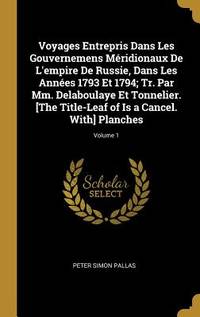
ref. 88415aafParis, de l’imprimerie de J. P. Jacob à Paris chez Deterville et à la Librairie Economique, 1805, gr. in-4to (oblong), page de titre poussiéreuse et renforcée + au total 55 planches gravées, sur le titre pt. timbre rouge ‘Cabinet Topographique du Roi’ et cote ms. (E. 5 / 48), cartonnage du XIXe s. couvert de papier marbré, pièce de titre maroquin rouge au dos. Bel exemplaire.
ref. DADAX0270521992Wentworth Press 2018-07-27. hardcover. New. 6.14x1.50x9.21. Buy with confidence. Excellent Customer Service & Return policy. Wentworth Press hardcover
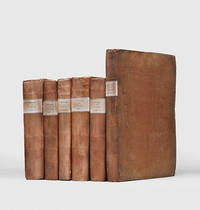
ref. 110602Paris chez Maradan 1789-93. 4 XXXII 773 3 4 550 2 4 491 1 4 722 2 4 559 1 pp. Atlas volume : 4 pp. 1 large folding engraved map of the Russian Empire by Tardieu 10 other engraved maps 5 folding 97 engraved plates 23 folding by N. Thomas. Conttemporary three calf. Spines gilt with red labels. . First French edition translated by Gauthier de la Peyronie. A fine copy. Peter Simon Pallas 1741-1811 German naturalist and explorer. In 1767 Pallas was invited by Cathrine II of Russia to become a professor at St. Petersburg Academy of Sciences and a year later he led an expedition to South East Russia and Siberia concentrating on natural history and ethnography. He published his major findings from the expedition in 1771-76 under the title; Reise durch verschiedene Provinzen des Russischen Reichs in three volumes. Later translated into Russian French and English. unknown
ref. 0270521992.Ghardcover. Good. Access codes and supplements are not guaranteed with used items. May be an ex-library book. hardcover
1789ref. 168579Paris: Maradan 1789-93. The celebrated French translation in the original boards First edition in French. First published in German this is the account of Pallas's expedition across the central Russian provinces from 1768 to 1774. He reported on the passage of Venus brought back numerous animal and plant specimens and made anthropological observations of local peoples. Simon Peter Pallas 1741-1811 was a German zoologist and botanist and a leading figure in the Russian scientific enlightenment. He was educated at Halle Göttingen and at Leiden where he submitted his doctorate in 1760. After a trip to England to study natural history and geology Pallas settled at The Hague where he published the acclaimed Elenchus zoophytorum and Miscellanea zoologica. He soon attracted the attention of Catherine the Great who invited him to St Petersburg where he became a professor of natural history at the Imperial Academy of Sciences. In 1768 at the specific request of the tsarina he was placed in charge of an expedition of five naturalists and seven astronomers into Russia and Siberia. Over the next six years the party traversed the empire from the plains of European Russia to the borders of Mongolia. "Pallas arrived back in St Petersburg in July 1774 with a vast amount of data and many fossil specimens but broken in health. His hair was whitened with fatigue and nearly all of his companions had died. His journals had been regularly despatched back to St Petersburg and were awaiting him on his arrival" Howgego. His chief geological contribution was the recognition of the temporal sequence of rocks from the centre to the flanks of a range. He also found a wide distribution of mammoth and rhinoceros fossils in the Siberian ice. This work was originally published in German in the period 1771-76. This French edition includes additional material covering the findings of the natural historians Samuel Gottlieb Gmelin Ivan Ivanovich Lepekhin and Johann Gottlieb Georgi. Volume I is the second issue with the Maradan imprint and dated 1789. 6 vols comprising: 5 text vols quarto 274 x 214 mm; folio with maps and plates 354 x 265 mm. With 97 engraved plates 26 folding 10 engraved maps 3 folding 2 double-page large folding general area map as called for loosely inserted. Original dark pink paper covered boards neatly rebacked to style with typographical labels edges uncut. Boards a little rubbed and sunned with minor neat repairs soiled and softened at the corners lightly browned throughout also some occasional marginal damp staining minor loss to front free endpaper in Vol. IV preliminary leaves split at head in Vol. V corners of front board of atlas heavily bumped. A very good wide-margined copy. Atabey 900; Cohen-De Ricci p. 781; Cross D11 for first English edition; Howgego I P10; Nissen ZBI 3076. hardcover
ref. 0270521984.Gpaperback. Good. Access codes and supplements are not guaranteed with used items. May be an ex-library book. paperback
ref. 1174947683.Gpaperback. Good. Access codes and supplements are not guaranteed with used items. May be an ex-library book. paperback
ref. 1175287628.Gpaperback. Good. Access codes and supplements are not guaranteed with used items. May be an ex-library book. paperback
ref. 51-4109Paris: Deterville Librairie économique1805. Folio. New half orange goatskin and marbled boards by Sasha Mosalov; original spine preserved. 28 x 40 cm. 37 of 55 plates. Right part of plate 16 missing. Title page and a few others soiled. Brunet IV col. 325; Cat. Russica 36; Stafleu & Cowan 7224; Wood p. 511; DSB X pp. 283-285. Russie - PALLAS Pierre-Simon. ATLAS des Voyages entrepris dans les gouvernemens méridionaux de l'empire de la Russie dans les années 1793 et 1794 par Mr. le professeur Pallas. Paris Deterville 1805.In-4 oblong demi-veau reliure de l'époque. 37 planches sur 55.partie droite de la carte 16 manquante. Paris: Deterville, Librairie économique1805 hardcover