516 results
2012ref. 71102NY./ Oxford, Bergham Books, 2012. Origi.Pappband, 8°, 465 Seiten.
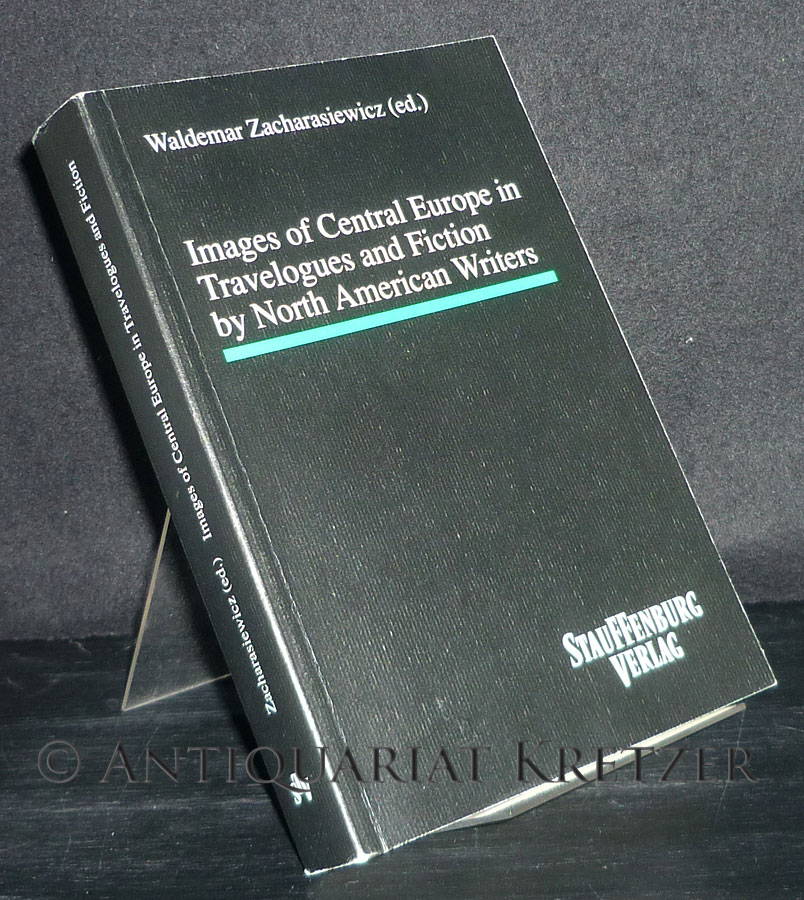
1995ref. 7104575Tübingen: Stauffenburg-Verlag 1995. 395 Seiten. Gr. 8° (22,5-25 cm). Orig.-Broschur. [Softcover / Paperback].
1991ref. 004210Paris, ESG, 1991. Broschiert 8° 0
1869ref. 316802Boston: Alfred Mudge and Sons 34 School Street 1869. First Edition. With 6 original mounted photographs. 57 pp. 1 vols. 8vo. Original burgundy cloth. Very good small nick and loss to upper spine. First Edition. With 6 original mounted photographs. 57 pp. 1 vols. 8vo. Celebration of the arrival of first transatlantic telegraphic cable on American shores with speeches of the dignitaries of Duxbury and Boston and a patriotic summary of the history of telegraphy; n appendix gives material on the cable fleet and press accounts. Alfred Mudge and Sons, 34 School Street unknown books
1967ref. 15960Syracuse: Syracuse University Press 1967. First edition. x 179 pp w/index. Fine in near fine dust jacket with one internally mended closed tear to front panel of the dust jacket. Review slip laid in. Syracuse: Syracuse University Press unknown books
1898ref. 23101New York: Outing Publishing Company 1898. First Edition. Original publisher's gilt stamped and printed cloth; t.e.g.; untrimmed. Very good; some wear to the head of the spine; small puncture to the front cover. 8vo 12 17 - 160 frontispiece and text illustrations. All the illustrations are half-tones. The frontispiece is by T S Johnson. The Yampa was an American ocean-going cruising schooner yacht for pleasure use from 1887 to 1899. The yacht was originally built for Chester W. Chapin a rail baron and U.S. Congressman from Massachusetts. Richard S Palmer member of the NY Yacht Club was its final owner. It was constructed in 1887 by the firm Harlan and Hollingsworth in Wilmington Delaware. She was considered the best in her class until 1891. The Yampa was 135 ft overall 110 ft at the water line and her draft was 13.8 ft. The author was on board when she sailed to the Baltic and to Southampton in England in 1897 on the occasion of Queen Victoria's Diamond Jubilee. From there she went to the North Sea and to Kiel Germany and on to St. Petersburg. The return voyage took the boat to the Caribbean St Thomas St Vincent and then north. She was eventually purchased by Kaiser Wilhelm as a gift for his wife. An entertaining account. Absent from Toy. Outing Publishing Company hardcover books
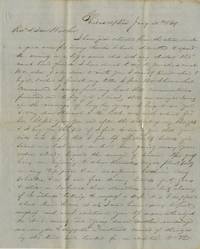
1849ref. List3737Philadelphia Pennsylvania 1849. Eight page letter measuring 8 x 10 pages appx. 1800 words. Fine condition. A lengthy and literary 1849 family letter from Robert Lind Philadelphia to his brother discussing enslavement and the growing sectional crisis California Gold Rush migration and Presbyterian intellectual life and including a remarkable inherited family narrative concerning a clandestine aristocratic marriage in pre-Revolutionary Ireland that ultimately forced the writer's grandfather into exile. Lind provides a rich cross-section of American intellectual and family life on the eve of the 1850s. He discusses the state of the church the movement of ministers westward the instability of clerical life and the increasingly volatile national debate over enslavement and sectionalism. The letter meditates extensively on the survival of the Union just months after the conclusion of the Mexican-American War and amid the gathering crisis that would soon erupt into the Compromise of 1850. Lind responds to his brother's pessimism about the future of the republic with an expression of moderate antebellum Unionism: "I am sorry to find you had such discouraging hopes of the Republic for my own part I don't think that even the subject of Slavery with all the violence of the fanatical Abolitionists of the North & the disunionists of the South will be able to divide us - the people of the U.S. in each and every direction love the Union too much to permit such a catastrophe". Lind captures an aspect of political belief widespread among educated Northerners in the late 1840s that controversy over enslavement was dangerous but ultimately containable because emotional attachment to the Union would remain stronger than sectional extremism. He condemns both radical abolitionism and Southern disunionism in nearly symmetrical language reflecting the outlook of conservative or moderate Northerners who viewed themselves as defenders of national stability rather than partisans of either section. Equally revealing is his discussion of John C. Calhoun who "has regarded the subject in a partial light so long that I give him the credit of honestly believing it a blessed Institution"-Lind attempts to understand Calhoun's ideology as a sincere product of his environment. Yet he immediately contrasts that worldview with what he sees as the inevitable moral direction of modern civilization: "we live in an age of progress & enlightenment - the sympathies of Christendom is being fast enlisted in favour of the black republic sentiment is decidedly opposed to its enslavement's enlargement or extension." Lind is not a radical abolitionist yet neither is he proslavery; he represents the uneasy center of antebellum Northern opinion still convinced in 1849 that compromise and national affection would ultimately prevent disunion. The letter is equally valuable for its vivid contemporary references. California dominates conversation in Philadelphia: "For the last few months this has been the engrossing topic of conversation a great many have shipped from this city for the El Dorado." One relative is preparing to leave for San Francisco "not to dig but to plant himself" there professionally as a physician. Lind also discusses assembling material for a biography of his father to be included in a major Presbyterian biographical work by the noted minister and historian William Buell Sprague. However the heart of the letter is the extraordinary anecdote occupying nearly a third of the manuscript. Lind recounts a family story newly uncovered during a visit to Ireland involving his grandfather a clandestine aristocratic marriage mistaken identity scandal and eventual exile from the country. According to the narrative a young Irish nobleman had fallen in love with a peasant girl but could not openly marry her without jeopardizing his inheritance. A secret marriage was arranged and Lind's grandfather became mistakenly implicated: "They employed this person who resembled him very much in appearance procured him a suit of clothes & horse just like his learned him the marriage service & they were married in a woods close by where Grandfather lodged." The consequences were devastating. Rumors spread that Reverend Lind had in fact secretly performed the illicit marriage ceremony and "The proofs were so strong against him . that his congregation ceased to visit his church & he was eventually compelled to leave the country." Only much later-nearly half a century after the Reverend's death-the truth finally emerged. Lind describes how an aged participant confessed the deception on his deathbed before assembled witnesses: "He wished to relieve his conscience that Mr. Lind had nothing to do in the matter but that it was him who had performed the service & consequently that he was the guilty man." The episode is an interesting example of transatlantic memory: an eighteenth-century Irish scandal survived orally within a Presbyterian emigrant family before being partially verified decades later through renewed contact with the old country. An exceptional and highly literary mid-nineteenth century family letter combining antebellum political commentary Presbyterian intellectual networks California Gold Rush migration and an unforgettably dramatic Irish emigration narrative. books
1961ref. 28200Paris: La Compagnie Generale Transatlantique 1961. First edition. Paper wrappers. A very good copy with a tear in the tail of spine a small crease in a corner of the rear wrapper. 124 pp. Illus. with b/w photos & b&w and color drawings. 4to. French text. Article by Jules Romains one on Algeria some photos of the new France and of performers Charles Trenet Edith Piaf and Charles Aznavour. La Compagnie Generale Transatlantique unknown books
1929ref. 75588Paris: Cie. Gle. Transatlantique 1929. Softcover. Fine. First edition. Text in French and English. Fine in sewn wrappers save for small adhesions to the back wrap. Cie. Gle. Transatlantique unknown books
1934ref. 606586not signed on a 3/4 length shot of Jack Benny with Patsy Kelly with Sydney Howard in a scene from the 1934 film "Transatlantic Merry-Go-Round." Photograph is on single weight stock; 10" x 8"; very good mounting traces on the back; small stain upper left margin; minor signs of handling; 1934. books
19658vo., First Edition, with 40 plates on 20 and a full-page chart in the text, some light offsetting to free endpapers; cloth, gilt back, a very good, clean copy. The standard early history of the great liner
19868vo., Second Edition, with plates and pictorial endpapers; blue cloth, gilt back, a very good, bright, clean copy in price-clipped dustwrapper.
19768vo., First Edition, with plates and diagrams in the text; purple cloth, gilt back, a near fine copy in unclipped dustwrapper.
19568vo., First Edition, with frontispiece, plates and maps; blue cloth, gilt back, a near fine copy in unclipped dustwrapper, the latter lightly creased at edges.
19698vo., First Edition, with numerous plates; blue cloth, gilt back, blue top, a very good, bright, clean copy in unclipped dustwrapper. Sold from an institution with its neat stamps on front free endpaper and title verso;, and tape scars on free endpapers.
1907Mm 300x405 Fascicolo in folio di pp. 8 con prima carta illustrate in bianco e nero, illustrazioni in nero nel testo. In buono stato. SPEDIZIONE IN 24 ORE DALLA CONFERMA DELL'ORDINE.
2003Mm 245x305 RARO - Volume rilegato in tela con sovraccoperta editoriale, 285 pagine profusamente illustrate in nero e a colori, con ulteriori 91 facsimile in appendice. Copia in perfetto stato. SPEDIZIONE IN 24 ORE DALLA CONFERMA DELL'ORDINE.
1959This is a very good substantial run of the Transatlantic Review with just light wear. Very clean inside and out. All issues softcovers in their original wrappers. The run contains issues 2, 3, 4, 5, 6, 9, 12, 13, 14, 18, 19, 20, 22, 23, 24, 26, 27, 32, 35, 36, 42 & 43, 44, 45, 49 and the Index volume. 25 issues in all from 1959 to 1974. Size varies a bit, typically 8" or 9" X 6". Heavy set, foreign shipping will be extra. This set will be securely wrapped and packed in a sturdy box and shipped with tracking.
1997No marks or inscriptions. No creasing to covers. A very clean very tight copy with bright unmarked boards, minor traces of storage and no bumping to corners. 60pp. Embroidery magazine with features on the language of textiles, textiles of Southern Africa, designing for dishes, wirework in context, a museum curator's day, Michael Brennand-Wood, traditional Japanese embroidery, Ten Plus Textiles, transatlantic styles, felt carpets from Central Asia, easy steps to design and embroidery sales, events, books and exhibitions.
1924In-4, brossura, in buono stato di conservazione. In questo numero: "Tra il ghiaccio e i cavalloni. Il transatlantico italiano Presidente Wilson, durante la traversata da Napoli a New York, è stato sorpreso da una tempesta. Il termometro discese a parecchi gradi sotto zero, e le onde che flagellavano i fianchi del bastimento si cambiarono tosto in una coltre di ghiaccio. Un'enorme ondata fece rotolare sul piroscafo un grosso cavo. Alcuni marinai lottarono più di un'ora, sul ponte coperto di ghiaccio, sferzati continuamente dalle ondate, per rendersi padroni di questo groviglio di corde." "Uno spettacolo di nuovo genere a Milano. Le abbondanti nevicate dei giorni scorsi hanno permesso ai 300 allievi dello Sci Club di abbandonarsi a svariate e attraenti esercitazioni sui prati del Parco.".
1933In-4, brossura. In buono stato di conservazione. In questo numero: “La tragedia dell’’Atlantique’.
1905In-4, brossura, in buono stato di conservazione. In questo numero: "Sottomissione all'ammiraglio Birilef, ministro della marina, dei marinai russi ammutinati a Cronstadt." "Grave mischia a bordo di un transatlantico francese per l'improvvisa pazzia di un italiano.".
1974Avec envoi de l'auteur.
Penguin Books - 1977 - In-8 - Cartonnage souple illustré - Nombreuses Illustrations - 232 pages - très propre
PARIS, Compagnie Générale Transatlantique - 1919 - In-8 - Cartonnage éditeur illustré - Dessins de Maurice ACHENER - 144 pages - Très propre Imprimé en commémoration de son nouveau paquebot, le Paris, la Compagnie Générale Transatlantique, 6 rue Auber, Paris, a édité ce livre, pour l'offrir à ses passagers.