4 risultati
1977rif. 40413The Boeing Company. Very Good in Very Good dust jacket. 1977. Fourth Edition. Cloth. A Very Good Later edition that is edgeworn and housed in a chipped alike dust-jacket; A capsule history of Boeing design evolution from the stick-and-wire B&W of 1916 to today's military and commercial jets missiles and space vehicles; 4to; 78 pages . The Boeing Company hardcover books
2013rif. 143734Leiden Netherlands: Brill 2013. Hardcover. As New. Cream & red boards 464 pp. some BW illus. Series: Brill's Studies in Intellectual History. A collection of 19 essays: 10 written in English 9 in German. Draws "on case studies from the thirteenth to the twentieth centuries covering Europe and beyond. . Investigates how knowledge was acquired organized and sometimes lost. It examines collections of texts and objects -- libraries textbooks miscellanies commonplace books data collections pertaining to historical events encyclopedias royal and ducal treasures curiosity cabinets galleries and museums -- to uncover the processes of accumulation organization selection and rejection that have shaped learning. The essays emphasize the complex relationship between the intentions of collectors and the limitations they encountered." back cover. Brill hardcover books
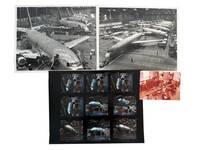
1970rif. 236751970. Boeing commercial aircraft engineering and production photo archive documenting 747 fuselage assembly at Everett and 737 final assembly at Renton circa 1970s during the company's expansion from conventional jetliner manufacture into wide body mass production. The 747 program required Boeing to coordinate a new airframe of unprecedented size with specialized tooling elevated work platforms component supply networks and a purpose built factory completed while the first aircraft was already under development. Photographs of the 737 line place that effort within Boeing's larger manufacturing system where several aircraft programs advanced simultaneously through separate but related sequences of subassembly joining systems installation testing and finishing. Photo archive of 12 silver gelatin and color photographs on four sheets ranging from approximately 4 x 6 inches to 9 x 10 inches Washington State circa 1970s. Nine color images arranged as a contact sheet show a Boeing 747 fuselage under construction inside a large assembly building suspended and supported amid scaffolding elevated platforms overhead cranes access stairs and surrounding work stations. Successive views record the unfinished forward fuselage from several positions including the cockpit section upper deck open structural areas and work platforms aligned along the aircraft's sides. A separate color photograph shows three technicians working around a long cylindrical mechanical or aerospace component mounted horizontally on supports in a laboratory or engineering shop with wiring hand tools parts cabinets and test equipment surrounding the assembly. Two large silver gelatin prints depict rows of Boeing 737 aircraft in successive stages of completion at the Renton final assembly plant from bare metal airframes crowded by scaffolding to nearly finished aircraft standing on an open production floor. A Boeing Public Relations caption dated July 1976 identifies the "737 final assembly line" states that fuselage and subassembly sections were brought from other buildings and joined on a single row line beside the 727 assembly area and records a production rate of three Advanced 737 200 aircraft per month. Versos carry Boeing file stamps editorial markings handwritten filing notes and the identification "Final assembly of Boeing 737 at Renton Wash." Boeing launched the 747 program in the second half of the 1960s after Pan American World Airways committed to the new aircraft forcing the company to design both the airplane and the industrial system needed to produce it on a compressed schedule. The first 747 rolled out at Everett in 1968 and flew in 1969 introducing a twin aisle passenger cabin a raised flight deck and a fuselage large enough to serve passenger cargo and convertible configurations. Its production depended on the controlled movement of immense structural sections through fixed assembly positions with cranes and elevated tooling giving workers access to surfaces that could not be reached through conventional narrow body production methods. The Renton photographs show how Boeing maintained standardized output on the smaller 737 while the Everett plant absorbed the scale and complexity of the 747 linking engineering development to repeatable factory production across two major commercial aircraft programs. Light surface wear occasional edge creasing and small tears adhesive caption residue stamps and editorial annotations; color images retain good detail with some warm color shift. Overall in good condition. A factory level record of how Boeing converted wide body aircraft design into an organized production system while sustaining high volume jetliner manufacture at Renton. unknown books
1960rif. 234801960. Boeing industrial photo archive depicting aircraft manufacturing machining and early jetliner development during the rapid expansion of commercial air travel in the decade after the Boeing 707 transformed passenger aviation. Boeing introduced the 707 into commercial service in 1958 accelerating the replacement of propeller-driven fleets with turbine-powered aircraft capable of faster transcontinental and intercontinental travel while the 737 program launched in 1965 aimed to extend jet transportation onto shorter regional routes previously dominated by piston and turboprop aircraft. The group centers on Boeing's transition from military and long-haul production into high-volume civilian jetliner manufacturing during the years when American airports airlines and aerospace plants expanded around mass passenger aviation. Wichita manufacturing operations appear prominently linking the labor of machinists inspectors welders and assembly crews directly to the emergence of the modern commercial airliner industry. Photo archive of 9 silver gelatin and press photographs ranging from approximately 4 x 5 to 8 x 10 inches Wichita Kansas and Everett Washington circa 1960s-1967. Factory floor scenes show Boeing workers machining aircraft components on heavy drill presses welding structural assemblies beneath large tubular support frameworks and inspecting fabricated sections identified in verso notation as work connected to the "747 jet" and "heel beam under the wing." A posed group portrait includes machinists and supervisors standing on a production floor identified in manuscript as "Everett Washington Shop 4420." Boeing press photographs stamped "Photo by The Boeing Company" include an early Boeing 737 in flight the unfinished fuselage on the assembly line beneath a "First 737" sign and rollout preparations outside a Boeing hangar marked with a countdown placard reading "737 first flight 23 days away." Several versos retain Boeing numerical press codes including "P41473" "P40870" and "6A72097" while pencil annotations identify "Boeing Wichita" and internal production references. The 737 made its first flight on April 9 1967 entering a commercial aviation market reshaped by Cold War aerospace spending postwar suburbanization and the dramatic increase in passenger air travel during the 1960s. Industrial archives showing both internal aircraft manufacture and public-facing rollout imagery from this transitional period remain far less common than later airline publicity material particularly with direct factory-floor labor content tied to Boeing's Wichita operations. Light edge wear occasional surface creasing and minor fading to several prints; overall in very good condition. unknown books