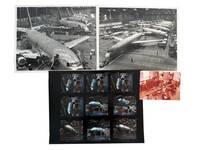
1970réf. 236751970. Boeing commercial aircraft engineering and production photo archive documenting 747 fuselage assembly at Everett and 737 final assembly at Renton circa 1970s during the company's expansion from conventional jetliner manufacture into wide body mass production. The 747 program required Boeing to coordinate a new airframe of unprecedented size with specialized tooling elevated work platforms component supply networks and a purpose built factory completed while the first aircraft was already under development. Photographs of the 737 line place that effort within Boeing's larger manufacturing system where several aircraft programs advanced simultaneously through separate but related sequences of subassembly joining systems installation testing and finishing. Photo archive of 12 silver gelatin and color photographs on four sheets ranging from approximately 4 x 6 inches to 9 x 10 inches Washington State circa 1970s. Nine color images arranged as a contact sheet show a Boeing 747 fuselage under construction inside a large assembly building suspended and supported amid scaffolding elevated platforms overhead cranes access stairs and surrounding work stations. Successive views record the unfinished forward fuselage from several positions including the cockpit section upper deck open structural areas and work platforms aligned along the aircraft's sides. A separate color photograph shows three technicians working around a long cylindrical mechanical or aerospace component mounted horizontally on supports in a laboratory or engineering shop with wiring hand tools parts cabinets and test equipment surrounding the assembly. Two large silver gelatin prints depict rows of Boeing 737 aircraft in successive stages of completion at the Renton final assembly plant from bare metal airframes crowded by scaffolding to nearly finished aircraft standing on an open production floor. A Boeing Public Relations caption dated July 1976 identifies the "737 final assembly line" states that fuselage and subassembly sections were brought from other buildings and joined on a single row line beside the 727 assembly area and records a production rate of three Advanced 737 200 aircraft per month. Versos carry Boeing file stamps editorial markings handwritten filing notes and the identification "Final assembly of Boeing 737 at Renton Wash." Boeing launched the 747 program in the second half of the 1960s after Pan American World Airways committed to the new aircraft forcing the company to design both the airplane and the industrial system needed to produce it on a compressed schedule. The first 747 rolled out at Everett in 1968 and flew in 1969 introducing a twin aisle passenger cabin a raised flight deck and a fuselage large enough to serve passenger cargo and convertible configurations. Its production depended on the controlled movement of immense structural sections through fixed assembly positions with cranes and elevated tooling giving workers access to surfaces that could not be reached through conventional narrow body production methods. The Renton photographs show how Boeing maintained standardized output on the smaller 737 while the Everett plant absorbed the scale and complexity of the 747 linking engineering development to repeatable factory production across two major commercial aircraft programs. Light surface wear occasional edge creasing and small tears adhesive caption residue stamps and editorial annotations; color images retain good detail with some warm color shift. Overall in good condition. A factory level record of how Boeing converted wide body aircraft design into an organized production system while sustaining high volume jetliner manufacture at Renton. unknown books
2024réf. x-9819758696Springer Nature 2024. Hardcover. New. 247 pages. 9.25x6.10x9.49 inches. Springer Nature hardcover
194396 pages. Features: Nice color ad for Schenley Whiskey inside front cover features pot-bellied stove being carried into nice home; Large illustrated ad for J&L Steel with military theme; Nice one-page photo ad for Boeing with photo taken beneath wing of huge plane; Brief obituaries for Horace D. Taft, Christopher G. Sinsabaugh, Joseph J. Sinnott and Henry A. Shute; Nice illustrated Bell and Howell ad shows soldier using their movie camera; Nice military-themed one-page photo-ad for Beech Aircraft shows their AT-11 bombing trainers; Nice military-themed ad for Chevrolet Trucks; Photo of FDR and Churchill at Casablanca; Photo of FDR inspecting US troops near Cacablanca; Lots of war coverage; MacArthur's plan to drive back the Japs; U-boat menace still tops agenda; Nazis lament manpower pinch - photo of Goring and Goebbels in full dress; Ernst Franz Sedgwick Hanfstaengl - photo and brief write-up of this former friend of Hitler; Interesting one-page two-color ad for Milwaukee Machine Tools features boy studying behind stacks of enemy books such as Mein Kampf; Fantastic one-page color ad for Seagram's V.O. Whiskey features illustration of a very early version of Skype as men in Chicago and London do business face-to-face; Wholesale horsemeat market in Newark, NJ; The Significance of 'Unconditional Surrender'; Photo of Marine Generals Holcomb, Mitchell and Vandegrift on Guadalcanal; Fantastic one-page color-illustrated Continental Can ad shows downed fliers adrift pouring SOS colored fluid into ocean; Fantastic one-page color-illustrated ad for Aircraft Accessories Corporation; Nice two-page color ad for Old Grand-Dad, Old Taylor, Old Crow, Mount Vernon and Old Overhold whiskeys; Classy Dowmetal Magnesium ad shows planes flying from aircraft carrier; Great photo from the Pullman-Standard plant in Hammond IN shows Merry Leone and Robert Patterson Jr. demonstrating the "Bomb Boogie" dance; Classy one-page ad for Scott Fine Radio Receivers; Nice one-page photo ad for Bethlehem Steel displays their safety practices; Photo of Coach Shaughnessy of Pitt; Nice one-page ad for movie "Yankee Doodle Dandy"; Jack Benny entertains troops; Nice Gem razor blad ad features illustration of clean-cut sailor; Color-photo ad for Canadian Club whiskey inside back cover features Jungle Zoo, winter hq of Clyde Beatty's Circus at Fort Lauderdale; Fantastic back cover color ad for Chesterfield cigarettes features US Marine Raiders in jungle. Center two pages loose but present. Average wear and soiling. Unmarked. A worthy vintage copy. Book
1944réf. 5-911Boeing Airplane Company/Craftsman. 1944 1944. 601p. Line drawings. Photographs. Original printed black cloth. Flap with snap closure. Issued to the Aero Service Corp # 3059 dated feb 2 1945 crossed out then 12-26-57. Very Good copy. Hardcover. Very Good. Boeing Airplane Company/Craftsman. 1944 Hardcover
1979réf. 80836General Motors Acceptance Corporation / Calvin E. Nelson 1979. First Edition; First Printing. Hardcover. Very Good in boards. Bound lease agreement.; 8vo - over 7¾" - 9¾" tall. General Motors Acceptance Corporation / Calvin E. Nelson hardcover
1943réf. 5-909Boeing Airplane Company/Craftsman. 1943 1943. Copy no. 4587. 682p. Line drawings. Photographs. Original printed black cloth. Lettering on front rubbed. Near Fine copy. Hardcover. Near Fine. Boeing Airplane Company/Craftsman. 1943 hardcover
1960réf. 234801960. Boeing industrial photo archive depicting aircraft manufacturing machining and early jetliner development during the rapid expansion of commercial air travel in the decade after the Boeing 707 transformed passenger aviation. Boeing introduced the 707 into commercial service in 1958 accelerating the replacement of propeller-driven fleets with turbine-powered aircraft capable of faster transcontinental and intercontinental travel while the 737 program launched in 1965 aimed to extend jet transportation onto shorter regional routes previously dominated by piston and turboprop aircraft. The group centers on Boeing's transition from military and long-haul production into high-volume civilian jetliner manufacturing during the years when American airports airlines and aerospace plants expanded around mass passenger aviation. Wichita manufacturing operations appear prominently linking the labor of machinists inspectors welders and assembly crews directly to the emergence of the modern commercial airliner industry. Photo archive of 9 silver gelatin and press photographs ranging from approximately 4 x 5 to 8 x 10 inches Wichita Kansas and Everett Washington circa 1960s-1967. Factory floor scenes show Boeing workers machining aircraft components on heavy drill presses welding structural assemblies beneath large tubular support frameworks and inspecting fabricated sections identified in verso notation as work connected to the "747 jet" and "heel beam under the wing." A posed group portrait includes machinists and supervisors standing on a production floor identified in manuscript as "Everett Washington Shop 4420." Boeing press photographs stamped "Photo by The Boeing Company" include an early Boeing 737 in flight the unfinished fuselage on the assembly line beneath a "First 737" sign and rollout preparations outside a Boeing hangar marked with a countdown placard reading "737 first flight 23 days away." Several versos retain Boeing numerical press codes including "P41473" "P40870" and "6A72097" while pencil annotations identify "Boeing Wichita" and internal production references. The 737 made its first flight on April 9 1967 entering a commercial aviation market reshaped by Cold War aerospace spending postwar suburbanization and the dramatic increase in passenger air travel during the 1960s. Industrial archives showing both internal aircraft manufacture and public-facing rollout imagery from this transitional period remain far less common than later airline publicity material particularly with direct factory-floor labor content tied to Boeing's Wichita operations. Light edge wear occasional surface creasing and minor fading to several prints; overall in very good condition. unknown
1960réf. 234801960. Boeing industrial photo archive depicting aircraft manufacturing machining and early jetliner development during the rapid expansion of commercial air travel in the decade after the Boeing 707 transformed passenger aviation. Boeing introduced the 707 into commercial service in 1958 accelerating the replacement of propeller-driven fleets with turbine-powered aircraft capable of faster transcontinental and intercontinental travel while the 737 program launched in 1965 aimed to extend jet transportation onto shorter regional routes previously dominated by piston and turboprop aircraft. The group centers on Boeing's transition from military and long-haul production into high-volume civilian jetliner manufacturing during the years when American airports airlines and aerospace plants expanded around mass passenger aviation. Wichita manufacturing operations appear prominently linking the labor of machinists inspectors welders and assembly crews directly to the emergence of the modern commercial airliner industry. Photo archive of 9 silver gelatin and press photographs ranging from approximately 4 x 5 to 8 x 10 inches Wichita Kansas and Everett Washington circa 1960s-1967. Factory floor scenes show Boeing workers machining aircraft components on heavy drill presses welding structural assemblies beneath large tubular support frameworks and inspecting fabricated sections identified in verso notation as work connected to the "747 jet" and "heel beam under the wing." A posed group portrait includes machinists and supervisors standing on a production floor identified in manuscript as "Everett Washington Shop 4420." Boeing press photographs stamped "Photo by The Boeing Company" include an early Boeing 737 in flight the unfinished fuselage on the assembly line beneath a "First 737" sign and rollout preparations outside a Boeing hangar marked with a countdown placard reading "737 first flight 23 days away." Several versos retain Boeing numerical press codes including "P41473" "P40870" and "6A72097" while pencil annotations identify "Boeing Wichita" and internal production references. The 737 made its first flight on April 9 1967 entering a commercial aviation market reshaped by Cold War aerospace spending postwar suburbanization and the dramatic increase in passenger air travel during the 1960s. Industrial archives showing both internal aircraft manufacture and public-facing rollout imagery from this transitional period remain far less common than later airline publicity material particularly with direct factory-floor labor content tied to Boeing's Wichita operations. Light edge wear occasional surface creasing and minor fading to several prints; overall in very good condition. unknown books
1943réf. 25935Seattle: Boeing Aircraft Corp 1943 Scarce Boeing manual Document number D-4142 this stamped #2031 numerous photos and schematics 2 in color marked "Restricted" at the top of every page details all systems of the B-17 including armaments fuselage engine and electrical only minor wear to black flex leatherette boards name & Lockheed address of former owner inside front cover titles to front panel faded but clear & legible a clean tight exceptional copy of this very rare wartime manual concerning the B-17 the earliest numbered copy we've seen; sm 8vo; 682pp fully illus. Hard Cover. Near Fine. Boeing Aircraft Corp hardcover
1919réf. 21571San Francisco: Caroline Poole/John Henry Nash 1919. First Edition Limited #153 of 250 copies for private distribution. From the library of John Henry Nash with his bookplate to front pastedown. Quarto; iii 53pp. Frontis is photograph of a woman in the desert; plus eleven additional tipped-in photographs and large folding map of journey at rear. Near Fine copy spine lightened & light scraping on title label in half grey linen and grey paper-covered boards. The interesting chronicle of a daring and adventuresome 2-week motor journey from Pasadena to Colorado Springs in 'Sallie' a 1913 Packard Six. O'Day p. 14-15. The archive of Caroline Boeing Poole an independent adventurer whose collection of American Indian baskets was the largest in private hands when she gave it to the Southwest Museum it now resides in the Autry Museum. Poole was sister to William Boeing the aviation pioneer who founded The Boeing Company and wife of Col. J. H. Poole a philanthropist and World War I veteran serving as Theodore Roosevelt’s aide in the Spanish-American War. According to The Autry website she was the third woman to ride on a transatlantic commercial Zeppelin. Of this pioneering trip by motor car Poole wrote "This little book was written from my letters to Col. Poole who was then in France & in response to the many inquiries from interested friends. Forgive its shortcomings & gaze upon and enjoy Mr. Nash's beautiful work behind whose skirts The Author hides - Caroline Poole' from a 1927 letter. Caroline Poole/John Henry Nash unknown


