270 resultados
1999Book is in excellent condition. Binding is solid and square, covers have sharp corners, exterior shows no blemishes, text/interior is clean and free of marking of any kind. Contents include: Internment of Japanese Americans, Boeing's B-17 and B-29, Workforce is transformed, Warren Magnuson, Energy for war, Militarization of the economy, Cuc and African americans, Role of OPA, Seattle housing, Liberalism in disarray, Waterfront strike, etc.
192952 pages. Features: Heating, Ventilating and Cooling Aircraft for Passenger Transportation; Recent Improvements in Airplane Structures; Materials in Aircraft Structures; Boeing Production Methods; The Junkers Aero Diesel - a water-cooled, vertical six-in-line operating on the well-known Junkers Opposed-Piston Two-Cycle Principle (article with photos); Aerodynamic Anomalies; Welding Our Air Transport Systems; Seaplane Design; New Aircraft - with photo of Fokker F-32 and more; News of the Industry; Airports and Airways - with photo of the first Saunders Fly-It-Yourself hangar at Fairfax Airport, Kansas City; New Developments; U.S. Hammered Piston Ring Co. ad includes photo of Arthur Nutt, Designer of the Curtiss Challenger; Western Electric ad for their Radio Telephone; Los Angeles County promotional ad; many more vintage ads. Unmarked with average wear. A sound vintage copy. Book
1973ref. 017530Boeing Corporation 1973. Book. Very Good . Soft cover. Revised NO. 2 in spiral stiff plastic wraps 113 pages complete with many diagrams. This is a working copy of a 707 instruction manual underlining highlighting and pilot's notes throughout. Some soiling previous owners name label affixed to front cover along top edge in ink and embossed stamp. Front cover plastic cracking at spirals. Uncommon. Boeing Corporation Paperback
ref. 74776E-190. Very Good. Paperback. Folder. 4to. No Date. Unpaginated. Illustrated with color photos. Wrappers lightly worn with some light shelf-wear to the extremities present. Book is free of ownership marks. Text is clean and free of marks. Binding tight and solid. The BGM-109 Tomahawk Land Attack Missile TLAM is an American long-range all-weather jet-powered subsonic cruise missile that is used by the United States Navy Royal Australian Navy Royal Netherlands Navy and Royal Navy in ship and submarine-based land-attack operations. This was apparently the Air Launched Cruise Missile variant that was developed by Boeing for the US Air Force.; 8vo 8" - 9" tall . paperback
1942ref. BBS-0767044Boeing Craftsman Seattle 1942 1942. First Edition. Hardcover. Very Good. Signed. > First edition. Special edition numbered 613 with a date of August 8 1942. 682 pages in black leather with green lettering on front. Sgt Don B Love has signed the front free endpaper with station and where he was located. Book has mild age toning to interior pages and some rubbing along outer spine. Black and white illustrations and diagrams throughout. Boeing, Craftsman Seattle 1942 hardcover
1943ref. 95696Limited Restricted Edition: Boeing Seattle Washington 1943. Near Fine. 1943. First Edition. Hardcover. Hardcover in textured black cloth with pictorial stamped titles to covers. Wartime Limited Restricted Edition red stamped #6478 July 27 1943. Book is in near fine condition crisp and clean with tight binding and sharp corners. Generally fresh and bright. Historic photos as well as detailed technical diagrams and specs throughout. 8vo. 682pp. ; 8vo 8" - 9" tall . Boeing, Seattle, Washington, 1943. hardcover
1995ref. 0905290013ACCESS NETWORK 1995. Paperback. Very Good. Nice looking book has edge wear. ACCESS NETWORK paperback
ref. 13490Boeing Large hardcover in fine condition with fine dust jacket. Book enclosed in plastic slip cover. Hardcover. Fine/Fine. Boeing Hardcover
ref. 37496Boeing. Very Good with No dust jacket as issued. N.D. First Edition. 3-ring binder. A corporate produced hole punched document in stiff card covers with metal binding clasps. SHows light shelf and edge wear and light rubbing. . Boeing unknown
1991ref. 1195z1991. Soft Cover. Good. PB/pub.1991/Gd. condition/175 pages - Gives description of the panel of the Boeing 747 400.AT91195z paperback
1960ref. 234801960. Boeing industrial photo archive depicting aircraft manufacturing machining and early jetliner development during the rapid expansion of commercial air travel in the decade after the Boeing 707 transformed passenger aviation. Boeing introduced the 707 into commercial service in 1958 accelerating the replacement of propeller-driven fleets with turbine-powered aircraft capable of faster transcontinental and intercontinental travel while the 737 program launched in 1965 aimed to extend jet transportation onto shorter regional routes previously dominated by piston and turboprop aircraft. The group centers on Boeing's transition from military and long-haul production into high-volume civilian jetliner manufacturing during the years when American airports airlines and aerospace plants expanded around mass passenger aviation. Wichita manufacturing operations appear prominently linking the labor of machinists inspectors welders and assembly crews directly to the emergence of the modern commercial airliner industry. Photo archive of 9 silver gelatin and press photographs ranging from approximately 4 x 5 to 8 x 10 inches Wichita Kansas and Everett Washington circa 1960s-1967. Factory floor scenes show Boeing workers machining aircraft components on heavy drill presses welding structural assemblies beneath large tubular support frameworks and inspecting fabricated sections identified in verso notation as work connected to the "747 jet" and "heel beam under the wing." A posed group portrait includes machinists and supervisors standing on a production floor identified in manuscript as "Everett Washington Shop 4420." Boeing press photographs stamped "Photo by The Boeing Company" include an early Boeing 737 in flight the unfinished fuselage on the assembly line beneath a "First 737" sign and rollout preparations outside a Boeing hangar marked with a countdown placard reading "737 first flight 23 days away." Several versos retain Boeing numerical press codes including "P41473" "P40870" and "6A72097" while pencil annotations identify "Boeing Wichita" and internal production references. The 737 made its first flight on April 9 1967 entering a commercial aviation market reshaped by Cold War aerospace spending postwar suburbanization and the dramatic increase in passenger air travel during the 1960s. Industrial archives showing both internal aircraft manufacture and public-facing rollout imagery from this transitional period remain far less common than later airline publicity material particularly with direct factory-floor labor content tied to Boeing's Wichita operations. Light edge wear occasional surface creasing and minor fading to several prints; overall in very good condition. unknown
1960ref. 234801960. Boeing industrial photo archive depicting aircraft manufacturing machining and early jetliner development during the rapid expansion of commercial air travel in the decade after the Boeing 707 transformed passenger aviation. Boeing introduced the 707 into commercial service in 1958 accelerating the replacement of propeller-driven fleets with turbine-powered aircraft capable of faster transcontinental and intercontinental travel while the 737 program launched in 1965 aimed to extend jet transportation onto shorter regional routes previously dominated by piston and turboprop aircraft. The group centers on Boeing's transition from military and long-haul production into high-volume civilian jetliner manufacturing during the years when American airports airlines and aerospace plants expanded around mass passenger aviation. Wichita manufacturing operations appear prominently linking the labor of machinists inspectors welders and assembly crews directly to the emergence of the modern commercial airliner industry. Photo archive of 9 silver gelatin and press photographs ranging from approximately 4 x 5 to 8 x 10 inches Wichita Kansas and Everett Washington circa 1960s-1967. Factory floor scenes show Boeing workers machining aircraft components on heavy drill presses welding structural assemblies beneath large tubular support frameworks and inspecting fabricated sections identified in verso notation as work connected to the "747 jet" and "heel beam under the wing." A posed group portrait includes machinists and supervisors standing on a production floor identified in manuscript as "Everett Washington Shop 4420." Boeing press photographs stamped "Photo by The Boeing Company" include an early Boeing 737 in flight the unfinished fuselage on the assembly line beneath a "First 737" sign and rollout preparations outside a Boeing hangar marked with a countdown placard reading "737 first flight 23 days away." Several versos retain Boeing numerical press codes including "P41473" "P40870" and "6A72097" while pencil annotations identify "Boeing Wichita" and internal production references. The 737 made its first flight on April 9 1967 entering a commercial aviation market reshaped by Cold War aerospace spending postwar suburbanization and the dramatic increase in passenger air travel during the 1960s. Industrial archives showing both internal aircraft manufacture and public-facing rollout imagery from this transitional period remain far less common than later airline publicity material particularly with direct factory-floor labor content tied to Boeing's Wichita operations. Light edge wear occasional surface creasing and minor fading to several prints; overall in very good condition. unknown books
1969ref. 738295PN. New. 1969. Soft Cover. Date is original print. This is a reprint edition. . PN paperback
1979ref. 758543PN. New. 1979. Soft Cover. Date is original print. This is a reprint edition. . PN paperback
1979ref. 758545PN. New. 1979. Soft Cover. Date is original print. This is a reprint edition. . PN paperback
1979ref. 758544PN. New. 1979. Soft Cover. Date is original print. This is a reprint edition. . PN paperback
1979ref. 758542PN. New. 1979. Soft Cover. Date is original print. This is a reprint edition. . PN paperback
1975ref. 749572PN. New. 1975. Soft Cover. Date is original print. This is a reprint edition. . PN paperback
1974ref. 749296PN. New. 1974. Soft Cover. Date is original print. This is a reprint edition. . PN paperback
1975ref. 751325PN. New. 1975. Soft Cover. Date is original print. This is a reprint edition. . PN paperback
1981ref. 764335PN. New. 1981. Soft Cover. Date is original print. This is a reprint edition. . PN paperback
1973ref. 746825PN. New. 1973. Soft Cover. Date is original print. This is a reprint edition. . PN paperback
1994ref. 14617Seattle Wa U. S. A.: Boeing Airplane Company. Fine. 1994. Three-ring binder. Pages are un-numbered but the book is about 2" thick. ; 4to 11" - 13" tall . Boeing Airplane Company unknown
1946ref. 40461Very Good. 1946. Ephemera. Map fo Oahu with hand drawn flight path; 4to 11" - 13" tall; 5 pages; Offered is a 4 page typed press release Fact Sheet S-651 from Boeing Aircraft Co dated Aug 23 1946. It describes in considerable detail the planned Polar flight of the PACUSAN Dreamboat B-29 Superfortress under the command of Col C. S. "Bill" Irvine. At the time of the press release Boeing and Pacific Air Command planned for the flight to establish a non-stop distance record of nearly 10000 miles from Oahu to Cairo. It appears to be a working draft typed and with with manuscript corrections additions and deletions by an unknown hand in pen. Presumably the corrections were made by someone in the Pacific Air Command of the Army. The 4 pages are divided in to sections: "The Flight" - "Purpose and Significance" - "The Crew" - "The Airplane" - "Navigation" - "Communication." The editorial changes to the pages appear to flow from a military hand; this seems likely to have been copy sent out to the Army Air Force press office and sent back with corrections. For example the civilian crew who were Boeing employees have had their Boeing associations crossed out. Additions to some passages and biographical details emphasize chain of command structure and add details of service during WWII. Editorial additions include note made of a possible 2nd route over Iceland and an unusual change in quoted material. In the original draft Lt Gen. Ennis Whitehead is quoted as saying to Irvine about the flight plan - "Bill you're nuts." A manuscript changes the quote to "That route looks tough." In the AP filed story of Aug 23 Irvine is quoted instead as speaking to himself "Bill I said you're crazy." The text of the Fact Sheet contains substantial detail on the modifications to the plane the background of Irvine and the crew and the importance of the Polar flight in testing advances in Navigational and Communications technology. The flight was originally planned to take place between Sept 1 and Sept 10 but operational delays resulted in a flight date of Oct 4 by which time a Navy Lockheed P2V-1 Neptune "Truculent Turtle" flight from Australia to Ohio had established a new non-stop flight record of over 11000 miles. The rivalry between the Army and Navy air branches forms some of the backdrop to this event but there is considerable significance to Irvine's successful Polar flight. Along with this in-house Boeing news release is a large folding map of Oahu which includes a red pencil flight path circuit of the island. Presumably it is a record of a planned or actual fly-by of the Island by the Pacusan Dreamboat. I find no newspaper records of such a flight. I suspect it was planned as a pre-flight photo-op and press event. It includes take off from Hickam Field a circuit of the field circuit of the island and a loop around Diamond Head and landing again at Hickam. A primary document of this important Boeing and Army Air Force flight an historic early Polar flight much covered in contemporary news accounts. VG thus . unknown
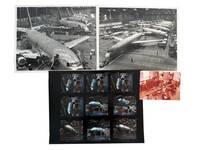
1970ref. 236751970. Boeing commercial aircraft engineering and production photo archive documenting 747 fuselage assembly at Everett and 737 final assembly at Renton circa 1970s during the company's expansion from conventional jetliner manufacture into wide body mass production. The 747 program required Boeing to coordinate a new airframe of unprecedented size with specialized tooling elevated work platforms component supply networks and a purpose built factory completed while the first aircraft was already under development. Photographs of the 737 line place that effort within Boeing's larger manufacturing system where several aircraft programs advanced simultaneously through separate but related sequences of subassembly joining systems installation testing and finishing. Photo archive of 12 silver gelatin and color photographs on four sheets ranging from approximately 4 x 6 inches to 9 x 10 inches Washington State circa 1970s. Nine color images arranged as a contact sheet show a Boeing 747 fuselage under construction inside a large assembly building suspended and supported amid scaffolding elevated platforms overhead cranes access stairs and surrounding work stations. Successive views record the unfinished forward fuselage from several positions including the cockpit section upper deck open structural areas and work platforms aligned along the aircraft's sides. A separate color photograph shows three technicians working around a long cylindrical mechanical or aerospace component mounted horizontally on supports in a laboratory or engineering shop with wiring hand tools parts cabinets and test equipment surrounding the assembly. Two large silver gelatin prints depict rows of Boeing 737 aircraft in successive stages of completion at the Renton final assembly plant from bare metal airframes crowded by scaffolding to nearly finished aircraft standing on an open production floor. A Boeing Public Relations caption dated July 1976 identifies the "737 final assembly line" states that fuselage and subassembly sections were brought from other buildings and joined on a single row line beside the 727 assembly area and records a production rate of three Advanced 737 200 aircraft per month. Versos carry Boeing file stamps editorial markings handwritten filing notes and the identification "Final assembly of Boeing 737 at Renton Wash." Boeing launched the 747 program in the second half of the 1960s after Pan American World Airways committed to the new aircraft forcing the company to design both the airplane and the industrial system needed to produce it on a compressed schedule. The first 747 rolled out at Everett in 1968 and flew in 1969 introducing a twin aisle passenger cabin a raised flight deck and a fuselage large enough to serve passenger cargo and convertible configurations. Its production depended on the controlled movement of immense structural sections through fixed assembly positions with cranes and elevated tooling giving workers access to surfaces that could not be reached through conventional narrow body production methods. The Renton photographs show how Boeing maintained standardized output on the smaller 737 while the Everett plant absorbed the scale and complexity of the 747 linking engineering development to repeatable factory production across two major commercial aircraft programs. Light surface wear occasional edge creasing and small tears adhesive caption residue stamps and editorial annotations; color images retain good detail with some warm color shift. Overall in good condition. A factory level record of how Boeing converted wide body aircraft design into an organized production system while sustaining high volume jetliner manufacture at Renton. unknown