réf. 200710218Paris, Albin Michel, 1990 ; in-8, 250 pp., broché, couverture illustr. Sur les traces d'Alexandrea David-Neel.
réf. 201007695Paris, Seuil, 1993 ; in-4, 96 pp., br. Très bon état.
réf. 201005327Graz, Leopold Stocker verlag, 1983 ; grand in-8, 247 pp., broché, couverture illustr. Bon état - Unvergangliches und unbekanntes vom dach der welt nach der kulturrevolution.
réf. 201601210Paris, Grasset-jeunesse, 1998 ; in-4, cartonnage d'éditeur .
réf. 50445P., Imprimerie Nationale, 1963, plaquette in 8° agrafée, paginée 327 à 335.
réf. 201011339Paris, Stock, 1976 ; in-8, 168 pp., broché, couverture illustr. Bon état.
réf. 200706813Paris, Stock, 1976 ; in-8, 168 pp., broché, couverture illustr.
réf. 201703354S.l., Editions mythra , 1980 ; in-4, 91 pp., cartonnage de l'éditeur.
réf. 201311285Paris, Editions mythra imprimerie fot , 1980 ; in-4, 93 pp., cartonnage de l'éditeur.
réf. 201111998Paris, GRUND, s.d. ; in-4, 136 pp., cartonnage de l'éditeur. Très bon état - cartonnage d'éditeur avec sa jaquette.
réf. 12536Hanoï, Imprimerie d'Extrême-Orient, Octobre-Novembre-Décembre 1928. 1 volume in-4, 36 pp. (annonces et affiches publicitaires) + 81 pp. (169-249) + 22 pp. (annonces et affiches publicitaires), reliure moderne plein cuir bordeaux, couvertures illustrées conservées, très nombreuses illustrations photographiques in et hors texte, très bel exemplaire.
2017réf. 87733Leuven: Peeters 2017. First Edition. First Impression. Thick octavo 24.5cm; original pictorial card wrappers; xxxvi34-940pp; illus.; text is entirely in French. A Fine copy of this substantial monograph on Tibetan ache lhamo theatre as it was performed in the pre-modern era before 1950 and as it is still performed today in the Tibet Autonomous Region and within the Tibetan diaspora in India and Nepal. 87733. Peeters unknown
2017réf. 87733Leuven: Peeters 2017. First Edition. First Impression. Thick octavo 24.5cm; original pictorial card wrappers; xxxvi34-940pp; illus.; text is entirely in French. A Fine copy of this substantial monograph on Tibetan ache lhamo theatre as it was performed in the pre-modern era before 1950 and as it is still performed today in the Tibet Autonomous Region and within the Tibetan diaspora in India and Nepal. 87733. Peeters unknown books
1972réf. 1151Paris, Maisonneuve, 1972, in-8, broché, VIII-227 pages, (4) planches hors-texte.
1968réf. 85865Oxford: The Clarendon Press 1968-1970. First Thus. Three volumes. Octavo. 22cm. Publisher's navy blue cloth titled and decorated in gilt to spines and front boards. Dustjackets. xix; 319pp.; xiv; 1; 326pp.; xv; 1; 235pp. All vols clean and tight very light wear to the cloth with some minor scuffing to corners and spine ends; internally clean a little thumbing to the page edges in places. top-edges a little dusty; in clean bright pictorial dustjackets with soiling to the paler regions and some shallow fraying to the spine ends the front panel of "The People of Tibet" has a patch of abrasion to the front panel possiblyy from a poorly removed label. A very good clean set. First published in 1928. Bell was for a large portion of his life the British Political Officer for the Bhutan Sikkim and Tibet regions of "British India" and was in effect considered the unofficial British Ambassador to Tibet. Although he resigned from these appointments in 1919 Bell was despatched on a diplomatic mission to Lhasa in the early 1920's for which he was subsequently knighted and became close acquaintances with the Dalai Lama being chosen to represent Tibetan interests in the Simla Convention where Great Britain and China met ostensibly to decide the fate of Tibet. The Clarendon Press unknown
1968réf. 85865Oxford: The Clarendon Press 1968-1970. First Thus. Three volumes. Octavo. 22cm. Publisher's navy blue cloth titled and decorated in gilt to spines and front boards. Dustjackets. xix; 319pp.; xiv; 1; 326pp.; xv; 1; 235pp. All vols clean and tight very light wear to the cloth with some minor scuffing to corners and spine ends; internally clean a little thumbing to the page edges in places. top-edges a little dusty; in clean bright pictorial dustjackets with soiling to the paler regions and some shallow fraying to the spine ends the front panel of "The People of Tibet" has a patch of abrasion to the front panel possiblyy from a poorly removed label. A very good clean set. First published in 1928. Bell was for a large portion of his life the British Political Officer for the Bhutan Sikkim and Tibet regions of "British India" and was in effect considered the unofficial British Ambassador to Tibet. Although he resigned from these appointments in 1919 Bell was despatched on a diplomatic mission to Lhasa in the early 1920's for which he was subsequently knighted and became close acquaintances with the Dalai Lama being chosen to represent Tibetan interests in the Simla Convention where Great Britain and China met ostensibly to decide the fate of Tibet. The Clarendon Press unknown books
1965réf. 120851Paris, école française d’Extrême-Orient, coll. « Publications hors série de l’école française d’Extrême-Orient » 1965 In-8 24 x 15,5 cm. broché, couverture grise, auteurs & titre en noir sur le dos et le premier plat, 164 pp., XII-XIII planches, sommaire, bibliographie. Exemplaire en très bon état.
1979réf. 85781Berkeley: Dharma Publishing 1979. Third printing. Two quarto volumes; cloth hardcovers dustjackets; 210pp paginated continuously; illus. Both volumes clean tight and unmarked - Near Fine. In the original dustwrappers slightly rubbed at extremities v.II with a small loss to rear panel and a closed tear at base of front flap-fold Very Good overall. From the library of noted poet and translator Nathaniel Tarn with his printed bookplate to pastedowns. Photographs taken by the author and her husband Lama Anagarika Govinda during an expedition to Central and Western Tibet in the years 1947-49. A remarkable record of Tibetan geography architecture and sacred art in the period immediately preceding the Seventeen Point Agreement which ceded sovereignty over Tibet to China. Dharma Publishing unknown
1979réf. 85781Berkeley: Dharma Publishing 1979. Third printing. Two quarto volumes; cloth hardcovers dustjackets; 210pp paginated continuously; illus. Both volumes clean tight and unmarked - Near Fine. In the original dustwrappers slightly rubbed at extremities v.II with a small loss to rear panel and a closed tear at base of front flap-fold Very Good overall. From the library of noted poet and translator Nathaniel Tarn with his printed bookplate to pastedowns. Photographs taken by the author and her husband Lama Anagarika Govinda during an expedition to Central and Western Tibet in the years 1947-49. A remarkable record of Tibetan geography architecture and sacred art in the period immediately preceding the Seventeen Point Agreement which ceded sovereignty over Tibet to China. Dharma Publishing unknown books
1909réf. 215622Leipzig.: F. A. Brockhaus. Dritte Auflage Third Edition. 1909. Photographic frontispiece folding map with outline colour numerous monotone and black and white photographic plates & illustrations a few in colour x 414 pages 23 x15 cm text in German; original pebbled cloth embossed in gilt and black coloured illustration laid down on the upper board spine a little sunned edges a little bumped front free endpaper abraded at the top edge presumably by the removal of a name occasional very light foxing a very good copy. German edition of Sven Hedin's "Adventures in Tibet". . F. A. Brockhaus hardcover
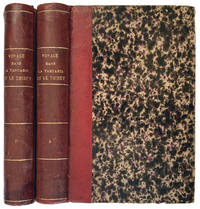
1857réf. AB1069Paris:: Gaume freres 1857. 1857. 2 volumes. 12mo. xv 1 430; iv 524 pp. Early quarter red gilt-stamped calf marbled boards; rubbed. Bookplate; binder's rubber-stamp of L. Brisset Valognes. A folding map is expected with this title other issues not present here. In fact there are different issues of this work with different paginations. "French missionary-traveller was born at Toulouse on the 1st of August 1813. In his twenty-fourth year he entered the congregation of the Lazarists at Paris and shortly after receiving holy orders in 1839 went out to China. At Macao he spent some eighteen months in the Lazarist seminary preparing himself for the regular work of a missionary. Having acquired some command of the Chinese tongue and modified his personal appearance and dress in accordance with Chinese taste he started from Canton. He at first superintended a Christian mission in the southern provinces and then passing to Peking where he perfected his knowledge of the language eventually settled in the Valley of Black Waters or He Shuy a little to the north of the capital and just within the borders of Mongolia. There beyond the Great Wall a large but scattered population of native Christians had found a refuge from the persecutions of Kia-King to be united half a century later in a vast but vague apostolic vicariate. The assiduity with which Huc devoted himself to the study of the dialects and customs of the Tatars for whom at the cost of much labour he translated various religious works was an admirable preparation for undertaking in 1844 at the instigation of the vicar apostolic of Mongolia an expedition whose object was to dissipate the obscurity which hung over the country and habits of the Tibetans. September of that year found the missionary at Dolon Nor occupied with the final arrangements for his journey and shortly afterwards accompanied by his fellow-Lazarist Joseph Gabet and a young Tibetan priest who had embraced Christianity he set out. To escape attention the little party assumed the dress of lamas or priests. Crossing the Hwang-ho they advanced into the terrible sandy tract known as the Ordos Desert. After suffering dreadfully from want of water and fuel they entered Kansu having recrossed the flooded Hwang-ho but it was not till January 1845 that they reached Tang-Kiul on the boundary. Rather than encounter alone the horrors of a four months' journey to Lhasa they resolved to wait for eight months till the arrival of a Tibetan embassy on its return from Peking. Under an intelligent teacher they meanwhile studied the Tibetan language and Buddhist literature and during three months of their stay they resided in the famous Kunbum Lamasery which was reported to accommodate 4000 persons. Towards the end of September they joined the returning embassy which comprised 2000 men and 3700 animals. Crossing the deserts of Koko Nor they passed the great lake of that name with its island of contemplative lamas and following a difficult and tortuous track across snow-covered mountains they at last entered Lhasa on the 29th of January 1846. Favourably received by the regent they opened a little chapel and were in a fair way to establish an important mission when the Chinese ambassador interfered and had the two missionaries conveyed back to Canton where they arrived in October of the same year. For nearly three years Huc remained at Canton but Gabet returning to Europe proceeded thence to Rio de Janeiro and died there shortly afterwards. Huc returned to Europe in shattered health in 1852 visiting India Egypt and Palestine on his way and after a prolonged residence in Paris died on the 31st of March 1860." / "His writings comprise besides numerous letters and memoirs in the Annales de la propagation de la foi the famous Souvenirs d'un voyage dans la Tartarie le Thibet et la Chine pendant les annees 1844-1846 2 vols. Paris 1850; Eng. trans. by W. Hazlitt 1851 abbreviated by M. Jones London 1867; its supplement crowned by the Academy entitled L'Empire chinois 2 vols. Paris 1854; Eng. trans. London 1859; and an elaborate historical work Le Christianisme en Chine &c. 4 vols. Paris 1857-1858; Eng. trans. London 1857-1858. These works are written written in a lucid racy picturesque style which secured for them an unusual degree of popularity. The Souvenirs is a narrative of a remarkable feat of travel and contains passages of so singular a character as in the absence of corroborative testimony to stir up a feeling of incredulity. That Huc was suspected unjustly was amply proved by later research. But he was by no means a practical geographer and the record of his travels loses greatly in value from the want of precise scientific data." Britannica. Gaume freres, 1857. hardcover
1852réf. 215573London.: Office of the National Illustrated Library. 1852. Two volumes 19 x 12.5 cm original gilt decorated cloth top edge gilt a little soiled still a good attractive set of a classic work. Volume I: folding map black and white wood engravings viii 293 pp 1 publisher's adverts owner's inked inscription on the flyleaf; Volume II: black and white engravings x 304 pp publisher's adverts some offsetting. Early edition in English translated by William Hazlitt son of the great essayist. One of the world's great travel classics. Written by Abbé Evariste Régis Huc a French missionary and explorer. Huc and his travelling companion and fellow priest and Lazarite missionary Joseph Gabet were among the very first Europeans to have reached Lhasa and Huc's account remains a vivid first hand history of western contact in China and Central Asia. . Office of the National Illustrated Library. hardcover
1857réf. AB1069Paris:: Gaume freres 1857. 1857. 2 volumes. 12mo. xv 1 430; iv 524 pp. Early quarter red gilt-stamped calf marbled boards; rubbed. Bookplate; binder's rubber-stamp of L. Brisset Valognes. A folding map is expected with this title other issues not present here. In fact there are different issues of this work with different paginations. "French missionary-traveller was born at Toulouse on the 1st of August 1813. In his twenty-fourth year he entered the congregation of the Lazarists at Paris and shortly after receiving holy orders in 1839 went out to China. At Macao he spent some eighteen months in the Lazarist seminary preparing himself for the regular work of a missionary. Having acquired some command of the Chinese tongue and modified his personal appearance and dress in accordance with Chinese taste he started from Canton. He at first superintended a Christian mission in the southern provinces and then passing to Peking where he perfected his knowledge of the language eventually settled in the Valley of Black Waters or He Shuy a little to the north of the capital and just within the borders of Mongolia. There beyond the Great Wall a large but scattered population of native Christians had found a refuge from the persecutions of Kia-King to be united half a century later in a vast but vague apostolic vicariate. The assiduity with which Huc devoted himself to the study of the dialects and customs of the Tatars for whom at the cost of much labour he translated various religious works was an admirable preparation for undertaking in 1844 at the instigation of the vicar apostolic of Mongolia an expedition whose object was to dissipate the obscurity which hung over the country and habits of the Tibetans. September of that year found the missionary at Dolon Nor occupied with the final arrangements for his journey and shortly afterwards accompanied by his fellow-Lazarist Joseph Gabet and a young Tibetan priest who had embraced Christianity he set out. To escape attention the little party assumed the dress of lamas or priests. Crossing the Hwang-ho they advanced into the terrible sandy tract known as the Ordos Desert. After suffering dreadfully from want of water and fuel they entered Kansu having recrossed the flooded Hwang-ho but it was not till January 1845 that they reached Tang-Kiul on the boundary. Rather than encounter alone the horrors of a four months' journey to Lhasa they resolved to wait for eight months till the arrival of a Tibetan embassy on its return from Peking. Under an intelligent teacher they meanwhile studied the Tibetan language and Buddhist literature and during three months of their stay they resided in the famous Kunbum Lamasery which was reported to accommodate 4000 persons. Towards the end of September they joined the returning embassy which comprised 2000 men and 3700 animals. Crossing the deserts of Koko Nor they passed the great lake of that name with its island of contemplative lamas and following a difficult and tortuous track across snow-covered mountains they at last entered Lhasa on the 29th of January 1846. Favourably received by the regent they opened a little chapel and were in a fair way to establish an important mission when the Chinese ambassador interfered and had the two missionaries conveyed back to Canton where they arrived in October of the same year. For nearly three years Huc remained at Canton but Gabet returning to Europe proceeded thence to Rio de Janeiro and died there shortly afterwards. Huc returned to Europe in shattered health in 1852 visiting India Egypt and Palestine on his way and after a prolonged residence in Paris died on the 31st of March 1860." / "His writings comprise besides numerous letters and memoirs in the Annales de la propagation de la foi the famous Souvenirs d'un voyage dans la Tartarie le Thibet et la Chine pendant les annees 1844-1846 2 vols. Paris 1850; Eng. trans. by W. Hazlitt 1851 abbreviated by M. Jones London 1867; its supplement crowned by the Academy entitled L'Empire chinois 2 vols. Paris 1854; Eng. trans. London 1859; and an elaborate historical work Le Christianisme en Chine &c. 4 vols. Paris 1857-1858; Eng. trans. London 1857-1858. These works are written written in a lucid racy picturesque style which secured for them an unusual degree of popularity. The Souvenirs is a narrative of a remarkable feat of travel and contains passages of so singular a character as in the absence of corroborative testimony to stir up a feeling of incredulity. That Huc was suspected unjustly was amply proved by later research. But he was by no means a practical geographer and the record of his travels loses greatly in value from the want of precise scientific data." Britannica. Gaume freres, 1857. hardcover books
1993réf. 85837London: Serindia Publications 1993. First Edition. First impression. Quarto. Red cloth hardcover; dustjacket; 319pp; illustrations in color and b/w. A fine unworn copy. In the original dustwrapper similarly Fine. From the library of noted poet / translator / Buddhist scholar Nathaniel Tarn with his printed bookplate inside front cover. Serindia Publications unknown
1993réf. 85837London: Serindia Publications 1993. First Edition. First impression. Quarto. Red cloth hardcover; dustjacket; 319pp; illustrations in color and b/w. A fine unworn copy. In the original dustwrapper similarly Fine. From the library of noted poet / translator / Buddhist scholar Nathaniel Tarn with his printed bookplate inside front cover. Serindia Publications unknown books