MACARTNEY, lord George, STAUNTON, GeorgeLivre Rare Book

940 resultados
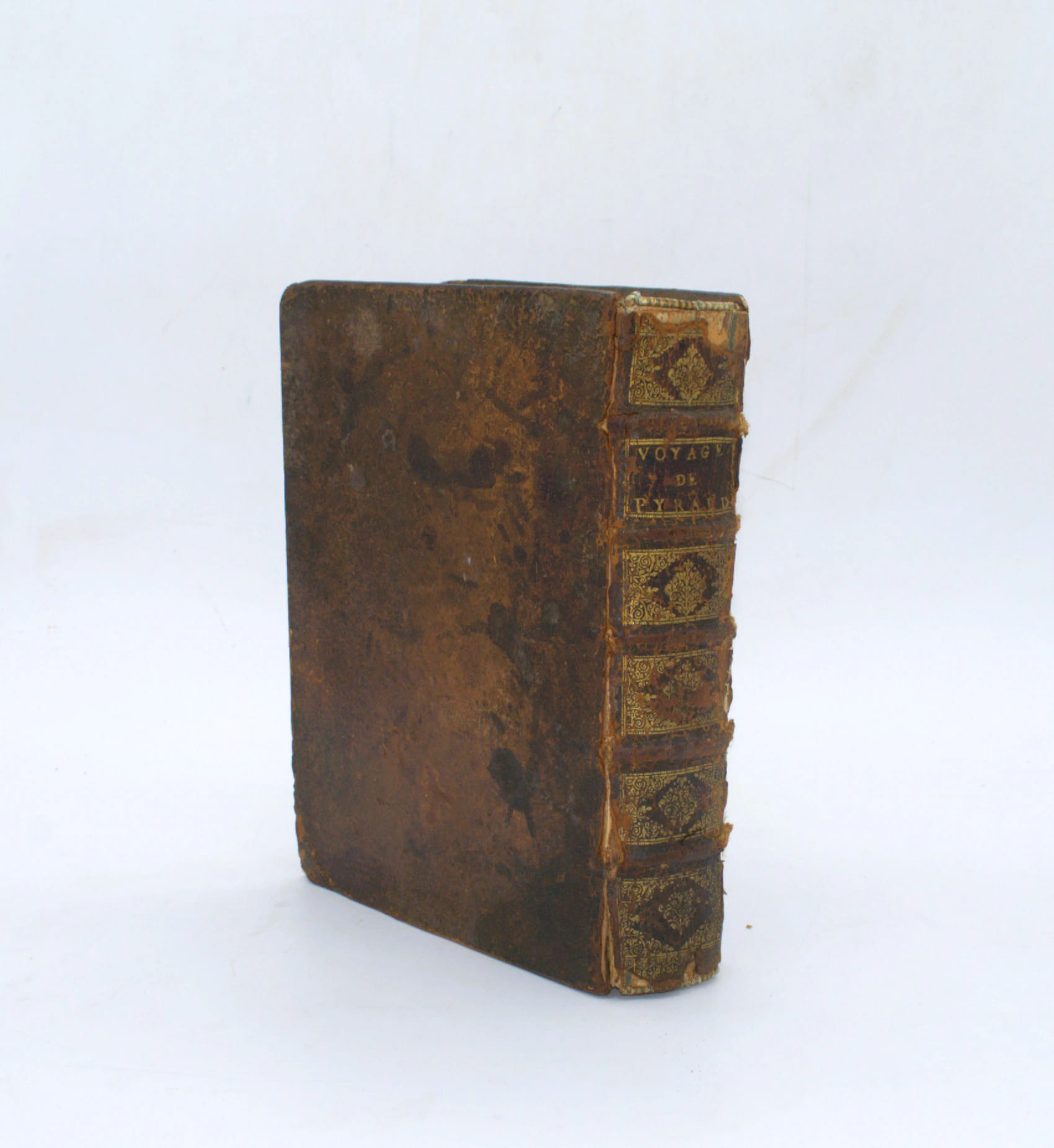
1804ref. PHO-2366Paris, Chez Buisson, 1804, in-4 (32x23,5cm), 2ff. et 41 planches dont 3 cartes (complet), reliure d’attente, étiquette au plat dans une pochette en toile bleu, réparations aux cartes.
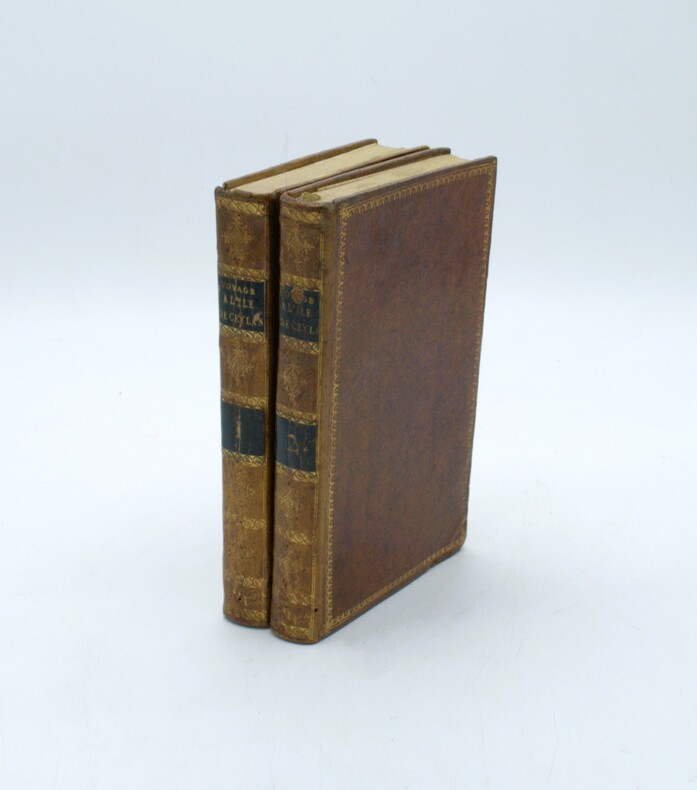
1803ref. PHO-1636Paris, Dentu, an XI (1803). 2 volumes in-8 (191 x 124 mm). 4 cartes et plans repliés hors texte : une carte de l'île de Ceylan par Arrowsmith et de la pêche des perles et les plans des ports de Trinquemale et Colombo, basane mouchetée de l'époque, dos lisses ornés avec pièces de titre et tomaison, dentelles dorées sur les plats, frottements et vieille épidermure au tome 2.
1920Sm. 8vo., Tenth Edition, on India Paper, with 38 folding coloured maps, 11 full-page maps and plans (a number coloured), numerous illustrations, plans and tables (several full-page) in the text, and a very large folding coloured map mounted on cloth in pocket at rear, some mild offsetting to blank preliminaries, endpapers very lightly age-soiled; handsomely bound in full crushed red morocco BY HATCHARDS, upper board lettered in gilt, back with five shaped raised bands, second compartment lettered in gilt, all edges gilt, wide gilt doublures elaborately tooled in gilt with a floral border enclosing multiple frames, laid paper endpapers, red, yellow and green silk head- and tail-bands, red buckram pocket, a splendid and ornate copy ideal as a gift or for presentation. THE BINDING IS SIGNED ON FRONT PASTE-DOWN. IT WAS COMMISSIONED BY GUY WESTMACOTT WHOSE NAME IS LETTERED IN GILT ON FRONT BOARD (this could well be Guy Randolph Westmacott of the Grenadier Guards). A SPLENDID AND UNIQUE COPY OF THE ONE OF THE BEST EDITIONS OF THE FINEST TRAVELLER'S GUIDE TO INDIA AND SURROUNDING REGION. VERY SCARCE IN ANY CONDITION.
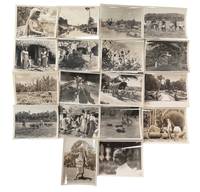
1934ref. 237251934. British Ceylon photographic archive circa 1934 documenting the labor systems that sustained one of the British Empire's most profitable plantation economies. Rather than emphasizing colonial administration or metropolitan life the photographs concentrate on the people whose agricultural work produced tea coconuts rice and other commodities that defined Ceylon's export economy during the final decades of British rule. The archive records both plantation labor and village agriculture placing field workers animal labor transportation and rural settlements within the same narrative of production that underpinned the island's economy before independence in 1948. Photo archive of 18 silver gelatin photographs each 4 x 5 inches British Ceylon circa 1934. The photographs depict women plucking tea leaves into large wicker baskets; groups of men women and children harvesting grain by hand; buffalo drawing plows through cultivated fields; coconut gathering and processing; elephants employed in heavy labor; cattle standing in flooded waterways; and villagers sorting agricultural products outside thatched dwellings. Other photographs show a village street lined with tiled roof buildings waterways with native boats landscaped gardens flowering branches tree-lined roads and portrait studies of rural residents including a Kandyan dancer in ceremonial costume and an elderly man identified only through the original negative caption. Several negatives retain contemporary handwritten captions identifying locations including Hambantota and describing subjects and related scenes indicating production for documentary or promotional use rather than private photography. The photographs were apparently produced during the S.S. Resolute World Cruise which departed on January 14 1934 for a 134 day itinerary through twenty nine countries and territories. Within that context the images record not only British Ceylon's plantation economy but also the way commercial world cruises presented the colony to Western travelers emphasizing tea estates agricultural labor village life wildlife and staged cultural performance as representative scenes of imperial Ceylon before independence in 1948. In reality production depended heavily upon Tamil labor recruited from southern India while Sinhalese villagers continued to dominate much of the island's rice cultivation and local agriculture distinctions reflected in the archive's movement between commercial plantations and village landscapes. Light surface wear with occasional curling at the corners; overall very good condition. A concentrated visual record of agricultural labor and rural production in British Ceylon during the final years of imperial rule. unknown
1934ref. 237251934. British Ceylon photographic archive circa 1934 documenting the labor systems that sustained one of the British Empire's most profitable plantation economies. Rather than emphasizing colonial administration or metropolitan life the photographs concentrate on the people whose agricultural work produced tea coconuts rice and other commodities that defined Ceylon's export economy during the final decades of British rule. The archive records both plantation labor and village agriculture placing field workers animal labor transportation and rural settlements within the same narrative of production that underpinned the island's economy before independence in 1948. Photo archive of 18 silver gelatin photographs each 4 x 5 inches British Ceylon circa 1934. The photographs depict women plucking tea leaves into large wicker baskets; groups of men women and children harvesting grain by hand; buffalo drawing plows through cultivated fields; coconut gathering and processing; elephants employed in heavy labor; cattle standing in flooded waterways; and villagers sorting agricultural products outside thatched dwellings. Other photographs show a village street lined with tiled roof buildings waterways with native boats landscaped gardens flowering branches tree-lined roads and portrait studies of rural residents including a Kandyan dancer in ceremonial costume and an elderly man identified only through the original negative caption. Several negatives retain contemporary handwritten captions identifying locations including Hambantota and describing subjects and related scenes indicating production for documentary or promotional use rather than private photography. The photographs were apparently produced during the S.S. Resolute World Cruise which departed on January 14 1934 for a 134 day itinerary through twenty nine countries and territories. Within that context the images record not only British Ceylon's plantation economy but also the way commercial world cruises presented the colony to Western travelers emphasizing tea estates agricultural labor village life wildlife and staged cultural performance as representative scenes of imperial Ceylon before independence in 1948. In reality production depended heavily upon Tamil labor recruited from southern India while Sinhalese villagers continued to dominate much of the island's rice cultivation and local agriculture distinctions reflected in the archive's movement between commercial plantations and village landscapes. Light surface wear with occasional curling at the corners; overall very good condition. A concentrated visual record of agricultural labor and rural production in British Ceylon during the final years of imperial rule. unknown books
1899Série complète des premières 15 années/volumes, ensemble plus de 7000 pages, richement illustré (principalement des photos en n/bl, des cartes et des dessins), 27cm., reliures uniformes d'époque en rouge (dos en cuir avec titré doré, dos à cinq nerfs, charnières peu passées et qqs. traces d'usage), brochures originales conservées et reliées, feuilles de garde marbrées, qqs. vagues taches d'humidité dans les tomes 1 à 4 (dans le marge du texte, pas dans le texte), texte frais, poids: 30 kg., R108410
1899ref. R108410Bruxelles, Charles Bulens 1899-1913 Série complète des premières 15 années/volumes, ensemble plus de 7000 pages, richement illustré (principalement des photos en n/bl, des cartes et des dessins), 27cm., reliures uniformes d'époque en rouge (dos en cuir avec titré doré, dos à cinq nerfs, charnières peu passées et qqs. traces d'usage), brochures originales conservées et reliées, feuilles de garde marbrées, qqs. vagues taches d'humidité dans les tomes 1 à 4 (dans le marge du texte, pas dans le texte), texte frais, poids: 30 kg., R108410
1701ref. 109761701 un volume, reliure plein veau brun raciné (binding full calfskin) in-douze (duodecimo), dos à nerfs (spine with raised bands), important manque de cuir au dos (dos cassé à restaurer)décoré or (gilt decoration) frotté (spine rubbed) manque de dorure (lack of gilt)- entre-nerfs - compartiments or à fleuron fleurette (floweret) - titre frappé or (gilt title), pièce de titre à filets sur fond bordeaux foncé (label of title with gilt line), plats épidermés (lights scratches), charnière fendue (cracked joints) et coins écornés (corners dog-eared), tranches lisses (edges smoothes), légère trace d'eau en marge, ex-libris Caroli Joan. B. EDM. Machart 1771 dans une étiquette blanche à encadrement illustré en noir, orné de 6 planches dépliantes hors-texte , [34]-352 pages avec Approbation & Privilège du Roy + [6] feuillets de planches, 1701 à Trévoux et à Paris Jean Boudot Editeur,
1707ref. PHO-767Amsterdam, Étienne Roger, 1707. 2 volumes in-12 (160x100) ,relié plein veau époque , dos à nerfs orné , tranches rouges , titre en rouge et noir , coiffes usées . 508pp-515pp illustré d’un frontispice et de 15 figures sur 10 planches .Ex-libris Mich Comitis vandalini Mniszech (1742-1806)
1782ref. PHO-10601782 , A Paris , Chez l'auteur & Froulé & Nyon, In-8 (150x225mm), xxij, 340pp. et (6) 376pp. et (6) 362pp.,illustré de 7 planches dépliantes gravées par Poison d’après l’auteur, relié plein veau marbré époque , dos lisse avec pièces de titre et tomaison vertes, tranches mouchetées rouges, filets sur les plats , dos frottés , coiffes et coins usés , petites rousseurs.
1880ref. 237851880. Ceylon colonial photo archive depicting tea cultivation estate labor transportation and urban life circa 1880s to 1910s documenting the plantation economy that made the island one of Britain's principal sources of tea as British merchants shifted the enormous domestic tea market away from China and toward production within the Empire. Coffee leaf rust appeared in Ceylon in 1869 and spread rapidly through the island's coffee districts precipitating the collapse of the crop that had dominated the colonial export economy and accelerating planters' conversion of the central highlands to tea. James Taylor had established commercial tea cultivation at Loolecondera Estate near Kandy in 1867 and the new industry expanded rapidly as coffee failed; by 1900 some 380000 acres in Ceylon were planted in tea. By 1879 the results showed that in more than 70 percent of tea sold in London still came from China while by 1900 China supplied only about 10 percent and black teas from British controlled India and Ceylon constituted the bulk of the market. Photo archive of albumen and silver gelatin photographs and photographic postcards ranging from approximately 3½ x 5 to 4 x 6 inches Ceylon circa 1880s to 1910s. Tea production forms the strongest body of imagery. Women and men stand among densely planted tea bushes or work through rows of plants with women carrying the large woven baskets used to collect leaves; individual and group views are captioned "Tea plucker" "Tea picking Ceylon" "Pruning tea Kandy" and in French "Cueillette du thé à Ceylan." One Skeen & Co. Colombo card numbered 84 and captioned "Tea plucker" isolates a woman at work with a large basket strapped behind her while another shows a large group of workers seated with baskets and gathered tea in a plantation clearing. A card captioned "Estate coolies Ceylon" depicts an estate employee in European dress standing with women and a child outside a thatched dwelling preserving in its printed terminology the racial and labor classifications through which plantation workers were presented to contemporary consumers of colonial imagery. Other photographs move from plantation production into the roads vehicles and cities of colonial Ceylon: rickshaw pullers pose with European passengers and beside their vehicles; a street scene records "Native town Kandy Ceylon"; Colombo appears in views of the "Colpetty Road near Galle Face Colombo" a crowded procession captioned in French "Colombo départ des troupes Anglaises" and a civic monument among palms. Another postcard depicts "Royal visitors leaving Ceylon" while a country road scene shows pedestrians carts and roadside activity. Skeen & Co. one of the principal commercial photographic firms operating from Colombo in the late nineteenth and early twentieth centuries is identified on several cards but no single photographer can be assigned to the archive as a whole. The tea scenes record the labor at the center of one of the fastest agricultural conversions in the nineteenth century British Empire. Coffee rust Hemileia vastatrix was first observed in Ceylon in 1869 and within little more than a decade had destroyed the commercial basis of the coffee plantation system; tea already demonstrated commercially by Taylor replaced it across much of the highlands. Ceylon tea exports to Britain rose from only 282 pounds in 1875 to more than 4.3 million pounds in 1885 while the plantation landscape expanded until almost all former coffee districts had been replanted with tea during the 1890s. That expansion depended on a large year round plantation workforce much of it composed of Tamil laborers brought from southern India and on the colonial infrastructure that connected the highlands with Colombo and overseas markets. Roads and the railway between Kandy and Colombo had initially served the coffee economy and could be redirected toward tea after the blight while Colombo developed as the commercial and shipping center through which the crop entered imperial markets. The archive therefore records several stages and social spaces of the same colonial economy from plucking and pruning in the highlands to estate communities road transport Kandy and the metropolitan port city of Colombo while the postcards themselves show how plantation labor and colonial development were converted into commercial images for circulation beyond the island. Light to moderate surface wear toning occasional fading and creasing with some photographs showing age related discoloration and edge wear. Overall in good condition. A visual record of the plantation labor and colonial infrastructure behind Ceylon's transformation from a failed coffee economy into a major tea producer that helped Britain replace Chinese tea with supplies produced under imperial control. unknown
1880ref. 237851880. Ceylon colonial photo archive depicting tea cultivation estate labor transportation and urban life circa 1880s to 1910s documenting the plantation economy that made the island one of Britain's principal sources of tea as British merchants shifted the enormous domestic tea market away from China and toward production within the Empire. Coffee leaf rust appeared in Ceylon in 1869 and spread rapidly through the island's coffee districts precipitating the collapse of the crop that had dominated the colonial export economy and accelerating planters' conversion of the central highlands to tea. James Taylor had established commercial tea cultivation at Loolecondera Estate near Kandy in 1867 and the new industry expanded rapidly as coffee failed; by 1900 some 380000 acres in Ceylon were planted in tea. By 1879 the results showed that in more than 70 percent of tea sold in London still came from China while by 1900 China supplied only about 10 percent and black teas from British controlled India and Ceylon constituted the bulk of the market. Photo archive of albumen and silver gelatin photographs and photographic postcards ranging from approximately 3½ x 5 to 4 x 6 inches Ceylon circa 1880s to 1910s. Tea production forms the strongest body of imagery. Women and men stand among densely planted tea bushes or work through rows of plants with women carrying the large woven baskets used to collect leaves; individual and group views are captioned "Tea plucker" "Tea picking Ceylon" "Pruning tea Kandy" and in French "Cueillette du thé à Ceylan." One Skeen & Co. Colombo card numbered 84 and captioned "Tea plucker" isolates a woman at work with a large basket strapped behind her while another shows a large group of workers seated with baskets and gathered tea in a plantation clearing. A card captioned "Estate coolies Ceylon" depicts an estate employee in European dress standing with women and a child outside a thatched dwelling preserving in its printed terminology the racial and labor classifications through which plantation workers were presented to contemporary consumers of colonial imagery. Other photographs move from plantation production into the roads vehicles and cities of colonial Ceylon: rickshaw pullers pose with European passengers and beside their vehicles; a street scene records "Native town Kandy Ceylon"; Colombo appears in views of the "Colpetty Road near Galle Face Colombo" a crowded procession captioned in French "Colombo départ des troupes Anglaises" and a civic monument among palms. Another postcard depicts "Royal visitors leaving Ceylon" while a country road scene shows pedestrians carts and roadside activity. Skeen & Co. one of the principal commercial photographic firms operating from Colombo in the late nineteenth and early twentieth centuries is identified on several cards but no single photographer can be assigned to the archive as a whole. The tea scenes record the labor at the center of one of the fastest agricultural conversions in the nineteenth century British Empire. Coffee rust Hemileia vastatrix was first observed in Ceylon in 1869 and within little more than a decade had destroyed the commercial basis of the coffee plantation system; tea already demonstrated commercially by Taylor replaced it across much of the highlands. Ceylon tea exports to Britain rose from only 282 pounds in 1875 to more than 4.3 million pounds in 1885 while the plantation landscape expanded until almost all former coffee districts had been replanted with tea during the 1890s. That expansion depended on a large year round plantation workforce much of it composed of Tamil laborers brought from southern India and on the colonial infrastructure that connected the highlands with Colombo and overseas markets. Roads and the railway between Kandy and Colombo had initially served the coffee economy and could be redirected toward tea after the blight while Colombo developed as the commercial and shipping center through which the crop entered imperial markets. The archive therefore records several stages and social spaces of the same colonial economy from plucking and pruning in the highlands to estate communities road transport Kandy and the metropolitan port city of Colombo while the postcards themselves show how plantation labor and colonial development were converted into commercial images for circulation beyond the island. Light to moderate surface wear toning occasional fading and creasing with some photographs showing age related discoloration and edge wear. Overall in good condition. A visual record of the plantation labor and colonial infrastructure behind Ceylon's transformation from a failed coffee economy into a major tea producer that helped Britain replace Chinese tea with supplies produced under imperial control. unknown books
1744ref. 122971à Paris, chez Jean Desaint & Charles Saillant 1744 3 volumes. In-16 17 x 9,5 cm. Reliures de l’époque veau havane marbré, dos à nerfs encadrés de fers dorés, [18]-396-353-471-[7] pp., bandeaux, lettrines, 1-1 cartes repliées, table en fin de chaque volume. Coiffes avec accroc, coins de pied émoussés et frottés, intérieur frais.
1890ref. 44332London 1890. Small 12mo pp. 40; lexicon in triple column; original glazed pictorial wrappers; adverts on endpapers and lower cover - that inside the upper cover an ad for Mazawattee Coffee. Very good. The lexicon occupies 38 pages triple column. The last leaf contains the essay "The Truth About Tea." Wellcome Library only in OCLC with variant wrappers. No other editions located. Not in Vancil. unknown
1890ref. 44332London 1890. Small 12mo pp. 40; lexicon in triple column; original glazed pictorial wrappers; adverts on endpapers and lower cover - that inside the upper cover an ad for Mazawattee Coffee. Very good. The lexicon occupies 38 pages triple column. The last leaf contains the essay "The Truth About Tea." Wellcome Library only in OCLC with variant wrappers. No other editions located. Not in Vancil. unknown books
ref. 225183S.l., s.d. (vers 1905) in-8 oblong (16 x 22 cm), [27] ff. n. ch. de papier fort, regroupant 88 petits tirages photographiques contrecollés et légendés en français, 3 tirages volants, toile chagrinée cerise, dos lisse muet, encadrements à froid sur les plats (reliure de l'époque). Exemplaire déboîté. Certaines photos passées.
1715ref. PHO-1978Rouen : Jean-Baptiste Machuel le jeune, 1715. 4 volumes in-12 (160 x 97 mm). 3 frontispices gravés sur cuivre et 42 cartes, plans et figures dont de nombreux dépliants. Plein veau époque, dos à nerfs ornés avec tomaison et pièce de titre, tranches rouges. Tome 1, 7ffnch (préface)408pp-12ff (table), illustré d’un frontispice par Scotin le jeune, 3 cartes dont la mappemonde et 6 planches. Tome 2 ,2ff (titre et chapitre) 396pp-5ff (table), contient le traité des vents (p275), illustré d’un frontispice et 9 planches dont la rose des vents et les cartes des 2 hémisphères. Tome 3 ,393pp,5ff (table), illustré d’un frontispice par Scotin le jeune, 2 cartes et 6 planches. Tome 4, 20pp-381pp-8ff (table), illustré de 18 planches dont 3 cartes. L'illustration se compose de 3 titres-frontispices et de 42 planches hors texte, souvent dépliantes : mappemonde, cartes des différentes îles, profils de côtes, vues de ports (Manille, Bahia, Scio) et vues d'îles (Canaries, Cap Vert), monuments, Indiens, scènes de bataille, naufrage, flore (abricotier, cacaotier), oiseaux, poissons, insectes et une curieuse représentation de la « vache de la montagne ou cheval marin ».
ref. 244271Paris, Dentu, an XI 2 tomes en 1 vol. in-8, 6-316 pp. et 304 pp., 4 pl. dépliantes, demi-fauve marbré, dos lisse orné (reliure de l'époque). Petit accroc à la coiffe supérieure, coins usés, épid. sur le plat supérieur.
1745ref. 21089Erfurt, Jungnicol, 1740 - 1745. 4 Bll, 280 S., 123 S. 8°. Mod. Pp. [4 Warenabbildungen]
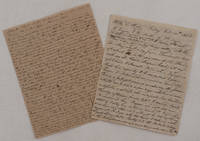
ref. M53HMS Thalia “18 leagues to the North of St. Jago” 20 October 1805 and Colombo Fort 21 June completed 2 September 1806. Both Octavos ca. 23x18 cm and 25x20 cm. Each 3 ½ pp. Both addressed and sealed on the last pages. Brown ink on watermarked laid and white paper. Fold marks both letters with minor holes on the 4th pages after opening affecting several words; second letter with tears and minor holes on folds but overall very good letters. Two extensive letters giving an interesting firsthand account of the early British rule in Sri Lanka the British occupied former Dutch possessions on the island only ten years earlier in 1795. The first letter describes Cleather’s voyage to Ceylon from England on board HMS Thalia with the notes on the heat of the gun room‚ the frigate’s captain Walker Santiago Island Cape Verde where they got fresh supplies and water social life on board the ship et al. “I sleep every night in the most tantalizing situation you can possibly imagine Rayner having strung my cot in the after gun room in the midst of <…> chests of dollars to the amount of 40.000 £ which they are taking out for the Company there is 400.000 £ standing more below.” The second letter completed almost a year later gives an inside look into the life of British military and civil society on Ceylon shortly after the end of the First Kandyan War 1803-1805. Cleather praises the Colombo garrison’s chaplain Reverend W.H. Heywood in whose house he started writing the letter notes that he has dined with the “Chief Secy. Mr. Arbuthnot the 2nd personage in the Island” and mentions “innumerable” balls and suppers to which “I am constantly invited.” His regiment “is stationed about ten miles from the Fort <…> I have a small house but very comfortable near the parade & not far from a pretty little Cot.tage of Heywoods where he generally resides – for this I pay two guineas a month nothing here.” Cleather mentions that the Regiment which consists of sepoys trains a lot because it is expected to be reviewed shortly; notes on his relation with his colleague officers – Lieut.-Col. T.W. Kerr who “has an unfortunate disposition to talk scandal” Fort Adjutant Mr. Stewart officers wives and daughters and others. “I do not much … the heat and have never had a day’s illness since I landed in the Island. I had no duty for two or three months at first being laid up with hurts in my legs. This is common enough & is thought nothing of it is long since over…” Captain W.H. Cleather of the first Ceylon Regiment was educated at Exeter College Oxford and arrived in Ceylon in 1805. Through his sister Mary Littlehales to whom the letters are addressed he was a brother-in-law of Vice-Admiral Bendall Robert Littlehales 1765-1847 a participant of the Napoleonic Wars and Captain Edward Littlehales 1805-1888 a commander of HMS Dolphin on the coast of West Africa during the suppression of the slave trade in the 1840s. During his career in the British Ceylon he served in different Ceylon Regiments was the Fort adjutant at Galle Jaffna and Colombo. He took part in military actions during the Uva Rebellion 1817-1818 and for many years served as Deputy Judge Advocate in Ceylon. hardcover
1938A SET OF 28 MAGNIFICENT FOLIO WOOD-ENGRAVINGS DEPICTING THE SCENERY, PEOPLE AND WILDLIFE OF SOUTH AND SOUTHEAST ASIA AND PACIFIC ISLANDS, including Ceylon, Weh (Sabang), Sumatra, Singapore, Java, and Bali. Also includes title-page, 8 pages of text describing the author / artist's travels (SIGNED IN INK BY THE AUTHOR / ARTIST), list of wood-engravings, and justification / colophon. From a total edition of 40 sets, THIS IS SET NUMBER 1, printed for Maurice Blum, ONE OF ONLY TEN SETS PRINTED ON JAPON NACRE. Folio. Loose as issued in custom-made folding case. FINE AND BRIGHT. Extremely rare, especially on Japanese paper.
1706ref. PHO-1901Amsterdam, Jacques Desbordes, 1706. 3 volumes in-12° (sur 3), 10ff-405pp-3pp (catalogue); 2ff-402pp-14ff( table) ; 4ff.-388pp.-10ff., illustré de 3 frontispices, 1 portrait et 30 (32) cartes et planches dépliantes dont une belle carte (25x36cm), manque la page de titre tome 1. Relié plein veau époque, dos à nerfs ornés avec pièce de titre et tomaison, tranches rouges, charnières frottées, début de fente (tome 1), coiffes usées, petit manque de cuir au dos, mouillure au tome 3, traces de restauration, manque la grande carte mais la carte de Ceylan est bien présente.
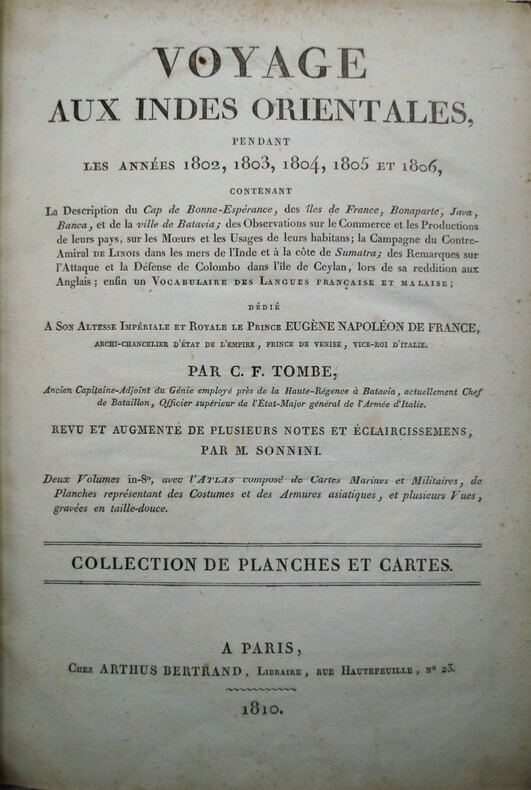
1810ref. PHO-1157Paris: Arthus Bertrand, 1810. — Atlas in-4, (295x200) (2 ff.), 18 cartes et planches , la plupart dépliantes ,relié demi veau ,dos lisse avec fers de navire , manque au dos .
1679ref. PHO-2525A Paris, Chez Louis Billaine, 1679. In-4° ; 5ff.-1 carte h.-t.-repl.-327 pp.-218 pp.-144 pp.-12ff., veau époque, dos à nerfs orné avec titre. Manque au dos et charnières, coins usé, travail de ver sur les 17 premiers et 30 derniers feuillets, petite mouillure angulaire, titre bruni, feuillet « Au lecteur » déchiré sans manque, brunissures. L’une des meilleures descriptions des Maldives et une importante description de Goa.
1807ref. 41521ABLondon, Longman, Hurst, Rees, and Orme, 1807. 4to. XII, 445, (2); VI, 360, (8)pp. With 23 (15 aquatints; 2 fold.) engr. plates, 1 engr. map and 1 engr. plan. Contemp. full calf with 2 red labels, richly gilt, a.e.g. (signed: Simier).