Arzu CeylanBiblio.com
Cynthia CeilanBiblio.com
Myths of a Merciful God
ref. 6126704860Hardback. New. pp. 268 hardcover

Cold Books · India67,36 US$≈ 60,18 €
946 resultados
2017ref. 1-3659746665LAP LAMBERT Academic Publishing 2017. Paperback. New. 136 pages. Turkish language. 8.66x5.91x0.31 inches. LAP LAMBERT Academic Publishing paperback
ref. 6126704860Hardback. New. pp. 268 hardcover
ref. 46050London : CIGM c.1920. Wooden box 152 x 80 x 70 mm with chromolithographic label on five sides one illustrated; surface wear commensurate with extensive use. The Ceylon and India General Mission CIGM was a non-denominational organisation founded in 1892. Initially its evangelical work was carried out among Ceylon’s Sinhalese Buddhists and Tamil Hindus but its operations soon expanded from Ceylon into South India and then throughout whole of the subcontinent. Eventually missions were established as far away as the Philippines. CIGM merged with the Poona & Indian Village Mission PIVM to become the International Christian Fellowship ICF which in turn merged with SIM in 1989. unknown
1804ref. 20204AB1804. Vienna Doll 1804. 21 : 135 cm. Titel 452 pages 2 engraved platges 1 many-folded map. Contemporary boards 2 back labels. First German edition of the Account of the Island of Ceylon 1803. Published at the same time as the Weimar edition but with the addition of the two engravings depicting the natives and pearl fishing. - "Percival lived in Ceylon for three years as an English colonial officer. Here he provides a regional description of the island covering the nature of the country as well as the population and economy and the colonial history to date" Griep/L. Includes an addition by the translator on pearl fishing.- Binding stained and rubbed inside fine. hardcover
1800ref. ABC_47410Ceylon Sri Lanka and the Netherlands 1800. Contemporary decorated paper wrappers. 8vo 16.5 x 10.5 cm. Written in a late 18th-century or early 19th-century cursive in French and Dutch. With: 2 MANUSCRIPT - FRENCH & DUTCH POEMS AND SONGS. Quelques Chansons. Ad 1: An interesting manuscript probably written by a Dutch person in the service of the VOC Dutch East-India Company during the time the VOC had trading stations and later was ruling Sri Lanka until 1802. Remarkably the majority of the birds snakes and other animals described here are described by the same indigenous names as those used by Jacob Haafner in his Reize te voet door het eiland Ceilon 1754. The birds other animals plants and trees described include: a "kiroudin" a kind of eagle or harrier native to the Malabar coast the "pambou-rajah of konigs slang" poisonous "Royal" snake a "rollewaijs" a Rollewai a kind of bat typical for Ceylon the "tijger-royal" Royal tiger the "anacondo" an anaconda or water boas a large snake a "alamaram/wortelboom" mangrove tree the "ananas" pineapple the "casjou" cashew nut and "mangas" mangos among many others. Ad 2: A manuscript written in French and Dutch consisting of thirteen humorous poems and songs in French and Dutch. This part was probably added a few decades after the text on the natural history of Ceylon by the same author possibly after their return to the Netherlands. It is written in a later hand upside down and back to front from p. 28 to p. 15: 6 humorous poems in French: "Le vaillant troubadour" "Romance" in 3 stanzas "Romance de la petite Condrille" in 3 stanzas no title in 3 stanzas no title in 5 stanzas and 7 humorous poems in Dutch: "Toverfluit" "Oost-Indië boven" a riddle "De schrandere priester" "De getrouwe raad" "De gereede raadgever" and finally "De predikant en de dorpsschout".With manuscript annotations on the wrappers mainly repeats of the supposed title: "Quelques Chansons". The wrappers show clear signs of wear with some paper loss to the spine and edges of the wrappers. With manuscript writing exercises and an excerpt of a French text on the paste-downs/inside of the wrappers. Otherwise in good condition.l cf. Valentijn V 1726 pp. 50-54. unknown
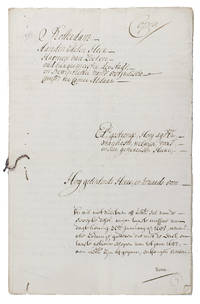
1699ref. ABC_47411Jaffanapatnam Ceylon 1699. Folded and kept together by an orange white and blue piece of string in the left margin 1.5 cm from the edge of the leaves in the middle. Folio 33 x 21 cm. The Dutch letter is written in a neat late 17th-century cursive hand in brown ink. Contemporary copy Copia perhaps by Schenkenberg himself or by his secretary including the address on the first leaf: Rotterdam./ Aenden Edelen Heer./ Harmen van Zoelen/ oud burgermeester der stadt/ en Bewinthebber vande Oostindische/ Comp. ter Camer Aldaar.Very interesting letter by the Director commandeur of the fort and Dutch East India Company VOC station Jaffanapatnam on the northern-most coast of Ceylon now: Sri Lanka facing the Coromandel coast of India. The fort was captured from the Portuguese by Rycklof van Goens in the 1630s and was an important stronghold for the VOC presence on Ceylon during the late 17th and 18th centuries. The letter offers clear insight in the VOC policy regarding appointments nominations and commissions as well as for the required qualifications and salaries for the various functions. The letter also shows how important family ties recommendations and even favouritism and nepotism were in these matters.Matthaeus Schenkenberg was born in Batavia in 1667 as son of Hendrik Schenkenberg and Henrietta Chasteleyn. He writes that after having been chief-merchant opperkoopman for eight years he had been appointed by the high command at Batavia the hooge regeering director commandeur of the fort Jaffanapatnam Jaffna in June 1698 as the successor of Hendrik Swaardecroon with a monthly salary of 120 guilders for five years. Hardly a year after this appointment he is already dissatisfied - one of his predecessors Floris Blom who was director from 1669-1693 earned 150 guilders - and he is seeking for a following step in his career. Thats why he is writing this letter to his uncle Harmen van Zoelen or Soelen; ca. 1635-1702 hoping to be helped into a better job: a good move because Van Zoelen was one of the directors of the VOC chamber in Rotterdam and burgomaster of that city.Which is why he asks his uncle to put in a good word for him in order to obtain an appointment as for instance Governor of places like Macassar Celebes Ambon or Banda island between Sumatra and Malacca. Indeed Mattheus Schenkenberg was appointed Governor of Banda where he ultimately died on 14 June 1709 his tomb is still in existence.With faint folding lines and some pencil annotations on the first and last pages small wormholes in the left inner margins of the leaves very slightly affecting the text but not its legibility the edges are very slightly frayed and the last page is slightly browned. Overall in very good condition.l Bons Kinderen van de Verenigde Oost-Indische Compagnie Master scriptie Univ. Leiden 2015 esp. pp. 82-83; Van den Belt Het VOC bedrijf op Ceylon in de 18e eeuw Zutphen 2008; Valentijn V 1726 p. 564. unknown
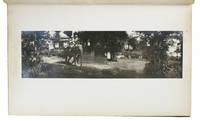
1903ref. LCCDKE4XUWG9Batavia: G. Kolff & Co. 1903. Contemporary brown cloth title in gold decorated endpapers. Folio. With 1 engraved double-page plate 4 lithographed colour-plates and 22 albumen photographs with guard leaves containing text. 2 works in 1 volume. Rare first and only edition of a report on the investigation of tea cultivation and production in Assam India and Ceylon. The Dutch cultural association Cultuur Maatschappij in Palakan-Salak asked H.J.Th. Netscher and Alexander Albert Holle to investigate the Assam and Ceylon tea cultivation and production with regard to the economic position of Java tea in the world market. Netscher and Holle had their investigations on tea cultivation and culture in British India and Ceylon printed but never put them on the market merely giving some copies to parties concerned with the tea industry. They gave the present copy to Norbert Pieter van den Berg head agent of the Dutch East Indian commercial bank at Batavia and president of the Javanese bank. The report discusses various aspects of tea and its cultivation including the geographic dissemination different kinds of tea seeds the conservation of tea seeds the process of drying tea leaves and the arrangement of tea factories. But the book also describes some remarkable things that caught Netscher and Holles attention of during their journey. They write for example about sugar and elephants. Nevertheless the main purpose of their report was to gather information on British-Indian tea cultivation especially regarding competion on the world market.The 22 albumen photographs in the present copy inserted through the whole book show mainly the tea gardens of Assam and Ceylon but also elephants and landscapes Netscher and Holle saw on their journey. A sign for that at least some of these photographs are contemporary is that they refer to their own train on one of the pictures. These pictures give this extensive and important report on tea cultivation enriching insights into the tea cultivation in British-India and Ceylon ca. 1900.Presentation copy from the Cultuur Maatschappij Parakan-Salak to Norbert Pieter van den Berg with some bolts at the end of the book unopened. Head and foot of spine slightly rubbed corners bumped some stains on the boards. Slightly browned not affecting the text otherwise in very good condition.l WorldCat 9 copies not noting the albumen prints; for Netscher & Holle: All about tea p. 128; Performing otherness: Java and Bali on international stages 1905-1952 p. 15; for Norbert Pieter van den Berg: Biographisch woordenboek der Noord- en Zuidnederlandsche letterkunde pp. 55-56. G. Kolff & Co., hardcover
1732ref. 18171Batavia 1732. Contemporary blue wrappers. 4to. Rare first edition probably printed in Batavia of the sentence against Mr. Petrus Vuyst Governor of Ceylon between 1726 and 1729 pronounced by the Council of Justice at Batavia on 19 May 1732. Vuyst had sentenced 19 innocent people to death and mistreated and tortured many others. He faced trial for these severe charges was found guilty and consequently executed at Batavia's castle on 3 June 1732.Three other editions appeared in Holland all printed after this original edition "Na een origineel Copy van Batavia zoo en gelyk het den gevangene is voorgelese" Landwehr 1012-1014. Very good copy.l Landwehr & V.d. Krogt VOC 1011; STCN 2 copies; cf. Knuttel 16915-16916. unknown
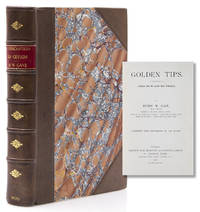
1900ref. 316899London: Sampson Low Marston and Company Limited St. Dunstan s House 1900. First Edition. Illustrated with photos by the Author and full-page partially colored map. xii 474 ii pp. 8vo. Bound in half brown polished calf marbled paper sides red leather title label a.e.g. Fine. First Edition. Illustrated with photos by the Author and full-page partially colored map. xii 474 ii pp. 8vo. Sampson Low, Marston and Company, Limited, St. Dunstan s House unknown
1697ref. F7UEAGCAXE78Copy imprint: The Hague: widow and heirs of Hillebrandt Jacobsz. van Wouw 1697. Modern plain-paper wrapper attached with 3 copper staples. 4to. With the woodcut arms of the States General lion with sword and 7 arrows in an elaborately decorated cartouche with military attributes on title-page and 1 woodcut decorated initial. A late edition copying the original 1645 imprint of a provisional agreement made between the Dutch States General and the Portuguese ambassador Francisco de Zousa Continho on the jurisdiction and territory of Fort Galle one of the most important outposts in Ceylon Sri Lanka one of the most important outposts both strategically and as a trading centre. The Dutch had captured it from the Portuguese in 1640 and they had been fighting in the region since that time. As the Eighty Years' War was nearing its conclusion the present treaty was written in an attempt to settle the dispute. The dispute in fact continued beyond the peace of 1648 until the Dutch managed to drive the rest of the Portuguese out of Ceylon by 1658. The treaty notes the losses and battles caused by the dispute between the two powers and the demands made by the Dutch government to secure their position in the East Indies. This includes their demand for a yearly supply of cinnamon through which the Portuguese are to pay off their debt and restitution by both parties for the losses they caused one another. The parties agree to honor the treaty and not trespass on each other's rights and territories. Copies were to be sent to the Viceroy in Goa and to various governors in the East Indies.With library stamps. In very good condition.l STCN 2 copies; cf. Knuttel 5202 & 5202b other eds.; Landwehr 242 other ed. widow and heirs of Hillebrandt Jacobsz. van Wouw, unknown
ref. A9781343882478Hardback. New. hardcover
ref. A9781346057286Hardback. New. hardcover
ref. 41719708-nnew. unknown
ref. 46835916-nnew. unknown
ref. 41719708like new. unknown
1954ref. 222612Australia. Circa1954. An album of 128 black and white photographs and 12 colour postcards detailing a trip to Ceylon in 1954 cord tie. 25 x 33cm. Few postcards loose leaves trifle friable cloth-covered boards little shelf worn overall in good condition. Although the album begins with aerial shots of the P&O Stratheden in Sydney and includes a few non-contemporary studio photographs of Ceylon the majority of the album is comprised of private photographs with handwritten captions and dates. Loosely inserted at the rear is the original photographic film within a Kodak-branded sleeve a 14-page stapled booklet introducing guests to the Galle Face Hotel in Colombo and an itinerary of a motor tour of Ceylon presumably undertaken by the album's creator. . hardcover
2011ref. DADAX3640906942Grin Publishing 2011-05-07. paperback. New. 5.83x0.12x8.27. Buy with confidence. Excellent Customer Service & Return policy. Grin Publishing paperback
2006ref. DADAX3531152580VS Verlag f 2006-11-14. 2006. paperback. New. 6.69x0.63x9.61. Buy with confidence. Excellent Customer Service & Return policy. VS Verlag f paperback
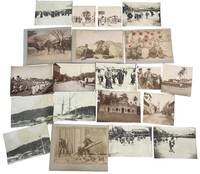
1890ref. 236871890. British Ceylon and Japan photo archive circa 1890 to 1910 documenting public ceremony craft production daily life during the expansion of imperial travel in Asia. The Japanese images record religious processions rickshaw travel workshops and leisure scenes associated with the late Meiji period while the Ceylon photographs depict Colombo streets architecture ceremonial dress and colonial urban space. Verso inscriptions identify Nagoya and Colombo without establishing a single photographer or original sequence. Photo archive of 24 photographs comprising eight hand colored photographs mounted to cardstock approximately 5 x 3½ inches and sixteen glossy and matte silver gelatin prints ranging from approximately 2½ x 2½ to 3 x 4½ inches Japan and British Ceylon circa 1890 to 1910. The hand colored Japanese views show women in rickshaws beneath flowering trees artisans making paper umbrellas workers shaping timber a cooper surrounded by tubs and hoops and a lantern shop filled with suspended paper lanterns. Other photographs depict monks attendants musicians and costumed participants moving through public squares with parasols banners and ceremonial objects. The Ceylon views include a Colombo street leading toward a clock tower palm lined compounds civic and religious buildings harbor craft and men in formal ceremonial dress. Inscriptions include "Nagoya" "Colombo" and "Vue de Colombo." The Japanese photographs belong to the commercial visual culture of the Meiji era when photographers produced hand colored views of occupations transport festivals costume and craft work for foreign travelers. These images often arranged workers and tools for clarity while the smaller prints record crowds streets and religious movement with less formal staging. The Colombo photographs reflect the parallel growth of photography under British colonial rule in Ceylon where ports municipal buildings and ethnographic subjects circulated through travel albums and commercial view markets. Light to moderate surface wear fading abrasions edge wear and occasional creasing; several mounts show staining or loss. Overall good condition. A compact visual record of Asian urban life religious practice artisanal labor and colonial travel at the turn of the twentieth century. unknown
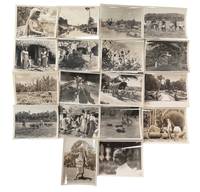
1934ref. 237251934. British Ceylon photographic archive circa 1934 documenting the labor systems that sustained one of the British Empire's most profitable plantation economies. Rather than emphasizing colonial administration or metropolitan life the photographs concentrate on the people whose agricultural work produced tea coconuts rice and other commodities that defined Ceylon's export economy during the final decades of British rule. The archive records both plantation labor and village agriculture placing field workers animal labor transportation and rural settlements within the same narrative of production that underpinned the island's economy before independence in 1948. Photo archive of 18 silver gelatin photographs each 4 x 5 inches British Ceylon circa 1934. The photographs depict women plucking tea leaves into large wicker baskets; groups of men women and children harvesting grain by hand; buffalo drawing plows through cultivated fields; coconut gathering and processing; elephants employed in heavy labor; cattle standing in flooded waterways; and villagers sorting agricultural products outside thatched dwellings. Other photographs show a village street lined with tiled roof buildings waterways with native boats landscaped gardens flowering branches tree-lined roads and portrait studies of rural residents including a Kandyan dancer in ceremonial costume and an elderly man identified only through the original negative caption. Several negatives retain contemporary handwritten captions identifying locations including Hambantota and describing subjects and related scenes indicating production for documentary or promotional use rather than private photography. The photographs were apparently produced during the S.S. Resolute World Cruise which departed on January 14 1934 for a 134 day itinerary through twenty nine countries and territories. Within that context the images record not only British Ceylon's plantation economy but also the way commercial world cruises presented the colony to Western travelers emphasizing tea estates agricultural labor village life wildlife and staged cultural performance as representative scenes of imperial Ceylon before independence in 1948. In reality production depended heavily upon Tamil labor recruited from southern India while Sinhalese villagers continued to dominate much of the island's rice cultivation and local agriculture distinctions reflected in the archive's movement between commercial plantations and village landscapes. Light surface wear with occasional curling at the corners; overall very good condition. A concentrated visual record of agricultural labor and rural production in British Ceylon during the final years of imperial rule. unknown
1880ref. 237851880. Ceylon colonial photo archive depicting tea cultivation estate labor transportation and urban life circa 1880s to 1910s documenting the plantation economy that made the island one of Britain's principal sources of tea as British merchants shifted the enormous domestic tea market away from China and toward production within the Empire. Coffee leaf rust appeared in Ceylon in 1869 and spread rapidly through the island's coffee districts precipitating the collapse of the crop that had dominated the colonial export economy and accelerating planters' conversion of the central highlands to tea. James Taylor had established commercial tea cultivation at Loolecondera Estate near Kandy in 1867 and the new industry expanded rapidly as coffee failed; by 1900 some 380000 acres in Ceylon were planted in tea. By 1879 the results showed that in more than 70 percent of tea sold in London still came from China while by 1900 China supplied only about 10 percent and black teas from British controlled India and Ceylon constituted the bulk of the market. Photo archive of albumen and silver gelatin photographs and photographic postcards ranging from approximately 3½ x 5 to 4 x 6 inches Ceylon circa 1880s to 1910s. Tea production forms the strongest body of imagery. Women and men stand among densely planted tea bushes or work through rows of plants with women carrying the large woven baskets used to collect leaves; individual and group views are captioned "Tea plucker" "Tea picking Ceylon" "Pruning tea Kandy" and in French "Cueillette du thé à Ceylan." One Skeen & Co. Colombo card numbered 84 and captioned "Tea plucker" isolates a woman at work with a large basket strapped behind her while another shows a large group of workers seated with baskets and gathered tea in a plantation clearing. A card captioned "Estate coolies Ceylon" depicts an estate employee in European dress standing with women and a child outside a thatched dwelling preserving in its printed terminology the racial and labor classifications through which plantation workers were presented to contemporary consumers of colonial imagery. Other photographs move from plantation production into the roads vehicles and cities of colonial Ceylon: rickshaw pullers pose with European passengers and beside their vehicles; a street scene records "Native town Kandy Ceylon"; Colombo appears in views of the "Colpetty Road near Galle Face Colombo" a crowded procession captioned in French "Colombo départ des troupes Anglaises" and a civic monument among palms. Another postcard depicts "Royal visitors leaving Ceylon" while a country road scene shows pedestrians carts and roadside activity. Skeen & Co. one of the principal commercial photographic firms operating from Colombo in the late nineteenth and early twentieth centuries is identified on several cards but no single photographer can be assigned to the archive as a whole. The tea scenes record the labor at the center of one of the fastest agricultural conversions in the nineteenth century British Empire. Coffee rust Hemileia vastatrix was first observed in Ceylon in 1869 and within little more than a decade had destroyed the commercial basis of the coffee plantation system; tea already demonstrated commercially by Taylor replaced it across much of the highlands. Ceylon tea exports to Britain rose from only 282 pounds in 1875 to more than 4.3 million pounds in 1885 while the plantation landscape expanded until almost all former coffee districts had been replanted with tea during the 1890s. That expansion depended on a large year round plantation workforce much of it composed of Tamil laborers brought from southern India and on the colonial infrastructure that connected the highlands with Colombo and overseas markets. Roads and the railway between Kandy and Colombo had initially served the coffee economy and could be redirected toward tea after the blight while Colombo developed as the commercial and shipping center through which the crop entered imperial markets. The archive therefore records several stages and social spaces of the same colonial economy from plucking and pruning in the highlands to estate communities road transport Kandy and the metropolitan port city of Colombo while the postcards themselves show how plantation labor and colonial development were converted into commercial images for circulation beyond the island. Light to moderate surface wear toning occasional fading and creasing with some photographs showing age related discoloration and edge wear. Overall in good condition. A visual record of the plantation labor and colonial infrastructure behind Ceylon's transformation from a failed coffee economy into a major tea producer that helped Britain replace Chinese tea with supplies produced under imperial control. unknown
2010ref. DADAX3838348796LAP Lambert Academic Publishing 2010-04-10. paperback. New. 5.91x0.20x8.66. Buy with confidence. Excellent Customer Service & Return policy. LAP Lambert Academic Publishing paperback
2021ref. SONG1913087026Edward Everett Root 2021-03-31. hardcover. Used: Good. 6.29x0.77x9.48. Buy with confidence. Excellent Customer Service & Return policy. Edward Everett Root hardcover
ref. SONG3631644582Peter Lang Gmbh Internationaler Verlag Der Wissenschaften 2014-06-16. New. hardcover. Used: Good. 5.83x0.75x8.27. Buy with confidence. Excellent Customer Service & Return policy. Peter Lang Gmbh, Internationaler Verlag Der Wissenschaften hardcover
ref. 3738627383.Gpaperback. Good. Access codes and supplements are not guaranteed with used items. May be an ex-library book. paperback