Ceylon - Percival, RobertBiblio.com

345 résultats
1804réf. 20204AB1804. Vienna Doll 1804. 21 : 135 cm. Titel 452 pages 2 engraved platges 1 many-folded map. Contemporary boards 2 back labels. First German edition of the Account of the Island of Ceylon 1803. Published at the same time as the Weimar edition but with the addition of the two engravings depicting the natives and pearl fishing. - "Percival lived in Ceylon for three years as an English colonial officer. Here he provides a regional description of the island covering the nature of the country as well as the population and economy and the colonial history to date" Griep/L. Includes an addition by the translator on pearl fishing.- Binding stained and rubbed inside fine. hardcover
2025réf. x-1032690011Routledge 2025. Hardcover. New. 182 pages. 9.18x6.12x9.21 inches. Routledge hardcover
2025réf. x-1041015232Routledge 2025. Hardcover. New. 258 pages. 9.18x6.12x9.45 inches. Routledge hardcover
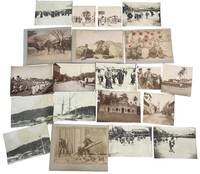
1890réf. 236871890. British Ceylon and Japan photo archive circa 1890 to 1910 documenting public ceremony craft production daily life during the expansion of imperial travel in Asia. The Japanese images record religious processions rickshaw travel workshops and leisure scenes associated with the late Meiji period while the Ceylon photographs depict Colombo streets architecture ceremonial dress and colonial urban space. Verso inscriptions identify Nagoya and Colombo without establishing a single photographer or original sequence. Photo archive of 24 photographs comprising eight hand colored photographs mounted to cardstock approximately 5 x 3½ inches and sixteen glossy and matte silver gelatin prints ranging from approximately 2½ x 2½ to 3 x 4½ inches Japan and British Ceylon circa 1890 to 1910. The hand colored Japanese views show women in rickshaws beneath flowering trees artisans making paper umbrellas workers shaping timber a cooper surrounded by tubs and hoops and a lantern shop filled with suspended paper lanterns. Other photographs depict monks attendants musicians and costumed participants moving through public squares with parasols banners and ceremonial objects. The Ceylon views include a Colombo street leading toward a clock tower palm lined compounds civic and religious buildings harbor craft and men in formal ceremonial dress. Inscriptions include "Nagoya" "Colombo" and "Vue de Colombo." The Japanese photographs belong to the commercial visual culture of the Meiji era when photographers produced hand colored views of occupations transport festivals costume and craft work for foreign travelers. These images often arranged workers and tools for clarity while the smaller prints record crowds streets and religious movement with less formal staging. The Colombo photographs reflect the parallel growth of photography under British colonial rule in Ceylon where ports municipal buildings and ethnographic subjects circulated through travel albums and commercial view markets. Light to moderate surface wear fading abrasions edge wear and occasional creasing; several mounts show staining or loss. Overall good condition. A compact visual record of Asian urban life religious practice artisanal labor and colonial travel at the turn of the twentieth century. unknown
réf. 62771c.1875. . Albumen print. Very good tonal range and in good condition pasted on original mount. Dimensions: 214 x 269mm. 8.5 x 10.6 inches. [c.1875]. unknown
réf. Bloomsbury-9781848854253I.B.Tauris. Hardback. New. 320 pages I.B.Tauris hardcover
réf. Bloomsbury-9781848854253I.B.Tauris. Hardback. New. 320 pages I.B.Tauris hardcover
réf. 260101964 to 1972. Cymru Plantation Dimbula Ceylon Sri Lanka. The Cymru Estate in Dimbula was established in 1870. The invaluable ‘History of Ceylon Tea’ website only has data regarding the estate up to the year 1929. The present item provides a mass of statistical information for the years 1964 to 1972. It is entirely in manuscript in several hands and comprises 73pp 16mo written with portrait orientation in a 12.5 x 8 cm ruled notebook with 69pp in blue and red ink at the front and the other four pages in pencil at the back. In rough black cloth with brown patterned endpapers and cloth pencil-holder. Internally in good condition lightly aged in heavily-worn covers. The plantation was clearly a substantial concern: at 1 May 1964 the number of ‘Workers on Cymru’ is given as 737 with breakdown for ‘U. D.’ meaning unclear and ‘LD’ i.e. ‘Labour Day - Fridays’ and with a similar breakdown for ‘Non-Workers’ total 527 and details of ‘Labour per acre’ and ‘Workers live room’. A further breakdown of men and women workers UD and LD is given on 29 February 1968 with a total of 352 men and 322 women. The final page gives a useful list under the heading ‘OUTPUT’ ‘Optimum Crop 12000 lbs.’ of the aspects involved in the running of such a concern. These include spreading tatting rolling roll breaking fermenting sifting packing stencilling also ‘On overtime’. The notebook is entirely statistical in nature apart from a four-page list of instructions for the cultivation of ‘Coffee Arabica’ a page of ‘Bees Instructions’ and a page headed ‘Formula for pre-mix for light traffic’ as well as lists of native names of native ‘Field Staff’ both on ‘Labour. Day.’ and ‘U. D.’ Also several lists of names of employees with job descriptions planting mistblowing compost pruning storekeeper field officer ‘Creeper’ ‘Sen. Asst Clk - Rice store’ ‘Driver Cymru’ ‘boys weeding’ with some marked as ‘Ret’ retired or ‘Dis.’ dismissed. Although the information relates to the Cymru Estate mention is made of Kangales and Tangakelle. Details are given of employment wages ‘Bonuses - Excess Rates’ manuring including breakdowns for various ‘Manure Mixtures’ pruning weeding plucking nursery planting sifting estimates. Numerous tables including two full double-page ones: ‘Cymru - Manuring / Pruning Programme 64 1964’ and ‘Manuring & Pruning Programme 1965’. Also a two-page table of ‘Clonal Clearings’; four pages of statistics on ‘Sifting Gookookoya’; and full-page tables for ‘Rolling Programme’ and on adjoining pages ‘Lower Division’ and ‘Upper Division’ with nine columns headed: Fld Acs Weed Contr Jat. date of Prune Total Nitro AM Due in pencil: ‘Urea / April’ Last Yield Weed. Another table of ‘Plucking Cost Per M. T. / Yield Ra.’ Loosely inserted are two leaves one on a page torn from a calendar dated 31 March 1973. 1964 to 1972. Cymru Plantation, Dimbula, Ceylon [Sri Lanka]. hardcover
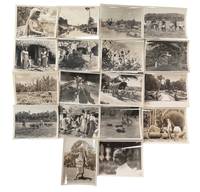
1934réf. 237251934. British Ceylon photographic archive circa 1934 documenting the labor systems that sustained one of the British Empire's most profitable plantation economies. Rather than emphasizing colonial administration or metropolitan life the photographs concentrate on the people whose agricultural work produced tea coconuts rice and other commodities that defined Ceylon's export economy during the final decades of British rule. The archive records both plantation labor and village agriculture placing field workers animal labor transportation and rural settlements within the same narrative of production that underpinned the island's economy before independence in 1948. Photo archive of 18 silver gelatin photographs each 4 x 5 inches British Ceylon circa 1934. The photographs depict women plucking tea leaves into large wicker baskets; groups of men women and children harvesting grain by hand; buffalo drawing plows through cultivated fields; coconut gathering and processing; elephants employed in heavy labor; cattle standing in flooded waterways; and villagers sorting agricultural products outside thatched dwellings. Other photographs show a village street lined with tiled roof buildings waterways with native boats landscaped gardens flowering branches tree-lined roads and portrait studies of rural residents including a Kandyan dancer in ceremonial costume and an elderly man identified only through the original negative caption. Several negatives retain contemporary handwritten captions identifying locations including Hambantota and describing subjects and related scenes indicating production for documentary or promotional use rather than private photography. The photographs were apparently produced during the S.S. Resolute World Cruise which departed on January 14 1934 for a 134 day itinerary through twenty nine countries and territories. Within that context the images record not only British Ceylon's plantation economy but also the way commercial world cruises presented the colony to Western travelers emphasizing tea estates agricultural labor village life wildlife and staged cultural performance as representative scenes of imperial Ceylon before independence in 1948. In reality production depended heavily upon Tamil labor recruited from southern India while Sinhalese villagers continued to dominate much of the island's rice cultivation and local agriculture distinctions reflected in the archive's movement between commercial plantations and village landscapes. Light surface wear with occasional curling at the corners; overall very good condition. A concentrated visual record of agricultural labor and rural production in British Ceylon during the final years of imperial rule. unknown
1880réf. 237851880. Ceylon colonial photo archive depicting tea cultivation estate labor transportation and urban life circa 1880s to 1910s documenting the plantation economy that made the island one of Britain's principal sources of tea as British merchants shifted the enormous domestic tea market away from China and toward production within the Empire. Coffee leaf rust appeared in Ceylon in 1869 and spread rapidly through the island's coffee districts precipitating the collapse of the crop that had dominated the colonial export economy and accelerating planters' conversion of the central highlands to tea. James Taylor had established commercial tea cultivation at Loolecondera Estate near Kandy in 1867 and the new industry expanded rapidly as coffee failed; by 1900 some 380000 acres in Ceylon were planted in tea. By 1879 the results showed that in more than 70 percent of tea sold in London still came from China while by 1900 China supplied only about 10 percent and black teas from British controlled India and Ceylon constituted the bulk of the market. Photo archive of albumen and silver gelatin photographs and photographic postcards ranging from approximately 3½ x 5 to 4 x 6 inches Ceylon circa 1880s to 1910s. Tea production forms the strongest body of imagery. Women and men stand among densely planted tea bushes or work through rows of plants with women carrying the large woven baskets used to collect leaves; individual and group views are captioned "Tea plucker" "Tea picking Ceylon" "Pruning tea Kandy" and in French "Cueillette du thé à Ceylan." One Skeen & Co. Colombo card numbered 84 and captioned "Tea plucker" isolates a woman at work with a large basket strapped behind her while another shows a large group of workers seated with baskets and gathered tea in a plantation clearing. A card captioned "Estate coolies Ceylon" depicts an estate employee in European dress standing with women and a child outside a thatched dwelling preserving in its printed terminology the racial and labor classifications through which plantation workers were presented to contemporary consumers of colonial imagery. Other photographs move from plantation production into the roads vehicles and cities of colonial Ceylon: rickshaw pullers pose with European passengers and beside their vehicles; a street scene records "Native town Kandy Ceylon"; Colombo appears in views of the "Colpetty Road near Galle Face Colombo" a crowded procession captioned in French "Colombo départ des troupes Anglaises" and a civic monument among palms. Another postcard depicts "Royal visitors leaving Ceylon" while a country road scene shows pedestrians carts and roadside activity. Skeen & Co. one of the principal commercial photographic firms operating from Colombo in the late nineteenth and early twentieth centuries is identified on several cards but no single photographer can be assigned to the archive as a whole. The tea scenes record the labor at the center of one of the fastest agricultural conversions in the nineteenth century British Empire. Coffee rust Hemileia vastatrix was first observed in Ceylon in 1869 and within little more than a decade had destroyed the commercial basis of the coffee plantation system; tea already demonstrated commercially by Taylor replaced it across much of the highlands. Ceylon tea exports to Britain rose from only 282 pounds in 1875 to more than 4.3 million pounds in 1885 while the plantation landscape expanded until almost all former coffee districts had been replanted with tea during the 1890s. That expansion depended on a large year round plantation workforce much of it composed of Tamil laborers brought from southern India and on the colonial infrastructure that connected the highlands with Colombo and overseas markets. Roads and the railway between Kandy and Colombo had initially served the coffee economy and could be redirected toward tea after the blight while Colombo developed as the commercial and shipping center through which the crop entered imperial markets. The archive therefore records several stages and social spaces of the same colonial economy from plucking and pruning in the highlands to estate communities road transport Kandy and the metropolitan port city of Colombo while the postcards themselves show how plantation labor and colonial development were converted into commercial images for circulation beyond the island. Light to moderate surface wear toning occasional fading and creasing with some photographs showing age related discoloration and edge wear. Overall in good condition. A visual record of the plantation labor and colonial infrastructure behind Ceylon's transformation from a failed coffee economy into a major tea producer that helped Britain replace Chinese tea with supplies produced under imperial control. unknown
1890réf. 44332London 1890. Small 12mo pp. 40; lexicon in triple column; original glazed pictorial wrappers; adverts on endpapers and lower cover - that inside the upper cover an ad for Mazawattee Coffee. Very good. The lexicon occupies 38 pages triple column. The last leaf contains the essay "The Truth About Tea." Wellcome Library only in OCLC with variant wrappers. No other editions located. Not in Vancil. unknown
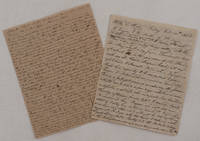
réf. M53HMS Thalia “18 leagues to the North of St. Jago” 20 October 1805 and Colombo Fort 21 June completed 2 September 1806. Both Octavos ca. 23x18 cm and 25x20 cm. Each 3 ½ pp. Both addressed and sealed on the last pages. Brown ink on watermarked laid and white paper. Fold marks both letters with minor holes on the 4th pages after opening affecting several words; second letter with tears and minor holes on folds but overall very good letters. Two extensive letters giving an interesting firsthand account of the early British rule in Sri Lanka the British occupied former Dutch possessions on the island only ten years earlier in 1795. The first letter describes Cleather’s voyage to Ceylon from England on board HMS Thalia with the notes on the heat of the gun room‚ the frigate’s captain Walker Santiago Island Cape Verde where they got fresh supplies and water social life on board the ship et al. “I sleep every night in the most tantalizing situation you can possibly imagine Rayner having strung my cot in the after gun room in the midst of <…> chests of dollars to the amount of 40.000 £ which they are taking out for the Company there is 400.000 £ standing more below.” The second letter completed almost a year later gives an inside look into the life of British military and civil society on Ceylon shortly after the end of the First Kandyan War 1803-1805. Cleather praises the Colombo garrison’s chaplain Reverend W.H. Heywood in whose house he started writing the letter notes that he has dined with the “Chief Secy. Mr. Arbuthnot the 2nd personage in the Island” and mentions “innumerable” balls and suppers to which “I am constantly invited.” His regiment “is stationed about ten miles from the Fort <…> I have a small house but very comfortable near the parade & not far from a pretty little Cot.tage of Heywoods where he generally resides – for this I pay two guineas a month nothing here.” Cleather mentions that the Regiment which consists of sepoys trains a lot because it is expected to be reviewed shortly; notes on his relation with his colleague officers – Lieut.-Col. T.W. Kerr who “has an unfortunate disposition to talk scandal” Fort Adjutant Mr. Stewart officers wives and daughters and others. “I do not much … the heat and have never had a day’s illness since I landed in the Island. I had no duty for two or three months at first being laid up with hurts in my legs. This is common enough & is thought nothing of it is long since over…” Captain W.H. Cleather of the first Ceylon Regiment was educated at Exeter College Oxford and arrived in Ceylon in 1805. Through his sister Mary Littlehales to whom the letters are addressed he was a brother-in-law of Vice-Admiral Bendall Robert Littlehales 1765-1847 a participant of the Napoleonic Wars and Captain Edward Littlehales 1805-1888 a commander of HMS Dolphin on the coast of West Africa during the suppression of the slave trade in the 1840s. During his career in the British Ceylon he served in different Ceylon Regiments was the Fort adjutant at Galle Jaffna and Colombo. He took part in military actions during the Uva Rebellion 1817-1818 and for many years served as Deputy Judge Advocate in Ceylon. hardcover
réf. Z1-F-061-00165Nabu Press. Used - Like New. Used - Like New. This is a reproduction of an out of print title. This book may have occasional imperfections such as missing or blurred pages poor pictures errant marks etc. that were either part of the original artifact or were introduced by the scanning process. Ships from UK in 48 hours or less usually same day. Your purchase helps support Sri Lankan Children's Charity 'The Rainbow Centre'. 100% money back guarantee. We are a world class secondhand bookstore based in Hertfordshire United Kingdom and specialize in high quality textbooks across an enormous variety of subjects. We aim to provide a vast range of textbooks rare and collectible books at a great price. Our donations to The Rainbow Centre have helped provide an education and a safe haven to hundreds of children who live in appalling conditions. We provide a 100% money back guarantee and are dedicated to providing our customers with the highest standards of service in the bookselling industry. Nabu Press unknown
1800réf. ABC_47410Ceylon Sri Lanka and the Netherlands 1800. Contemporary decorated paper wrappers. 8vo 16.5 x 10.5 cm. Written in a late 18th-century or early 19th-century cursive in French and Dutch. With: 2 MANUSCRIPT - FRENCH & DUTCH POEMS AND SONGS. Quelques Chansons. Ad 1: An interesting manuscript probably written by a Dutch person in the service of the VOC Dutch East-India Company during the time the VOC had trading stations and later was ruling Sri Lanka until 1802. Remarkably the majority of the birds snakes and other animals described here are described by the same indigenous names as those used by Jacob Haafner in his Reize te voet door het eiland Ceilon 1754. The birds other animals plants and trees described include: a "kiroudin" a kind of eagle or harrier native to the Malabar coast the "pambou-rajah of konigs slang" poisonous "Royal" snake a "rollewaijs" a Rollewai a kind of bat typical for Ceylon the "tijger-royal" Royal tiger the "anacondo" an anaconda or water boas a large snake a "alamaram/wortelboom" mangrove tree the "ananas" pineapple the "casjou" cashew nut and "mangas" mangos among many others. Ad 2: A manuscript written in French and Dutch consisting of thirteen humorous poems and songs in French and Dutch. This part was probably added a few decades after the text on the natural history of Ceylon by the same author possibly after their return to the Netherlands. It is written in a later hand upside down and back to front from p. 28 to p. 15: 6 humorous poems in French: "Le vaillant troubadour" "Romance" in 3 stanzas "Romance de la petite Condrille" in 3 stanzas no title in 3 stanzas no title in 5 stanzas and 7 humorous poems in Dutch: "Toverfluit" "Oost-Indië boven" a riddle "De schrandere priester" "De getrouwe raad" "De gereede raadgever" and finally "De predikant en de dorpsschout".With manuscript annotations on the wrappers mainly repeats of the supposed title: "Quelques Chansons". The wrappers show clear signs of wear with some paper loss to the spine and edges of the wrappers. With manuscript writing exercises and an excerpt of a French text on the paste-downs/inside of the wrappers. Otherwise in good condition.l cf. Valentijn V 1726 pp. 50-54. unknown
2011réf. 95483Damiani. New. Hardcover. FREE UPGRADE to Courier/Priority Shipping Upon Request - IN STOCK AND IMMEDIATELY AVAILABLE FOR SHIPMENT - Flawless copy brand new pristine never opened -- Text in Turkish and English. 184 pp. With 63 col. Ills. -- with a bonus offer--; One of Turkey's most prominent artists Taner Ceylan makes hyperrealist paintings that bespeak absolute technical mastery and precision but which are also freighted with an emotional and sexual dimension usually absent from the genre--qualities that have set him apart from the prevailing tendencies in contemporary Turkish art and which at times have also brought him outright abuse in the press. Ceylan's paintings occupy a register somewhere between the mutely homoerotic as in his portrait of a bloodied and perspiring boxer--possibly an allegory of the artist's own trials and the overtly sexual to enter his website "you must be at least 18 years of age" . Curator Dan Cameron who has championed the painter orients him in a tradition of sexually explicit art stemming from Robert Mapplethorpe to Jeff Koons but points out that the implicit argument of Celyan's work is "a romantic arguing for the wholesomeness of gay male sexuality." . 2011. 8862081731 . Damiani hardcover
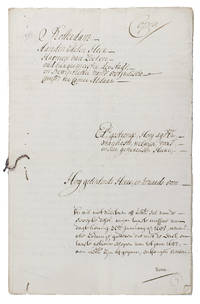
1699réf. ABC_47411Jaffanapatnam Ceylon 1699. Folded and kept together by an orange white and blue piece of string in the left margin 1.5 cm from the edge of the leaves in the middle. Folio 33 x 21 cm. The Dutch letter is written in a neat late 17th-century cursive hand in brown ink. Contemporary copy Copia perhaps by Schenkenberg himself or by his secretary including the address on the first leaf: Rotterdam./ Aenden Edelen Heer./ Harmen van Zoelen/ oud burgermeester der stadt/ en Bewinthebber vande Oostindische/ Comp. ter Camer Aldaar.Very interesting letter by the Director commandeur of the fort and Dutch East India Company VOC station Jaffanapatnam on the northern-most coast of Ceylon now: Sri Lanka facing the Coromandel coast of India. The fort was captured from the Portuguese by Rycklof van Goens in the 1630s and was an important stronghold for the VOC presence on Ceylon during the late 17th and 18th centuries. The letter offers clear insight in the VOC policy regarding appointments nominations and commissions as well as for the required qualifications and salaries for the various functions. The letter also shows how important family ties recommendations and even favouritism and nepotism were in these matters.Matthaeus Schenkenberg was born in Batavia in 1667 as son of Hendrik Schenkenberg and Henrietta Chasteleyn. He writes that after having been chief-merchant opperkoopman for eight years he had been appointed by the high command at Batavia the hooge regeering director commandeur of the fort Jaffanapatnam Jaffna in June 1698 as the successor of Hendrik Swaardecroon with a monthly salary of 120 guilders for five years. Hardly a year after this appointment he is already dissatisfied - one of his predecessors Floris Blom who was director from 1669-1693 earned 150 guilders - and he is seeking for a following step in his career. Thats why he is writing this letter to his uncle Harmen van Zoelen or Soelen; ca. 1635-1702 hoping to be helped into a better job: a good move because Van Zoelen was one of the directors of the VOC chamber in Rotterdam and burgomaster of that city.Which is why he asks his uncle to put in a good word for him in order to obtain an appointment as for instance Governor of places like Macassar Celebes Ambon or Banda island between Sumatra and Malacca. Indeed Mattheus Schenkenberg was appointed Governor of Banda where he ultimately died on 14 June 1709 his tomb is still in existence.With faint folding lines and some pencil annotations on the first and last pages small wormholes in the left inner margins of the leaves very slightly affecting the text but not its legibility the edges are very slightly frayed and the last page is slightly browned. Overall in very good condition.l Bons Kinderen van de Verenigde Oost-Indische Compagnie Master scriptie Univ. Leiden 2015 esp. pp. 82-83; Van den Belt Het VOC bedrijf op Ceylon in de 18e eeuw Zutphen 2008; Valentijn V 1726 p. 564. unknown
réf. P94Oblong Folio album ca. 275x38 cm. 49 paper leaves. With 49 mounted albumen photographs including 47 larger ones from ca. 235x29 cm 9 ¼ x 11 ½ in to ca. 145x20 cm 5 ½ x 7 ¾ in; and two smaller photos ca. 9x135 cm 3 ½ x 5 ¼ in. Eighteen photos with captions and/or photographers’ stamps and signatures in negative. Period brown half sheep album with cloth boards gilt-tooled with the gilt-lettered initials “A.L.” on the front board; moire endpapers. Photos seemingly mounted at a later date. Mounts slightly waved and crinkled a couple of photos with minor losses on the corners or extremities but overall a very good collection of interesting strong photos. An attractive collection of large albumen studio photos of British India and Ceylon by famous local studios. The photos of India mostly attributed to Bourne and Shepherd show the architecture of Agra Taj Mahal the tomb of Itimad-ud-Daulah Akbar’s tomb Ahmedabad Rani Sipri’s Mosque the Temple of Hathi Singh Lucknow Dikulsha Kothi Kolkata Buddhist Pagoda in the Eden Gardens; there are also views of the Elephanta Caves a train turning on the Agony Point Loop of the Darjeeling-Himalayan Railway a statue of Nandi Bull etc. The other photos show Fort Ali Masjid in the Khyber Pass by John Burke sculptures decorating a Hindu temple by “Nicholas & Co.” a town in Darjeeling with the Himalayas towering in the background hill stations portraits of workers at burning ghats cart drivers girls etc. The photos of Sri Lanka show Colombo Queen Street with the old lighthouse Grand Oriental Hotel hills with tea plantations the Temple of the Tooth in Kandy and portraits of Tamil tea pluckers by “Scowen & Co.” Overall a nice collection of large studio photos of British India and Ceylon. A list of captioned photos: The Taj. Agra. 1080 unsigned but Bourne & Shepherd; 3133. A dunga shikari & kitchen boat; Lucknow the Dikulsha Palace signed “Borne 1149”; Huthi Singh’s Tomb. Ahmedabad. 2236 signed “Bourne & Shepherd 2236”; Ranee Seepika Musjid. Ahmedabad. 2233 signed “Bourne & Shepherd 2233”; Lucknow. View from the terrace of the Hooseinabad Emambara signed “Borne 1051”; The Mausoleum of Akbar. Sekundra. 1251 unsigned but Bourne & Shepherd; Agra. The Mausoleum of Prince Etmad-Dowlah from the Gate signed “Borne 1232”; The Taj from fountain. Agra. 1077 unsigned but Bourne & Shepherd; An Ekka. 1128 signed “B.S.”; Ali Musjid. signed “Burke 28”; Sculptures on a Hindu temple signed “Nicholas & Co. Madras”; Pagoda in Eden Gardens. Calcutta. 1710. signed “B.ourne”; Dalada Maligawa Temple of the Tooth. Kandy signed “Scowen & Co.”; Tamil cooly plucking tea leaf signed “Scowen & Co. Ceylon”; A Fijian landscape with colonial buildings signed “Dufty & Co. Levuka. Fiji”; A view of the Grand Oriental Hotel in Colombo signed “Photographers W.L.H. Skeen & Co. Colombo Ceylon”; The Angel of Cawnpore memorial signed “V. Pont. 69”. hardcover
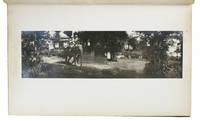
2009réf. 018683Istanbul: NTV Yayinlari 2009. Limited Edition . Hardcover. Fine. Elephant Folio - over 15 - 23" tall. Original bdg. In the original case. Oblong elephant folio. 49 x 34 cm. In English and Turkish. Very heavy volume. 1000 copies were printed. Numbered edition. Panoramic photographs of Turkey by Nuri Bilge Ceylan between the years 2003 and 2009 has been published by NTV in December 2009. Turkey cinemascope.= Sinemaskop Türkiye. Text by Yildirim Türker. Album of photographs. NTV Yayinlari hardcover
1732réf. 18171Batavia 1732. Contemporary blue wrappers. 4to. Rare first edition probably printed in Batavia of the sentence against Mr. Petrus Vuyst Governor of Ceylon between 1726 and 1729 pronounced by the Council of Justice at Batavia on 19 May 1732. Vuyst had sentenced 19 innocent people to death and mistreated and tortured many others. He faced trial for these severe charges was found guilty and consequently executed at Batavia's castle on 3 June 1732.Three other editions appeared in Holland all printed after this original edition "Na een origineel Copy van Batavia zoo en gelyk het den gevangene is voorgelese" Landwehr 1012-1014. Very good copy.l Landwehr & V.d. Krogt VOC 1011; STCN 2 copies; cf. Knuttel 16915-16916. unknown
1903réf. LCCDKE4XUWG9Batavia: G. Kolff & Co. 1903. Contemporary brown cloth title in gold decorated endpapers. Folio. With 1 engraved double-page plate 4 lithographed colour-plates and 22 albumen photographs with guard leaves containing text. 2 works in 1 volume. Rare first and only edition of a report on the investigation of tea cultivation and production in Assam India and Ceylon. The Dutch cultural association Cultuur Maatschappij in Palakan-Salak asked H.J.Th. Netscher and Alexander Albert Holle to investigate the Assam and Ceylon tea cultivation and production with regard to the economic position of Java tea in the world market. Netscher and Holle had their investigations on tea cultivation and culture in British India and Ceylon printed but never put them on the market merely giving some copies to parties concerned with the tea industry. They gave the present copy to Norbert Pieter van den Berg head agent of the Dutch East Indian commercial bank at Batavia and president of the Javanese bank. The report discusses various aspects of tea and its cultivation including the geographic dissemination different kinds of tea seeds the conservation of tea seeds the process of drying tea leaves and the arrangement of tea factories. But the book also describes some remarkable things that caught Netscher and Holles attention of during their journey. They write for example about sugar and elephants. Nevertheless the main purpose of their report was to gather information on British-Indian tea cultivation especially regarding competion on the world market.The 22 albumen photographs in the present copy inserted through the whole book show mainly the tea gardens of Assam and Ceylon but also elephants and landscapes Netscher and Holle saw on their journey. A sign for that at least some of these photographs are contemporary is that they refer to their own train on one of the pictures. These pictures give this extensive and important report on tea cultivation enriching insights into the tea cultivation in British-India and Ceylon ca. 1900.Presentation copy from the Cultuur Maatschappij Parakan-Salak to Norbert Pieter van den Berg with some bolts at the end of the book unopened. Head and foot of spine slightly rubbed corners bumped some stains on the boards. Slightly browned not affecting the text otherwise in very good condition.l WorldCat 9 copies not noting the albumen prints; for Netscher & Holle: All about tea p. 128; Performing otherness: Java and Bali on international stages 1905-1952 p. 15; for Norbert Pieter van den Berg: Biographisch woordenboek der Noord- en Zuidnederlandsche letterkunde pp. 55-56. G. Kolff & Co., hardcover