[CHINA -- SINO-JAPANESE WAR].Biblio.com
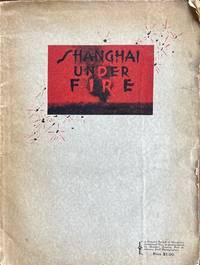
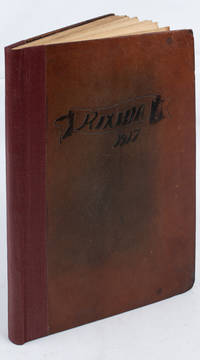
1937réf. 60087Shanghai China: Post-Mercury Co. 17-21 Avenue Edward VII Shanghai Evening Post & Mercury 1937. 4to. 9 x 12 in. xv 1 88 pp. With 100s of text photo illustrations on gray-blue tinted paper. Colour-illustrated softcovers cover art photo of red & black tinted smoking skyline of Shanghai w/ bomb bursts illustrated on front cover “Shanghai Area War Maps” on endpapers -- surprisingly light interior toning to the XV pp. of text on light-gray tinted paper bumping & wear at covers some dustsoiling chipping head & foot of spine still G copy stapled as issued. First edition 1st printing of this scarce illustrated pro-China work documenting the opening campaigns by the Imperial Japanese Army Air Force and Navy during the Second Sino-Japanese War. Hostilities had increased throughout the 1930s following the first Sino-Japanese War in which Japan had conquered and absorbed Manchuria into the Japanese Empire. Chiang Kai-shek’s nationalist forces joined with the warlords of Hunan and Szechwan provinces to fight the Japanese after a number of provocations in the summer of 1937. Chiang Kai-shek believed that by initially attacking and bombing Japanese naval installations and troops in and around Shanghai he would force the foreign powers to ally with China to fight against Japan to protect their enormous investments in southern China. The Nationalist Chinese armies held out for three months against ferocious bombardment and shelling by the Japanese from planes based in Taiwan and ships on the Huangpu River inflicting huge numbers of casualties on the Chinese and eventually forcing the Chinese to retreat from Shanghai to Nanking with Japanese reinforcements constantly decimating them. These images show victims at the South Station bombings caring for Chinese wounded Chinese women training as soldiers and nurses in the aftermath of the North Station Area shelling and bombing bitter retreat by Chinese soldiers the advances and marching of Japanese forces in Shanghai and beyond. This would later be revised and reissued in March 1938; See: Dorothy Perkins Japan Goes to War: A Chronology of Japanese Military Expansion 1997 pp. 127-135; Crittall in Shanghai -- Some Photos Unearthed December 22 2008. Post-Mercury, Co., 17-21 Avenue Edward VII, Shanghai Evening Post & Mercury, paperback
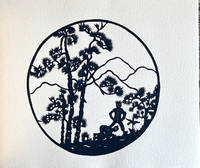
1930réf. 64082Chefoo Yantai China: Self-Help Dept. Women’s Bible School Presbyterian Mission ca. 1930. Oblong 4to. 9.25 x 7 in. 18 leaves unnumbered. w/ title leaf promotional explanatory leaf laid-in printed text on tissue papers w/ borders each facing the eight delicately cut-out silhouette Jianzhi paper designs on the facing leaves of thick paper stock. Pictorial silk flexible covers punch-sewn at gutter margin as issued w/ black silk braid NF copy. First edition thus of this beautiful album of mounted paper Jianzhi silhouette cut-outs prepared and cut from stencil drawings from a pattern. The introductory laid-in leaf details the steps of preparing the pattern sewing down the stencil to ten thicknesses and thereupon using tiny scissors and knives of various shapes to create the subsequent designs. Typically these are good for making ten at a time and then pasted on cards. These were fundraisers for the China Inland Mission Women’s Bible College in Chefoo Yantai and copies would have different stories and designs. This particular copy includes Wen Yen Beh and the Lost Ball; Djang Liang and Whang Hsi Gung; Han Hsien and Hsiao Nine; Outwitting of Wang Shen; The friend who failed; How the frogs got their croak; and finally Story of Si Mah Gwang. These original occupational works enhanced vocational training for Chinese women in developing a skill aided funding for the Women’s Bible College but also contributed to funding the Temple Hill Hospital at the CIM also known as the Yuhuangding Hospital. It later served during World War II during the 1942-43 Japanese Occupation as an internment camp. Worldcat locates 4 similar copies w/ varying supposed dates and frequently different stories or legends Texas A&M Peabody Essex Royal Danish Library & UBC. Self-Help Dept., Women’s Bible School, Presbyterian Mission, unknown
1943réf. 63876New York: Alfred A. Knopf 1943. First Edition. First printing. Laid-in is a 2-pp ALS dated Dec. 26 1944 on Agnes Smedley's letterhead to Lt. Eugene S. Brewer Jr. see note below. Octavo 21cm. Original red cloth boards titles in gilt on spine; dustjacket; maroon top-stain; viii528xvi pp; illus. Folding map inserted before half-title. A Very Good copy with expected evidence of reading and use; there is a small closed tear in the margin of the folding map which is otherwise clean and complete. In the original dustwrapper unclipped priced $3.50 generally rubbed and soiled with old clear tape reinforcements at flap-folds; just VG. Ownership and bookplate of Eugene S. Brewer Jr.; a 4¢ "Sun Yat Sen" U.S. postage stamp affixed to front free endpaper. Additionally laid-in is a folded circular printing the "Statement of Policy" of the Committee for a Democratic Policy Toward China later the Committe for a Democratic Far East Policy. Jacket design by Jean Carlu. The revolutionary journalist's major work a memoir of her twelve years as a correspondent on the front lines of both the Chinese revolution and the Second Sino-Japanese War from 1929 to 1942. Smedley 1892-1950 was a prolific left journalist and probable spy known for her active support of Chinese and Indian revolutionary causes and for her many writings on Maoist China. The laid-in letter of about 250 words is dated Dec. 26 and addressed to a young Army lieutenant from Michigan Eugene S. Brewer. Smedley discusses the recent U.S. Presidential elections stating that she voted for Roosevelt despite disagreeing with "many things Roosevelt has done and still does.but I was afraid of Dewey and his rotten reactionaries. Now I grow more and more afraid of Churchill and it would be a godsend if he'd fall dead or if someone would kindly bump him off." She comments on British policy in India: "As long as Nehru remains in prison I have no hearing for any agent of the British" - and concludes with a description of her work for China relief "raffling off things for 2 weeks to aid cultural workers in Chung King.I'm tired tramping the streets selling chances for 10¢! So much work for so little." Eugene S. Brewer 1914-2001 was a 1935 graduate of the University of Michigan. He won a 1938 Avery Hopwood Prize for a proletarian novel apparently never published "Some Brass and No Groceries." After a brief and apparently unremarkable scriptwriting career in Hollywood Brewer returned to his home town of Owosso Michigan where he was for many years a county planner and surveyor. Brewer's connection to Smedley is uncertain but likely dated from his student days at Michigan. Alfred A. Knopf unknown
1980réf. N4937Tokyo: Nigensha Publishing 1980. Silk broidery. Fine. Folio. Leporello format book bound in silk broidery and in the original decorative box. FOLIO. Attached brochure in English: Autor Chiang Chao-shen "LETTERS AND POEMS BY FOUR SUNG MASTERS SU SHIH. MI FEI" 19pp English and Chinese A FINE COPY. VERY CLEAN AND FRESH. Nigensha Publishing unknown
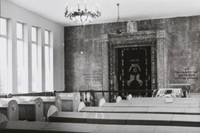
réf. 24786Israel: NP n/d. vg. Oblong quarto. Bolted blue faux-leather with inlaid b/w reproduction of a photograph of the exterior of the synagogue. Inside of front and back board lined in silk-moire. This unique album was presented to Mr. & Mrs. Harry Burston on occasion of their visit to Israel on October 1971. Printed presentation plates in English and Hebrew on title-page. Verso of title-page with 39 original signatures of guests who attended the reception at the synagogue on Nov. 1 1971. Album contains 14 original 4 1/4" x 6 1/2" glossy b/w photographs inserted on card stock. Each photo protected by tissue guard. One photo shows the exterior the rest is of the interior of the Synagogue and Cultural Center in Tel-Aviv. Photographs with captions in English and Hebrew. "In Eternal Memory: This building was built in Memory of the Jewish Communities in China by Igud Yotzei Sin in Israel. The construction of the building was possible thanks to the Administrator General and Official receiver of the State of Israel who handed over the proceeds received from the sale of the Synagogue in Shanghai and through the generous donations from the former residents of China in Israel and all over the world. The building was set thanks to the great devotion extended by the President of the Building Committee Mr. M. A. Zaigraeff. The inauguration of the skeleton of the building took place on the 20th August 1959. The inauguration of the opening of the building took place on 6th September 1961. Architects & Building plans: Mr. G. Rabinovitch Mr. A. Kahane Aron Kodesh." In 1951 a group of Jewish leaders from several communities of former China residents in Israel founded "Igud Olei Sin" which was later changed to "Igud Yotsei Sin." Small sticker of S. Sanzetti Photo Studio on inside of rear board. Minor age toning on title-page and on margin of card stock. Near fine condition. Unique copy. NP unknown
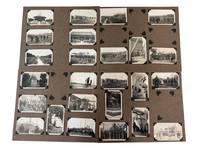
1910réf. 235901910. Late Qing China and Philippines photo archive depicting military authority public punishment foreign presence and imperial architecture circa 1910 in the years immediately before the Xinhai Revolution ended dynastic rule in China. The Chinese photographs show Beijing monuments urban crowds soldiers execution spectators and foreign personnel at a moment when Qing authority remained visible but unstable. The group places tourist views of imperial architecture beside scenes of coercion and military order linking travel photography to the political crisis of the late Qing state. Photo archive of 32 silver gelatin photographs each 2.5 x 4.25 inches cornered in on 11 x 13.5 inch brown album leaves mainly China with several Philippines views circa 1910. The images show Beijing landmarks including the Temple of Heaven palace buildings imperial gates stone lions carved walls ceremonial terraces walled compounds and garden architecture. Several views show Chinese crowds gathered near military or judicial scenes including a public execution aftermath with a severed head displayed from a pole before laughing onlookers and children with a placard stating the events transpired. Other photographs show Chinese soldiers and civilians in open grounds foreign military or naval personnel a group of men in white naval style uniforms seated in a circle Chinese junks harbor traffic street scenes rickshaws and colonial buildings. The Philippines photographs appear to include Manila street and harbor views a woman and girl a domed theater or civic building tropical shoreline and American colonial urban scenes. China in 1910 stood between the punitive settlement that followed the Boxer Rebellion and the republican revolution that began in Wuchang in October 1911. Foreign troops remained in North China under treaty rights imperial and provincial authorities tried to preserve order through policing army reform and public punishment and revolutionary societies used anti Manchu and anti foreign resentment to attack the legitimacy of Qing rule. The execution photographs show law as spectacle with the punished body displayed before civilians and soldiers rather than hidden within prison administration. The Beijing views record the ceremonial architecture of the dynasty at the same time that its political power was nearing collapse while the Philippines views place China within a wider American and European imperial geography of ports garrisons and colonial travel. Light surface wear toning and occasional fading; mounted with photo corners on album leaves. Overall very good condition. A concentrated visual record of military order public punishment foreign presence and imperial space in East Asia immediately before the fall of the Qing dynasty. unknown
1986réf. 2092902139000691Tokyo Industry and Trade Planning and Development 1986. Soft Cover. Fine. Number of books: 50 Tokyo Industry and Trade Planning and Development paperback
1976réf. 2091502135710097Sankeishinbun-sha 1976. Soft Cover. Fine. The book is in fine condition. Sankeishinbun-sha paperback
2005réf. 2081502111900819Kagaku 2005. Soft Cover. Fine. Number of pages: 236p Size: B4 hardcover book Kagaku paperback
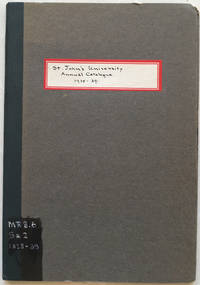
1939réf. ABE-1606099109934First edition. Slim octavo 22.915.7cm 66pp. Original paperback rebound by library. Text pages complete. More photos available upon request. Scarce. Shanghai: St. John's University, 1939 hardcover
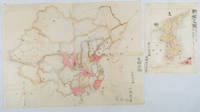
1902réf. 220266Japan. No date. Circa1902. Two very attractive colour folded manuscript maps one showing China and the other Korea. Map of China: Watercolour map 48 x 63.5cm. Closed tear now professionally repaired. Map of Korea: Finely detailed watercolour map a few tiny holes very neatly repaired on the verso with archival washi. 33 x 24.5cm Two delicate hand-painted maps one of China and one of Korea produced by a Japanese student cartographer named Koike Tokushige 小池徳重. The undated map of China appears to have been produced in the first five years of the twentieth century: a time when Japan had recently colonized Taiwan and when Japanese economic and political interest in the region was rapidly expanding. The inscription on the map suggests that it was a third year college project. But the high level of detail suggests that the artist had considerable experience of map making. The map of China shows the main provinces rivers major transport routes the Great Wall and the location of key cities although the names of the cities are not included. It also shows outlines of the Korean Peninsula Taiwan and the Japanese island of Kyushu but not the rest of Japan. The map of Korea is more detailed. It provides an accurate outline of the Korean Peninsula with careful hatching indicating changes in elevation. Rivers and major road routes are shown on the map and the locations of major towns are marked though only Busan and Incheon are named. Dotted lines show coastal sea routes and routes between Kyushu and Busan and between Incheon and China. The map shows the Gyeongin railway line between Seoul and Incheon which was completed in 1899 and route of the Gyeongbu railway line between Busan and Seoul whose construction started from both ends in 1901. But the map depicts only small sections of this line close to Seoul and Busan as being completed with the rest more lightly outlined to show the projected route implying that the map was drawn around 1901-1902 and certainly before the Gyongbu line was opened in 1904. Inserted text gives the land area and population of Korea. Rather strangely though the figure given for the Korean population is vastly underestimated. Ikeda gives this as 5.7 million when in fact at that time is was around 18 million. . unknown
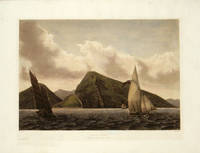
1833réf. 199435Paris.: Arthus Betrand. 1833-1835. Aquatint with handcolour 22.1 x 32 cms; 32.2 x 46.4 cms sheet including platemark "La Favorite" blindstamp at the foot light cockling to paper edge-toning the image a fine dark impression in very good condition. A fine view of the Fort of Bocca-Tigris in the Pearl River delta just downstream from Canton Guangzhou; one of the many fortifications protecting this strategic route of the China Trade to Canton. This atmospheric image of the fort with a junk and a yacht sailing in the river in the foreground is from the official account of the Laplace voyage in the Favorite 1830-32 by voyage artist François-Edmond Pâris 1806-1893. The strait is now crossed by the Humen Pearl River Bridge . (Arthus Betrand). unknown
1879réf. 168207Shanghai.: American Presbyterian Mission Press. 1879. xx 259pp the original wrappers have at some stage been resewn and bound into a quarter leather binding with linen spine the inner edge has been re-enforced and is discoloured. Additions & Corrections have been bound in. New endpapers one page has an archival tape repair to the inner hinge. Paper slightly browned and a little dusty in places rough cut edges corners rubbed but a very good firm copy. 25 x 16.5cm. Thomas Watters 1840 - 1901 was a noted scholar-consul of his day. He spent over 32 years in China serving in Taiwan Fuchow Swatow Ichang Canton and elsewhere and was acting Consul-General in Korea 1887-1888. . American Presbyterian Mission Press. hardcover
réf. 535481959. 4to. ll. 117. Red cloth gilt lettering to upper board and spine. Numerous captioned photographs including 24 in colour one of which has come loose. Old ownership inscription of "Susann Edgar". Ji Lin lies across the northern border of North Korea. 1959. hardcover
1930réf. 186728China: c. 1930s. The first postal savings bank in China was established in 1919 with an initial presence of 11 branches across the country. The design of this savings box reflects the Western influences on the country's postal service and the text at the base states that the box can be opened at any local post office. Metal tin 165 x 60 mm painted green raised Chinese characters and decoration front face slit. With key. Wear to green paint lock mechanism working well: very good. unknown
1900réf. 15592AB1900. ca. 1900 9 : 15 cm. Colour Aquatint Framed under glas. Lovley scene of a woman playing the flute another woman with a child is watching her. Unfortunately this aquatint was not finished. On the reverse side with inscribition. unknown
2019réf. BN126216Neldiritto Editore 2019. 2019. Hardcover. Manuale di diritto civile I manuali superiori Manuale di diritto civile I manuali superiori Chiné Giuseppe; Zoppini Andrea Neldiritto Editore hardcover
2021réf. 2081502111903968national library 2021. Soft Cover. Fine. The book is in fine condition. national library paperback
1827réf. 12801AB1827. Leipzig Ponthieu 1827. 17 : 11 cm. XVI pages 1 leaf 198 pages; 2 leaves 172 pages; 2 leaves 140 pages With 3 engraved frontispiece. Original wrappers. Very rare first German edition of 10 Chinese stories in the translation of the French edition. Interesting specially because of the introduction which contains explinations and notes about the contact between China and the West. It was published first in French edited by Jean-Pierre Abel-Remusat. The translation into German was made by Gottfried Wilhelm Becker. Jean-Pierre Abel-Rémusat 1788 - 1832 was the first professor at the College de France for Sinologie and is still known today for the publishing of a Chinese peom "Iu-kiao-li ou les deux cousines roman chinois" . unknown
2000réf. AIB213_ZA8522_213China Press 2000-01-01. hardcover. New. Ship out in 2 business day And Fast shipping Free Tracking number will be provided after the shipment.Language:Chinese.2010. Hardcover. Book Condition: New. Dust Jacket Condition: New. 1st Edition. This edition of the Pharmacopoeia of the Peoples Republic of China known as Chinese Pharmacopoeia 2010 or in abbreviation as ChP 2010 has been prepared in accordance with the principles and requirements recommended by the Ninth Pharmacopoeia Commission and accomplished with the effort made by Commission members and its Secretariat and with collaborated support of relevant institutions and organ. Satisfaction guaranteedor money back. China Press hardcover
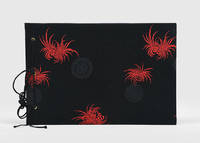
1920réf. 180565China: c. 1920s. An attractive handmade gift for the tourist market the delightful papercuts depicting rural scenes and figures. The large example on the first page incorporates the motif "double happiness" within a setting of birds flowers and foliage. Landscape octavo. With 20 handmade papercuts some embellished with colour pieces of textile on 10 leaves glassine guards. Original black brocade boards with black and red embroidered decoration tied with black cord through three holes. Binding smart small mark on read board occasional spotting internally: near-fine. hardcover
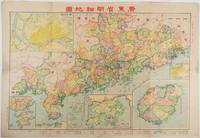
1936réf. 216107Qi 昌亞新地學社. Minguo 25 1936. A very attractive colour folding map of Guangdong province including inset maps of Guangzhou Shantou the European concessions of Hong Kong and Macau as well as Hainan the Paracel Islands and South China Sea. Scale of 1:1300000. Divided into eight panels measuring 54.5 x 79cm. Little light browning tide mark left margin barely intruding into printed image few tiny chips at extremities mended on reverse with washi in few places though overall in very good condition. A curious and colourful map of Guangdong issued towards the end of the Nanjing decade detailing the province's local political divisions its infrastructure such as roads railways and telegraph lines as well as its topography through stylised mountain ranges ridges and passes. Inset maps of Hong Kong and Macau noted as foreign concessions alongside maps of the South China Sea and Paracel Islands ostensibly affirms the status of these territories as rightful components of Guangdong in the view of the Kuomintang Government. . [Qi?] 昌亞新地學社. unknown
1934réf. 20978Nanchang Kiangsi China: The Association for the Advancement of New Life Movement 1934. Good condition. Pamphlet touting the benefits of the Chinese government led civic education program known as the New Life Movement established by General Chiang Kai-shek to promote cultural reform combat corruption and unite China under a centralized ideology. China at the time had been threatened by Western imperialism as well as rising Japanese militarism and communism. The New Life Movement stressed traditional Confucian morality and the Methodist notion of self-cultivation as the solution to the perceived degeneration of the Chinese people and was considered by the Kuomintang to be key element of Sun Yat Sen's Three Principles of the People. In China the New Life Movement ended in 1949. Chiang launched this movement from his Nanjing headquarters when he was the leader of the Republic of China. He expelled Chinese communists from the party and led a successful unification of China. Despite a professed focus on reform Chiang's government concentrated on battling Communism within China as well as confronting Japanese aggression. When the Allies declared war on Japan in 1941 China took its place among the Big Four. Civil war broke out in 1946 ending in a victory by Mao Zedong's Communist forces and the creation of the People's Republic of China. From 1949 until his death Chiang led the KMT government in exile in Taiwan which many countries continued to recognize as China's legitimate government. The 'Contents' include the Beginning of the New Life Movement NLM; The Unification and Promotion of the NLM; the Future of the NLM; The Important Speeches of General Chiang Kai-Shek; The Slogans Rules and Emblem of the NLM; Outline of the NLM; Appendix: The Staff of the General Association for the Promotion of the NLM. The Appendix last 2p comprises a list of the organizations staff; President Chiang Kai Sheh 32 Directors a Director-in-Chief a General Secretary Secretary and Head of the First Second & Third Departments and 18 Secretaries. The lengthy list of slogans and rules runs to 95 items including #40. Do not smoke opium. We were not able to find this title on OCLC. However a similar pamphlet "Outline of the New Life Movement" was found OCLC: 3976888 14pp pamphlet color plates. Pamphlet small 4to 2 pp 18pp plus one color plate of the symbol for the organization. Blue paper wrappers stitch bound with pale blue ribbon. Blue paper wrappers marked & ruffled at spine with 1 1/2" split lower spine fox spotting on lower edge of cover. The Association for the Advancement of New Life Movement unknown
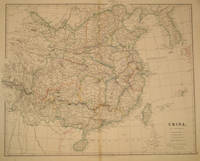
1832réf. 14181London: J. Arrowsmith 1832. Map of China by John Arrowsmith whose position in the Admiralty lead to the most recent discoveries being translated quickly to new information on his maps. 23 3/4 x 19 1/2". Original outline and wash color. Korea showed at the top right corners as well as Taisan Formosa and the Loo Choo Islands. Published 15 Feby. 1832. Slt. darkening at fold o/w very good condition. HKD5800. J. Arrowsmith unknown
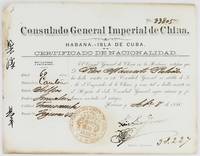
1880réf. 2592Havana: September 8 1880. Very good. Partially-printed broadside 6.5 x 8.25 inches completed in manuscript in Spanish and Chinese. Small marginal wormhole mild edge wear light toning. Ink stamp of the Consulado General at bottom-center. A scarce certificate issued in 1880 by the Chinese Consulate in Havana authenticating the registration and details of a Chinese laborer in Cuba. The printed form is completed in manuscript with the name of the recipient his age place of origin occupation and place of residence. The present examples were completed for a sixty-year-old laborer from Canton being called Pedro Pulido who was going to work and/or live at 48 Calle Figueroa in Havana. The printed text states that "El Cónsul General de China en la Habana certifica que blank ha hecho constar en este Consulado General ser súbdito de S.M. el Emperador de la China y como tal se halla inscrito en el Registro de dicho Consulado General segun número y filiacion anotados al márgen." The certificate is dated September 8 1880 and is stamped with the seal of the consulate in red and with the rubberstamped signature of the Consul General Lin Liang Yuan. The form are also bears two ink signatures in Chinese in the left margin a rare occurrence. An excellent document of the bureaucracy surrounding imported Chinese labor to Cuba in the last quarter of the 19th century. September 8 unknown