107 résultats
1948réf. 100373G. T. Foulis & Co. London. 1948. G. T. Foulis. 1948. Fourth edition. Hardback. No DW. Original blue cloth sunned to spine top corner crumpled. Illustrated. Pages browned small close tear to bottom of page 96 otherwise clean and sound. PRESENTATION COPY FROM CHULA "For Robin with love from Chula March 28 1951." Robin Dalton lived to 101 and had an extraordinary life and career. As a literary agent she represented Edna O'Brien John Osborne Iris Murdoch Ben Travers George Orwell Margaret Drabble B. S. Johnson Bernice Rubens and many more. She also produced films spied for Thai Government and for over five years dated the cousin and best man of Prince Philip David Milford Haven. It was he that introduced her to the Chulas and after being snowed in for five days at their Cornish house in 1947 they became her lifelong friends. On her honeymoon to her second husband in Cornwall Robin was approached by Chula who asked her to become an intelligence officer for the kingdom of Thailand. Officially she was a press attaché. "What went on taught me that every single crazy thing you see in a spy film or book is true." Within a day of husband's early death Lisba Princess Chula had offered to pay for her daughter's Lisa's education hardcover
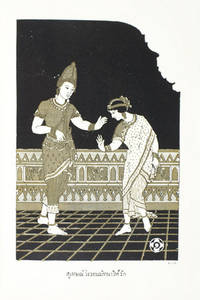
1926réf. 18071Siam: Self Published 1926. Hardcover. g. 8vo. 94 ff. 16 full page lovely illustrations all b/w overlaid in gold. Black cloth with gorgeous large gilt rose bush surrounded by decorative gilt border with traditional Oriental symbols. Gilt on spine with Thai writing and decorative gilt rose and emblem. English page posted inside front cover explaining the title origin and occasion of book's presentation. Title in red and black on title page. In Thai. The illustrations in this work are absolutely magnificent each being a perfect example of traditional Thai and Siamese art and imagery. Spine starting some spotting to outside edges of pagers but book is in good - very good condition. Presented to the celebrants on the occasion of the cremation of the late King of Siam Rama VI March 24 1926. King Vajiravudha 1818 - 1925 whose reigning title was Phra Mongkut Klao Chaoyuhua was known for his passionate love of theater. He was educated in England and his great love of literature and poetry in both Thai and English along with his scholastic abilities was later to manifest itself during his reign. Among his lasting achievements were devising a system of transliterating Thai into English and of translating the entire works of Shakespeare into Thai. His passion for traditional Thai theater and ballet left a mass of published scores which form the basis of the study of these arts even through the present day. His passion was creating literary works for the Siamese theater with over one thousand poems and plays of romantic and nationalistic themes. Self Published hardcover
réf. 21411Firmley Park Farnborough 22 October 1898. 3 pp. 6 x 4 inches in good condition remains of two hinges where formerly mounted. Vajiravudh 1881-1925 Rama VI was King of Siam now Thailand from 1910 until his death. He succeeded his father King Chulalongkorn. Prince Vajiravudh was born on 1 January 1881 to Chulalongkorn and one of his four queens Saovabha. In 1888 upon coming of age Vajiravudh received the title Krom Khun Thep Dvaravati. He was firstly educated in the Royal Palace in Siamese and English language. He continued his education in Britain at the Royal Military Academy Sandhurst in 1891 and became part of Durham Light Infantry Regiment upon graduation. In 1894 his half-brother Crown Prince Vajirunhis died. Vajiravudh was then appointed the new Crown Prince of Siam. He studied in law and history at Christ Church Oxford in 1899. However he suffered the appendicitis that barred him from personally receiving the graduation in 1901. Crown Prince Vajiravudh returned to Siam in 1902. unknown
réf. 2092621 May 1879. In Siamese script. 1 page 13 x 8 inches black borders horizontal folds in good condition. With a typed English translation. Embossed royal crest at the head of the letter. Chulalongkorn 1853-1910 who reigned as Rama V of Siam 1868-1910. Written at the Throne Baromarat Satit Maha Loru. On the 1st day of the 7th month of the year of the Rabbit Era 1241 corresponding to the 21st of May 1879. . His Royal Highness was our Aide de Camp and our beloved brother in whom we had great confidence as an officer because he was always diligent faithful and careful in conducting the affairs of his office. translation David Banks Sickels 1827-1918 Civil War correspondent and author served as diplomatic representative of Siam from 1876 to 1881. unknown
réf. 20795Royal residence grand palace Bangkok 13 September 1862. 3½ pages 9 x 7 inches folds in good condition one royal monogram or seal cut from the centre of the first page with loss of a few words now neatly repaired two corners lightly dampstained. With a complete typed transcript. A lengthy letter entirely in the hand of the King discussing his requirements from the West including a gun made to his own specifications for use against enemies along the river a sewing machine and some pills and pursuing the possibility of selling Siamese tobacco in London and Manila. King Maha Mongkut also known as Rama IV ruled Siam now Thailand from 1851 to 1868 during which time he successfully negotiated with Western powers and modernized his nation. Mongkut ascended the throne upon the death of his half-brother Jetta Rama III after spending 27 years as a Buddhist monk. Educated and multi-lingual Mongkut negotiated with the United States and European powers to open Siam to international trade. If the kind of Armstrong guns can not be purchased can you ask the maker of Needham patent gun again can they make other one cannon in like manner of that has been purchased some time ago but I wish larger than the former as two inches bore or two & half inches bore the barrel shall be not rifle but shall as smoth as common gun in which the large cartriage of several balls like the fouling piece can be used in employment on board our small Steamer travelling in our river to treat with our enemies that must be occurred in our way on currence of river only where the near approaching of force of enemies shall be treated with several balls discharged at once from our cannon; you may understand perhaps as you have seen this river. unknown
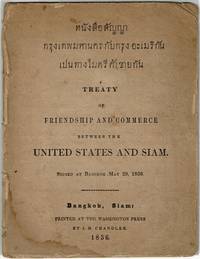
1856réf. 71211Bangkok Siam: printed at the Washington Press by J. H. Chandler 1856. 8vo approx. 8½" x 6¾" pp. 25 1; self-wrappers; Thai and English text on opposite pages; small hole from an old adhesion in the middle of the fourth and fifth leaf sense at least in the English version remains clear; some curling at the edges and small marginal nicks and tears; in all a good clean copy. The first treaty between the US and Siam had been negotiated by Edmund Roberts in 1833. It ensured free trade and most favored nation status for the United States. Sir John Bowring negotiated a new treaty on behalf of Great Britain with the recently enthroned King Mongkut aka Rama IV. When the Americans learned of this mission they sent Townsend Harris who was on his way to Japan to Bangkok to update the original treaty for the U.S. which was signed on May 29 1856. Townsend Harris 1804-1878 was an American merchant and politician who served as the first United States Consul General to Japan. He negotiated the the Treaty of Amity and Commerce or the "Harris Treaty of 1858" between the US and Japan and is credited as the diplomat who first opened Shogunate Japan to foreign trade and culture in the Edo period thereby paving the way for greater Western influence in Japan's economy and politics. Prior to his efforts in Japan however Harris was rerouted from his trip to Japan to make his way to Siam. Re-designated the Treaty of Amity Commerce and Navigation the amendments granted Americans extraterritorial rights in addition to those in the Roberts Treaty. Two American missionaries played essential roles in the negotiation of the Harris Treaty: Stephen Mattoon worked as a translator for Townsend Harris during the negotiations. He graduated from Princeton Theological Seminary in 1846 and the following year went to Bangkok where he worked as a Presbyterian missionary. He was subsequently appointed the first United States consul to Siam. Shortly after his return to the United States in 1865 he became president of the Biddle Memorial Institute in Charlotte North Carolina where he remained until his death in 1889. This copy of the Harris Treaty was passed down through his family and is accompanied by an 1880 letter to his sister on Biddle Institute letterhead. The Treaty of Friendship and Commerce between the United States and Siam granted American citizens extraterritorial rights and secured important diplomatic and trade privileges for the U.S. in Siam. Included are articles addressing the ownership of land in Siam by Americans; the mutual protection of American and Siamese citizens at sea and on land; parameters of trade between the two countries; free exercise of religion by Americans living in Siam; limitations on travel by American ships of war; and details on trade and import duties and the special exclusion thereof for opium; and other rules and regulations concern smuggling false manifests port clearances etc. Includes a list of 44 articles that are free from taxes rhinoceros hides elephant bones kingfisher's feathers ivory etc. on the recto of the final leaf. Both the American and British treaties with King Mongkut's government were printed by John Hassett Chandler by turns a "U.S. Consul tutor printer and book binder punch-cutter and type founder inventor engineer designer and engraver mechanic artist author missionary translator and interpreter" genealogy.com. He was born in 1813 at Pomfret Connecticut and came to Bangkok in 1843 as a Baptist missionary and set up the first printing press in the kingdom to use Thai characters. Chandler would later assist Mongkut in setting up another press inside the palace. In 1856 Harris chose Chandler and Mattoon to serve as his advisors at the court. Both of them already held positions in the Royal household and Chandler had grown so close to the Mongkut and his family that he was one of two missionaries the king chose to join the procession at the ratification ceremony for Harris's Treaty. Most of the publications of the Washington Press in Bangkok were religious in nature although there are also a number of almanacs grammars dictionaries and newspapers for the period from 1830 to 1860. The Bowring and Harris treaties appear to be the only official documents issued by the press. The Harris Treaty is also one of the earliest primary sources documenting American colonial interests in Asia. It is extremely rare and we can trace only six institutional copies at LC AAS Cornell Colgate University of Hong Kong and Strasbourg the last of which is apparently missing the title page. See also Conroy- Krutz Missionary Diplomacy: Religion and Nineteenth-Century American Foreign Relations. Cornell University Press Ithaca 2024. And Lord Donald C. Missionaries Thai and Diplomats. Pacific Historical Review 354 1966. printed at the Washington Press by J. H. Chandler unknown
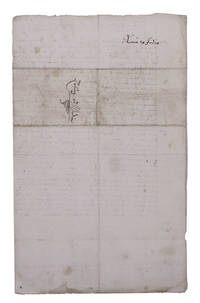
1608réf. L6GEZEYF77VKThe Hague 1608. Folio 34 x 21 cm. Dutch manuscript translation written in brown ink on paper in a slightly sloped Dutch gothic cursive hand 35 lines with text area 21 x 17.5 cm plus 2-line drop-title very neatly written of a 1607 letter from Ekathatsarot King of Ayutthaya Siam/Thailand to Maurits of Nassau Prince of Orange received in 1608 distributed as a manuscript tidings. 1 leaf. A contemporary Dutch manuscript translation of a letter written late in 1607 by King Ekathotsarot of Ayutthaya then generally called Siam in the West and more or less the present-day Thailand sent with the first Siamese embassy to the Netherlands and addressed to the Dutch stadtholder Maurits of Nassau Prince of Orange who received it in September 1608. We have found no printed version of the present text it supplies details that we have not found in any other source and the original Thai version appears not to survive giving the present document the greatest importance for understanding the earliest diplomatic relations between Siam and the Dutch Republic and throwing light on activities of the VOC Dutch East India Company in its earliest years. It names two Siamese ambassadors who apparently headed the embassy of fifteen people. Ekathotsarots letter proposes a friendship and alliance between the two nations requests various goods and military aid against the Portuguese in Tanassery Tenasserim in the Kingdom of Taungoo now the Tanintharyi region of Myanmar formerly Burma. He sends various presents which are listed and offers to send anything Maurits wishes to have from Siam and neighbouring regions noting that all the princes and kings of the neighbouring regions are his subjects except for the King of Queda! meaning Kedah on the Malay peninsula who is his enemy.Prince Ekathotsarot ca. 1556-1610 succeeded his brother to the throne ruling as King Sanphet III from 1605 to 1610. He brought stability to Siam and was eager to expand trade with many foreign powers including the Dutch Republic. The Dutch were disappointed in their hopes to use Siam as a stepping stone to trade with China but the Siamese did allow the VOC to establish trading posts at Sangora in 1607 and Ayutthaya in 1608.In late 1607 the VOC sent the Siam embassy of fifteen people from Ayutthaya the capital of Siam to Pattani in Southern Thailand and from there the ship sailed to Bantam Banten the main base of the VOC on Java. As instructed by the VOC five persons including two ambassadors were sent with the return fleet from Matelief to Fort Rammekens Holland. This brought with them his letter to the Dutch stadtholder whom the Dutch and Siamese called the King of Holland in their correspondence. The present title indicates that the original letter in the Thai language was written in gold: the original letter of King Ekathotsarot was engraved on a golden roll which was stored in an ivory case. The visit of the Siamese embassy to the Dutch Republic has been reported in a printed newsletter published in 1608 telling both the reception of the Siamese embassy by Prince Maurits in The Hague as well as the demonstration of the newly invented telescope. Present day three copies of this newsletter have survived. It says the Portuguese had told the Siamese that the Dutch were just pirates without a country but Ekathotsarots letter shows he was quite well informed knowing what the Dutch had that he wanted and knowing what to offer them in return. He offers free trade for Dutch merchants in the region and requests Dutch ships with captains and soldiers to help drive out the Portuguese iron cannons with the largest cannonballs and especially skilled artisans who could smelt and cast iron people skilled in the use of artillery and skilled gilders and tanners.With a few tiny holes in the paper along the old folds not affecting the text and a small marginal tear and stain at the foot but otherwise in very good condition and with all three deckles intact the left edge was the centre of the sheet. Perhaps the only surviving version of a 1607 letter from the King of Siam to the Dutch stadtholder Maurits Prince of Orange: a unique source of information on Dutch-Siamese relations and on the early history of the VOC.l Cf. John Anderson English Intercourse with Siam in the Seventeenth Century London 1890; Han ten Brummelhuis Merchant courtier and diplomat; A history of the contacts between the Netherlands and Thailand Lochem 1987; Dirk van der Cruysse Siam & the West 1500-1700 Paris 1991 /Chiang Mai 2002; J.J.L. Duyvendak The First Siamese Embassy to Holland in: Toung Pao 32 1936; Paul Pelliot Les relations du Siam et de la Hollande en 1608 in: Toung Pao 32 1936 George Vinal Smith The Dutch in Seventeenth-Century Thailand DeKalb Ill. 1977; Henk Zoomers & Huib Zuidervaart ed. Embassies of the King of Siam sent to His Excellency Prince Maurits Arrived in The Hague on 10 September 1608 Wassenaar 2008 none of these titles has cited the content of the Kings letter proving both the importance and rarity of the manuscript. unknown