36 résultats
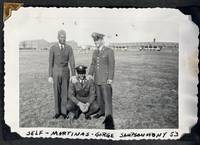
1953réf. 212881953. African American military photo album 1953-1960 documenting the service and personal life of a Black U.S. Air Force serviceman across multiple postings during and after the Korean War. The album records military duty daily routines and interpersonal relationships within an increasingly integrated armed forces providing visual evidence of African American participation in Cold War military infrastructure. The material captures both overseas deployment in Korea and domestic life across U.S. bases situating individual experience within broader patterns of military service and social change following desegregation. Album comprises 101 black-and-white silver gelatin photographs most measuring approximately 3.5" x 3.5" mounted on black pages with corner mounts. Early images place the serviceman at Kessler Air Force Base in Mississippi followed by extensive documentation of his time in Korea likely associated with the 650th Aircraft Control and Warning Squadron as indicated by a tent marked with unit insignia. Photographs show military encampments with tents and barracks vehicles including trucks and jeeps and groups of soldiers engaged in daily routines. One caption identifies "Our home in Korea" accompanying images of base infrastructure. Additional scenes include a USO performance at "K-6 Korea 54" where servicemen gather beneath a "Camp Shows" banner. The album continues with postings at Ellsworth Air Force Base in South Dakota and locations in Alaska where winter conditions specialized vehicles and outdoor activities are visible. Social and interpersonal life is extensively documented with repeated appearances of individuals identified as "Daril" "Bunky" "Peanuts" and others shown in uniform at leisure and in group settings. Domestic scenes include family gatherings such as "Roger's Birthday Party June 59" and images of women and children identified as "Mary" "Rochelle" and "Teresa" indicating sustained family connections. Travel photographs include roadside markers such as "Welcome to Illinois" and "Entering Indiana" while Alaska-based images depict community events including dog sled races and local festivals. Created during the transitional period following the desegregation of the U.S. military these photographs provide a sustained record of African American service members operating within integrated units while maintaining personal and family networks across geographic distances. The combination of overseas deployment domestic postings and family life offers a comprehensive view of military and social experience during the 1950s. Album pages show some loss and covers are detached; photographs remain sharp with strong tonal quality and are largely well-preserved; overall very good condition. This album offers an extensive documentary record of African American military life and community formation in the Korean War and early Cold War period. unknown books
1956réf. 215131956. African American Military History Korean War Unidentified photographer African American soldiers in South Korea 1956 documents Black military service within the early post armistice U.S. occupation of Korea and provides visual evidence of desegregation in practice following Executive Order 9981. Produced three years after the Korean Armistice Agreement the images situate African American enlisted men within the operational landscape of U.S. military engineering and logistical support during the Cold War consolidation of American presence on the Korean peninsula. The archive documents the role of Black soldiers in infrastructure maintenance transport and base security while also recording their proximity to Korean civilian life in a recovering war zone. The identification of the 376 Engineer Battalion places the material within the institutional framework of the U.S. Army Corps of Engineers whose work underpinned military mobility and reconstruction during this period. South Korea 1956. Archive of 22 black and white silver gelatin photographs most measuring approximately 5 x 4 inches depicting African American soldiers stationed near a U.S. military installation likely in the Uijeongbu or Dongducheon corridor north of Seoul where engineering and support units were concentrated. Multiple images include signage identifying the "376 Engineer Battalion" while others show mixed-race groups of soldiers gathered near convoys of M35 2½ ton cargo trucks and smaller support vehicles used for personnel and supply transport. One photograph includes a Fairchild C-119 Flying Boxcar aircraft in the background confirming the logistical environment of cargo movement and aerial supply. Soldiers appear in standard issue fatigues with visible non commissioned officer insignia engaged in routine duties such as transport checkpoint supervision and base operations. Several photographs depict Korean civilians moving through nearby marketplaces and village spaces including women wearing traditional hanbok passing through areas of visible economic strain characterized by unpaved roads and temporary structures. English and Hangul signage including a storefront labeled "Kind Shop" further situates the images within a localized commercial environment shaped by U.S. military presence. The archive documents a transitional period in both U.S. military policy and Korean society as the formal desegregation of the armed forces intersected with the realities of overseas deployment in a recently devastated region. While integrated units are visible the clustering of Black soldiers within shared duties and informal groupings indicates the persistence of racialized social structures within the ranks. At the same time the photographs establish the everyday presence of American troops within civilian Korean spaces during early Cold War reconstruction linking military labor to broader geopolitical objectives in East Asia. Light surface wear including minor creasing and scattered abrasions; images remain clear with strong contrast. Overall very good condition. A cohesive visual record of African American military labor postwar occupation and cross cultural contact in Korea during a formative phase of U.S. global military expansion. unknown books
réf. 162576N.p.: N.p. 1974. Collection of eleven vintage borderless black-and-white photographs of rock pop and jazz musicians performing circa 1973 taken by noted French photographer Claude Gassian. With Gassian's stamp on the verso of every photograph. Collection includes two photographs of Alice Cooper one photograph of J.J. Cale one photograph of Chick Corea Stanley Clarke and Al Di Meola Return to Forever one photograph of Carla Bley at an electric keyboard two photographs of Bryan Ferry with Roxy Music one photograph of John McLaughlin and Jean-Luc Ponty Mahavishnu Orchestra one photograph of Alvin Lee with Ten Years After and one photograph of Tom Johnston Jeff "Skunk" Baxter and Patrick Simmons The Doobie Brothers. Born in Paris in 1949 Claude Gassian began his career in the 1970s capturing numerous iconic images of rock-and-roll musicians throughout that decade. His work has been the subject of several exhibitions and has been featured in several photography books including "Rock Images" 1990 and "Claude Gassian photographies 1970-2001" 2001. 9.5 x 7 inches. Very Good to Near Fine some with light edgewear and faint aging to the emulsion. N.p. unknown books
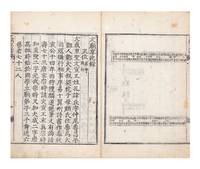
réf. 9430Four leaves of illus. 30 folding leaves. Large 8vo 305 x 208 mm. orig. yellow semi-stiff wrappers upper wrappers somewhat soiled both wrappers with some worming new stitching. Korea: 1765. First edition of this book published on royal command by King YÅngjo of ChosÅn. The book was compiled by Kim Kwi-ju 金龜柱 1740-86 the older brother of Queen Consort ChÅngsun 1745-1805. The royal Preface is furthermore written in Kim’s standard script calligraphy. Years after the compilation of this book factional intrigue under YÅngjo’s successor ChÅngjo led to Kim being exiled after which he soon died. Our book outlines sacrifices at the Confucian temple in Seoul including the KyesÅng å•“è–ç¥ and SongjÅl 崇節祠 shrines. The KyesÅng shrine built in 1669 was the site of sacrifices to the fathers of several Confucian sages including Confucius and Mencius. At the temple as a whole a number of Chinese and Korean Confucian sages and worthies were worshipped. The book contains illustrations outlining the layout of the shrines with the placement of the tablets for the various Confucian scholars marked with their names. The royal Preface is dated 1765. Ordering the compilation of a record of past exemplars apparently made the king reflect on his own character and actions. He wrote “when I with my shallow learning recite the writings of the sages and worthies but remain unable to learn the Way of the sages and worthies and when I admire the deeds of the sages and worthies but cannot act in their manner it is like knowing what something tastes like but not get to eat it or like knowing the road but being unable to follow it. Even though I might laugh at people of the past why would people of the future not laugh at me too” Minor worming mostly marginal towards end. See WorldCat 855527023 for a digital copy. unknown books
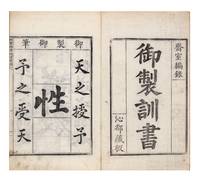
réf. 942941 folding leaves. Large 8vo 337 x 206 mm. orig. semi-stiff wrappers new stitching. Korea: Simdo æ²éƒ½ 1756. First edition and rare; WorldCat lists only one printed copy at Berkeley. This book of exhortations on good government with striking royal calligraphy was written by King YÅngjo or Yeongjo of ChosÅn 1694-1776 in 1756. At this time YÅngjo was commemorating the death of his father the previous king. According to Fang Chaoying 1908-85 YÅngjo then in his 65th year “could not foresee that he was to live twenty more years and so it appears that he was trying to justify himself in his own mind with regard to posterity as well as to the ancestors whom he expected to face any day” The Asami Library 115. YÅngjo offered three main principles for a king to follow: “to venerate Heaven to love the people and to treat the officials with respect” ibid. Large standard script characters written by the king himself are reproduced in the beginning of the book. The king’s brush records Confucian assertions such as “the following of human nature is called the Way / the cultivation of the Way is called instruction.” Accepting the Mencian dictum that human nature is inherently good the king continues: “I possess the good human nature / to realize the bright mandate of Heaven.” The main text of the book is reproduced in the handwriting of the important scholar-official SÅ MyÅng-ŭng or Seo Myeong-eung å¾å‘½è†º 1716-87. SÅ wrote in many genres and had a cosmopolitan outlook. For example he wrote a Preface to one of the major multilingual lexicographical works produced in ChosÅn in the 18th century see Söderblom Saarela “Mandarin over Manchu” 379-80. Very fine and fresh copy beautifully printed. References Fang Chaoying. The Asami Library: A Descriptive Catalog. Edited by Elizabeth Huff. Berkeley: University of California Press 1969. Söderblom Saarela Mårten. “Mandarin over Manchu: Court-Sponsored Qing Lexicography and Its Subversion in Korea and Japan.” Harvard Journal of Asiatic Studies 77.2 2017. unknown books
1797réf. 111991797. Woodblock-printed. 4 1 16 39; 40 33 2 folding leaves. Three kwÅn in two volumes. Small folio 341 x 216 mm. orig. semi-stiff patterned wrappers handwritten title on upper covers old stitching. HansÅng: Chujaso Preface dated 1797. Very rare Korean collection of community rituals K. hyangnye 鄉禮 compiled by and printed for the King of Korea. We find no copy in Korea and only three copies in WorldCat Berkeley Columbia and Harvard. The reign of King ChÅngjo of Korea r. 1776-1800 witnessed a shift in the sovereign’s role in relation to Confucian teachings. “ChÅngjo sought to formulate the sage-king as an active ruler who instructed his ministers rather than received instruction from them was directly involved in the administration of the state and exercised discretion when and how he in his sagely wisdom deemed fit.”–Christopher Lovins King ChÅngjo SUNY: 2019 p. 29. As the guardian and propagator of Confucian learning he oversaw various editorial and printing projects carried out by the royal publishing house the Chujaso 鑄字所. The compilation and publication of the Collected Community Rituals reflected King ChÅngjo’s belief that a king’s ritual transformation of his people must begin at the local level. The Collected Community Rituals opens with the royal edict dated 1797 followed by a list of community ritual records compiled throughout Chinese and Korean history. The bulk of the work is devoted to the rituals of the banquet and archery competitions followed by coming-of-age K. kwanrye 冠禮 and marriage rituals. Detailed interlinear commentaries were compiled by scholars of the Kyujanggak 奎章閣 the Royal Library of the Korean court under the leadership of Yi PyÅng-mo 1742-1806. Their names are listed at the end of volume two. The original printing used the chÅngyuja ä¸é…‰å— kabinja style of movable metal type of 1777 and copies were distributed to localities throughout Korea. They were also sent to regional governmental printing houses where they were cannibalized to produce woodblocks for further printing. Nice set preserved in a jil. Our copy also has prayers for ancestral mountain and land deities as well as instructions for offering rites all handwritten in black ink on the endpapers. Red leaf-shaped seals on the first leaf of both volumes read 逸民山水 . ⧠Asami Library 4.14. King ChÅngjo Hongjae chÅnsÅ 弘齋全書 in Han’guk munjip ch’onggan 韓國文集å¢åˆŠ digital access via krpia.co.kr. unknown books
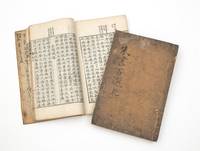
réf. 889392.5; 95 folding leaves. Two vols. Small folio orig. yellow-brown patterned wrappers some soiling to wrappers old stitching. ChÅnju today’s Jeonju: 1795 or possibly later. A selection of 100 letters written by Zhu Xi 1130-1200 the great synthesizer of the philosophical school known as Neo-Confucianism. Zhu Xi who lived in southeastern coastal China far from the center of power became extremely influential in East Asia for centuries following his death. His interpretation of Neo-Confucianism a metaphysically argued philosophy of the self the family and the state became official orthodoxy in late imperial China and ChosÅn Korea promulgated largely through the civil service examination system. However there were challenges to its primacy from intellectuals especially from the 18th century onward. “In the opinion of many historians the Song’s preeminent philosopher Zhu Xi outshined Confucius himself. He was the only person in Chinese history apart from Confucius and Mencius whom the official hagiography addressed as Master” Kuhn The Age of Confucian Rule 103. Given Zhu Xi’s standing in Korea several collections of excerpts from his works were published beginning in the 16th century. On account of its authorship Royally Authorized Selection of One Hundred Letters by Zhu Xi became one of the most widely circulated such collections for the last century of the ChosÅn period. According to the court chronicle the culturally ambitious King ChÅngjo 1752-1800 himself made the selection on the basis of Zhu Xi’s collected works a voluminous oeuvre that numbered 2354 pieces of writing in one scholar’s recent count. Text-critical notes e.g. on place names personal names official titles and expressions that might be unfamiliar to Korean readers were then added by four high civil officials which were printed in the upper margin of the text. The book was finished on the 25th day of the 12th month of the 18th year of ChÅngjo’s reign Qianlong 59 which corresponds to 15 January 1795. While most of the 18th year corresponds to 1794 it is incorrect to date the book to that year. The book was first printed in Seoul with metal movable type — the so-called chÅng’yu cha ä¸é…‰å— set of type cast in 1777 the chÅng’yu year when ChÅngjo ascended the throne. Further editions were subsequently published at several provincial offices using woodblocks intended for wide dissemination among the educated elite. Our copy belongs to one of these provincial woodblock editions. The title-page says ŭlmyo wanyÅng kan’in ä¹™å¯å®Œç‡ŸåˆŠå° meaning that it was printed in 1795 the ŭlmyo year in the provincial government offices at ChÅnju Jeonju in what is now southern South Korea. However it is possible that the actual copy was struck later than that date as the blocks remained on the site. They were moved to the local official Confucian school in 1899 where they remain today. Fine set of a very rare book. Minor staining and soiling at beginning and end of each volume. ⧠WorldCat accession number 874756267. References Kuhn Dieter. The Age of Confucian Rule: The Song Transformation of China. Cambridge: Mass.: Harvard University Press 2011. unknown books
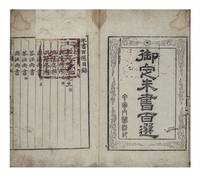
réf. 11191. 1 p.l. 4 25 34 29; 37 30 28 folding leaves. Six kwÅn in two volumes. Small folio 360 x 223 mm. orig. wrappers some wear & rubbing handwritten title on covers orig. stitching. HansÅng: Kyujanggak ca. 1799. A royal gift presented by the king of Korea. In 1794 King ChÅngjo 1752-1800 of the ChÅson dynasty compiled and had printed a collection of the letters of the great Neo-Confucian philosopher Zhu Xi 朱熹 1130-1200 to be disseminated throughout his kingdom. As King ChÅngjo wrote on this occasion “the learning of Master Zhu in its expansive and oceanic plentitude is best represented by his collected writings; the writings of Master Zhu in their utmost subtlety and precision are best represented by his personal correspondences” “ChusÅ paeksÅn yukkwÅn” 朱書百é¸å…å· in Hongjae chÅnsÅ 弘齋全書 Collected Writings of King ChÅngjo kwÅn 180. Drawing from a number of established collections he selected 100 letters and carefully arranged them “beginning with the letter to Yanping 延平 i.e. Li Tong æŽä¾— 1093-1163 Zhu Xi’s teacher to pronounce his lineage of instruction and ending with the letter to Zhiqing ç›´å¿ i.e. Huang Gan 黃干 1152-1221 Zhu Xi’s disciple to demonstrate the bestowment of teachings.” That 1794 edition with moderate marginal annotations on “personal and place names as well as philological glosses and references” was sent to be printed with the chÅngyuja ä¸é…‰å— metal type cast in the year 1777. Printed copies were sent to various official printing houses throughout the kingdom and used as models to carve woodblocks for a xylographic edition ibid. Sometime around 1799 realizing that in the capital only metal type copies of the book remained the king ordered woodblocks to be made locally as well for the work so that more copies could be printed and distributed ChÅngjo “Sinin ogyÅng…” æ–°å°äº”經… in Hongjae chÅnsÅ kwÅn 36. Most woodblock re-editions of this work retain the original title-page which contains not only the title Royal Edition of a Hundred Selected Letters of Zhu K. ŎjÅng chusÅ paeksÅn å¾¡å®šæœ±æ›¸ç™¾é¸ but also the inscription in seal script that reads ç”²å¯…å…§é–£æ´»å° — “palace edition printed with movable type in the kabin year 1794.” This title-page compounded with the absence of any additional paratextual information likely resulted in the description of these woodblock re-editions as the original metal type 1794 edition in spite of lacking the features of metal typography. We have carefully examined our copy and found that it was likely printed with the woodblocks carved around 1799 undoubtedly through the cannibalization of a typographic copy and kept within the royal library. Certain qualities of our copy make it distinctive: not only are the cursive characters rendered with impressive clarity the marginal annotations mentioned in King ChÅngjo’s edict are also preserved in faux-manuscript style — a feature absent in some other copies we have consulted erroneously described as the 1794 edition. The best evidence that our copy was printed by the royal library K. kyujanggak 奎章閣 of course is the fact that it was a royal gift K. naesabon 內賜本 presented by the king himself to notable officials or individuals in this case an examinee from SuwÅnbu 水原府. The “Record of Presentation” K. naesagi 內賜記 is handwritten on the front endpaper of the first volume as usual and is dated to the second month of Xianfeng 5 1855. However both the name of the recipient and the official responsible for the Record have been obscured. A name Im Hŭi-ji 林熙之 is written next to the name of the recipient but in a clearly different hand and ink. Records of the Royal Secretariat K. SŭngjÅngwÅn ilgi 承政院日記 states that on the 29th day of this month copies of the Hundred Selected Letters were indeed bestowed to six examinees but all their names are not given. On the first leaf of the table of contents and facing the title-page is the Seal of Presentation K. naesa’in å…§è³œå° which reads å¥Žç« ä¹‹å® Treasure of the Kyujanggak. This seal was used for presentation copies roughly between 1782 and 1894 as shown by Lee & Song in “A Study on Naesabon Preserved in Kyujanggak” in Journal of Korean Library and Information Science Society 43 no. 2. This book is rare outside of East Asia. We find three copies under WorldCat 35891835 with a misspelled title and described as the 1794 edition on account of the aforementioned title-page which our copy also possesses. None of them is described as a presentation copy. Very good set. Some occasional soiling and dampstaining. Unimportant worming mostly marginal. ⧠King ChÅngjo Hongjae chÅnsÅ 弘齋全書 in Han’guk munjip ch’onggan 韓國文集å¢åˆŠ digital access via krpia.co.kr. unknown books
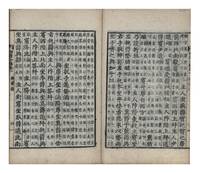
réf. 7461Two parts in one vol. Small folio orig. wrappers somewhat tired & a little soiled some light staining & soiling here & there manuscript title on upper cover later stitching. Hansong Seoul: Kyujanggak the Royal Library Preface dated 1793 & 1796. First edition of this handsome and large-format 323 x 217 mm. royal publication. King Chongjo 1752-1800 was one of the most intellectual and enlightened of the Korean monarchs. Perhaps Korea’s greatest bibliophile as royal patron he supported all aspects of the book: typographers printers authors librarians and lexicographers. A number of “royal” editions were published under his auspices. He founded the Kyujanggak Library in 1776 now part of the library of the Seoul National University. “The official rhyming dictionary of Chinese characters compiled under the supervision of King Chongjo and engraved in 1796. The arrangement is different from the usual Korean system in that instead of three rows of characters in the same rhyme there are four rows with the ipsÅng characters distributed in the bottom row” Fang The Asami Library 12.3. The main compiler of this work was the reformer Tong-mu Yi 1741-93 who had travelled to China and was an important member of the Northern Learning School. This group of intellectuals recognized the practical benefits of commerce and technology and urged the modernization of Korean society. Yi was appointed by King ChÅngjo as one of the famed four editors of the Royal Library overseeing the publication of books. A very nice copy. References Fang Chaoying. The Asami Library: A Descriptive Catalog. Edited by Elizabeth Huff. Berkeley: University of California Press 1969. unknown books
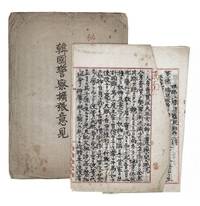
réf. 1116770 folding leaves all roughly 250 x 170 mm. Korea: mostly dated between 1910 and 1913. This fascinating collection comprises a series of handwritten administrative and case notes pertaining to police spying activities regulations and security planning in colonial Korea under Japanese rule. The documents were prepared by operatives in the Police Bureau of the Government-General of ChosÅn . Our documents are diverse in scope ranging from operational details such as surveillance and sentry procedures at the Amnok River Bridge 鴨緑江橋 the natural border between North Korea and China today accompanied by a folding colored map of the river oversight of local shrines and temples investigations into human trafficking and the abduction of women and civil police deployment plans covering major port cities. Certain entries are dated and bear the personal annotations of Akashi Motojiro who served as Chief of Police in the Government-General of ChosÅn and later became Governor-General of Taiwan. His contributions include a "Proposal to Expand the Ethnic Korean Police" marked "secret" and dated December 1911 as well as memoranda documenting statistics and tallies of Japanese and Korean police officers as of October 1912. Akashi's involvement underscores the significance of these notes for understanding the structure and priorities of the colonial police. Japan's formal annexation of Korea in 1910 inaugurated a colonial regime 1910-45 that employed its police force to maintain public order suppress dissent enforce new regulations and monitor civil society - overseeing everything from resident registration and religious activities to labor and public health. While the "military rule" of the 1910s gave way to a "cultural rule" with some reforms after 1919 police surveillance and public-security operations continued as fundamental mechanisms of control. This collection offers an extremely rare perspective on both the daily operations and the broader institutional planning of Japanese colonial policing. Fine condition. unknown books
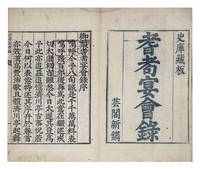
réf. 11384. 1 46 folding leaves. Small folio 346 x 227 mm. orig. yellow semi-stiff wrappers lightly rubbed title in manuscript on upper cover old stitching. HansÅng: Un'gak 1773. First and apparently only printing of the official record of "linked songs" composed at the royal banquet of elders on the occasion of King YÅngjo's r. 1724-76 80th birthday in 1773 printed the day after the banquet and presented to its guests. The title is not in WorldCat or KORCIS; we locate only two other copies both in Korea. In the intercalary third month of the 50th year of his reign King YÅngjo - the longest reigning monarch in ChosÅn history - held two birthday banquets within the KyÅnghŭigung 慶熙宮 palace complex. According to the colophon the first was a banquet of high-ranking officials held at the SungjÅng Hall 崇政殿 on the first day of the month. The second which took place a day later was a gathering of elders at the Kimsang Gate 金商門 "to reminisce about the events of the kingdom's past." The suggestion for these banquets came from the Grand Heir wangseson 王世孫 enthroned as King ChÅngjo in 1776 and was accepted by King YÅngjo only reluctantly. The high-ranking official SÅ MyÅng-ŭng å¾å‘½è†º 1716-87 who composed the colophon describes the festive banquet of elders as follows: "On this day the rain ceased and the sky cleared. A gentle breeze blew softly. Looking up at the throne one saw the King standing tall beneath the colorful canopies the table to his left and staff to his right. Looking down at the banquet hall one saw white-haired elders and toothless seniors their faces glowing amidst the delicacies. When the bells and drums were about to sound and the cups were not yet raised the elderly commoners delighting in this joyous gathering cast aside their staffs and rose to dance. Stooping and stumbling they advanced forward while shouting: 'May the King live a thousand years!'" King YÅngjo smiling at this sight composed a short verse that invoked the famous Song of Great Wind Ch. dafeng ge 大風歌 of Liu Bang 劉邦 256-195 B.C.E. the first king of the Han dynasty likewise written during an auspicious gathering of elders. He then asked the Grand Heir and other officials at the banquet to each compose a song echoing his own in three enneasyllabic lines ending with the sinographs sul 述 baek 百 and Åk 億 respectively. The sequence of "linked songs" thus composed - together with the names and positions of their authors - were collected and printed to ensure the longevity of their transmission. The colophon continues "King Gao of the Han in the prime of his life happily celebrated with the elders of his village. This was of course a common occurrence. Yet he did not know that throughout the four quarters of the realm ritual and music take precedence; instead he was preoccupied with recruiting fierce warriors.Now our sovereign achieving the seniority of Yao and Shun observes the flourishing rites of Yu and Xia. The sagely ruler honors the longevity of his subjects and his subjects likewise revere the longevity of the sage ruler. This is truly something unheard of among the rulers of the Han and Tang dynasties." SÅ MyÅng-ŭng believes that the format of linked songs which brought together King YÅngjo and his subjects through reciprocal "winds of transformation" K. p'unghwa 風化 elevated this Korean banquet above its various Chinese precedents and into closer proximity to the sagely rites of old. Writing on the transregional tradition of linked songs in East Asia Amy Y. Zhang observes the "ubiquitousness of linked verse as a potential means of constructing defining and negotiating community" and when adapted by the Korean monarchy it became "a way to cultivate harmonious relations with his subjects and to ensure continued prosperous rule"-Zhang "Writing Communities into Being: The Art of Linked Verse" PhD diss. Harvard 2025 pp. 243-44. Based on the presentation inscription on the front endpaper in our and another copy see below the woodblocks for the Record were likely carved overnight so that imprints could be distributed to guests of the banquet the next day "the third day of the intercalary third month of the 38th year of the Qianlong reign." The title-page states that the woodblocks were carved at Un'gak 芸閣 i.e. the kyosÅgwan 校書館 the royal printing house and kept within the royal archives K. sago å²åº«. Our copy was presented to Sin U-sang 申禹相 1730-99 the Assistant Director of the Ministry of War K. pyÅngjo chwarang 兵曹ä½éƒŽ whose name together with the song he had composed at the banquet appears on f. 36r of the Record. Facing the title-page and on the first leaf of the royal Preface is the Seal of Presentation K. naesa'in å…§è³œå° which reads sÅnsajigi 宣賜之記. The oldest of five seals of presentation used throughout ChosÅn history the sÅnsajigi seal appears in royal presentation copies from 1534 to 1778 as Lee & Song demonstrate in "A Study on Naesabon Preserved in Kyujanggak" in Journal of Korean Library and Information Science Society 43 no. 2. The title though recorded in traditional Korean bibliography is not in WorldCat or KORCIS. We locate only two other copies one held at the Academy of Korean Studies in SÅngnam call no. MF35-2211 and the other at the Sudang kot'aek ä¿®å ‚å¤å®… residence of the Yi clan in Yesan. The front endpaper of the Academy of Korean Studies copy is not digitized while the Sudang kot'aek copy bears a similar royal presentation inscription dated to the same day as our copy. It was presented to Yi Su-il æŽç§€é€¸ 1705-79 whose composition is recorded on f. 30r-v. Excellent copy a few leaves lightly stained on upper corner. unknown books