1211 resultados
1750Nürnberg, Georg Peter Monath, 1750. 4to. later hcalf. Raised bands. richly gilt spine. Old spine pasted on. Stamps on foot of title-page. Engraved frontispiece. (6),370,(10) pp., 6 folded engraved maps, 7 (of 8) engraved plates. First and last quires with scattered brownspots.
1913ref. 32062Copenhagen, 1913-17. Lex8vo. Alle 10 dele i orig. bogtrykte omslag, ubeskåret og uopskåret. 474,516,39,346,286,175,320,236,436,387 pp., tekstillustrationer, 4 portrætter, 153 plancher og 1 kort.
1815ref. 53829London, J. Mawman, 1815. Later hcalf. Raised bands, titlelabel with gilt lettering. Small stamp on title-page and the first leaves. (4),171,(3) pp. Faint marginal brownspots, wide-margined copy. Some contemporary reviews from newspapers bound in. At end a catalogue, 7 pp. from the publisher Gale, Curtis, and Fenner.
1801ref. 55912Paris, Nyon, AN IX (1801). Bound in 3 fine uniform contemp. full mottled calf. Stamp on title-pages. Richly gilt spines. Titlelabels with giltlettering. Broad gilt borders on covers. Inside gilt borders. All edges gilt. Light wear to some corners. Engraved folded frontispiece. (4),XXXVI,432(4),464(4),378 pp., 22 folded engaved plates and 6 folded maps. Internally clean and fine, on good paper.
1913Copenhagen, 1913-17. Lex8vo. Alle 10 dele i orig. bogtrykte omslag, ubeskåret og uopskåret. 474,516,39,346,286,175,320,236,436,387 pp., tekstillustrationer, 4 portrætter, 153 plancher og 1 kort.
1815London, J. Mawman, 1815. Later hcalf. Raised bands, titlelabel with gilt lettering. Small stamp on title-page and the first leaves. (4),171,(3) pp. Faint marginal brownspots, wide-margined copy. Some contemporary reviews from newspapers bound in. At end a catalogue, 7 pp. from the publisher Gale, Curtis, and Fenner.
1801Paris, Nyon, AN IX (1801). Bound in 3 fine uniform contemp. full mottled calf. Stamp on title-pages. Richly gilt spines. Titlelabels with giltlettering. Broad gilt borders on covers. Inside gilt borders. All edges gilt. Light wear to some corners. Engraved folded frontispiece. (4),XXXVI,432 (4),464 (4),378 pp., 22 folded engaved plates and 6 folded maps. Internally clean and fine, on good paper.
1774ref. PHO-1217Paris, Saillant et Nyon, Panckoucke, 1774. 4 volumes in-4, 2 ff., xviii, 1 ff., xxxii, 388; 3 ff., 536 ; 3 ff., 394, 1 ff.; 1 ff., viii, 367, veau marbré, triple filet doré, dos orné, pièces de titre et de tomaison , tome 1 , reliure différente (demi veau) , défauts de reliure ( charnières fendues , manques ,coins usés , coiffes absentes , etc),illustré de 47 planches et cartes (52), la plupart dépliantes , 1 planche déchirée avec manque , plusieurs déchirées sans manque , quelques feuillets détachés.
1832ref. PHO-1689Paris, J. Tastu, 1832, In-folio, demi-chagrin noir, dos orné de filets dorés à froid Atlas de botanique seul comprenant 76/80 pl. sur chine collé, liste des planches in fine, peu de défauts.
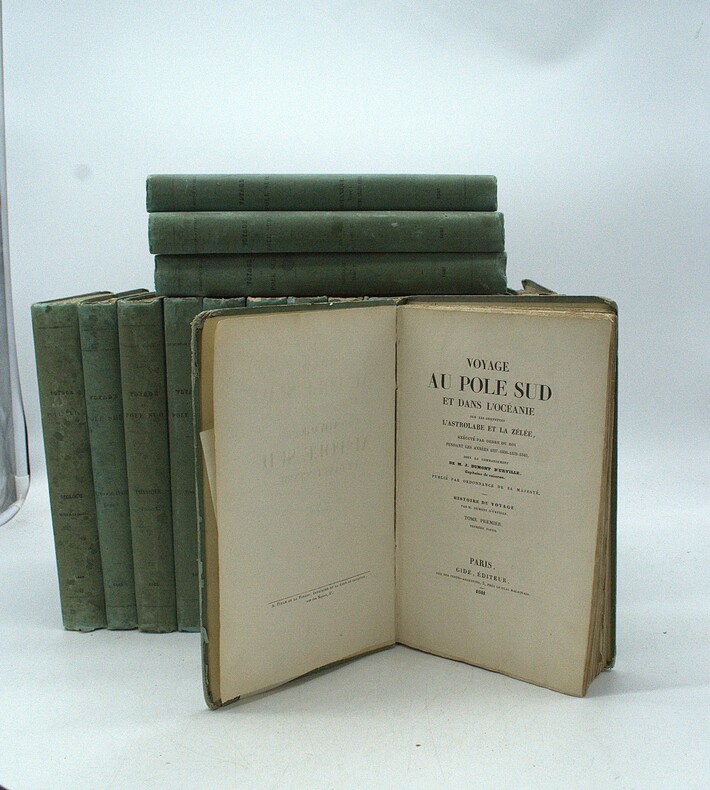
1841ref. PHO-1967Paris, Gide, 1841-1848, in-8, cartonnage éditeur, frottements, qlqs petits manques de matière, coins usés, qlqs coiffes usées, qlqs taches aux plats, T4 avec manque au dos et en haut du 1er plat 16 volumes de texte (sur 21) comprenant : Histoire du voyage, 1841-1846. 10 volumes en premier tirage, (1er tome, 1ère partie correspondant au 1er tome, 1er tome seconde partie correspondant au 2nd tome et 2nd tome, 1ère partie correspondant au tome 3), T2 mouillure en marge sur les derniers feuillets, T4 mouillure, T2 rousseurs, papier légèrement bruni aux tomes 3,4,5,6,7,8 et début tome 9. Zoologie, 1846, 2 volumes (sur 4, tome 1 et2) Botanique, 1845, 1 volume (sur 2), tome 1, plantes cellulaires, papier légèrement bruni Physique, 1842. 1 seul volume (en raison de la mort de Vincendon-Dumoulin) bien que d’autres annoncés, papier légèrement bruni Géologie, Minéralogie et Géographie physique du Voyage. 1848- 1 volume (sur 2, le second paru en 1854), 1 planche in-fine, papier légèrement bruni Hydrographie. 1843. 1 volume (sur 2), 1 planche in-fine, papier légèrement bruni.
1844ref. PHO-2326Paris, Artus Bertrand, 1844, 2 volumes in-8 (220 x 135 mm), xlvi-295pp.-2ff.-298p-1058p., Demi-chagrin et coins, dos lisse avec auteur, titre et tomaison, très légers défauts. Illustrée de 2 cartes dépliantes gravées par S. Jacobs, montées en fin du premier volume : "Carte de l’archipel Taïti par Vincendon-Dumoulin", 1844 et "Carte de l’île Taïti d’après Vilson et les travaux récents de la frégate l’Artémise".
1774ref. PHO-2388Paris, Saillant et Nyon, Panckoucke, Hôtel de Thou, 1774-1785, 14 vol. in-8 (20x12,5cm). Basane porphyre poque, dos à nerfs avec pièces de titre, date du voyage et tomaison maroquin vert, triples filets aux plats, tranches cailloutées bleues. Coins usés, coiffes arasées, frottements, etc…, petite mouillure au t1. 2 tableaux dépliants au tome 3 du 3ème voyage.
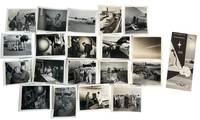
1963ref. 237791963. Operation Deep Freeze U.S. Navy photo archive documenting the preparation and execution of the first flight from Africa to Antarctica September 27 to October 1 1963 a 4700-mile airlift that demonstrated the expanding reach of the American Antarctic logistics network. The flight occurred as the United States was transforming its Antarctic presence from the expeditionary operations of the International Geophysical Year into a permanent scientific program dependent upon military transportation and infrastructure. Photographed principally by Lt. jg H. S. Hemphill for Task Force Forty Three the archive follows two VX 6 LC 130F Hercules aircraft through preparations in South Africa the flight to Antarctica and arrival at McMurdo Station. The aircraft departed Cape Town on September 30 carrying 9600 gallons of fuel each and weighing approximately 10000 pounds above their usual operating weight; after 14 hours and 26 minutes they reached McMurdo where Rear Admiral James R. Reedy formally opened Deep Freeze 64 operations on October 1. Photo archive of 17 silver gelatin photographs approximately 4 x 5 inches Cape Town South Africa aboard VX 6 LC 130F aircraft and McMurdo Station Antarctica September 27 to October 1 1963; with the U.S. Naval Support Force Antarctica pamphlet Antarctic Highlights Washington 1969. The photographs form a contemporary visual record of the first Cape Town-to-McMurdo flight from ground preparation through arrival with Navy captions identifying personnel aircraft and stages of the operation. At Cape Town crews remove unnecessary equipment and clothing to reduce aircraft weight test communications inspect fuel systems and prepare the 3600-gallon auxiliary tank required to extend the range of the LC 130F. James P. Houghton appears beside the tank; Claude C. Stanley and John E. Wood inspect aircraft 148318 before departure. A crew portrait identifies Andrew C. Huggins William B. Kurlak John D. Stitch Thomas H. Dunn M. E. Westlund Robert Wolcott George H. Fuller E. R. Simpson Jack H. Tankersley and Houghton. In flight Staff Sergeant Arthur L. Kreing works over navigation charts Alan F. Blanchard and Richard A. Millington play cards and other crewmen rest receive oxygen and change into cold-weather clothing as the aircraft approaches Antarctica. One image captioned "The morning after Cairo" shows John Wood administering oxygen to Chief Claude C. Stanley while Chief Earl D. Gordinier waits nearby. At McMurdo Hemphill records Rear Admiral Reedy leaving the aircraft after the 4700-mile flight and being met by Commander R. R. McGregor of Antarctic Support and wintering commander Robert Marvel. The accompanying Antarctic Highlights pamphlet describes the Navy's Antarctic stations aircraft ships communications power systems and support of scientific work. The flight came only a few years after the International Geophysical Year of 1957 to 1958 and two years after the Antarctic Treaty entered into force. Sustaining the expanding American scientific presence required a logistical system capable of moving personnel equipment fuel and supplies across thousands of miles into one of the world's least accessible regions. The Cape Town-to-McMurdo flight demonstrated that the Navy's developing LC 130 airlift system could reach Antarctica directly from Africa as well as through the established New Zealand approach. Hemphill's photographs consequently document more than an aviation first: they record the military transportation infrastructure that helped transform American activity in Antarctica from periodic expeditions into sustained scientific operations. Slight curling to the photographs with contemporary verso annotations intact; photographs overall in very good condition and pamphlet in good condition. unknown
1963ref. 237791963. Operation Deep Freeze U.S. Navy photo archive documenting the preparation and execution of the first flight from Africa to Antarctica September 27 to October 1 1963 a 4700-mile airlift that demonstrated the expanding reach of the American Antarctic logistics network. The flight occurred as the United States was transforming its Antarctic presence from the expeditionary operations of the International Geophysical Year into a permanent scientific program dependent upon military transportation and infrastructure. Photographed principally by Lt. jg H. S. Hemphill for Task Force Forty Three the archive follows two VX 6 LC 130F Hercules aircraft through preparations in South Africa the flight to Antarctica and arrival at McMurdo Station. The aircraft departed Cape Town on September 30 carrying 9600 gallons of fuel each and weighing approximately 10000 pounds above their usual operating weight; after 14 hours and 26 minutes they reached McMurdo where Rear Admiral James R. Reedy formally opened Deep Freeze 64 operations on October 1. Photo archive of 17 silver gelatin photographs approximately 4 x 5 inches Cape Town South Africa aboard VX 6 LC 130F aircraft and McMurdo Station Antarctica September 27 to October 1 1963; with the U.S. Naval Support Force Antarctica pamphlet Antarctic Highlights Washington 1969. The photographs form a contemporary visual record of the first Cape Town-to-McMurdo flight from ground preparation through arrival with Navy captions identifying personnel aircraft and stages of the operation. At Cape Town crews remove unnecessary equipment and clothing to reduce aircraft weight test communications inspect fuel systems and prepare the 3600-gallon auxiliary tank required to extend the range of the LC 130F. James P. Houghton appears beside the tank; Claude C. Stanley and John E. Wood inspect aircraft 148318 before departure. A crew portrait identifies Andrew C. Huggins William B. Kurlak John D. Stitch Thomas H. Dunn M. E. Westlund Robert Wolcott George H. Fuller E. R. Simpson Jack H. Tankersley and Houghton. In flight Staff Sergeant Arthur L. Kreing works over navigation charts Alan F. Blanchard and Richard A. Millington play cards and other crewmen rest receive oxygen and change into cold-weather clothing as the aircraft approaches Antarctica. One image captioned "The morning after Cairo" shows John Wood administering oxygen to Chief Claude C. Stanley while Chief Earl D. Gordinier waits nearby. At McMurdo Hemphill records Rear Admiral Reedy leaving the aircraft after the 4700-mile flight and being met by Commander R. R. McGregor of Antarctic Support and wintering commander Robert Marvel. The accompanying Antarctic Highlights pamphlet describes the Navy's Antarctic stations aircraft ships communications power systems and support of scientific work. The flight came only a few years after the International Geophysical Year of 1957 to 1958 and two years after the Antarctic Treaty entered into force. Sustaining the expanding American scientific presence required a logistical system capable of moving personnel equipment fuel and supplies across thousands of miles into one of the world's least accessible regions. The Cape Town-to-McMurdo flight demonstrated that the Navy's developing LC 130 airlift system could reach Antarctica directly from Africa as well as through the established New Zealand approach. Hemphill's photographs consequently document more than an aviation first: they record the military transportation infrastructure that helped transform American activity in Antarctica from periodic expeditions into sustained scientific operations. Slight curling to the photographs with contemporary verso annotations intact; photographs overall in very good condition and pamphlet in good condition. unknown books
1748ref. 6620Kbhvn., Chr.Rothe, 1748. Samt. helldrbd. Rig rygforgyldning, som dog er delvist bortslidt. Kobberst.frontisp., (36), 574 pp. Kobberst.titelvign., foldekort og 4 kobberst. plancher, nogle plancher rep. i kanter og foldning. Titelblad rep.i højre margin.
1748Kbhvn., Chr.Rothe, 1748. Samt. helldrbd. Rig rygforgyldning, som dog er delvist bortslidt. Kobberst.frontisp., (36), 574 pp. Kobberst.titelvign., foldekort og 4 kobberst. plancher, nogle plancher rep. i kanter og foldning. Titelblad rep.i højre margin.
1773London, Strahan & Cadell, 1784, due volumi in-4° (cm. 29 x 21,5) legatura ottocentesca in mezza pelle con angoli, titoli dorati al dorso, tagli marmorizzati, pp. XL-378 con 37 tavole fuori testo, compreso il ritratto dell’A. in antiporta + 396 con 27 tavole fuori testo. Le stupende incisioni in rame, anche a piena e doppia pagina, sono realizzate per lo più sui disegni dal vero di W. Hodges; ci sono inoltre mappe della spedizione, anche di grandi dimensioni e più volte ripiegate, sezioni di piroghe, tavole raffiguranti piante, animali e vari oggetti provenienti dalle isole del Pacifico esplorate dall’A. In fine, il prospetto delle rotte della spedizione; un vocabolario della lingua parlata nelle Society Isles; una lista delle varie lingue parlate nei Mari del Sud; e un saggio di Sir J. Pringle su come preservare la salute dei marinai. L’opera è il resoconto ufficiale della seconda spedizione di Cook nell’emisfero australe, quella in cui per la prima volta viene oltrepassato il Circolo Polare Antartico (gennaio 1773). Vengono scoperti ed esplorati, inoltre, vari gruppi insulari del Pacifico meridionale, in merito ai quali viene fornita qui per la prima volta una grande quantità d’informazioni. Qualche lieve spellatura e sbucciatura ai dorsi, angoli consunti; vistosi restauri ai due frontespizi e alla seconda carta del secondo volume, senza mai perdita di testo. Rare e leggere fioriture, alcune carte un po’ brunite. Nel complesso, una copia molto buona, completa di tutte le tavole, di quest’opera famosa, la più bella di Cook. Questa edizione è l’ultima a essere del medesimo formato di quella originale del 1777.
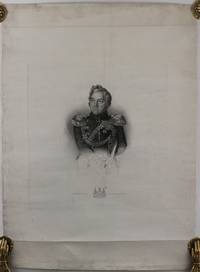
ref. R60Steel engraving print size 39x345 cm on a large sheet 655x485 cm. “B.R. Davies direxit. J. Thomson sculpt.” underneath the image. With an engraved title in Russian and Lazarev’s coat of arms engraved on the lower margin. Blank margins with minor repaired tears creases on the upper and lower blank margins not affecting the images overall a very good print. Official portrait of Admiral Mikhail Petrovich Lazarev 1788-1851 Russian naval officer circumnavigator and the discoverer of Antarctica. The print engraved in England on the special order of the Russian Naval Ministry shows Lazarev in his late years as the Chief of Staff of the Black Sea Fleet since 1832; the Admiral is depicted waist length dressed in uniform with all his regalia and holding a spyglass under his left arm. His name under the portrait is adorned with the coat of arms of Lazarev noble family. ‘‘Lazarev first circumnavigated the globe in 1813-1816 aboard the vessel Suvorov; the expedition began at Kronstadt and reached Alaska. During this voyage Lazarev discovered the Suvorov Atoll. As a commander of the ship Mirny and Fabian Gottlieb von Bellingshausen’s deputy on his world cruise in 1819–1821 Bellingshausen commanded Vostok Lazarev took part in the discovery of Antarctica and numerous islands. On January 28 1820 the expedition discovered the Antarctic mainland approaching the Antarctic coast at the coordinates 69°21’28’’S 2°14’50’’W / 69.35778°S 2.24722°W / -69.35778; -2.24722 and seeing ice-fields there. In 1822-1825 Lazarev circumnavigated the globe for the third time on his frigate Kreyser conducting broad research in the fields of meteorology and ethnography’’ Wikipedia. Later Lazarev took part in the Battle of Navarino 1827 part of the Greek War of Independence 1821-32; was in charge of the naval units of the Baltic Fleet 1830 and became the Commander of the Black Sea Fleet the Black Sea ports and military governor of Sevastopol and Nikolayaev since 1833. unknown
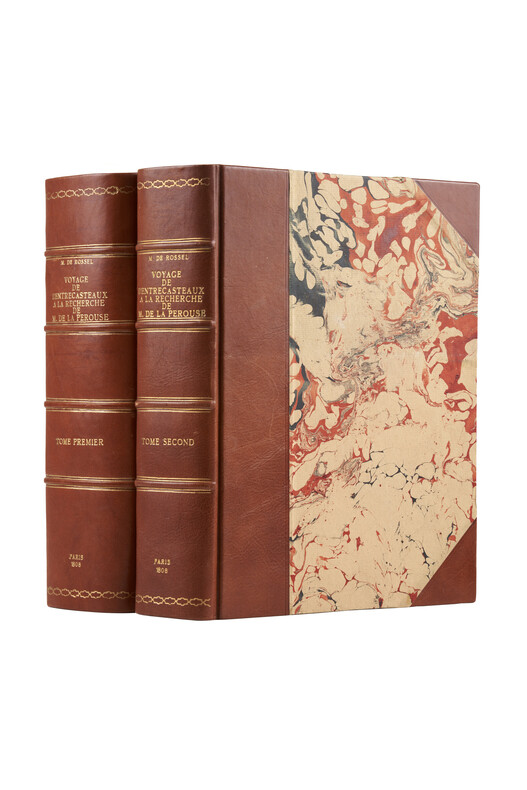
1808ref. PHO-1626Paris, Imprimerie impériale, 1808. 2 grands et forts volumes in-4 (32x24), lvi, 704 p., 33 pl. ; viii, 692 p., relié demi basane et coins moderne, dos avec auteur, titre, tomaison, lieu et date, exlibris en page de garde, non rogné, tome 2 non coupé, petite mouillure au tome 2, petites rousseurs aux illustrations du tome 1. Exemplaire sur papier bleuté, complet de son illustration mais sans son atlas de cartes
1889Kjøbenhavn, Bianco Luno, 1888 & 1889. 8vo. 2 volumes, uniformly bound in a bit later half calf with gilt lettering to spines. In ""Meddelelser om Grønland"", vol. 9-10. Light sunning to spine and a few scratches to boards, otherwise a fine and clean set. (14), 420 pp. + 17 folded plates" (8), 400, (10) pp. + 41 plates, each with an accompanying leaf of text and 1 folded map.
1832Kiøbenhavn, J. D. Qvist, 1832. 4to (255 x 213 mm). Nice contemporary half calf over marbled boards with gilt lettering and ornamentation to spine. With offsetting to verso of plates and vague, barely visible dampstain to upper outer corner on pp. 193-210. An exceptionally fine and clean copy. XVII, (1), 216 pp. + 8 coloured plates (all with preserved tissueguards) and 1 large folded map.
1906ref. ANTARCTI024617William Blackwood Edinburgh and London. 1906. First edition. Prefatory Note by William S. Bruce. Octavo. pp xxiv 375. Numerous black-and-white photographs; two folding maps one at rear. Original slate-grey pictorial cloth lettered in white. An account of the Scottish Antarctic Expedition 1902-1905. Peter Speak author of William Speirs Bruce: Polar Explorer and Scottish Nationalist 2003 describes the expedition as "by far the most cost-effective and carefully planned scientific expedition of the Heroic Age" and yet it received no formal honour or recognition from the British government and its members were denied even the prestigious Polar Medal. A major achievement of the expedition was the cataloguing of more than 1100 species of animal life 212 of them previously unknown to science. R.H. Rudmose Brown was the chief botanist. Presentation copy inscribed on the half-title page: "With the kind regards of R.N. Rudmose Brown" and with a short inscription on the headed notepaper of The University Sheffield: "To Mr Hendrickson with happy memories of a day in Green Harbour - R N Rudmose Brown". The recipient Peder Leonard Henrickson 1859-1932 was a harpooner and because of his extensive experience of hunting in Arctic waters was taken on by Fridjof Nansen for the 1893-6 Norwegian Polar Expedition on board the Fram. J. Arthur Bain in his Fridtjof Nansen: His Life and Explorations 1895 describes him thus: "He is a tall square-built man of exceptional physical powers which have often been severely tested. When off Novaya Zemlya in 1888 the schooner Enigheden of Christiansund on which he was harpooner became a total wreck. The storm continuing he was compelled to remain on deck for several days during which he was literally encased in ice. He at last managed to crawl ashore and report says 'was able to thaw and dry his clothes.' His herculean strength has enabled him to endure all hardships and he entered on his latest voyage with an iron constitution and strong resolve." Green Harbour or Gr�nfjorden in Norwegian lies on the southern side of Isfjorden on Spitsbergen's west coast. Rudmose Brown published a book Spitsbergen: An Account of Exploration Hunting the Mineral Riches & Future Potentialities of an Arctic Archipelago 1920 and presumably he met Hendricksen during the course of his researches. Most of the white enamel lettering on the spine had flaked off but is intact together with the illustration on the upper cover. Three closed tears to the folds of the last large map about 5-6cm each. Bump to top corner of front cover. Top corner of the text block of the first few pages slightly bumped. Overall a very good copy indeed. William Blackwood, Edinburgh and London. hardcover
ref. 59950(Copenhagen, DMI, 1893-1930). Small folio. The issues 1893-1915 are all bound with all the original printed wrappers (stating that they are off-prints) for every issue (except for the front wrapper for the first issue) in four near contemporary blue half cloth bindings with gilt titles and years to spine. The issues 1916-1930 are all present in the original printed wrappers and housed in three custom-made slipcases identical to the four preceding volumes. Ste back wrapper of the 1924-issue is loose. Otherwise the set is generally in excellent condition, with stamps from the Danish Meteorological Institute, in the holdings of which it has been until the present day. With numerous charts and maps throughout.
(Copenhagen, DMI, 1893-1930). Small folio. The issues 1893-1915 are all bound with all the original printed wrappers (stating that they are off-prints) for every issue (except for the front wrapper for the first issue) in four near contemporary blue half cloth bindings with gilt titles and years to spine. The issues 1916-1930 are all present in the original printed wrappers and housed in three custom-made slipcases identical to the four preceding volumes. Ste back wrapper of the 1924-issue is loose. Otherwise the set is generally in excellent condition, with stamps from the Danish Meteorological Institute, in the holdings of which it has been until the present day. With numerous charts and maps throughout.
1777Bern, Typographischen Gesellschaft, 1777. 4to. Contemp. full calf. Raised bands, gilt spine. Titlelabel with gilt lettering. Gilt borders on covers. Edges of covers gilt. A stamp on title-page. (6),122 "(4),304,(2) pp., 5 folded engraved maps and 6 folded engraved plates. Light foxing to 1 map. Clean and fine, printed on thick paper.