Thou, Jacques-Auguste de.MareMagnum

8vo. 126 pp., final blank f. With printer's device on t. p. Half vellum (c. 1900) with marbled boards and giltstamped spine title. Edges sprinkled in red. Third edition of the famous "Hieracosophion", the second to contain the third book. - "Celebrated poem on falconry" (Schwerdt), written in Latin hexameters by Jacques-Auguste de Thou (1553-1617), a distinguished and highly erudite French nobleman. "His poem was reprinted by N. Rigault in 'Rei Accipitrariae Scriptores' in 1612 and also translated into Italian [...] De Thou succeeded his father, Christophe, as president of parliament; he was privy councillor to Henry III, and also to Henry IV of France, and keeper of his library. He was not thirty when he composed the elegant verses on hawking, which were probably inspired by the experience he gained of this noble sport during his sojourns at foreign courts" (ibid.). On p. 7, we find "an important note on the various kinds of hawks used for Falconry, with the Latin and French names for them" (Harting). - Very minor brownstaining; traces of an old bookseller's label on endpapers. A good copy. Adams T 658. BM-STC French 225. Barbier IV, 1270. Harting 306. Souhart 461. Schwerdt II, 261. Thiébaud 897. Graesse VI/2, 147. OCLC 69042873. Cf. Brunet V, 840 (first ed. 1584). Not in Renouard or Schreiber.
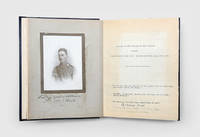
1918réf. 156559India Mesopotamia and Persia: December 1914 - July 1918. I have come to the conclusion that the war out here is much more pukka campaigning than in France An unpublished and otherwise untraced First World War album recording the experiences of an officer serving in India Mesopotamia and with Dunsterforce in Persia. It preserves his lively letters home and over 150 photographs taken on duty the final letter written only days before he was killed in action at Resht. Most letters are addressed to his mother Ada Eliza Wilkinson née Machin and the album opens with his formal portrait signed by her on the verso. Beginning with his voyage to India in December 1914 he records life in Port Said the Suez transit and his posting to Quetta where he lived comfortably but grew frustrated at being far from the fighting. Throughout 1915 he describes training frontier camps and the slow grind of the war his early enthusiasm giving way to weariness and disillusion. In late 1916 he finally volunteered for active service in the Middle East reaching Basra in October and soon taking part in mobile desert operations railway protection and frequent skirmishes with Turkish forces. His letters convey both the hardships and the relative freedom of campaigning compared with the Western Front. Wounded by a sniper in early 1917 he recuperated briefly in India before returning to the field. In December 1917 he joined Dunsterforce in Persia reporting on the weakening Ottoman position. He was killed in action at Resht on 20 July 1918 and buried with military honours at the Russian consulate. The album concludes with numerous letters of condolence from senior officers and comrades. The photographs document Bombay Quetta Delhi and daily military life in India as well as Basra Amara Beit Nama and operations in Mesopotamia and Persia including irrigation works armoured cars and troop movements. Loosely inserted are three autograph letters a postcard and a 1949 British Legion Service of Remembrance. No other manuscript or typescript copies of the letters are known. The family also compiled a memorial volume for Wilkinson's brother Geoffrey Miles Wilkinson killed later in the war. Quarto 255 x 205 mm. Occasional contemporary manuscript annotations. Together 258 typescript sheets each with text one side only 153 mounted photographs with typescript captions mostly gelatin silver snapshots photographic portrait mounted on card. Bound in contemporary black leatherette front cover monogrammed "J.G.W." Binding with some wear typescript sheets toned some photos oxidized as expected foxing and adhesive marks to opening portrait: a very good example. hardcover
Small folio (27 x 18 cm). XVIII, 170 pp. (pp. VI and XVIII blank). With 14 sepia photographic plates, 1 folding facsimile letter, 2 folding graphs, a plate with 6 pie charts and 1 illustration (also in red) showing schematically a smuggling box. Original pink paper wrappers. Exceptionally rare work on drug trafficking in Egypt in the 1930s and an important example of the "war on drugs" of the author, who was director of the Central Narcotics Intelligence Bureau. Thomas Wentworth Russell (1879-1954), sometimes better known as Russell Pasha, was a police officer in service of Egypt who was appalled by the increasing drug trafficking in Egypt and the high amount of drug addicts in the country. He founded the Central Narcotics Intelligence Bureau (CNIB), making it his mission to rid Egypt of especially what he called "white drugs" (cocaine, morphine, heroin), but also of "black drugs" (hashish, opium). Russell can be considered as one of the most important anti-drug campaigners in Egypt in his time and after, as he really raised awareness for the rising problem. In this work, Russell describes how drugs are smuggled in large quantities from abroad to Egypt. In many chapters, he extensively describes the foreign sources of supply (discussing not only important drug barons, but also mentioning specific ships and other means of transport which smuggled drugs), cases in which weapons were used by traffickers, on people involved in the trade, on traffickers and their methods of smuggling (among others in shoes, camel saddles, etc.), on addiction and the social effects and death rates, and many more. It is a scarce and outstanding example of Russell's anti-drug campaign, extensively describing drug trafficking in Egypt in the 1930s, being well-illustrated with photographs of drug barons, users, traffickers and methods of concealment. - Presentation copy to the English poet and dramatist John Drinkwater with an inscription by Russelll on the front wrapper ("John Drinkwater / With compliments from the director / Tho Russell / 24/3/33" / [Arabic script]") and his red stamp next to the inscription. - Spine worn, front wrapper detached, covers with light residual dampstain. A highly uncommon survival. Not in WorldCat.
4to. (7) ff., 1 blank f., (4) ff. With woodcut device on title, large historiated woodcut initials, and an additional engraved folding plan of Tripolis (204 x 285 mm), not called for by bibliographies. 18th century full vellum with giltstamped red morocco label to spine (very similar to the bindings done for the Venetian library of Giacomo Soranzo). First dated publication of Ulloa's account of the siege of Tripolis in Italian. Includes the three-page dedication to Johann Jakob Fugger - the only place in the book where Ulloa's name appears. The author, a courtier of King Philip II, celebrates the defence of St Angelo's fortress on Malta, modern Libya. - In the 1551 Siege of Tripoli, the Ottoman fleet vanquished the Knights of Malta in Tripoli; the city was captured on 15 August by Sinan Pasha after six days of bombardment. The knights, many of them French, were returned to Malta upon the intervention of the French ambassador, and shipped onboard his galleys, while the mercenaries were enslaved. Murad Agha, the Ottoman commander of Tajura since 1536, was named as the Pashalik of the city. The siege was the first step in the all-out Italian War of 1551-59 in the European theatre. In 1553, Dragut was nominated commander of Tripoli by Suleiman, making the city a centre for piratical raids in the Mediterranean and the capital of the Ottoman province of Tripolitania. In a famous attack from Tripoli, in 1558, Dragut attacked Reggio and took all its inhabitants as slaves to Tripoli. In 1560, a powerful naval force was sent to recapture Tripoli, but that force was defeated in the Battle of Djerba, an event also described in Ulloa's book. The end of the volume is brought up by an interesting four-page account of Malta ("Descrittione dell'Isola di Malta") and a list of the names of Christian knights who died in the siege. The fine engraved plate bound after the preliminaries, entitled "Il vero disegno del porto, della città, della fortezza, et del sito dove è posta Tripoli di Barbaria. Ven. l'anno 1567 alla libreria della Colonna" appeared a year after the book. It is engraved by Paolo Forlani. - A clean, well preserved copy. Edit 16, CNCE 37528. BM-STC Italian 704. Gay 1494. Palau 343.401. Göllner 1134. Graesse VI, 224. Olschki L II, 222. Cf. Mortimer 509 (with note on this edition). Not in Adams, Blackmer or Aboussouan. This edition not in Atabey.
147 albumen and silver gelatin print photographs, mounted on loose cardstock (recto and verso). Some with inked captions in contemporary hand. Included is a typewritten military communication, also laid down on two sides of cardstock. Over one hundred photographs of French exploration of the Sahara by airplane and automobile in the first decade of flight, set against the backdrop of WWI, the first years of aviation, the Kaocen revolt, and French colonization of Algeria. - Thirty-two aerial photographs show not only towns and oases of the M'zab region of Saharan Algeria such as El Guerrara and Melika, but likely the landmarks by which early pilots were learning to navigate in vast tracts of desert; other photographs feature the Farman F.41 biplane, briefly in use in French North Africa in 1917. The goal to traverse the Sahara was not without dangers: two disasters appear in the record. One is a plane crash, shown in four photographs of a group of men inspecting the wreckage of a downed plane, possibly one of the Farman F.41s, though its state makes identification difficult. The second involves an altercation with local Tuareg people, with whom the French were at war at the time, in the midst of the larger conflict of WWI. The skirmish is described in a typed military communique. Addressed from the Gouvernement General de l'Algerie, 19th Corps d'Armee, Territoire du Sud, Territoire des Oasis, it reads: "Le commandant Militaire fait part aux Troupes du Territoire de la mort glorieuse due Personnel de l'Aviation Saharienne parti de Ouargla en reconnaissance automobile sure In-Salah le 27 Janvier [...] A leur arrivée dans les gorges d'Ain-Guettara; le Ier Février, les deux automobiles sont tombées dans une embuscade tendue par un rezzou de 80 Touaregs dissidents. Après une lutte héroique et après avoir épuisé toutes ses munitions, la petite troupe a été anéantie. Ce sont les premières victimes de la pénétration automobile et aérienne au Sahara [...] L'Escadrille Saharienne nouse aidera un jour à les venger". - Altogether, the collection provides a unique window into a series of historical moments: early aviation, exploration of the Sahara, French colonialism in Algeria, the Tuareg resistance, and the First World War. - A touch of wear, otherwise well preserved.
4to. (2), 362 pp. (but: 360 pp.; p. 176f. omitted); 100 pp. (complete). With engraved frontispiece (margins trimmed) and 16 engraved plates. Contemporary full vellum with ms. spine title. Leaves Bb2-4 and Cc1-2 supplied from another copy. The first German edition of Vairasse's "Histoire des Sevarambes" ("History of the Sevarambians"), translated from the French 1677-79 edition. This is an account of an imaginary journey to Australia, a utopian history in the style of Thomas Moore. Presented in the manner of the then-current geographical and anthropological works, the book provides a direct criticism of revealed and imposed religions, in particular of 17th century Catholicism. Remarkably, this edition also includes the first German publication of Thomas Skinner's slavery narrative entitled "The adventures of an English merchant, taken prisoner by the Turks of Algiers, and carried into the inland countries of Africa" ("Die Selsamen Begebenheiten Herrn T. S. Eines Englischen Kauff-Herrens, Welcher von den Algierischen See-Räubern zum Sclaven gemacht, und in das inwendige Land von Africa geführet worden"). - Lower margin of title torn with some loss, final two leaves torn and frayed without loss of text. Minor foxing to the plates; binding worn, edges somewhat defective. From the library of Swedish antiquarian bookdealer Björn Löwendahl (1941-2013). VD 17, 39:131551R. Holzmann/Bohatta II, 12150.
6 telegram folios (208 x 304 mm), dated 6 to 18 January 1922, pinned together with a cover note marked "very confidential" with the oval embossed seal of the Government of India. Includes a Grant of the Dignity of a Companion of "the Most Eminent Order of the Indian Empire" to Eardley Garforth Bryan Peel, issued by King George V, dated 2 June 1923, signed by the King and by Viscount William Peel as Secretary of State for India, to acknowledge the services rendered to secure British interests in the southern provinces of Persia. Stored loosely in later dark green calf document holder box, spine stamped in gold "Residency Ahwaz Bushire 1922/3" (257 x 375 mm). A collection of confidential Anglo-Persian diplomatic cables relating to the appointment of Eardley Garforth Bryan Peel (1888-1976) as British Consul General at Ahwaz (Southern Iran) in view of his good relations with the Bakhtiari Khans, Sheikh Khazal of Mohammerah and the Anglo-Persian Oil Company (APOC). - This group of important telegram exchanges from Percy Lyham Loraine (Envoy Extraordinary and Minister Plenipotentiary at Tehran), Arthur Prescott Trevor (Consul General at Bushehr, Southern Iran), and the Indian Political Service at Delhi, are pinned together with a cover note dated 18 January 1921, marked "very confidential" and bearing the stamp of the Government of India, indicating their subtle and yet relevant relation. They testify to the British government's shift of alliance from Sheikh Khazal of Mohammerah to Reza Khan and the central government in Tehran. The Grant of Dignity appointed to Peel further emphasises the connection between this prominent stakeholder and British oil interests. Thus, this collection plays a crucial role in shedding light and understanding the 'behind the scenes' of British foreign politics related to the protection of their oil fields in Khuzestan, and their procurement and management of Iranian oil in the first two decades of the 20th century. - Ever since the British discovery of oil in the Southern Iranian Province of Khuzestan in 1908, and the formation of the APOC the following year, a fine balance was maintained by knowledgeable British Consuls General between the Bakhtiari leaders, seated in Bushehr, and the powerful Sheikh Khazal (who inherited the Emirate of Mohammarah in 1897), seated at Mohammarah. The Khans and the Sheikh, ruler of Arabistan, received annual payments, political support, as well as arms and munitions from the British in return for guaranteeing support and protection of British interests against external attacks and providing security for the oil establishment. Until Reza Shah’s rise to near-absolute power and his coup d’état of 1921, the Iranian government had little control of the de facto autonomous province of Khuzistan and their local leader. This explains why all of Loraine’s formal and informal efforts, as British Envoy Extraordinary and Minister Plenipotentiary in Iran from 1921 until 1926, were directed towards achieving the peaceful submission of Britain’s Southern Iranian allies to the regime in Tehran. - In such delicate circumstances and given the inevitability of a conflict between the burgeoning central government in Tehran and the Southern Iranian tribal powers, the re-appointment of Eardley Garforth Bryan Peel, whose term of office at Ahwaz had ended in 1921 at the same time Loraine assumed office at Tehran, became a necessity to be able to mediate between the two litigious parties. In fact, Peel was the only person who not only had an in-depth understanding of the situation but was trusted by all members involved. As shown in our telegrams, the Indian Political Service at Delhi not only accepted Loraine’s advice to allow Peel to remain Consul General at Ahwaz but also nominated him to receive a British CIE order. Peel proved a skilled negotiator and succeeded in his mission of yielding a peaceful transition of power in Southern Persia and avoiding any threats to British interests in the oilfields. He managed to convince Khazal and the Bakhtiari Khans to meet in Dare Khazinah from 22 April to 2 May 1922 and made them promise to cooperate in virtue of protecting British interests, but also to continue to serve the Persian government faithfully and loyally, in order not to irritate Reza Khan. - Despite Peel’s tactful diplomacy, which averted great bloodshed, the British soon abandoned their Southern Iranian allies in favour of good relations with the increasingly powerful central government. Khazal was persuaded to surrender unconditionally and Reza Khan had him abducted and brought to Tehran, where he was kept for several years. His sheikhdom was abolished, and the provincial authority took full control of regional affairs. The Sheikh was stripped of all his powers and Iranian assets, and when he denied relocation to Iraq or Kuwait, he was assassinated in Mohammarah (now Khorramshahr) in 1936. These documents play a crucial role in unravelling the extremely complicated and confidential sequence of events that took place in those years, which stained early 20th-century Anglo-Persian diplomatic relations with the uncontrollable force of nature oil was to be in modern history, and specifically, in the geopolitical chessboard of Middle Eastern foreign affairs. - E. G. B. Peel was a British diplomat who, after achieving the rank of Captain in the Indian army, was posted first as Assistant-Superintendent of Police in Moradabad (Agra province, India) and later as a member of the Indian Political Service to the consulate at Mohammerah, where he rose to the rank of Acting Vice-Consul. In 1918 he was transferred to the consulate in Ahwaz, where he served until 1924 in the posts of Acting Vice-Consul (1918-21), Local rank Consul (1921-22), and Consul (1922-24). After completing his service at Ahwaz, he was posted to Agra and Kashmir provinces in India. He received the illustrious CIE (Companion Order of the Indian Empire) in 1923. - Provenance: the former property of a private English bibliophile, purchased from J & S. L. Bonham's, London, in 1999.
760 x 750 mm. Scale 1:1,000,000. Relief shown by hachures, spot heights, submarine contours, airports and airstrips, mining activity, and land routes. Key in English. Printed on cloth. Blueprint map of Saudi Arabia covering 20-26° N and 38-45° E, extending from the Nejd to the Red Sea coast including Jeddah and Yanbu al-Nakhal. It pays particular attention to geological features, showing the lava fields of Harrat Rahat, Harrat Kishb, Harrat Khaybar, Harrat Nawasif, Harrat Buqum and Harrat Hadan, as well as the Uruq Subay dunes and the tribal areas of Bilad Zahran and Bilad Ghamid. Among the most prominent labelled cities are Mecca with its environs (Muna, Shumaysi), Medina, Jeddah and Taif; the Darb al-Hijaz (Riyad-Jeddah Road) is named. - The sheet was prepared as a working document by Aramco and the US Geological Survey to help them in the early stages of comprehensive nationwide mapping and exploration work for the Saudi Government. - Slightly toned along folding lines and right margin.
Large 4to. All 31 issues, comprising a total of 774 pp. (some lithographic, others published as a typescript, but mostly letterpress), preserving the original printed wrappers. With 2 folding plans. Bound in 1920s green half calf over marbled boards. Rare collection of the annual reports published by the administrative board of the Beirut Port holding company: the complete stretch from 1889 (when work on the harbour began) to 1922. - Even since the 1860s, the old harbour of Beirut, 150 by 100 metres in length and a mere two metres deep, was rapidly becoming too small for the ever-expanding volume of traffic. In 1887 a consortium was formed of the Compagnie Impériale Ottomane de la Route Beyrouth à Damas, the Ottoman Bank, the Comptoir d'Escompte de Paris, the Banque de Paris et des Pays-Bas, and the Compagnie des Messageries Maritimes. Reincorporated as the Paris-based "Compagnie Impériale Ottomane du Port, des Quais et Entrepôts de Beyrouth", they obtained a concession from the Porte in 1888, and construction was completed in 1895. "The new harbor, located further to the east, provided deeper anchorage (two to six meters) next to an 800-meter-long pier running almost parallel to the coast and protected by a breakwater 350 meters long. The dock area covered twenty-one hectares, with vast warehouses whose metal cladding had been designed by Gustave Eiffel" (Kassir, p. 119). Located at the intersection of Europe, Asia and Africa, Beirut quickly became one of the principal ports between Europe and the Near East. Trade was hampered during the years of the First World War, but Beirut still received "more ships than any other port along the Syrian coast" (ibid., p. 122). - The first seven reports, covering the building phase, from 1889 to 1894, are printed as lithographs; from 1895 onwards they are letterpress, providing a full account of assets and liabilities, profits and losses, and resolutions adopted by the board, accompanied by extensive sets of tables. The publication was interrupted only in the war years, when the company was temporarily dispossessed, for which time the present volume instead contains a "Historique" and a "Memorandum", both published as typescripts. The series was resumed in 1921. - This collection bound for the "Banque de Syrie et du Liban" with their bookplate on the pastedown. Binding rubbed and chafed, but internally a very well-preserved set. Cf. Samir Kaffir, Beirut (UCA, 2010).
Folio (213 x 322 mm). (4), 316 pp. Parts printed in red and black. With numerous ornamental lines and several woodcut tailpieces. Modern half calf. "The Evangelion of the Greek Church, containing the Gospels arranged for liturgical reading throughout the year" (Darlow/M.). From the printing office of the monastery of St. John the Baptist at Shuwair in the Lebanon, which was operative between 1734 and 1899 (cf. Silvestre de Sacy I, pp. 412-414; Middle Eastern Languages and the Print Revolution. A Cross-Cultural Encounter, Westhofen 2002, pp. 179-181). Particularly remarkable in this present publication is the typographic decor: all pages are framed by double rules; new sections of text are headed with an ornamental line of floral elements across the entire page width, and numerous pages show smaller figural endpieces (roses, baskets, crosses, as well as the Virgin with the Child Jesus) - a charming juxtaposition of simple woodcuts showing floral and geometrical decor familiar from the Hebrew prints produced in 19th-century Palestine with the more elaborate products "à la italienne". - Some occasional worming, browning and brownstaining. Schnurrer 360. Darlow/Moule 1661.
Folio (242 x 342 mm). 19-442, 447-450 and 455-456 pp., with pp. 9-18, 443-446 and 451-454, 457-462 and the final leaf supplied in 18th-century manuscript. With 138 (instead of 149) text woodcuts by Leonardo Parassole after Antonio Tempesta. 19th-century half cloth with marbled covers. The first Gospel printing in the interlinear Arabic and Latin version, prepared at the same time and printed by the same press as the first Arabic-only Gospel. These were the first works ever produced by Ferdinando de' Medici's "Medicea" press, founded by Pope Gregory XIII to spread the word of Christ in the Orient. Supervised by the able scholar Giovambattista Raimondi (1536-1614), its strength lay in oriental, especially Arabic, printing. After Raimondi's death, the press relocated to Florence. - The Arabic text is printed in Robert Granjon's famous large fount, generally considered the first satisfactory Arabic printing type; as all early printed editions of the Arabic Gospels, it is based on the Alexandrian Vulgate (cf. Darlow/M. 1636). The Latin version is by Leonardo Sionita. The work begins with page 9, without a title page or any preliminary matter at all: "the intended prefatory matter was apparently never published" (Darlow/M.); these first eight pages were not supplied until the 1619 re-issue. The present copy lacks the first five leaves and eight leaves at the end, all of which have been supplied in Latin and Arabic manuscript by an 18th century hand. Occasional browning; some worming to gutter (occasionally touching text as well as woodcuts); severe edge defects to the first few printed leaves; final printed leaves remargined; several severely duststained. Darlow/Moule 1637. Mortimer 64 (note). Streit XVI, p. 866, no. 5138.
4to. (8), 474, (6) pp. With two woodcut coats of arms on t. p. and at the end. Late 19th century half calf. First edition of this adaptation of the Psalms, set in Arabic-Latin parallel text. Printed in some 3000 copies, most of which were used for a 1619 re-issue with only the title page changed. Famous for the clarity and elegance of the typeface created by Savary de Brèves: the extensive vocalisation helped this handy quarto volume achieve immense popularity among oriental scholars throughout Europe. Formerly it was assumed that the type design was based on specimens Savary had seen during his time as French envoy at Constantinople; today his probable model is believed to be a calligraphical manuscript from Qannubin, preserved in the Bibliotheca Vaticana. The cutting and founding of the types were done in Rome, in collaboration with Stefano Paolini, an experienced printer formerly of the Typographia Medicea. The Psalms' text is based on a manuscript Savary de Brèves had bought in Jerusalem (cf. Balagna, L’imprimerie arabe en occident, p. 55f.); as it occasionally departs from the Vulgate (as does the translation by the Maronites Sionita and Scialac), an extensive imprimatur was necessary. - Bellarmin's Arabic catechism and the Arabic-Latin Psalter would remain the only works to leave the Typographia Savariana in Rome; the types have survived and are now in the archives of the Imprimerie Nationale in Paris. - From the library of the Biblical scholar Samuel Davidson (1806-98) with his ms. ownership to title page; binding slightly bumped, but a fine copy altogether. STC 108. Darlow/Moule 1641. Lüthi 198. Smitskamp 33. Schnurrer 324 & p. 500-506. Fück 56. Ebert 18088. Brunet IV, 921.
Large 4to (220 x 266 mm). 2 parts in one vol. (4), 7, (1), 984, (4), 3, (1), 318 pp. Contemporary brown calf with ornamental blind-tooling; gilt title to spine. Well-preserved copy of the first complete edition of the Bible in Ottoman Turkish, printed in a vocalized Arabic typeface. Based on the manuscript of Ali Ufki Bey (Albert Bobovius), this version became the basis for further Turkish translations used by Armenian and Greek Christians. The New Testament had appeared separately in 1819. "In 1820 J. D. Kieffer [...] began a thorough revision of Ali Bey's translation of the Bible by comparing it with the original texts, as well as with the standard English, French, and German versions. He also collated it with W. Seaman's Nogai NT of 1666, with T. Erpenius' Arabic version, with H. Martyn's Persian version, with H. Brunton's Nogai NT of 1813, and with the London Polyglot. The translation of the NT was also carefully revised in view of the criticisms passed on the first edition. On crucial questions he had the advice of Baron Silvestre de Sacy. The complete Bible (without the Apocrypha) appeared in 1827, printed in Arabic character with full vocalization. The edition consisted of 5,000 copies of the Bible, and 2,000 copies of the NT issued separately" (Darlow/M.). - Binding insignificantly rubbed at extremities, very slight brownstaining due to paper. An excellent copy. Darlow/Moule 9456. Bruce Privratsky, A History of Turkish Bible Translations, v. S (2014), pp. 43ff. OCLC 61141750.
8vo. (4), 74, (2) pp. With 27 (17 folding) engr. plates and folding engr. map. Contemp. vellum (wants ties). One of several descriptions of the Mediterranean published by Enderlin. Includes reports of Constantinople, Moscow, and Kiev as well as the islands of Cyprus, Crete, and the Crimean. The plates show views of Candia, Canea, Famagusta, Kaminiek and Constantinople, as well as plants and animals. - Index to illustrations cropped and mounted on reverse of title. Some browning and brownstaining. Formerly in the Ottoman collection of the Swiss industrialist Herry W. Schaefer. VD 17, 23:279658Z. Blackmer 1303. Cf. Atabey 402.
Folio (210 x 330 mm). 5 pp. on 5 ff. French draft of the historic business deal between Britain and Persia that would initiate the era of oil in the Middle East. - The chain of events leading to Persia entering the international oil scene began with Antoine Ketabci Khan, the Persian commissioner general at the Paris Exhibition of 1900. Ketabci Khan, of Armenian descent, had held several posts in the Persian government, including the directorship of the customs service. Although the ostensible reason for Ketabci’s visit was the opening of the Paris Exhibition, his main purpose was to find an investor in Europe willing to take up the petroleum concession in Persia. In Paris, Ketabci sought the aid of Sir Henry Drummond Wolff, formerly (1887-90) the British minister in Tehran, who suggested William Knox D’Arcy, an English entrepreneur and financier who had made a fortune in gold mining in Australia and was eager to examine the proposition. On 28 May 1901 the prodigal Mozaffar-al-Din Shah granted D’Arcy an oil concession valid for sixty years, with exclusive rights to oil exploration in the entire country apart from the five northern provinces of Azerbaijan, Gilan, Mazandaran, Astarabad, and Khorasan. These provinces were excluded to avoid offending Russia, which regarded the northern part of Persia as its own sphere of influence, in the same way that Britain saw southern Persia as falling in its own orbit. In return, D’Arcy agreed to pay the Persian government twenty thousand pounds in cash, with another twenty thousand pounds worth of shares, as well as an annual royalty which was defined somewhat vaguely as equal to 16 percent of “annual net profits”. - Small rust stains to first leaf; slightly creased.
Large folio (470 x 350 mm). A total of 52 albumen prints (36 from Egypt, signed Zangaki brothers, all 215 x 275 mm, and 16 from Australia, mostly signed Hitch & Co., 150 x 200 mm), all mounted on cardboard, each with handwritten identifying captions in French, German, and English. Dark brown morocco binding gilt on upper cover with golden corner fleurons and gilt title "Februar - April 1895" (signed in lower left corner: "C. Keuth, relieur, Anvers"). Moirée endpapers. All edges gilt. A charming and sumptuously bound album commemorating a journey through Egypt in the spring of 1895. The photos include four views of Suez and the Canal, numerous impressive scenes of Cairo, its streets and palaces, with panoramic views, the Mosques of Muhammad Ali and of Sultan Hassan, the Citadel, the Tombs of the Caliphs, the Tombs of the Mamelukes, the road to the pyramids (with locals posing), the Sphinx and an ascent of the Great Pyramid, the statue of Ramses II at Saqqara and the Pyramid of Djoser, the Obelisk at Heliopolis, Pompay's Columns at Alexandria, etc. - The additional photos of Australia, dated February 1895, all show views from the Blue Mountains in New South Wales, including landscapes of the "Three Sisters", Nellie's Glen, Bride's Veil, and Negalong Gate, and interiors of the Jenolan Caves. - Some occasional fading, but generally in very good condition. The brothers Georgios and Constantinos Zangaki, originally hailing from Greece, set up their first studio in Port Said around 1870, and a second one in Cairo around 1895. After the inauguration of the Suez Canal in 1869, which opened Europe to Egypt and Eastern Asia, Egypt became a desirable destination for Western tourists. The brothers produced attractive images of Egypt for the growing market of European tourists, drawing on a familiar genre of orientalist scenes.
4to. 2 vols. bound as one. With 6 engraved illustration plates (I-VI, including 1 oblong folio folding). XVIII, 198; [4], 228 pp. Early 19th century half calf. Important scholarly edition, the first (and only?) one to contain the extensive commentaries by Johann Gottlob Schneider (1750-1822). One of the most important mediaeval works on hawking, "still one of the best" (Harting), and an important ornithological and zoological work in general, written by the Holy Roman Emperor Frederick (Friedrich) II (1194-1250). Frederick developed an enthusiasm for falconry in Italy and brought experts back from the Middle East when he returned from the crusades in 1239. His treatise discusses the capture, care and feeding, training and use of hawks, as well as the equipment, and was largely responsible for the spread of Middle and Near Eastern falconry through Europe. Frederick's text was first printed in 1596, but the present edition is “preferable à cause des excellentes motes de Schneider” (Thiébaud). The six plates show anatomical drawings of birds of prey, including a skull and skeletons. “By far the greatest contribution to zoology was due, mirabile dictu, to the Emperor Frederick II. His treatise on falconry, De arte venandi cum avibus, was completed by 1248 […] It is an astounding work, taking into account the Greek and Arabic literature on the subject, but essentially based upon the author’s own observations and experiments, and upon the information elicited by himself from his Muslim advisers. It set forth a number of new anatomical facts […] and discussed bird migrations and the mechanical conditions of flight. Frederick even instituted experiments to determine how vultures were attracted to their prey […] I said that Frederick’s knowledge was partly derived from Muslim writings. Indeed an Arabic treatise was translated for him by his astrologer and secretary, Theodore of Antioch, and another in Persian was also known to him” (Sarton). It is followed (vol. I, pp. 175-198) by another celebrated 13th century treatise on falconry: Albertus Magnus’s "De falconibus asturibus et accipitribus". It was originally part of his "De animalibus", where it comprised more than half of the text. "De animalibus" was first printed in 1478 and this part was included in the 1596 first edition of "De arte venandi cum avibus". Volume II contains Schneider’s commentaries, with a six-page Latin-German glossary of technical terms, a 20-page review of the literature, and an index. - With a modern armorial bookplate of the Verne d’Orcet family (barry of 7, sable and argent) at Château du Veuillin in Apremontsur-Allier (Nivernais), whose great library on the subject of hunting was begun ca. 1900. Volume I and the second half of vol. II slightly browned with occasional foxing or spots, but otherwise in good condition. The binding is slightly scuffed, the hinges worn with some cracks, and the foot of the spine damaged, but the book block is structurally sound and the tooling on the spine is well preserved. The greatest early work on hawking and falconry, in its most thoroughly annotated edition. Ceresoli, Bibliografia caccia, 243. Harting 308, pp. 168f. Lindner 11.0643.02. Nissen, IVB 333. Sarton, Introduction to the history of science II, 516. Schwerdt I, 188. Sotheby’s (Marcel Jeanson coll.) 28 February-1 March 1987, lot 241. Souhart, cols. 197f. Thiébaud, col. 432. VD18, 80448100 & 80448119 = 12775835.
13 x 18 cm. Original nitrate silver print. HRH King Abdulaziz ibn Sa'ud standing before his tent with Sir Gilbert Clayton and George Habib Antonius during one of their pivotal meetings at which they negotiated the Treaty of Jeddah, in which the UK recognized the Ibn Saud's sovereignty over Hejaz and Nejd. Clayton had been Chief of Arab Bureau over T. E. Lawrence when he helped facilitate the beginning of the Arab Revolt. Lawrence praises Clayton in his "Seven Pillars of Wisdom" (1935): "Clayton made the perfect leader for such a band as we were." In the centre of the photograph is King Abdulaziz, the first monarch of Saudi Arabia and father of the Sa'ud dynasty. He bagn his conquests by retaking his family's ancestral homeland of Riyadh in 1902. In 1925 he took Hejaz and in 1932 would unite all his dominions into the Kingdom of Saudi Arabia. In 1925 and 1927 Clayton made important voyages to Jeddah to meet with King Abdulaziz over the future of the Arabian Peninsula. These conferences culminated in the pivotal 1927 Treaty of Jeddah, in which the United Kingdom recognized the King's sovereignty over Hejaz and Nejd, and in return Abdulaziz would hold back his forces from attacking the neighboring British protectorates. As recently revealed by the release of British Intelligence documents, the two continued to have secret meetings in 1928 to settle the borders of present-day Iraq with the emerging Kingdom of Saudi Arabia. The records of these meetings, mostly typescripts and carbon copies, sold at Sotheby's in 2010 for more than $500,000. Photographic records of these critical and closely guarded negotiations are extremely rare; the only other one known is in the personal collection of the Antonius family. Even the Sotheby's archive included only photographs and slides of Clayton's funeral, and none of his meetings with Ibn Saud. - With French press caption printed on the reverse ("photo Meurisse - mention obligatoire").
Colour lithograph. 43 x 33.3 cm. One of the very rare Weißenburg illustrated broadsheets showing oriental motifs. These were published under the fictitious address of Hassan Uwais (Auvès) in Cairo. The actual publisher, Camille Burckardt, was head of the Weißenburg company from 1880 until 1888. - Slight crease, minor edge damage and browning. All of these prints are very rare; a different print commanded £21,250 at Sotheby's in 2012. Des Mondes de Papier p. 66, no. 2.
3 albums (all oblong 8vo) containing a total of 371 original photographs: 1) 71 photos (most 68 x 110 mm or 137 x 87 mm, with a few other variant sizes) mounted on 12 leaves, one loose photograph inserted. 2) 120 photos (most 60 x 85 mm, 90 x 140 mm or 84 x 135 mm, with a few other variant sizes) mounted on 12 leaves. 3) 181 photos (57 x 85 mm, 82 x 56 mm or 65 x 102 mm, with a few other variant sizes) mounted on 18 leaves. Original cloth-backed papered boards or imitation leather card binding; one album lacking covers. Large collection of early images of British military service in the Middle East, with historically important images of Faisal I of Iraq and his brother, Abdullah I of Jordan. One album, compiled by a member of No. 1 Armoured Car Company, is dated 1922 and is mainly focused on Egypt, while the other two contain a wide range of images from both sides of the Jordan, including a large aerial view of the Rest Camp at Jaffa, Amman (a mix of tourist views of the Roman theatre and remains of Turkish military transport), Tel Aviv, Jerusalem, Sarafand Camp and Ramleh Military Cemetery. The twin implements of British imperial military control in the form of armoured cars (Rolls Royce and Lancier) and aircraft (including Vimy and Vernon) are well represented. King Faisal I of Iraq is seen visiting Amman, while another shows his brother Abdullah I of Jordan arm-in-arm with an unidentified British political figure. - Covers with paper tears and some losses particularly to lower cover; extremities rubbed. A fine survival.
Folio (257 x 344 mm). (104) pp. More than 200 photo prints. Original giltstamped green cloth. Intriguing photo publication of both Iraq and Central Arabia during the Great War, brought out by St John Philby at the end of the year 1918, after he had served with the British administration in Baghdad from 1915 to 1917 and then travelled through the interior of the Arabian Peninsula as head of a mission to Ibn Saud. Philby completed a great tour of the Nejd in nine months, covering some 4000 kilometres. "Over 600 photographs were taken, some of which were later published in 1918 in 'Iraq in War Time', the first photographic book to appear on Najd" (Badr El-Hage, p. 95f.). The book, captioned throughout in English and Arabic (in which Philby was fluent), is divided into four sections: "Groups and Portraits" (43 illustrations); "Local Events" (55 illustrations); "Views" (112 illustrations, including "In Basrah City", "Amarah", "Nasiriyah", "Baghdad", "Najaf", "Mosul", "Suq al Shuyukh", "In Persia"), and "A Tour through Central Arabia" (24 illustrations). Among these are numerous equestrian images ("The best Arab horse 'Winchester' owned by Fahud el Nasar", "Well-known Basrah Race Horses", "Arabs competing for a prize offered for the best Arab mare", "Judging the Arab mares", "Winner of the Prize for Arab Mares" etc.), and the portrait section contains a veritable gallery of the sheikhs and political officers of the Arabian scene during the Great War. - The tour of the Nejd shows fascinating images of Jeddah, Nafudh, Sakha, Madhiq, Riyadh, Al-Hafar, Saqtah Gorge, the Shamsiyah Garden, etc., as well as Arab chiefs and a group portrait with the anonymous tourist Philby himself, surrounded by his Bedouin escort. "Although Philby was an amateur photographer, and the quality of his photographs fails at times to be up to standard, his achievements were remarkable, and his photographs documented many towns and villages for the first time" (Badr El-Hage, p. 114). - Near-indecipherable ownership inscription of Sheikh Abdulkareem bin Khaz’al, or possibly of the Sheikh of Muhammerah, Khaz’al bin Jabir bin Merdaw al-Ka’bi (1863-1936), to the verso of the rear free endpaper. A photograph of the Sheikh of Muhammerah appears in Part II. A few small scuffs and stains, corners bumped. A good copy of this rare and important work usually encountered only in poor condition. Badr El-Hage, Saudi Arabia: Caught in Time, 1861-1939, p. 95. Imperial War Museum 29(567)/3-5. OCLC 757755425. Not in Macro or Wilson.
8vo (180 x 252 mm). Arabic manuscript on paper. 58 ff. Script in bold black sini, 5 lines within double red rules, punctuation in red, black outlined gold rosettes between verses, headers in gold text on red ground, opening bifolium with red, blue and black and gold illuminated panels around three lines of text. 18th century full red leather with fore-edge flap, elaborately ruled and stamped in blind. Handsomely illuminated Qur'an Juz (one of thirty parts of varying lengths into which the Qur'an is divided) written in 18th century China. - Arab presence in China dates back as far as the first Caliphate: the Prophet's companion Sa'd ibn Abi Waqqas is traditionally credited with introducing Islam to China as ambassador in 650. Indeed, many major cities in China, such as Xi'an (or Chang'an, as it was known during the height of the Silk Road) and Beijing, boast a long and rich Muslim history. Qur'an sections written by Chinese Muslims show Chinese influence clearly in both the decoration and the script, which is derived from naskh. Juz' 29, the penultimate Juz' of the Qu'ran shown here, begins with surah 67, al-Mulk (The Sovereignty), and closes with the fifty lines of surah 77, al-Mursalat (The Emissaries). - Binding rebacked and spine and endpapers professionally replaced; subtle paper repairs; some later pagination marks. Altogether a beautiful example of the Chinese Muslim manuscript tradition. Provenance: Private UK collection formed in the 1960s and 1970s.
Large folding heliozincographed colour map, 2 (of 4) sheets, each measuring 940 x 700 mm (lacking the eastern sections). Both sections with original printed covers. Two sections of Hunter's large and extremely detailed map of the Arabian Peninsula and Gulf, showing the Red Sea coast of Saudi Arabia with the 'Asir, Hejaz and Nejd regions, as well as most of Yemen, with Kuwait and Southern Iraq. The two eastern sections, which covered Oman, the UAE, Qatar, Bahrain and part of eastern Saudi Arabia, are not present. - The Canadian-born Hunter later became a major figure in British India's Intelligence Service. He initially compiled the map between 1905 and 1908, to accompany J. G. Lorimer's "Gazetteer of the Persian Gulf". As the author recalls in his 1919 "Reminiscences", "a great deal of the information on the map was from sources considered secret at the time" (p. 357). Special surveys of the country's interior areas were carried out to achieve a hitherto unprecedented degree of accuracy: "The map was a distinct advance on anything which existed, as in 1908 no general map of Arabia on such a large scale existed" (p. 360). The "Hunter" map was used (and praised) by St John Philby during his journey across Arabia. - Such was the detail of Hunter's map that the Survey of India reissued it, with corrections, several times during the First World War and interwar period. As the maps were issued in parts and used on active service it is not unusual for sections to be missing. Many of the surviving copies show signs of official use; this issue bears a flight route, sketched out in red ink, along the southern Gulf coast to Baghdad. - Some light browning, several small tears to folds, otherwise very good. - Scarce. OCLC locates complete copies at the Library of Congress, University of Wisconsin, National Library of Israel and the BNF. Cf. Macro 1228.
8vo. (2), 54 pp. (wanting half title). - (Bound with) II: Henley, John. The Lord, He is God: or, The Atheist Tormented, by Sure Prognosticks of Hell Fire [...]. London, J. Roberts, 1730. 29, (1) pp. - (Bound with) III: [Lewis, Thomas. The nature of hell, the reality of hell-fire, and the eternity of hell-torments, explain'd and vindicated. London, J. Hooke & T. Bickerton, 1720]. 38 pp., (2 pp. of ads), wanting 4 pp. of prelimns including the title. - (Bound with) IV: [Oakes, Abraham]. The doctrine of hell-torments distinctly and impartially discussed. London, J. Noon, 1738. 72 pp. - (Bound with) V: [Fludger, John]. The absolute and proper eternity of hell torments fully proved from scripture, from reason, and from the natural attributes of God. London, T. Gardner, 1739. (2), 36 pp. - (Bound with) VI: Phileleutherus Dubliniensis [i.e., Patrick Delany]. Reflections upon polygamy, and the encouragement given to that practice in the scriptures of the Old Testament. London, J. Roberts, 1737. (2), 188 pp. - (Bound with) VII: [Booth, George, Earl of Warrington]. Considerations upon the institution of marriage. With some thoughts concerning the force and obligation of the matrimonial contract. Wherein is considered, how far divorces may, or ought to be allowed. London, John Whiston, 1739. VI, 154 pp. - (Bound with) VIII: [Clarke, Alured]. An essay towards the character of her late majesty Caroline, queen-consort of Great Britain, &c. London, J. & P. Knapton, 1738. (2), 46 pp. - (Bound with) IX: [Hildrop, John]. A letter to a member of Parliament, containing a proposal for bringing in a bill to revise, amend or repeal certain obsolete statutes, commonly called the ten commandments. London, R. Minors, 1738. (2), 61, (1) pp. Contemporary full calf, gilt. Only edition; rare: an apology of Islam and its Prophet, influenced by the writings of Pococke and Reland, and published a year after George Sale's "Koran", the first English Quran to be translated directly from the Arabic. The anonymous author counts among those "interested in revising 'imposture' theories by recasting Mahomet in a positive, Greco-Roman republican mold - a wise 'Arabian legislator' [...]. [This work,] occasioned by Sale's translation of the Qur'an, suggests that Islam anticipates the Protestant Reformation: Mahomet 'laid the foundations of a general and thorough Reformation, Conversion, and Re-Union in ages to come'" (H. Garcia, Islam and the English Enlightenment, 1670-1840 [2011], p. 256). From the beginning the author cautions that "no disputes ought to be conducted with more temper and moderation than those about religion, but, unluckily, none have been managed with such warmth, bitterness, and inequality" (p. 1); he defends the Prophet against unjust accusations levelled against him by his Christian detractors and closes with the admonition that young British scholars of theology would do well "to apply themselves, among their other exercises, to the study of the oriental tongues, which, upon an impartial survey of the present state of religion, seems to claim much of their attention" (p. 53f.). - Bound with this are eight other English theological works (all first or only editions) concerned with hell-fire and heresies, several written with a decidedly free-thinking slant. Binding severely rubbed and bumped; hinges cracked. Variously browned throughout with occasional staining; contemporary handwritten table of contents on loose flyleaf; second flyleaf clipped with a handwritten title "A Vol. of scarce & curious Tracts" on verso; first title page has 19th century ownership stamp "R. Blackwell". ESTC T91614. Chauvin XI, 680 (note).
Folio. (2), 13, (1) pp. With a full-page lithographed map ("Sketch of the East Coast of Africa"). Rare British parliamentary papers and correspondence with local agents on the slave trade, including accounts of the extent to which many Arabs of the Gulf involved themselves in slavery: "The illegal trade, which is in the hand chiefly of the Northern Arabs, is carried on in the following manner: The Arabs generally arrive at Zanzibar with the north-east monsoon in the early part of the year; their object being to purchase, if they can, and, if not, to kidnap, the slaves they may require, and to export them for sale to Arabia and the shores of the Red Sea and Persian Gulf [...]" (p. 2f.). The map shows the east coast of Africa from Madagascar to the Arabian Peninsula, including the Arabian Gulf and the southern shore of Persia. Disbound from volume of parliamentary papers, a good copy. Bennett 491. Wilson p. 210.