MELIK SCHAHNAZAR (Myr-Davoud-Zadour de) - LANGLÈS (Louis-Mathieu) - CHAHAN DE CIRBIED (Jacques).Livre Rare Book

130 results
1817ref. 0038441817 Paris, Imprimerie Royale, chez Nepveu, 1817. Petit in-12 (92 X 142 mm) veau fauve raciné, encadrement de filet doré sur les plats, dos lisse de veau brun cloisonné de filets dorés, fleuron à froid dans les compartiments, titre doré, signature du relieur dorée en queue, coupes et coiffes filetées, tranches teintes en bleu ciel (Rel. P. Meslant) ; (3) ff. de faux-titre et deux titres (le premier daté "1817", le second "1818"), frontispice, 360 pages, une gravure hors-texte.
2016New Persian Original bdg. HC. Folio. (34 x 24 cm). In Persian with abstracts in English. 392 p., color and b/w ills. Tehran became a major city of Iran after 1554 A.D. during the Safavid period when Shah Tahmasb I, son of Shah Ismail, ordered the implementation of two large-scale public works. The first project was the construction of ramparts and moats surrounding the entire city, which defined the city's perimeters and increased its defense. The rampart consisted of 114 towers, representing the 114 chapters within the Holy Quran and enclosed an area of 4.35 km2. The second project was the establishment of the bazaar, the heart of the industrial and commercial activities of the city, surrounded by numerous holy shrines. However, it was 240 years later in the Spring of 1796 A.D. that Tehran became the national capital of Iran, during Agha Mohammad Khan Qajar's reign. 2016 A.D. actually marks the 220th year since Tehran became the political centre of Iran. The first known map of Tehran (page 18), a Russian spy map, dates back to 1826 A.D. The next Russian map of Tehran (page 24) from 1852 A.D. was translated into Persian and presented as a gift to Naser al-Din Shah Qajar (page 29). After the establishment of the military polytechnic school in 1851 A.D. and the arrival of Europe an military instructors, the importance of accurate topographical maps was recognized by the nation's leaders. The Austrian artillery trainer for cannons, August Karl Krziz, coordinated in 1858 A.D. the preparation of the maps of Tehran (page 39) and its surrounding area (page 35). This was the beginning of scientific cartography in Iran. By 1863 A.D., maps of Tehran Province for the purpose of tax collection (page 58) were being produced by engineer Abdul Rasool Khan. Tehran dramatically expanded after a huge flood in 1867 A.D. destroyed a large portion of the Safavid period ramparts and moats, after which Alexander Bohler, a French military instructor, designed a new and enlarged rampart and moat enclosure. Within four years between 1867 A.D. and 1871 A.D., Tehran grew from 4 .35 km2 to 19.75 km2 with these new constructions. By 1891 A.D., a highly detailed and technical map of Tehran (page 64) had been produced by Abdul Ghafar Najmolmoq. During the reigning years of Mozafar al-Din Shah, Mohammad Ali Shah, and Ahmad Shah, maps for Tehran postal services (page 126) and Tehran provincial delineation (page 127) were produced. During these years, the Russian, British and French prepared several geopolitical maps of the region including Tehran. For example, the map on page 323 reproduces a map prepared in 1892 A.D. by the British Survey of India at the scale of 1:506,880. In 1914 A.D., German publisher Wagner & Debes prepared a touristic map of Tehran (page 134). In 1922 A.D. the Ministry of Culture's Investigation Section prepared a map of schools in Tehran (page 138). During the Pahlavi I period (1925~1941 A.D.), modernization of Tehran became a national priority. By 1930 A.D. a map for street enlargement in Tehran (page 158) had been published. In 1932 A.D., the demolition of the Naser al-Din Shah Qajar period ramparts began simultaneous to further expansion of urbanized Tehran. The 1936 A.D. military map of Tehran (page 169) is testimony to the changes in the urban morphology of this period. The creation of a dedicated military cartographic service in 1935 A.D. marked an important milestone in the history of cartography in Iran. The 1937 A.D. urban development plan of Tehran (page 170) clearly shows the new streets, squares and urban development envisioned. The first known aerial photograph of Tehran dating from 1940 A.D. (page 177) displays the realization of this urban development plan. After the invasions by the Russians, British and Americans in 1941 A.D., cartographic activities in Iran suddenly increased. Sergeant Mohammad Reza Ghaffari privately published maps of Tehran [.] The above mentioned maps are a few representative samples of the over 270 maps
1818ref. 003026Paris, Imprimerie Royale, chez Nepveu, Libraire, 1818
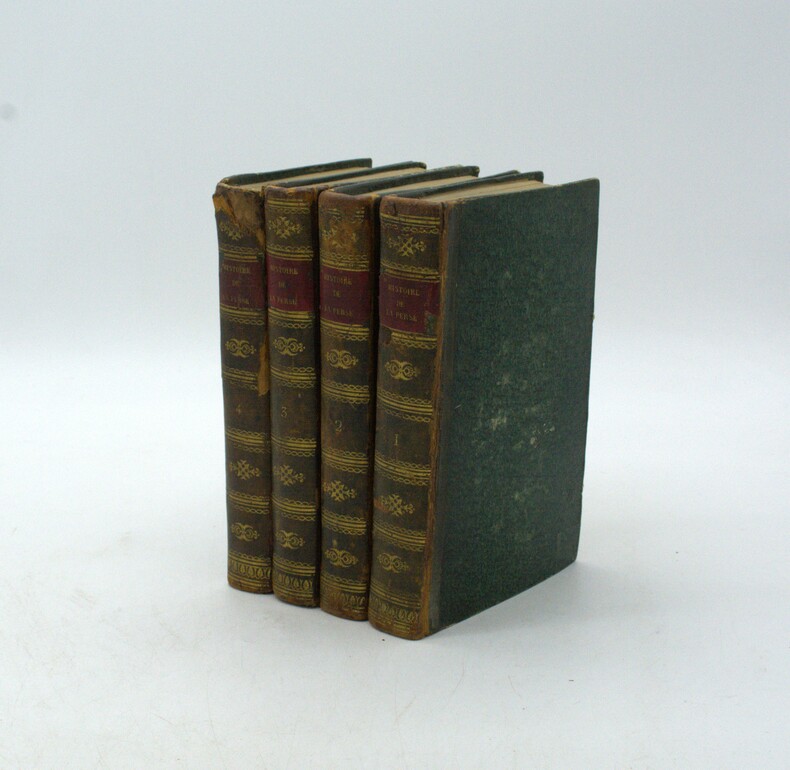
1814ref. PHO-1009A Paris, Chez Ferra, Libraire, et J. B. Imbert, Libraire, 1814. 5 volumes grand in-16,4ff-xxipp-218pp,4ff-268pp,4ff-226pp,4ff-327pp , relié plein veau époque, filet dorés encadrant les plats, dos lisse orné, pièces de titre et tomaison , tranches et gardes cailloutées , 1 plat détaché , charnières faibles , reliures frottées . 39 planches gravées en noir d'après les peintures persanes, dont cinq frontispices, certaines repliées, joli et rare de la collection Nepveu .Atabey 624; Hage-Chahine 2388
1800ref. P2-8BLeipzic, Treuttel & Wurtz ,1800. 4 volumes in-8 , relié demi basane , dos à nerfs avec auteur , titre et tomaison , tranches et gardes peignées , coupes et coins usés , petites rousseurs . Complet en 3 volumes de texte et 1 volume d’Atlas , de XXXVIII pp., 302 pp. - 2 ff., 410 pp. - 2 ff., 362 pp. - Atlas, 39 pp., 11 cartes dépliantes. Première édition française, traduite par Jean-Baptiste Boucheseiche sur la septième édition anglaise. Elle est illustrée de 11 cartes repliées réunies dans un atlas séparé
ref. 240109o.J. 20 einseitig bedr. Textbll. in engl. Sprache (U e 1-20), 20 einseitig bedr. Textbll. in deutscher Sprache (U 1-20), 36 Tafeln, 5 Bll. mit je 1 mont. Orig.-Fotografie. 40,5 x 55,5 cm, OBrosch.
1821ref. PHO-1948Paris, Pillet, 1821. 4 volumes in-8 (213x130) xxxvi-467pp, 479pp, 483 (catalogue), 465 pp, illustré d’un frontispice et 7 gravures Hors Texte (manque la carte), relié demi basane époque, dos lisse avec pièce de titre grenat, tranche jaunes, frottements aux charnières, manque au dos et charnière fendillée tome 4, coiffes usées, rousseurs éparses.
1818ref. PHO-1148Paris, Gide fils, 1818. 2 vol. in-8, demi-veau vert glacé, dos estampé à froid de motifs (lyre, bateau) - Coiffes usagées- VIII, VI, 465, 352 pp. carte dépliante in fine
1725ref. PHO-1251Paris, Étienne Ganeau, 1725. 2 volumes in-12, (160x100), xxiv-323p-errata , vi-318p . Relié plein basane marbré , dos lisse orné, pièces de titre et de tomaison rouges, tranches marbrées , dos frotté avec manque des pièces de titre et tomaison tome 2, coins , charnières et coiffes usés , petites rousseurs.
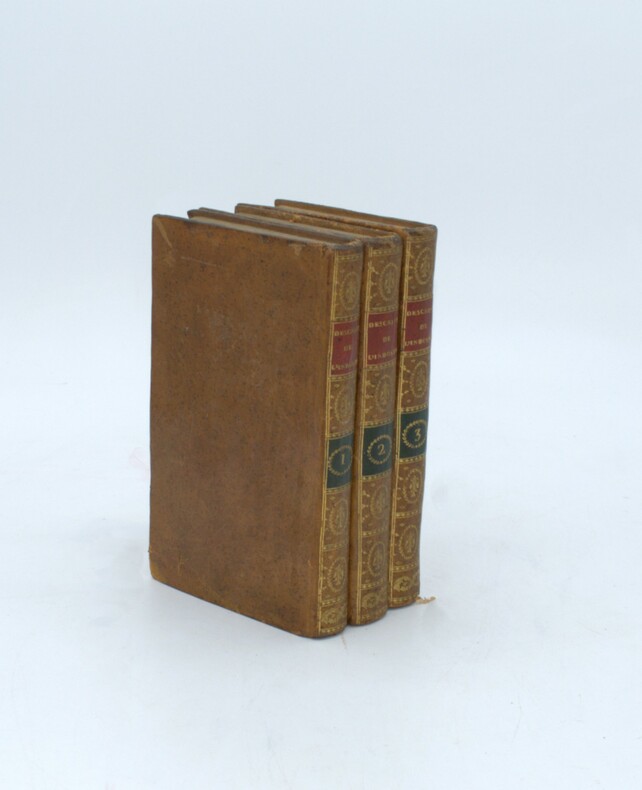
1800ref. PHO-1521Paris, imprimerie de Poignée,1800. 3 volumes in-8 (4), relié pleine basane, dos lisse orné avec pièce de titre rouge et tomaison verte titre et tomaison, une coiffe accidentée, petites rousseurs XXXVIII pp., 302 pp. - 2 ff., 410 pp. - 2 ff., 362 pp..
1873In-8 (240x160mm), pp. 404, 34 incisioni fuori testo, altre in acciaio nel testo, una carta del Turkmenistan, rilegato in percalina verde, titolo dorato al dorso. Fioriture sparse.
1912ref. 7549ALeipzig, Baedeker, 1912. Kl.8°. LXII, 570 S. Mit 40 Karten, 67 Plänen und 11 Grundrissen. OLn. mit Deckel- und RVg. Rücken angestaubt. 7. Auflage.
1814ref. PHO-1992A Paris, Chez Ferra, Libraire, et J. B. Imbert, Libraire, 1814. 4 (5) volumes grand in-16,4ff-xxipp-218pp,4ff-268pp,4ff-226pp,4ff-327pp., relié basane époque, frises dorées encadrant les plats, dos lisse orné avec titre et tomaison, tranches et gardes cailloutées, supralibro aux premiers plats entourés de lauriers dorés, coins usés, quelques frottements et griffures, petites rousseurs.
ref. 2601918 May 1917; on letterhead of the Russian Consulate San Francisco California United States. 2pp 4to. 41 lines including postscript in green ink. On aged and brittle air mail paper with chipping and discoloration at the head resulting in some loss to printed letterhead but with text clear and entire. Addressed to ‘Mon cher ami’ and with valediction from ‘Ton très dévoué ami’. The recipient is unidentified but would appear to have been a former colleague at the Russian legation in Tehran Persia. Signed ‘Geo. S. Romanovsky’. He begins by thanking him for his congratulations. The recipient is right: ‘les choses ont changé’. Life has become less complicated: ‘l’âme ne cherche plus de choses extraordinaires la ‘might sic for ‘night’ life’ fatigue. C’est le commencement de la vieillesse nom de Dieu!’ Reference to ‘les Himenes triomphant sic’. Later an intriguing reference: ‘Il y a quelques jours je pensais à une nuit que nous avons passée sic ensemble avec le hashish deux types de dervish et cette canaille autrichienne de Consul rappele toi de lui il est mort à Tauris. Je me rappelais comme c’était drôle toute cette nuit chaude ce “beng” ces poètes cités ses cigarettes fumées . Et le fantôme de l’Orient m’etait venu dans la chambre du “University Club” et les mûrs hyppocrytes sic ont rougi. Je rêve de l’orient encore mais je doute qu’il y aie des possibilités d’y retourner. Il ne faux jamais oublir le proverbe latin “non bis in idem.” ’ He continues with a comment on the heart and emotions concluding ‘Les meilleurs roses sont celles que le jardinier a pantées sur du fumier!’ He ends with a conversation urging a ‘longue Conversation’ with the recipient. It will be a pleasure in ‘la tourbillon de la vie nous nous trouverons réuni’. A book will have to be written ‘ainsi que nous partîmes à Tehran’. Postscript signed ‘Geo.’ suggests that he and the recipient should write often. 18 May 1917; on letterhead of the Russian Consulate, San Francisco, California [United States]. unknown
ref. 14529Magic Lantern Iran Collection of 3 Vintage Optical Lantern images of Iran circa 1905. 3 1/4" X 4." The images include the Qajar king palace royal gardens in Tehran and the Khaju Bridge in Isfahan. In the first image we see a Persian man in traditional 19th century clothing strolling in the Qajar royal Palace and gardens. The second image is a very rare aerial view of 19th century Tehran labeled "the Shah's gardens and the new neighborhoods." Since this image predates airplanes it is an extremely rare find probably using an aerial balloon. In the final image we see the Khaju Bridge which is one of the most famous bridges in Isfahan Iran. It was built by the Persian Safavid king Shah Abbas II around 1650 C.E. on the foundations of an older bridge. It has 23 arches and is 105 meters long and 14 meters wide. The bridge served as both a bridge and a dam and public meeting place as it links the Khaju quarter on the north bank with the Zoroastrian quarter across the Zayandeh River. These are positives on a glass lantern Gelatine silver bromure. In 1850 two Daguerreotypists in Philadelphia William and Frederick Langenheim invented a transparent positive image of a photograph in the form of a glass slide that could be projected onto a wall or screen using a Magic Lantern. Magic lanterns also known as optical lanterns provided one of the most popular forms of entertainment during their heyday in the 18th and 19th centuries. Using an artificial light source and a combination of lenses these devices enlarged small transparency images or miniature models and projected them onto a wall or screen. dimensions : The photographer of the first two images Arthur Radiguet died the same year the images were made1905 he worked for the " la Maison Molteni" famous for their lantern images. The third image was produced by T.H. McAllister a very important and famous company based in New York which specialized in magic lantern equipment and images. Scarce and in very good condition. unknown books
194878 pages. Articles: Kansas Staggers to the Polls - bootleggers will be out of luck if the state votes wet this fall; Why Ike Said No - a close friend explains Ike's refusal of the nomination; The Secret Papers of Harry L. Hopkins (part 14) - Three Titans Spin the Globe - revealing the conversations of Roosevelt, Churchill and Stalin at Teheran; Carelessness - The Child Killer; Air Transport - the answer to air power - in global warfare, cargo planes are as vital as fighting planes; Suited for the Campus - autumn style notes for college men from Maine to California. Fiction: Second Man on the Ticket; Someone to Watch Over Katie; Boy's Best Friend; It Wouldn't Be Fair; Rain in August; An Affair of State (conclusion). Ads include: Fortune shoes for men; DeSoto car; Bell Telephone; Seiberling tires; 1949 cars; Plymouth; RCA Victor radio-phonographs; Pendleton shirts; Hickok belts; Admiral portable radios; U.S. Rubber (centerfold); Dodge Trucks; Oldsmobile cars; Jantzen sweaters; Evelyn Neblett in Pepsodent ad; Rand shoes; Loretta Young in Auto-Lite ad; Springs Mills; Indian motorcycles; Dan River; TTD; Kodak; Camel cigarettes (back cover) featuring diving star "Jim" Fairbrother. Average wear. Unmarked. A sound vintage copy. Book
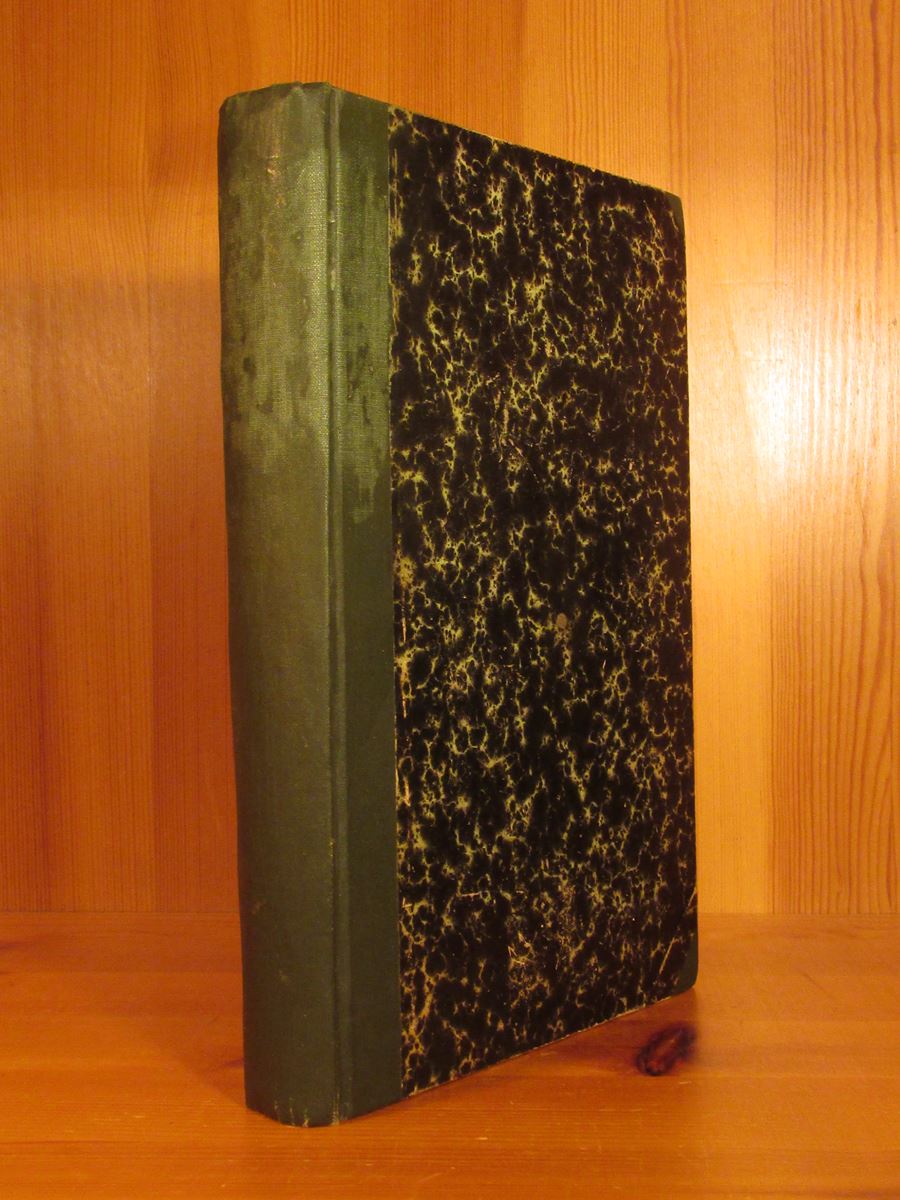
1873ref. SB-19-1628Leipzig, Brockhaus, 1873. Zweite vermehrte und verbesserte Auflage der deutschen Originalausgabe. XIV, 384 S. Grüner Halbleinenband der Zeit; Buchdeckel mit mehrfarbigen Marmorbezügen und mit Leinenecken; marmorierter Buchschnitt; farbige Vorsätze. Legendäre Reisebeschreibung des ungarischen Orientalisten und Turkologen Hermann Vámbéry (1832 - 1913). Vámbéry, der einer jüdisch-orthodoxen Familie entstammte, betrieb schon in jungem Alter ethnographisch-linguistische Studien und brachte sich autodidaktisch mehrere Sprachen, im Besonderen Arabisch, Türkisch und Persisch bei. Im Alter von 22 Jahren begab er sich nach Konstantinopel, wo er während seiner Tätigkeit als Hauslehrer Gelegenheit fand, verschiedene türkische Dialekte und Sprachen zu erlernen. 1861 begab sich Vámbéry, verkleidet als sunnitischer Derwisch, auf eine vierjährige Reise , die ihn zunächst in die bis dahin für westliche Reisende weitgehend verschlossenen Länder Armenien, Persien und Turkestan führte, später über das Uralgebiet und die Ostküste des Kaspischen Meeres nach Mittelasien; nach Aufenthalten in Chiwa, Teheran, Trapezunt, Buchara, Samarkand und Herat kehrte er von seiner Reise, die ihm weitreichende geographische, ethnographische und linguistische Erkenntnisse über die vorder- und mittelasiatischen Länder vermittelt hatte, ihm nach Konstantinopel zurück. In den folgenden drei Jahrzehnten, von 1865 bis 1905, lehrte Vámbéry als Professor für orientalische Sprachen der der Universität Budapest. Sein hier angebotenes Werk "Reise in Mittelasien" gibt die Stationen dieser faszinierenden Forschungsmission im Einzelnen wieder. Enthalten sind 12 ganzseitige Holzschnitt-Illustrationen sowie eine großformatige, mehrfach ausfaltbare Karte im Format 41 x 49 cm.
1905ref. 144261905. Molteni Radiguet & Massiot. Vue Prise du Palais du Shah Les Nouveaux Quartiers de Téhéran 1905. Original photographic glass lantern slide recording an elevated view from the Shah's palace in Tehran during the reign of Mozaffar al-Din Shah Qajar 1896-1907. The image encompasses the royal palace gardens and surrounding urban landscape with the developing districts of Tehran extending into the distance. Its French title translating to "View Taken from the Shah's Palace the New Districts of Tehran" specifically identifies the city's expanding neighborhoods. Dating from the final years of Qajar absolute monarchy the photograph records Tehran immediately before the Persian Constitutional Revolution of 1905-1911 which led to the establishment of a constitutional government and the opening of Persia's first national parliament in 1906. Vue Prise du Palais du Shah Les Nouveaux Quartiers de Téhéran. Paris: Projections Molteni Radiguet & Massiot 1905. Original gelatin silver bromide positive glass lantern slide measuring 8.5 x 10 cm. The photograph presents a broad elevated perspective overlooking the palace gardens toward Tehran's surrounding buildings and newer residential districts. The slide bears the French title "VUE PRISE DU PALAIS DU SHAH-LES NOUVEAUX QUARTIERS DE TEHERAN" and the publisher's identification "Projections Molteni Radiguet & Massiot 15 bd des filles du calvaire-Paris." Produced for projection through an optical or magic lantern the glass transparency could be enlarged onto a screen for public lectures educational presentations and illustrated travel programs. The Parisian optical firm Molteni was acquired in 1899 by Arthur Radiguet and Georges Massiot who continued manufacturing photographic projection equipment and lantern slides for scientific educational and public presentations. Arthur Radiguet a pioneer in electrical and optical instruments who also worked extensively with early X-ray technology died in 1905. The firm's distribution of photographic views brought images of distant cities and historic sites before European audiences through projected lectures. This Tehran view records the Qajar capital during a period of urban expansion and political unrest with its French inscription identifying the newer neighborhoods as the principal subject. The surviving glass positive preserves an early twentieth-century photographic view of the city before subsequent phases of modernization under the Pahlavi dynasty. In very good condition. unknown
1887ref. 145351887. Original hand-colored albumen photograph of a royal palace interior in Tehran Iran printed by E. Sangleboeuf in 1887 during the reign of Naser al-Din Shah Qajar 1848-1896. The image records the elaborate furnishings and architectural decoration associated with Qajar court interiors including geometric window ornamentation patterned carpets upholstered seating candelabras and floral arrangements. Its carefully applied gouache coloring distinguishes individual architectural and decorative features preserving a nineteenth-century photographic depiction of Persian royal interiors and the material culture of the Qajar court. Sangleboeuf E. printer. Interior of a Palace in Tehran. 1887. Original albumen photograph heightened by hand with gouache measuring 6.7" x 9" mounted on cardboard. The composition presents a richly furnished palace room with several seating areas patterned rugs candelabras and seven floral arrangements. Geometric window decorations are highlighted in blue and green while the furniture carpets and architectural details are selectively colored in red brown blue gold and grey. A small apparently ornamental pool occupies the center of the room. The gouache additions emphasize the interior's decorative surfaces while retaining the photographic detail of the original albumen print. The photograph dates from the reign of Naser al-Din Shah an enthusiastic patron of photography who maintained a photographic establishment at the Qajar court. Photography became an established means of recording royal residences palace ceremonies and architectural interiors in nineteenth-century Iran. E. Sangleboeuf is also documented as a printer of hand-colored Persian photographs dated 1887 including work associated with the photographer Antoine Sevruguin. The combination of albumen photography and applied gouache in this example records both the palace's furnishings and the contemporary practice of enhancing photographic prints with color. Some age-related foxing; overall in very good condition. unknown
ref. 14426Vintage Photograph of Teheran from 1905- Optical lantern image of the Qajar king Palace gardens in Tehran. This seems to be a aerial view of the garden with the city in background. Titled "VUE PRISE DU PALAIS DU SHAH-LES NOUVEAUX QUARTIERS DE TEHERAN" Photographer is "Projections Molteni Radiguet & Massiot 15 bd des filles du calvaire-Paris" This is a positive on a glass lantern Gelatine silver bromure. Magic lanterns also known as optical lanterns provided one of the most popular forms of entertainment during their heyday in the 18th and 19th centuries. In 1850 two Daguerreotypists in Philadelphia William and Frederick Langenheim invented a transparent positive image of a photograph in the form of a glass slide that could be projected onto a wall or screen using a Magic Lantern. Using an artificial light source and a combination of lenses these devices enlarged small transparency images or miniature models and projected them onto a wall or screen. dimensions : 85 cm x 10 cm. The photographer Arthur Radiguet died the year of this image in 1905 worked for the " la Maison Molteni" famous for their lantern images. Very rare to find such a aerial view of 1905 iran. In very good condition. unknown books
1963132 pages. Features: Tribute to a 'Great American Lady' - Eleanor Roosevelt; Angola - Arena of Struggle - excellent photos, most with guns; Approach to Automation in the Steel Industry - The Kaiser Plan ; Mideast Paradox - The 'Beggar Rich' - interesting article from Teheran, Iran; Again Nationalism Threatens - Arnold Toynbee complains that French nationalism obstructs political unification of the Western peoples; Texas - Two-fisted, Three-Party State - a political report on the Lone Star state; Marriage Counselors - Helpers and Hurters - the risk of seeking the advice of incompetents or dangerous quacks; Earth Problems For Space Men - preparations for manned space flight; Bertolt Brecht is Global, Except Here - a critic looks at 'the most important playwright of our time'; Portraits in Wood - samples of woodcuts by Uruguayan-born American artist Antonio Frasconi; 40 Years Ago - Adolf Hitler went into a beer hall and came out a national hero; Off-Track Betting - should it be legalized in New York?; Paddington Bows to Westminster - London reduces its number of boroughs from 90 to 32, allowing time-hallowed place names to be swallowed up; Leisure-Time Living - photos of stylish Italian fisherman's hut on shores of Lake Como; Encore for Music Lessons - new teaching approaches make them more popular; Renaissance of Lace - lovely fashion photos; Half-page color-photo ad for Horsman Dolls; Verbal Cartoons' - photo-illustrated article on Woody Allen; Many large gorgeous color-photo fashion ads; and more. Crossword completed in pencil, otherwise unmarked with moderate wear. Binding intact. A quality vintage copy. Book
194878 pages. Articles: Traffic Traps for Tourists - unjust arrests in many parts of the U.S.; Red Clouds over Olympus - Life in Greek village of Magoula is miserable under the Communists; The Secret Papers of Harry L. Hopkins (part 13) - from Cairo to Teheran - the first meeting with Stalin;.Sunday Dinner - lady in the kitchen; Pot Shots by One Shot Ross - Boxing Manager Wirt Ross; "There Goes Rusty" - one of the world's fastest greyhounds. Fiction: Plenty of Time for Love; The Inspector had a Wife; The Fugitive; The Logger and the Lady; River Crossing; An Affair of State (part 3 of 4). Ads include: Studebaker cars; Vitalis (with Bob Feller); Philco radio-phonographs; Firestone "Super-Balloon" tires; Gillette Blue Blades (2-pages in color); Kaiser-Frazer cars (centerfold); Pllymouth; "Good Sam" movie with Gary Cooper; Schlitz beer; GM Electro-motive division; Coke - shows Coke machine at gas station; Texaco - shows young lady water skiing; Rice-Stix; U.S. Army; Lucky Strike cigarettes (back cover). Unmarked with moderate wear and minor bits of moisture exposure to top and bottom edges. A sound vintage copy. Book
ref. 14535Vintage Colored Albumen Photograph of Inside the Palace in Teheran Iran. Printed in 1887 by E. Sangleboeuf. 6.7" x 9." glued on cardboard. This photograph of inside the Iranian palace is heightened with gouache a versatile painting technique which uses dense intensive colors. The gouache paint enhances the photo with a quiet brilliancy making the features of the room pop with subtle color. In the photograph we can see the geometric details of the window etchings standout in hues of blue and green while the furniture rugs and floral arrangements are lightly stroked with colors in red brown blue gold and grey. The room itself is richly furnished with various sitting areas candelabras seven floral arrangments and what appears to be a small pond in the center of the room. With some areas of age related foxing. Overall a rare and beautiful vintage photograph in very good condition. unknown books
Hardcover in-12 (11,5x18cm), XXVII-263 pp., ouvrage illustré de 18 vignettes hors-texte et bien complet de sa carte dépliante in-fine, reliure éd. percale avec titre et decor estampés. Mors us., 1er plat frotte, sinon bel exemplaire [TX-18]
1981ref. 116091Tokyo ; New York : Kodansha International 1981. Standard Edition 1981. Hardback. Fine copy in the original title-blocked cloth. Remains particularly well-preserved overall; tight bright clean and strong. Enclosed in original pictorial slipcase. ; 166 pages; Description: 166 p. Ill. some col. ; 37 cm. Subject: Iran Bastan Museum -Catalogs. Pottery Asian - Catalogs. Tokyo ; New York : Kodansha International hardcover