UTAGAWA, Hiroshige 歌川広重, UTAGAWA, Kuniyoshi 歌川国芳, & UTAGAWA, Toyokuni san sei 歌川豊国三世, artistsBiblio.com
6154 resultados
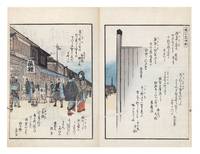
ref. 1107625 finely color-printed double-page woodcuts. 25.5; 15; 21.5 folding leaves. Three vols. 8vo orig. semi-stiff wrappers orig. block-printed title-slips on upper covers new stitching. Edo: 1853-54. First edition of this finely illustrated book which rarely appears complete in all three volumes. The “KyÅka Edo Hanabi SenryÅ has sub-titles that show the sort of specialization that was associated with the three leading Utagawa artists. Volume One by Hiroshige entitled ‘Nihonbashi Section’ consists mainly of views of central Edo figures in some prints threading their way through the hanging curtains of calligraphy showing the second floor of a brothel; Volume Two by Kuniyoshi related to the ‘licensed quarter’; and Volume Three by Kunisada = Toyokuni san sei to ‘theatre-land’.”–Hillier The Art of the Japanese Book p. 848 & image 559. At the time of publication these three members of the Utagawa school were at the pinnacles of their careers. The color-printed illustrations depict the fish markets of Nihonbashi the pleasure quarter of Yoshiwara and the backstage preparations in a kabuki theater. The witty and humorous kyÅka poetry appears with the images. Fine and fresh set preserved in an attractive modern chitsu. In the first volume the first 13 leaves have a wormhole maximum 50 mm. in length and becoming shorter as one progresses. This wormhole expertly repaired throughout is present in the woodcuts. unknown
ref. 2092902141600218Tsuta kichi ita N.A. Soft Cover. Fine. Size: 70cm width 69.5cm Number of books: 1 Tsuta kichi ita paperback
ref. 99001601Edo 1891. A brocade silk covered album Oban size all edge gilt with a total of 65 fine color prints including 2 title pages one dedication printbook size 24.5 x 35.5 cm. 4.15 cm. thick. A stunning group famous sights. R A R E ! . . . A STUNNING EXAMPLE WITH A SIXTY-FIVE . . . COLOR WOODBLOCK BLOCK PRINTS . . . BY THE MASTER OF JAPANESE LANDSCAPE . . Hiroshige II 1826-1869 and III 1843-1894: Were one in the same a pupil of the most famous and great master of landscape & composition Ando Hiroshige I. . Using his master's name plus his old name Ichiryusai he was the adopted son of Hiroshige I and was a very skilled painter who actually painted alongside & with the master until his master's death in 1858. . After that Ichiryusai specialized in Japan's modernization railroad prints depicting these new innovations recently imported from the West around Yokohama as well as issuing many series of beautiful landscape views and scenery. . In his later years he executed a most beautiful and exquisite set of his own interpretation of his master's most well-known series of prints showing Mt. Fuji and the celebrated places around Edo. This was not done to merely copy the master's works but rather as a sincere Confucian tribute to his adopted father & now father-in-law and master. He married his master's daughter. . He took each of the master's views & repainted them in pastel colors with great control & precision. Some of the more delicate places such as rainbows and clouds behind a flock of birds were actually brushed on by hand a technique rarely ever done. The woodblocks used were of the highest quality a majority of which were center cuts & these have left a most beautiful wood-pattern in the print. This example shows 28 prints from the Fuji Sanju Rokkei and 35 from the Edo Yonju Hakkei series with the title page from each present. . There is a dedication & memorial print to Hiroshige I from his faithful son and pupil. This print is most similar to one found as the frontispiece to the book by E. F. Strange: THE COLOR PRINTS OF HIROSHIGE London 1925. . It's clear that this print by Kunisada who is Toyokuni I was used as a model by Ichiryusai as it differs in what the master is holding. Kunisada shows him holding his rosary beads while Ichiryusai shows the master with his Fude brush pen and paper in hand. Ichiryusai and Kunisada had collaborated to issue a series of 36 prints: EDO JIMAN or THIRTY-SIX PLACES OF WHICH YEDO IS PROUD. . Ichiryusai has taken much care to represent the most wonderful views of Mt. Fuji & Edo with great skill. A majority of these prints are certainly well-known to the art world at large as well as by Japanese print collectors. . Many of these prints show up in the usual reference books. Some of the more famous Edo views are showing a falcon in winter rain on the river bridge storks cat view in Asakusa busy street scenes Asakusa temple & lantern in snow river scenes &c. . Some Mt. Fuji views show many snow scenes seasonal views cherry blossoms a majority show water and mountains a very charming set of prints. . Alternate title is MEISHO EDO HYAKKEI. . THE BINDING: This stunning album is beautifully bound in traditional silk-gilt brocade with prints on both sides of an accordion folded album. . Color photos are posted to our website. . REFERENCES: . L. Roberts: A DICTIONARY OF JAPANESE PRINTS ARTISTS p.44-45 for background on Hiroshige III & III. E. F. Strange: THE COLOR PRINTS OF HIROSHIGE R. Lane: IMAGES FROM THE FLOATING WORLD p.232-254 most all of the prints in this album are listed under Hiroshige I's series: MEISHO EDO HYAKKEI: ONE HUNDRED FAMOUS VIEWS OF EDO. . . unknown books
ref. 99001601Edo 1891. A brocade silk covered album Oban size all edge gilt with a total of 65 fine color prints including 2 title pages one dedication printbook size 24.5 x 35.5 cm. 4.15 cm. thick. A stunning group famous sights. R A R E ! . . . A STUNNING EXAMPLE WITH A SIXTY-FIVE . . . COLOR WOODBLOCK BLOCK PRINTS . . . BY THE MASTER OF JAPANESE LANDSCAPE . . Hiroshige II 1826-1869 and III 1843-1894: Were one in the same a pupil of the most famous and great master of landscape & composition Ando Hiroshige I. . Using his master's name plus his old name Ichiryusai he was the adopted son of Hiroshige I and was a very skilled painter who actually painted alongside & with the master until his master's death in 1858. . After that Ichiryusai specialized in Japan's modernization railroad prints depicting these new innovations recently imported from the West around Yokohama as well as issuing many series of beautiful landscape views and scenery. . In his later years he executed a most beautiful and exquisite set of his own interpretation of his master's most well-known series of prints showing Mt. Fuji and the celebrated places around Edo. This was not done to merely copy the master's works but rather as a sincere Confucian tribute to his adopted father & now father-in-law and master. He married his master's daughter. . He took each of the master's views & repainted them in pastel colors with great control & precision. Some of the more delicate places such as rainbows and clouds behind a flock of birds were actually brushed on by hand a technique rarely ever done. The woodblocks used were of the highest quality a majority of which were center cuts & these have left a most beautiful wood-pattern in the print. This example shows 28 prints from the Fuji Sanju Rokkei and 35 from the Edo Yonju Hakkei series with the title page from each present. . There is a dedication & memorial print to Hiroshige I from his faithful son and pupil. This print is most similar to one found as the frontispiece to the book by E. F. Strange: THE COLOR PRINTS OF HIROSHIGE London 1925. . It's clear that this print by Kunisada who is Toyokuni I was used as a model by Ichiryusai as it differs in what the master is holding. Kunisada shows him holding his rosary beads while Ichiryusai shows the master with his Fude brush pen and paper in hand. Ichiryusai and Kunisada had collaborated to issue a series of 36 prints: EDO JIMAN or THIRTY-SIX PLACES OF WHICH YEDO IS PROUD. . Ichiryusai has taken much care to represent the most wonderful views of Mt. Fuji & Edo with great skill. A majority of these prints are certainly well-known to the art world at large as well as by Japanese print collectors. . Many of these prints show up in the usual reference books. Some of the more famous Edo views are showing a falcon in winter rain on the river bridge storks cat view in Asakusa busy street scenes Asakusa temple & lantern in snow river scenes &c. . Some Mt. Fuji views show many snow scenes seasonal views cherry blossoms a majority show water and mountains a very charming set of prints. . Alternate title is MEISHO EDO HYAKKEI. . THE BINDING: This stunning album is beautifully bound in traditional silk-gilt brocade with prints on both sides of an accordion folded album. . Color photos are posted to our website. . REFERENCES: . L. Roberts: A DICTIONARY OF JAPANESE PRINTS ARTISTS p.44-45 for background on Hiroshige III & III. E. F. Strange: THE COLOR PRINTS OF HIROSHIGE R. Lane: IMAGES FROM THE FLOATING WORLD p.232-254 most all of the prints in this album are listed under Hiroshige I's series: MEISHO EDO HYAKKEI: ONE HUNDRED FAMOUS VIEWS OF EDO. . . unknown
