A Tale of the BorderBiblio.com
Fair Helen
ref. 0259303739.Gpaperback. Good. Access codes and supplements are not guaranteed with used items. May be an ex-library book. paperback

Bonita · United States$53.05≈ €47.30
578 results
1956ref. 2082702114607692Sadahakuen Shigakusha 1956. Soft Cover. Fine. Number of books: 1 Sadahakuen Shigakusha paperback
ref. 0259303739.Gpaperback. Good. Access codes and supplements are not guaranteed with used items. May be an ex-library book. paperback
2004ref. 2082702114607340Rookie Oraisha 2300yen 2004. Soft Cover. Fine. Number of books: 1 Rookie Oraisha 2300yen paperback
1983ref. 20827021146047982300 Yen Jitsugyo no Nihonsha 1983. Soft Cover. Fine. Number of books: 1 2,300 Yen Jitsugyo no Nihonsha paperback
1976ref. 2110502150415400Hanashinotokushu 1976. Soft Cover. Fine. Volume: 1 Hanashinotokushu paperback
1991ref. 2082702114603117Okinawa Times Co. Ltd. 12000 yen 1991. Soft Cover. Fine. Number of books: 1 Okinawa Times Co., Ltd. 12,000 yen paperback
1916ref. 239811916. Fifth Massachusetts Infantry Mexican Border photo and ephemera archive 1916 to 1917 documenting the mobilization encampment training movement and social organization of a Massachusetts National Guard regiment sent to the Southwest during the crisis surrounding Pancho Villa and the U.S. Punitive Expedition into Mexico. President Woodrow Wilson called National Guard units into federal service in June 1916 after Villa's March attack on Columbus New Mexico and Brigadier General John J. Pershing's subsequent advance into Mexico; by the end of the campaign most of the National Guard had been federalized and concentrated along the border. The Fifth Massachusetts Infantry was among the state organizations serving in the El Paso region contemporary reports identifying its soldiers among the thousands of militiamen stationed there while individual companies also operated from points including Las Cruces. The photographs and accompanying papers record that mobilization from inside the regiment identifying officers and enlisted men mapping camps and patrol country recording the material organization of military life and preserving the correspondence and commemorative culture that connected service on the border to home. Disbound album archive of 56 silver gelatin photographs and 13 pieces of ephemera including a piece of Texas cotton and a "Mexican cigarette" handwritten letters and verse newspaper clippings and a First Annual Dinner handout for the Fifth Massachusetts Infantry; photographs approximately 3 x 4.75 inches and album leaves approximately 5.5 x 7.25 inches principally Texas and New Mexico 1916 to 1917. Many photographs carry handwritten captions identifying people locations and events. A regimental band poses with cornets horns drums and other instruments the large bass drum lettered "Fifth Massachusetts Infantry Boston"; a lineup of five uniformed men before wooden camp buildings is identified as "Sergt. Maj. Gamble; Maj. Thomas; Sergt. Peters; Sergt. Murphy; Sergt. Bugler Ray." Individual portraits identify "Francis Smith" and "Chaplain Rollins" among others while other photographs record color guards soldiers with rifles mounted men trucks and military transport tent streets inspections camp formations and servicemen relaxing outside quarters. Landscape views follow the regiment through the border environment with captions referring to Camp Cotton El Paso Mount Franklin Las Cruces the Rio Grande and the Mexican border. One photograph captioned "Wrecked Tent Aug 17 1916" records damage within camp; another "Mexican Doby Hut / Aug. 23 1916" shows four Mexican children before an adobe dwelling. Ephemera extends the record beyond the camera: newspaper clippings concern the Fifth Massachusetts and border duty the unit dinner program documents post deployment regimental commemoration and handwritten correspondence includes a poem describing the anticipation of seeing a loved one again from the train home. The 1916 mobilization placed citizen soldiers from state National Guard organizations into a rapidly expanded federal border defense system while Pershing's Regular Army expedition pursued Villa inside Mexico. Guardsmen arriving in the Southwest encountered tent encampments shortages unfamiliar heat and terrain road marches drills trench digging weapons training patrol assignments and border guard duty; Army histories describe Camp Cotton near El Paso as initially austere with soldiers sleeping on the ground and constructing drainage and sanitation works before facilities improved later that summer. The 1916 border deployment also preceded American entry into the First World War by less than a year giving National Guard organizations practical experience in mobilization camp administration transport discipline and field service immediately before a much larger federal call to arms. Album leaves disbound with edge chipping tears losses around binding holes and scattered mounting residue; photographs show light to moderate silvering fading creasing and surface wear with ephemera variously toned and worn. Overall in good condition. A regimental record of how the Fifth Massachusetts Infantry lived trained moved and maintained unit identity during the United States military mobilization along the Mexican border in 1916. unknown
1916ref. 239811916. Fifth Massachusetts Infantry Mexican Border photo and ephemera archive 1916 to 1917 documenting the mobilization encampment training movement and social organization of a Massachusetts National Guard regiment sent to the Southwest during the crisis surrounding Pancho Villa and the U.S. Punitive Expedition into Mexico. President Woodrow Wilson called National Guard units into federal service in June 1916 after Villa's March attack on Columbus New Mexico and Brigadier General John J. Pershing's subsequent advance into Mexico; by the end of the campaign most of the National Guard had been federalized and concentrated along the border. The Fifth Massachusetts Infantry was among the state organizations serving in the El Paso region contemporary reports identifying its soldiers among the thousands of militiamen stationed there while individual companies also operated from points including Las Cruces. The photographs and accompanying papers record that mobilization from inside the regiment identifying officers and enlisted men mapping camps and patrol country recording the material organization of military life and preserving the correspondence and commemorative culture that connected service on the border to home. Disbound album archive of 56 silver gelatin photographs and 13 pieces of ephemera including a piece of Texas cotton and a "Mexican cigarette" handwritten letters and verse newspaper clippings and a First Annual Dinner handout for the Fifth Massachusetts Infantry; photographs approximately 3 x 4.75 inches and album leaves approximately 5.5 x 7.25 inches principally Texas and New Mexico 1916 to 1917. Many photographs carry handwritten captions identifying people locations and events. A regimental band poses with cornets horns drums and other instruments the large bass drum lettered "Fifth Massachusetts Infantry Boston"; a lineup of five uniformed men before wooden camp buildings is identified as "Sergt. Maj. Gamble; Maj. Thomas; Sergt. Peters; Sergt. Murphy; Sergt. Bugler Ray." Individual portraits identify "Francis Smith" and "Chaplain Rollins" among others while other photographs record color guards soldiers with rifles mounted men trucks and military transport tent streets inspections camp formations and servicemen relaxing outside quarters. Landscape views follow the regiment through the border environment with captions referring to Camp Cotton El Paso Mount Franklin Las Cruces the Rio Grande and the Mexican border. One photograph captioned "Wrecked Tent Aug 17 1916" records damage within camp; another "Mexican Doby Hut / Aug. 23 1916" shows four Mexican children before an adobe dwelling. Ephemera extends the record beyond the camera: newspaper clippings concern the Fifth Massachusetts and border duty the unit dinner program documents post deployment regimental commemoration and handwritten correspondence includes a poem describing the anticipation of seeing a loved one again from the train home. The 1916 mobilization placed citizen soldiers from state National Guard organizations into a rapidly expanded federal border defense system while Pershing's Regular Army expedition pursued Villa inside Mexico. Guardsmen arriving in the Southwest encountered tent encampments shortages unfamiliar heat and terrain road marches drills trench digging weapons training patrol assignments and border guard duty; Army histories describe Camp Cotton near El Paso as initially austere with soldiers sleeping on the ground and constructing drainage and sanitation works before facilities improved later that summer. The 1916 border deployment also preceded American entry into the First World War by less than a year giving National Guard organizations practical experience in mobilization camp administration transport discipline and field service immediately before a much larger federal call to arms. Album leaves disbound with edge chipping tears losses around binding holes and scattered mounting residue; photographs show light to moderate silvering fading creasing and surface wear with ephemera variously toned and worn. Overall in good condition. A regimental record of how the Fifth Massachusetts Infantry lived trained moved and maintained unit identity during the United States military mobilization along the Mexican border in 1916. unknown books
2008ref. Q-0521388082Cambridge University Press 2008-01-12. Paperback. New. In shrink wrap. Looks like an interesting title! Cambridge University Press paperback
ref. 6410831Cambridge University Press CUP . Papeback. New. pp. 140 Cambridge University Press CUP unknown
ref. 0521388082.Gpaperback. Good. Access codes and supplements are not guaranteed with used items. May be an ex-library book. paperback
1989ref. DADAX0521388082Cambridge University Press 1989-07-28. ReprintSubsequent. paperback. New. 6.00x0.35x9.00. Buy with confidence. Excellent Customer Service & Return policy. Cambridge University Press paperback
ref. ria9780521388085_inpPaperback. New. New Book; Fast Shipping from UK; Not signed; Not First Edition; Markets are assumed to be in a state of equilibrium. Fixed point theorems explain the circumstances of equilibrium. This book demonstrates the mathematical techniques involved and applies them to co-operative and noncooperative games. T paperback
ref. B9780521388085Paperback / softback. New. Markets are assumed to be in a state of equilibrium. Fixed point theorems explain the circumstances of equilibrium. This book demonstrates the mathematical techniques involved and applies them to co-operative and noncooperative games. This book will be useful as a text or reference work for mathematical economists graduate and advanced undergraduate students. paperback
1990ref. x-0521388082Cambridge Univ Pr 1990. Paperback. New. rep sub edition. 144 pages. 9.25x6.25x0.50 inches. Cambridge Univ Pr paperback
2021ref. 1265072021 Editions Saint Honoré - 2021 - Fort in-8 broché, couverture illustrée - 621 pages
1947Sm. 8vo., First Edition, with frontispiece and 71 half-tone illustrations (a number full-age) in the text; beige cloth, a near fine copy in unclipped dustwrapper. SCARCE IN THIS CONDITION.
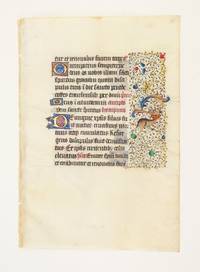
ref. ST17060NFrance probably Besançon 3rd quarter of 15th century. 239 x 165 mm. 9 3/8 x 6 1/2". Single column 15 lines in an elegant gothic book hand. Rubrics in dark pink line enders in pink and blue with white tracery and gold bezant one- and two-line initials painted gold on pink and blue ground with white tracery each side with a panel border decorated with hairline vines gold bezants and ivy and colorful flowers and acanthus RECTO BORDER INHABITED BY A CHARMING DOG-LIKE CREATURE. ◆A small light stain in border decoration largely masked by dense hairline vines but IN FINE CONDITION--bright clean and well preserved. From a large Book of Hours probably produced in Besançon this leaf features very pretty panel borders including one with a particularly charming inhabitant in the form of a dog-like creature with no front legs wearing an orange collar and emitting an acanthus leaf from its mouth. Imaginative touches like this and luxurious elements such as the several dozen gilt bezants and ivy leaves in each border and the unusually wide margins point to this manuscript having been quite a costly production. For additional leaves from this same manuscript at different price points please check our website. unknown
ref. ST17060NFrance probably Besançon 3rd quarter of 15th century. 239 x 165 mm. 9 3/8 x 6 1/2". Single column 15 lines in an elegant gothic book hand. Rubrics in dark pink line enders in pink and blue with white tracery and gold bezant one- and two-line initials painted gold on pink and blue ground with white tracery each side with a panel border decorated with hairline vines gold bezants and ivy and colorful flowers and acanthus RECTO BORDER INHABITED BY A CHARMING DOG-LIKE CREATURE. ◆A small light stain in border decoration largely masked by dense hairline vines but IN FINE CONDITION--bright clean and well preserved. From a large Book of Hours probably produced in Besançon this leaf features very pretty panel borders including one with a particularly charming inhabitant in the form of a dog-like creature with no front legs wearing an orange collar and emitting an acanthus leaf from its mouth. Imaginative touches like this and luxurious elements such as the several dozen gilt bezants and ivy leaves in each border and the unusually wide margins point to this manuscript having been quite a costly production. For additional leaves from this same manuscript at different price points please check our website. unknown books
1970Features: Sheep Camp Murders - Brushy Basin 1903; The Puzzle of Baptiste Charbonneau; Motion picture vignettes; Cook's Peak and the Bones of Sing Lee; The Border Jumpers - American settlers cross the Canadian border into British Columbia to lynch accused murderer Louie Sam; Lost Rhoades Mine - Brigham Young's Klondike; Trained for Trouble - Collies protected sheep; A Gambler who never quit - Dutch Jake Goetz; Tunnel of Death - tunnel to the bank vault of the First National Bank of Las Vegas; End of the Trail for Red Buck - George Waightman; The Barker Spread in the Sangre de Christos; Jessie Benton Fremon appraises Kit Carson; The Butterfield Trail in Texas; and more. Two-inch tear to front cover near spine else unmarked with average wear. Sound copy. Magazine
2017br. La caduta del muro di Berlino, simbolo dell'ordine bipolare sorto dalla seconda guerra mondiale, sembrò inaugurare una stagione in cui sarebbero venute meno molte altre frontiere, insieme alla liberalizzazione e integrazione dei mercati, la creazione di vaste zone di libero scambio, la nascita di una nuova unione politica e monetaria. Solo trent'anni dopo quella tendenza appare invertita e si assiste a una rivalutazione di confini e frontiere, a un'espansione del loro numero e persino alla loro reintroduzione là dove, come in Europa, erano state virtualmente abolite. Un illusorio ritorno di fiamma della sovranità nazionale, un fenomeno controtempo o la rivincita del peso della storia e del potere del luogo? Il fatto che le frontiere siano tornate di attualità, ci avverte l'autore nella sua analisi delle più pericolose linee di faglia che si sono aperte nel mondo contemporaneo, non significa però che esse corrispondano a ciò di cui l'attualità avrebbe bisogno.
2021br. Laddove le frontiere non delimitano nazioni, nascono instabilità croniche che inaspriscono conflitti e miseria. L'ex Jugoslavia, i Paesi del Sahel, l'Afghanistan e la Siria sono solo alcuni esempi. Malcolm, Laji, Hamid e Mohammed, protagonisti delle quattro conversazioni, ripercorreranno i drammatici eventi che hanno caratterizzato la storia di questi Paesi. Attraverso le loro visionarie congetture, tracceranno nuove linee di confine, ristabilendo l'identità di quei popoli soggiogati dai vincitori della Grande Guerra, sventrati dal colonialismo ottocentesco o smembrati dall'imperialismo britannico. Un viaggio fatto di parole per revisionare i confini e, infine, ritrovare le nazioni.
1997ref. 036747Editions De l' Aube broché Bristol illustré Bruxelles 1997 185 pages en format 15 - 22 cm 2-87678-368-7
2011ref. 870202011 L'Archipel, 2011 - In-8 broché - 253 pages
2010ref. 761442010 Editions du Seuil - 1 vol in-8 - Broché - 2010 - 358 pages