1866réf. 028728Paris, Librairie internationale, A. Lacroix, Verboeckhoven et Cie 1866 un volume in-8°, 402 pp., couverture imprimée. (dos fendillé, manque important à la couverture inférieure, rousseurs, feuillets brunis). Non coupé. TOME XIII SEUL.
1866réf. 028733Paris, Librairie internationale, A. Lacroix, Verboeckhoven et Cie 1866 un volume in-8°, 357 (2) 2 pp., couverture imprimée. (dos fendillé, petit manque au sommet du dos, rousseurs, feuillets brunis). Non coupé. TOME XII SEUL.
1864réf. 2402Paris, Lacroix, Verboeckhoven et Cie, 1864-1867. 19 vol. in-8, tables, index (tome XIX), demi-toile bleue (reliure de l'époque).
Librairie Internationale A. Lacroix, Verboeckhoven & Cie. 1864-1867. In-8 Carré. Relié demi-cuir. Etat d'usage. Couv. convenable. Dos fané. Quelques rousseurs. 19 tomes d'env. 300-400 pages chacun. Illustrés de cartes dépliables en noir et blanc. Pièces de titre rouges et vertes sur les dos. Auteurs, titres, tomaisons, fleurons et filets dorés sur les dos. Etiquettes de code sur les couvertures. Quelques tampons de bibliothèque. Ex-libris illustrés d'une gravure en noir et blanc (Bibliothèque de l'Institut Catholique de Toulouse) au dos des 1ers plats. Quelques petits trous de vers sur les dos. 'Collection d'Historiens contemporains'. Trad. de l'anglais par A.L. de Sadous. Avec Cartes et Plans.
Librairie Internationale A. Lacroix, Verboeckhoven & Cie. 1866. In-8 Carré. Broché. Bon état. Couv. légèrement passée. Dos satisfaisant. Quelques rousseurs. 334 pages. Illustré d'une carte en noir et blanc sur planche hors texte. Papier muet encollé sur le dos, le consolidant. Etiquette de code sur la couverture. Quelques tampons de bibliothèque. 'Collection d'Historiens contemporains'. Trad. de l'anglais par A.L. de Sadous. Avec Cartes et Plans.
1864Vol. 19 legati in-10 in-8° di pp. XVIII-6828 con 12 carte f.t. di cui 2 ripiegate. leg. in mezza tela coeva con picc. guasto ininfluente al dorso di un volume.
PARIS, Lib. Internationale - BRUXELLES, LEIPZIG & LIVOURNE, A. Lacroix, Verboekhoven et Cie Editeurs, 1860 - In-8° - Complet des19 Volumes Brochés, dont 3 sur la Grèce Légendaire 1 16 sur la Grèce Historique, Préface au Tome I : I à XVIII -326, 368, 386, 381, 373, 370, 412, 349, 335, 372, 315, 357, 353, 348, 339, 334, 402, 338 &376 (Un index des noms cités va de la page 271 à 376).Rousseurs dans certains volumes, Tome II dos cassé. Rare ouvrage. Seule Edition française autorisée par l'Auteur; Complet de ses 14 plans et cartes
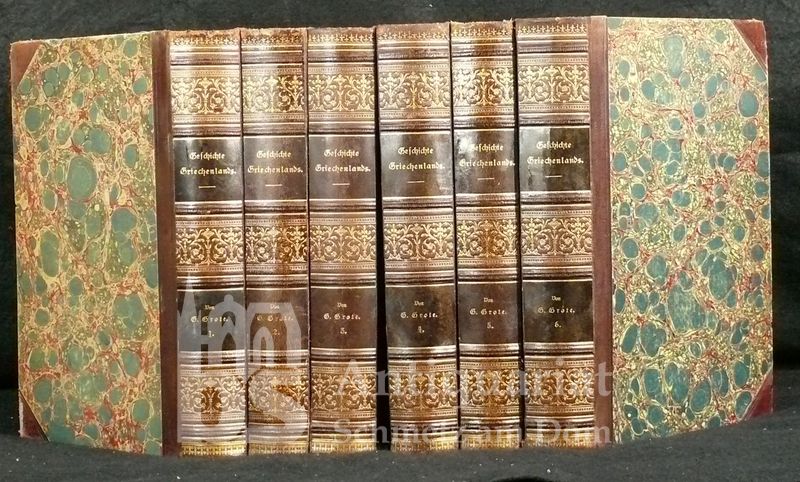
1880réf. 48590ABBerlin, Theodor Hofmann 1880-82. Zweite revidirte Auflage. 6 Bände. X S., 1 Bl., 712; 647, (1); 709, (1) S., 1 Bl.; 727, (1) S.; 1 Bl., 672; 757, (1) S. Orig.-Halbleder mit Rückenvergoldung. Kanten berieben, Lederecken teils auch beschabt. Ein Gelenk ca 3 cm angeplatzt. Durchgehend etwas gebräunt. 2 Karten mit Einriß, wovon eine im oberen Rand unterlegt. Bd V letztes Bl. mit kl. Einriß. [2 Warenabbildungen] 2
1918Dampstaining and mildewing to boards of some volumes. Volumes range from G+ to fair. Some hinges cracked. Some discolorations to spines. Not pretty. ; Everyman's Library
1907Pencil underlining and notes (many notes in pencil to rear inner cover). Scholar's name to ffep in pencil (W. P Wallace). Boards worn with tears along backstrip. Inner hinges cracked. Corners and spine ends edgeworn. Very faint dampstaining to lower corner of a few pages. ; Grote's History of Greece is one of the classic works of historical interpretation and scholarship. George Grote - banker, MP and a founder of London University - was the first historian to give a high value to the Greek creation of democracy, and this aspect of his work is closely relevant to current debates about democracy in our times. This abridgement of the original twelve volume work, which was made in the early years of the century and published by George Routledge and sons, is now available again and makes accessible the essential Grote. ; 812 pages
réf. 224629Berlin, Allgemeiner Verein für deutsche Literatur, 1903 in-8, [4] ff. n. ch., 456 pp., [4] ff. n. ch. de catalogue, avec 21 planches hors texte, percaline Bradel bordeaux, dos et plat supérieur ornés de filets dorés, tranches marbrées (reliure de l'éditeur). Charnière inférieure entièrement fendue.
1948réf. 69819LES DOCUMENTS D'ART - MONACO 1948 in-4 relié ; cartonage un peu tâché, sinonintérieur en bon état d’occasion.
1992Grove, Noel "Volcanoes : the Crucibles of Creation" [page 5-41] Book
1958xvii + 320pp., 20cm., softcover, good, F105342
1958réf. F105342Boston, Beacon Press 1958 xvii + 320pp., 20cm., softcover, good, F105342
1968Light rubbing and edgewear to wraps. Spine sunned. Former owner's name on half-title. ; 320 pages
1958Pencil underlining in text. Wraps are browned. Creasing to wraps. ; 320 pages
1961Scholar's name to ffep (Philippa Goold née Forder). Spine a bit browned. Foxing/dustsoiling to top of textblock. Light pencilling to a couple of pages. ; Euripides is here studied as a great artist of the theatre, and no attempt is made to discover his personal views and beliefs. Indeed, the author insists that such attempts have been made too frequently, and that they have obscured the greatness of the plays as works of art. Each play is discussed in turn as a piece of literature, with the emphasis on dramatic structure and development. ; 456 pages
2012RARE collection of papers studies in Near Eastern archaeology and history in honor of Eliezer D. Oren (b.1938), a Professor Emeritus of Bible, Archaeology and Ancient Near Eastern Studies at Ben-Gurion University of the Negev. The articles are in English, German and Hebrew. Contains b&w plates. 235x165mm. XVIII+475+85 pages. Hardcover. Cover slightly dirty. Small bump-mark on front cover. Rear cover upper and bottom edges bumped. Spine edges bumped. Some pages upper corner slightly bumped/wrinkled.
2002réf. 100124497University of California Press 2002 362 pages 22 8x2 4x14 6cm. 2002. Broché. 362 pages.
2004What was life like for Jews settled throughout the Mediterranean world of Classical antiquity--and what place did Jewish communities have in the diverse civilization dominated by Greeks and Romans? In a probing account of the Jewish diaspora in the four centuries from Alexander the Great's conquest of the Near East to the Roman destruction of the Jewish Temple in 70 C.E., Erich Gruen reaches often surprising conclusions. By the first century of our era, Jews living abroad far outnumbered those living in Palestine and had done so for generations. Substantial Jewish communities were found throughout the Greek mainland and Aegean islands, Asia Minor, the Tigris-Euphrates valley, Egypt, and Italy. Focusing especially on Alexandria, Greek cities in Asia Minor, and Rome, Gruen explores the lives of these Jews: the obstacles they encountered, the institutions they established, and their strategies for adjustment. He also delves into Jewish writing in this period, teasing out how Jews in the diaspora saw themselves. There emerges a picture of a Jewish minority that was at home in Greco-Roman cities: subject to only sporadic harassment; its intellectuals immersed in Greco-Roman culture while refashioning it for their own purposes; exhibiting little sign of insecurity in an alien society; and demonstrating both a respect for the Holy Land and a commitment to the local community and Gentile government. Gruen's innovative analysis of the historical and literary record alters our understanding of the way this vibrant minority culture engaged with the dominant Classical civilization. 386p. bibliography. index Book
1963réf. 29062-yc1026München und Berlin: C. H. Beck 1963. XXXII und 256 Seiten. Orig. Leinwand mit orig. Schutzumschlag (gering berieben und bestoßen, sonst sehr gutes und sauberes Exemplar). Gr.-8°. fest gebunden
1930réf. GITaz186Abbeville Typographie et Héliogravure Paillant 1930. In-8 broché XX 346pp. Illustrations à pleine page et 27 planches hors texte.
8vo, 1st edition. 272 pages. survey of 'outsider' groups in the Roman Empire will contribute greatly to our understanding of Roman social history. Examining men such as as Viriatus, Tacfarinus, Maternus and Bulla Felix, who were called latrones after clashing with the imperial authorities, special attention is given to perhaps the best-known 'bandit' of all, Spartacus, and to those who impersonated the emperor Nero after his death. Topics covered include: * Whom did the Romans see as bandits (latrones)? * What did they understand as robbery (lactrocinium)? * How pressing was the threat that the bandits posed? * How did their contemporaries perceive the danger? We are shown that the term latrones was not just used to refer to criminals but was metaphorically and disparagingly applied to failed political rebels, rivals and avengers. The word also came to represent the 'noble brigands', idealising the underdog as a means of criticising the winning side. The author therefore presents 'the bandit' as a literary construct rather than a social type.
réf. 7173Bruxelles, Séquoia, 1982 22 x 28, 168 pp., illustrations N/B et en couleurs, cartonnage + jaquette, tres bon état