18 269 résultats
réf. 83465Paris, Librairie Ancienne Edouard Champion, 1926. 13 x 17, 46 pp., broché, bon état.
réf. 86089Paris, Librairie Ancienne Edouard Champion, 1926. 13 x 17, 46 pp., broché, bon état (couverture légèrement défraîchie).
réf. 87342Paris, L. Hachette, 1840. 11 x 18, 111 pp., reliure dos toilé, état moyen (couverture abîmée, rousseurs).
réf. 49677Paris, Librairie Hachette, 1882. "12 x 18, 366 pp., reliure dos toilé, état moyen (reliure usagée mais solide; cachets du Collège jésuite Saint Stanislas à Mons; pas trop de rousseurs)."
1960réf. 117943Belles Lettres, coll. Budé 1960 Belles Lettres, coll. Budé, 45p+204p, 1960 (?), in-8 broché. Pages non coupées, bon état.
1961réf. 118537Les Belles Lettres Coll. Budé 1961 (copyright) Les Belles Lettres Coll. Budé, 1961 (copyright), in-8 broché, bilingue, texte établi et traduit par Legrand. Pages non coupées, bon état.
1904Cartonnage de l'éditeur. 292 pages.
réf. 81641Paris, Hachette, 1928. 10 x 15, 292 pp., reliure d'édition carton imprimé, bon état.
réf. 85674Paris, Librairie Ancienne Edouard Champion ,1926. 13 x 17, 46 pp., broché, bon état.
1581pp. [viii], 182, [ii], 79, [i]. Woodcut Estienne device on title page. Greek and Latin in parallel columns. Text uniformly foxed. Manuscript description of the acquistion (in 1800) of this copy and other bibliographic points. 4to. 26 cm. 18th century full limp vellum binding. Herodianus, supposed to have been a Syrian Greek, flourished during the third century A.D. In 203 he was in Rome, where he held some minor posts. His great historical work was written in Greek and narrates the events of the fifty-eight years between the death of Marcus Aurelius and the proclamation of Gordianus III. (180-238). The narrative is of special value as supplementing Dion Cassius, whose history ends with Alexander Severus. Chronicling the events of his own times, gifted with ordinary powers of observation, indubitable candour and independence of view his work is of inestimable value. He gives a lively account of many events such as: the death of Commodus; the assassination of Pertinax; how Didius Julianus bought the Roman Empire at auction; etc. Extensive use has been made of Herodianus by later chroniclers, especially the 'Scriptores historiae Au gustae' and John of Antioch. Poliziano did the first translation into Latin (1493) which conferred celebrity status on Herodian for the duration of the Renaissance. This Herodian was described by Dibdin as `an elegant, rare and critical edition', with notes and textual revisions by Henri Estienne. This is the first edition of any part of Zosimus (Editio Princeps), although Estienne only printed the first two books, translated by Leunclavius. The volume was dedicated to Sir Philip Sidney. Estienne (Etienne) (Latinized as Stephanus) was a great family of Parisian and Genevan printers of the 16th and 17th century, distinguished through five generations in scholarship as well as in their craft. Henri Estienne , Jr. (1531?-1598), was the greatest scholar of the family. He inherited his father's (Robert) press on the express condition that it should not be moved from Geneva. He was a well-trained scholar and devoted years to searching for manuscripts. Although humanism was far advanced, he, nevertheless, discovered numerous works of classical authors of which he issued first editions. His editions of Greek and Latin works are remarkable for their accuracy and textual criticism. Renouard 149/7; Schreiber 209; Dibdin II, 15; Adams H388, S1738. **PRICE JUST REDUCED! Small Box OST 1
1624réf. 30920Lugduni [Lyon], sumptibus Petri Ravaud, 1624. Un vol. au format gd in-12 (173 X 113 mm) de 8 ff. n.fol., 470 pp., 47 ff. n.fol. et 1 f. bl. Reliure de l'époque de plein veau glacé fauve, triple filet doré encadrant les plats, lesquels s'ornent d'un important semis de lys dorés, larges armes vicomtales dorées au centre, dos lisse orné d'un triple filet d'encadrement doré, filets verticaux en pointillés dorés, semis de lys dorés, titre doré, tranches dorées.
Madrid, 1975. 4to.; 476 pp. Cubiertas originales.
réf. 32910aafParis, Le livre, 1928, gr. in-8°, frontispice + 253 p., illustré avec des vignettes gravés sur bois par Carlègle, ex. non rogné brochure originale illustrée, rempliée.
1925réf. 33936Couverture souple. Broché. 271 pages. Rousseurs.
réf. 103.067Paris, Bernard Grasset, 1925. 12 x 18, 271 pp., reliure rexine verte, très bon état.
réf. c2998Paris, Bernard Grasset,1925 ; grand in-8°, broché,couverture rempliée crème imprimée en noir et brun rouge; 270pp.,2ff.nch.; couverture jaunie au dos et en bordure des plats.
réf. 42493aafFreiburg. i.B. / Tübingen, Akad. Verlagsbuchhandlung von J.C.B. Mohr, 1882, gr. in-8°, XIV + 556 S., vereinz. unterstrichen, Hs. Name + Ex-Libris "Heidi Willmann" a. Titelbl., Original-Halblederband, Rücken auf 4 Bünden.
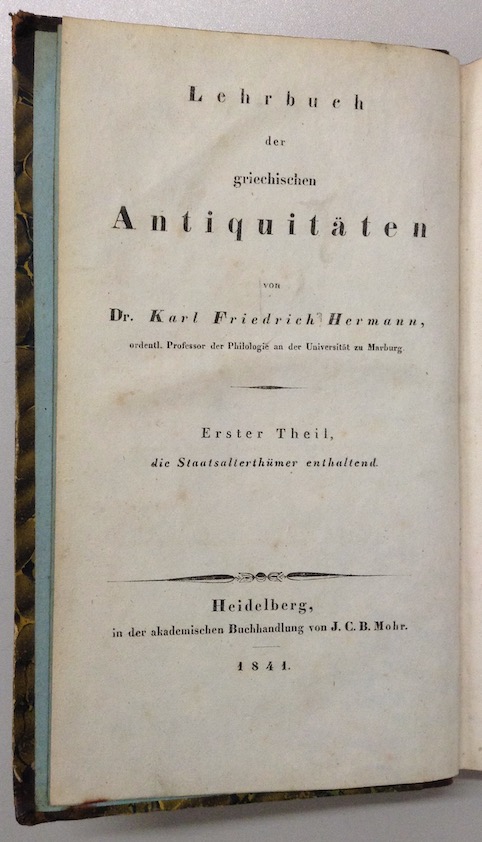
1841réf. 53239Heidelberg, Mohr, 1841-46. XI, 468 S.; X, 374 S. Halbleder d. Zeit (beschabt u. bestoßen). [2 Warenabbildungen]
réf. 62705aafLeipzig, Staritz, 1818-1837, in-8vo, browning in places, library stamp on first title page, contemporary boards with marbled paper, hw. paper title- and library-number on spine, rubbed and bumped, corners scraped, red edges.
1963Munchen Francke Verlag Bern 1963. In-8 relié pleine toile prune de 212 pages; Planches hors texte. Très bon état
1963réf. 119405Munchen Francke Verlag Bern Munchen Francke Verlag Bern 1963. In-8 relié pleine toile prune de 212 pages; Planches hors texte. Texte en allemand. Très bon état
2006235X155 mm. XXI+472 pages. Gilt hardcover with dust-jacket. Cover corners slightly bumped. Pen inscription on title page. Else in good condition.
1987réf. 6120Cambridge University Press. Very Good with no dust jacket. Hardcover. Light shelfwear. Spine ends are slightly rounded. Gift inscription from author on ffep "For Professor Habicht with kind regards Gabriel Herman".; 224 pages; In this book Gabriel Herman offers a new interpretation of Greek xenia a term traditionally rendered as 'guest-friendship'. Drawing on contemporary literary sources and inscriptions as well as anthropology sociology and comparative evidence from other times he shows that xenia was a bond of fictitious kinship akin to godparenthood rather than a tie of hospitality or ordinary 'friendship'. Starting off from this proposition he develops a dynamic model of the formation of elite relationships and values. He explores the concepts of obligation and loyalty gift and bribe treason and patriotism and places the Greek city within a new context of power relations. This book which assumes no knowledge of Greek will be of interest to students and teachers of ancient history and classics. It will also appeal to social and political scientists.; Signed by Author . 1987. 0521325412 . Cambridge University Press hardcover