18.211 risultati
1995Reprint of the 1898 ed. ; 328 pages
8vo, br. ed. xxv + 251pp., 24cm., in the series "Studia Hellenistica" vol.39, softcover, fine condition,
1969252p. illus. bibliography. index Book
1983The Parthenon sculptures collected by Lord Elgin nearly 200 years ago rank amongst the highest achievements of mankind. Since they went on display in the British Museum in 1817, artists, scholars, poets and millions of visitors have stood before them in wonder. This book tells their story, beginning in the fifth century BC when the Parthenon was built in Athens. The author explains what the sculptures represent, who made them and how they fitted into the grand design of the temple. He describes their gradual destruction by religious zealots, beseiging Venetians and other vandals before Lord Elgin brought them to the safety of London. 72p. illus.index. Book
1997'The romantic and even bizarre circumstances surrounding the appropriation of the Elgin Marbles, down to the unfortunate fates of the principal actors, are thoroughly and fascinatingly set forth by Theodore Vrettos in this melancholy saga of imperial connoisseurship, a tale that belies the end result:the beautiful room in the British Museum.' -John Updike"'The Elgin Affair is a vividly told story of greed, deceit, cunning, thievery, obsession, and astonishing cultural arrogance.Theodore Vrettos deserves great credit for this meticulous and dramatic historical reconstruction." -Tim O'Brien. 238p.plates bibliography,index Book
2016Mm 145x205 Volume in copertina rigida originale, sovraccoperta editoriale, 493 pagine con testo in lingua inglese, spagnolo, portoghese ed italiano. Copia eccellente, spedizione in 24 ore dalla conferma dell'ordine.
1914Majority of pages unopened. Wraps are a bit browned. Wraps have moderate chipping and tears. ; 34 pages
1977Minor shelfwear to book. DJ has a couple of small scratches to front panel and edgewear. ; 267pp.; 267 pages
1962rif. 37520Montreal: McGill University Press. 1962 Book. Fine. Hardcover. First Edition. A fascinating survey of "the economic agricultural geographical and cultural factors which shaped the destiny of this island people." Scholarlyreadable and comprehensive. 219p. illus. tables .statistics maps. bibliography. index. fold-out map. McGill University Press. hardcover
large 8vo hardcover in dj. ex-library with stamps and labels, ow. very good. pp.588. "A pioneering study in historical population biolography, this book offers the first comprehensive ecological history of the ancient Greek world. "; Ex-Library
1957224 p. 8vo. Original full cloth binding. Dust Jacket. W118
1957Edges spotted. Previous owner's name in front pastedown ; 8vo; 224 pages
1973Wraps have minor shelfwear; Contents: the foundations of the kingdom of Nicaea Reexamined; Foundations of the Principality of Epiros; Ecclesiastical Conflict; The Schism; The Healing of the Schism. ; Vyzantina Keimena Kai Meletai, 7; 108 pages
1950Cicellis' first book - a collection of short stories. Foreword by V. Sackville-West. First American edition from sheets printed in the UK. Original Scribner's DJ illustrated by Eisner, 237p. Book
2009rif. 140267Institute for Mediterranean Studies: Halcyon Days in Crete VI. A Symposium held in Rethymnon 13-15 January 2006. Soft cover 24 cm 438 pp. The island of Crete was conquered by the Ottomans in the mid-seventeenth century and was their last significant and long-lasting conquest of territory not previously held. Ottoman Crete has in recent years attracted historians’ attention for a number of reasons among which two particularities related to broader themes in Ottoman history stand out: the institution of private landownership in 1670 in breach of the age-long tradition of the miri ‘state’ land system and the emergence of a large Muslim population mainly through the conversion of locals to Islam. The papers in this volume bring to light new archival narrative and epigraphic sources for Ottoman Crete and the Eastern Mediterranean and aspire to contribute to the exploration of these but also other themes: centre-periphery relations and administration of an insular province taxation agricultural production social life and culture. . . ============================================================== IMPORTANT: The price does NOT include the shipping cost which depends on actual weight and destination. You will receive a message after placing the order with the exact cost and the options available; then you will have to approve / reject this cost; you may also ask about this cost before placing the order at dem.siatras@gmail.com . CUP paperback
199723x15.5 cm. 26+662 pages. Softcover. Cover slightly dirty. Spine slightly wrinkled. Papers slightly yellowing. Else in good condition.
1982vii + 149pp. + 1p. theses, with 25 figures in text, 27cm., text in English, Doctoral dissertation (Rijksuniversiteit te Leiden, the Netherlands), publisher's hardcover in grey cloth, stamp at verso of title page, text is clean and bright, G113053
1982rif. G113053Leiden, Universitaire Pers 1982 vii + 149pp. + 1p. theses, with 25 figures in text, 27cm., text in English, Doctoral dissertation (Rijksuniversiteit te Leiden, the Netherlands), publisher's hardcover in grey cloth, stamp at verso of title page, text is clean and bright, G113053
1966DJ is price-clipped. Former owner's bookplate on ffep. Slight edgewear to DJ. Light discoloration to DJ spine. ; A history of the Ionian and Aeolian Greeks, from Mycanaean age to the failure of their great revolt from Persia at the beginning of the fifth century B. C. Covers the intellectual achievments of the early Ionian thinkers and the political tenacity of the Ionian and Aeolian aristocracy. ; 220 pages
1977Starting with the Bronze Age this book discusses the Early Iron Age, and the colonial expansions which preceded Classical Greece. " .This book is especially valuable for its combination of political, economic and social history, literature, archaeology and philosophy into one whole picture of this fascinating subject. It should help the reader, generalist or specialist, gain a genuine insight into Greek history. " 257p.+ pates, bibliography. maps.Neat but spine is sun faded. Book
1977Starting with the Bronze Age this book discussses the Early Iron Age, and the colonial expansions which preceded Classical Greece. " ".This book is especially valuable for its combination of political, economic and social history, literature, archaeology and philosophy into one whole picture of this fascinating subject. It should help the reader, generalist or specialist, gain a genuine insight into Greek history. " 257p. bibliography.maps. plates index Book
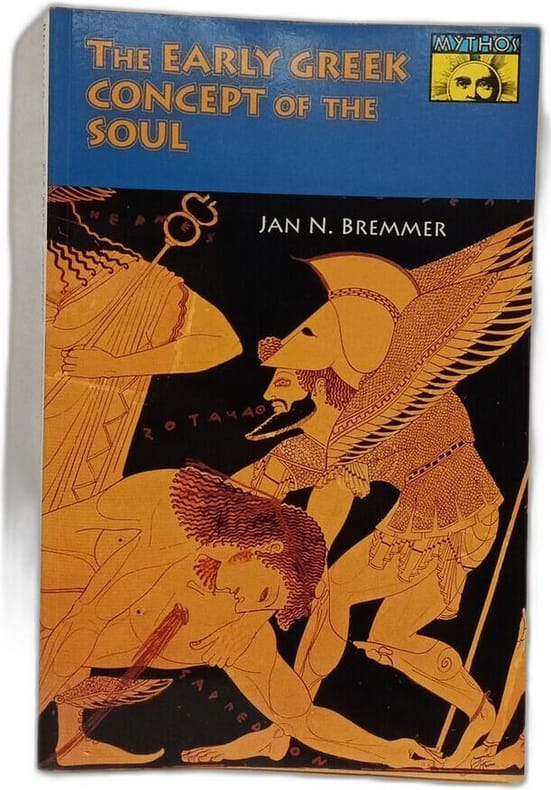
1987rif. 100143550Princeton University Press 1987 172 pages 13 97x1 27x21 082cm. 1987. Broché. 172 pages. Cet ouvrage académique examine l'évolution du concept d'âme dans la pensée grecque archaïque analysant comment les premières conceptions pré-philosophiques ont influencé le développement ultérieur de la philosophie et de la théologie grecques
1977In 1959 an archaeological dig unearthed the complete text, written on papyrus, of Menander's comedy The Dyskolos; this was the first complete work ever found by Menander, the a Greek dramatist and the best-known representative of Athenian New Comedy. A verse translation -a "superb modern rendering" of a lost Greek comedy recovered from thr papyrus. Book
8vo, br. ed. pp.400. Transcending ethnic, linguistic, and religious boundaries, early empires shaped thousands of years of world history. Yet despite the global prominence of empire, individual cases are often studied in isolation. This series seeks to change the terms of the debate by promoting cross-cultural, comparative, and transdisciplinary perspectives on imperial state formation prior to the European colonial expansion. The world's first known empires took shape in Mesopotamia between the eastern shores of the Mediterranean Sea and the Persian Gulf, beginning around 2350 BCE. The next 2,500 years witnessed sustained imperial growth, bringing a growing share of humanity under the control of ever-fewer states. Two thousand years ago, just four major powers-the Roman, Parthian, Kushan, and Han empires-ruled perhaps two-thirds of the earth's entire population. Yet despite empires' prominence in the early history of civilization, there have been surprisingly few attempts to study the dynamics of ancient empires in the western Old World comparatively. Such grand comparisons were popular in the eighteenth century, but scholars then had only Greek and Latin literature and the Hebrew Bible as evidence, and necessarily framed the problem in different, more limited, terms. Near Eastern texts, and knowledge of their languages, only appeared in large amounts in the later nineteenth century. Neither Karl Marx nor Max Weber could make much use of this material, and not until the 1920s were there enough archaeological data to make syntheses of early European and west Asian history possible. But one consequence of the increase in empirical knowledge was that twentieth-century scholars generally defined the disciplinary and geographical boundaries of their specialties more narrowly than their Enlightenment predecessors had done, shying away from large questions and cross-cultural comparisons. As a result, Greek and Roman empires have largely been studied in isolation from those of the Near East. This volume is designed to address these deficits and encourage dialogue across disciplinary boundaries by examining the fundamental features of the successive and partly overlapping imperial states that dominated much of the Near East and the Mediterranean in the first millennia BCE and CE. A substantial introductory discussion of recent thought on the mechanisms of imperial state formation prefaces the five newly commissioned case studies of the Neo-Assyrian, Achaemenid Persian, Athenian, Roman, and Byzantine empires. A final chapter draws on the findings of evolutionary psychology to improve our understanding of ultimate causation in imperial predation and exploitation in a wide range of historical systems from all over the globe. Contributors include John Haldon, Jack Goldstone, Peter Bedford, Josef Wiesehofer, Ian Morris, Walter Scheidel, and Keith Hopkins, whose essay on Roman political economy was completed just before his death in 2004.