1971Best.-Nr. 40440Oxford Clarendon Press. Very Good in Very Good- dust jacket. Second Edition. Hardcover. Faint foxing. Scholar's name to ffep and bookplate to inner cover John Karras. DJ has some tears. Dustjacket is protected in plastic sleeve.; Oxford University Press Academic Monograph Reprints; 595 pages; Traces the diffusion of the Greek city as a political institution through the lands of the Roman Empire bordering on the eastern Mediterranean over a period extending from Alexander's conquest to the sixth century. Chapters: Thrace Asia Lycia the Gauls Pamphylia Pisidia and Lycaonia Bithynia and Pontus Cappadocia Cilicia Mesopotamia and Armenia Syria Egypt Cyrenaica Cyprus. . 1971. 0198142811 . Oxford Clarendon Press hardcover
1937Best.-Nr. 34438Oxford Clarendon Press. Very Good with no dust jacket. First Edition. Hardcover. Scholar's name to ffep T. J. Dunbabin. Faint rounding to upper corners. Light rubbing to boards.; 576 pages; Traces the diffusion of the Greek city as a political institution through the lands of the Roman Empire bordering on the eastern Mediterranean over a period extending from Alexander's conquest to the sixth century. Chapters: Thrace Asia Lycia the Gauls Pamphylia Pisidia and Lycaonia Bithynia and Pontus Cappadocia Cilicia Mesopotamia and Armenia Syria Egypt Cyrenaica Cyprus. . 1937. Oxford Clarendon Press hardcover
2013Best.-Nr. 2093Athens 2013. Bilingual Greek-English edition. Soft cover 20 cm 80 pp. ill. Very rare. Limited availability. Self-publication paperback
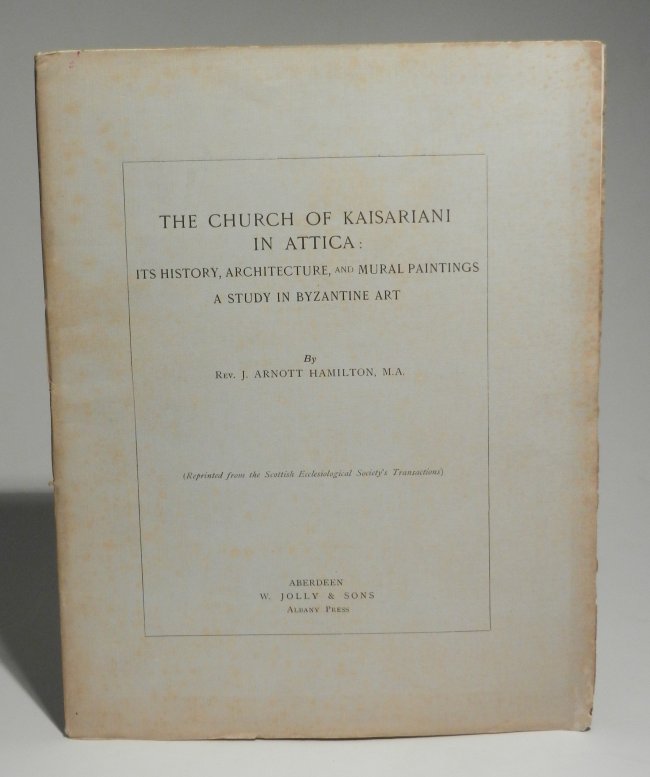
1916Best.-Nr. 28713-yg6249Aberdeen: W. Jolly & Sons Albany Press 1916. 28 pages. Orig. Paperback (some staining, otherwise a good uncut copy). 4°. broschiert/ Taschenbuch
19498' XV+408, (408-)731pp. black gilt hardcover, cover slightly worn, white dust jackets worn, slightly stained, slightly yellowing and the spine is slightly faded, dust jacket of Vol. II is torn on the edges, inner spine slightly loose, else in good condition.
2003IN HEBREW. 230X160 mm. 189 pages. Hardcover. Cover slightly rubbed. Spine bottom edge slightly bumped. Else in good condition.
198223x15.5 cm. XXIV+201 pages. Softcover. Cover slightly wrinkled and rubbed. Spine wrinkled. Else in good condition.
Best.-Nr. 85936Pelekanos 2003. Brand new. A facsimile reprint of the 1904 edition. Hard cover 25x19 cm 640 pp. Pelekanos, 2003 hardcover
1970viii + 120pp. + 5 plates out of text, 24cm., softcover, in the series "University of California publications: Classical studies" vol.5, stamp, good condition, G103427
1901Scholar's bookplate to inner cover (G. P. Goold). Fraying to spine ends. Spine a bit dulled. Lower corners bumped. Endpapers heavily foxed. ; Greek Text with English Introduction and Commentary, and translation. ; 318 pages
182428.5x20 cm. XIX+261 pages. Gilt hardcover and spine. Cover corners bumped and worn. Some pages age-stained or water-stained. Pages wavy and yellowing. Else in good condition. PLEASE NOTE: This item is overweight. We may ask for extra shipping costs.
1942Terrot Reaveley Glover (1869-1943) was a renowned Cambridge classicist and historian. This book presents a series of essays by Glover on various subjects largely related to classical life and literature. 242p. fontis, index. Donor inscription in Dutch on ffep, else fine Book
20111. The Mesolithic and Neolithic Bone Implements (Antiklia Moundrea-Agrafioti) 2. From Mesolithic Fishermen and Bird Hunters to Neolithic Goat Herders: The Mammal and Bird Bone Assemblage (Katerina Trantalidou) 3. The Non-vertebral Fish Bones (Judith Powell) 4. Fish Vertebrae (Dimitra Mylona) 5. Malacological Material (Lilian Karali) 6. Palynological Evidence (Chryssanthi Ioakim) 7. Charcoal Analysis (Maria Ntinou) 8. Archeobotanical Seed Remains (Anaya Sarpaki) 9. Neolithic Pottery: A Characterization Study (Konstantina Papakosta) 10. Sequential Radiocarbon Dating and Calculation of the Marine Reservoir Effect (Yorgos Facorellis) 11. Clastic Sediments (Katie Theodorakopoulou and Yannis Bassiakos) 12. Stable Isotopic Analysis of the Mollusk Shells (Ioannis Liritzis, Androniki Drivaliari and Adamantios Sampson). ; Prehistory Monographs 31; Vol. 2; 395 pages; This book completes the two-part series that serves as the final report for the excavation of the Cave of the Cyclops on the island of Youra in the Northern Sporades of Greece, a site that was occasionally occupied from the Mesolithic through Roman period. The second volume contains the results of detailed studies on the archaeological material, organic remains, and archeometric analyses that complete the image of this significant archaeological site. These studies help to further distinguish the main characteristics of the Mesolithic culture in the Aegean basin, including: the intense exploitation of sea resources, limited hunting activities, the collection of native fruits and land snails to supplement the diet, and attempts at domestication by isolated island communities.
1993Lower corners bumped. Else book and DJ have minor shelfwear. ; 1.06 x 8.75 x 5.75 Inches; 380 pages; This book is the first to examine how classical Greek cavalry actually operated on the battlefield. It looks at its prime characteristics, including mobility, protection, armament, training, leadership, flexibility, and motivation. Until now, it was generally assumed that ancient Greek cavalry was subordinated to the infantry because it was less effective in battle. This book challenges this assumption, analyzing the position of Greek cavalry, and especially the Athenian arm, not only in the battlefield but in society as a whole.
19932 corners and base of spine bumped. Ex-library copy with usual stamps, call numbers and pocket. ; 1.06 x 8.75 x 5.75 Inches; 380 pages; This book is the first to examine how classical Greek cavalry actually operated on the battlefield. It looks at its prime characteristics, including mobility, protection, armament, training, leadership, flexibility, and motivation. Until now, it was generally assumed that ancient Greek cavalry was subordinated to the infantry because it was less effective in battle. This book challenges this assumption, analyzing the position of Greek cavalry, and especially the Athenian arm, not only in the battlefield but in society as a whole.
1993Best.-Nr. 18297Oxford University Press. Good with no dust jacket. Hardcover. 2 corners and base of spine bumped. Ex-library copy with usual stamps call numbers and pocket.; 1.06 x 8.75 x 5.75 Inches; 380 pages; This book is the first to examine how classical Greek cavalry actually operated on the battlefield. It looks at its prime characteristics including mobility protection armament training leadership flexibility and motivation. Until now it was generally assumed that ancient Greek cavalry was subordinated to the infantry because it was less effective in battle. This book challenges this assumption analyzing the position of Greek cavalry and especially the Athenian arm not only in the battlefield but in society as a whole. . 1993. 0198144822 . Oxford University Press hardcover
2007Translation by Fani Spiridaki of "The Cat of Portovecchio: Corfu Tales" Portovekio is a bustling, picturesque fishing village in Corfu where each resident has a story to tell .... Zoe mourns dead husband and little Louisa her mother. The priest Antonis conspires and intrigues. Young lovers meet secretly. Chara is a hardy independent woman and her husband, Spyros is the most beautiful man in the village. .. A novel with the nostalgic scent of the islands of Greece.276p Book
2001Best.-Nr. 92062Lefkas: Public Library 2001. Bilingual Greek-English edition. Hard cover 25x35 cm 336 pp. rich b/w illustration. . . ================================================================== IMPORTANT: The shipping cost is an important parameter of this order; it is NOT included in the price and depends on the actual weight and destination; you will have to approve it after the confirmation of the order. You may ask for an estimate before placing the order at: dem.siatras@gmail.com Public Library hardcover
430 pages including bibliography, sources and index. "Although written four hundred years after Alexander's death, is the best and most reliable account of his life and those incidents - the murder of Cleitus, the burning of Persepolis, and Alexander's prayer for racial fusion".
2005Very minor shelfwear. ; 1.97 x 8.82 x 5.98 Inches; 938 pages; Long neglected and unappreciated, the philosophy of the Greek and Roman worlds--from the last days of Aristotle (c. 320 BC) until 100 B.C.--has over the last decade received a considerable amount of renewed scholarly attention. This history is organized by subject, rather than chronologically or by philosophical school, with sections on logic, epistemology, physics and metaphysics, ethics and politics. Written by specialists, it is intended to be a reference for any student of ancient philosophy. Greek and Latin are used sparingly and always translated in the main text.
20072 vols., roy. 8vo., with numerous illustrations and maps; cloth, gilt backs, a fine set in the dustwrapper. The set comprises Vol. I: Greece, the Hellenistic World and the Rise of Rome; Vol. II: Rome from the Late Republic to the Late Empire
8vo br. ed. pp. 444. The age of Augustus, commonly dated to 30 BC AD 14, was a pivotal period in world history. A time of tremendous change in Rome, Italy, and throughout the Mediterranean world, many developments were underway when Augustus took charge and a recurring theme is the role that he played in shaping their direction. The Cambridge Companion to the Age of Augustus captures the dynamics and richness of this era by examining important aspects of political and social history, religion, literature, and art and architecture. The sixteen essays, written by distinguished specialists from the United States and Europe, explore the multi-faceted character of the period and the interconnections between social, religious, political, literary, and artistic developments. Introducing the reader to many of the central issues of the Age of Augustus, the essays also break new ground and will stimulate further research and discussion.
8vo br. ed. pp. 444. stickers on cover, ucla store stamp, otherwise internally no marks, very good. The age of Augustus, commonly dated to 30 BC AD 14, was a pivotal period in world history. A time of tremendous change in Rome, Italy, and throughout the Mediterranean world, many developments were underway when Augustus took charge and a recurring theme is the role that he played in shaping their direction. The Cambridge Companion to the Age of Augustus captures the dynamics and richness of this era by examining important aspects of political and social history, religion, literature, and art and architecture. The sixteen essays, written by distinguished specialists from the United States and Europe, explore the multi-faceted character of the period and the interconnections between social, religious, political, literary, and artistic developments. Introducing the reader to many of the central issues of the Age of Augustus, the essays also break new ground and will stimulate further research and discussion.
8vo, br. ed. pp 646. Rome was the largest city in the ancient world. As the capital of the Roman Empire, it was clearly an exceptional city in terms of size, diversity and complexity. While the Colosseum, imperial palaces and Pantheon are among its most famous features, this volume explores Rome primarily as a city in which many thousands of men and women were born, lived and died. The thirty-one chapters by leading historians, classicists and archaeologists discuss issues ranging from the monuments and the games to the food and water supply, from policing and riots to domestic housing, from death and disease to pagan cults and the impact of Christianity. Richly illustrated, the volume introduces groundbreaking new research against the background of current debates and is designed as a readable survey accessible in particular to undergraduates and non-specialists. Paul Erdkamp is Professor of Ancient History at the Free University of Brussels (VUB). Previously, he was Research Fellow at the University of Leiden. He has published two monographs: Hunger and the Sword. Warfare and Food Supply in Roman Republican Wars (1998) and The Grain Market in the Roman Empire (2005), and is editor of The Roman Army and the Economy (2002), A Companion to the Roman Army (2007) and A Cultural History of Food in Antiquity (2012). His research interests include the ancient economy, army and warfare, ancient historiography, in particular Polybius and Livy, and social and cultural aspects of food in classical antiquity. Professor Erdkamp is currently co-chair of the Roman Society Research Centre