1 001 résultats
1895réf. 49284London arrison and Sons 1895. - Paris Gauthier-Villars 1895. 8vo. and 4to. Later full cloth gilt lettering to spine Ramsay and without wrappers Cleve. In "Proceedings of the Royal Society" Ramsay Vol. 58. Entire vol. offered. And in "Comptes Rendus Hebdomadaires des Séances de L'Academie des Sciences" Cleve Tome 120 No 15. Pp. 797- 850. Entire issue offered. Ramsay's papers: pp. 65-67 and pp. 81-89. - Cleve's paper: p. 834. Stamps tp edges and a few corners a bit bumped on vol. 58 otherwise clean and fine. First printing of both papers in which Ramsay and Cleve - independently - announced their discovery of Helium on the Earth. Although Ramsay announced the discovery of Helium before Cleve had completed his research the Swedish chemist was independent discoverer of the element.Helium was discovered in the sun already in 1868 by Jules Janssen and independently by Lockyer the same year. Janssen discovered helium in the sun when he observed a total eclipse in India by studying the spectra of the suns chromosphere and Lockyer also by spectroscopy found that the new line in the spectrum did not belong to any element then known and he named it Helium for the sun.In the same volume as Ramsays paper there are 5 papers by NORMAN LOCKYER dealing with the discovery of Helium on the earth examining Ramsay's and Cleve's findings.Parkinson "Breakthroughs" 1895. hardcover
1836réf. 43417Leipzig Johann Ambrosius Barth 1836. Without wrappers. In "Annalen der Physik und Chemie. Hrsg. von J.C. Poggendorff" Band 38 No. 6 = Zweyte Stück. Titlepage to Vol. 38. Pp. 241-450 a. 3 engraved plates.Entire issue offered Heft No. 6 Bd. 38. Schwann's paper: pp. 358-364. Clean and fine. First appearance of an importent paper in the history of biology in which Schwann describes his discovery and isolation of pepsin the substance in the stomach that aids digestion of eggwhite. It is the FIRST KNOWN ANIMAL ENZYME. The paper appeared at the same time in "Archiv für Anatomie Physiologie und Wissenschaftliches Medicin"Theodor Schwann 1810-1882 was a great German physiologist pathologist and experimenter. One of the founders of the cell doctrine and of the idea of the living nature of yeast. Born at Neuss near Düsseldorff. A catholic educated in the Jesuit Gymnasium in Cologne. Intended for the church but took to medicine. He was a pupil of Johannes Müller and a collegueand lifelong friend of J. Henle the anatomist. In Berlin Schwann was Johannes Müller's assistent for five years and it was then that he discovered pepsin in 1836 the paper offered.Parkinson "Breakthroughs" 1836 B.The issue contains other importent papers by Seebeck Matteucci Marchand G. Magnus "Ueber die Wirkung des Ankers auf Elektromagnete und Stahlmagnete" Schönbein J. Müller "Ueber die Structur und die chemischen Eigenschaften der thierischen Bestandtheile der Knorpel und Knochen" Nachtrag. Forchhammer "Der kopaische See und seine unterirdischen Abzugskanäle." with a map. unknown
1900réf. 51313Paris Gauthier-Villars 1900. 4to. No wrappers. In: "Comptes Rendus Hebdomadaires des Séances de L'Academie des Sciences" Tome 130 No 15 a. No 18. Pp. 962- 1044 a. pp. 1145- 1220. Entire issues offered. Villard's papers: pp. 1010-1012 a. 1178-1182 textillustrations. Clean and fine. First apperance of Villard's two papers in which he announced and described the discovery of a new type of radiation more powerfull and penetrating than alpha-and beta rays. The new type of rays was named by Rutherford as gammarays. unknown
réf. DADAX0205651585New unknown
réf. DADAX0444501142New unknown
réf. DADAX015500963XNew unknown
1831réf. 49604Paris Crochard 1831. Contemp. hcloth. Some scattered brownspots. "Annales de Chimie et de Physique" 2. Series Tome 48. 448 pp. 1 engraved plate. Entire volume offered. Soubeiran's paper: pp. 113-157. Scattered brownspots. First appearance of an importent paper in chemistry and medicine as it for the first time relates the finding of Chloroform which some years later was proved to have anaesthetic effects and was introduced in chirurgy in 1848 by Simpson.Justus von Liebig Souberain and Guthrie independently discovered Chloroform in 1831 but Souberain was the first to publish his results. Garrison & Morton No. 1851. - Gedeon "Science and Technology in Medicine" 36.7.The volume contains other notable papers by LIEBIG DUMAS DUTROCHET WÖHLER LECANU BECQUEREL etc. hardcover
réf. DADAX1843914085New unknown
réf. DADAX0674212401New unknown
1895réf. 42221London Harrison and Sons 1895. 4to. No wrappers as extracted from "Philosophical Transactions" Vol. 186 - I Series A. Pp. 187-241 a. 8 textillustrations apparatus. Fine and clean. First printing of this importent paper in the history of chemistry Lord Rayleigh's most famous discovery announcing the discovery of this new gas the first finding of one of the rare gases inert gases having unusual properties and forming a distinct group in the periodic table and all with zero valency."The original paper in the "Philosophical Transactions" will undoubtly rank as a classic the investigation having been a particularly brilliant ine." Ernst von Meyer in History of Chemistry. For this discovery Lord Rayleigh and W. Ramsay received the Nobel Prize 1904.After having made several measuring of the densities of gases "Rayleigh came across a curious puzzle. With oxygen he always obtained the same density regardless of how the oxygen might be produced whether from one particular compound from a second compound or from the air. The situation was different with nitrogen. The nitrogen he obtained from air constantly showed a slightly higher density than the nitrogen he obtained from any of various compounds. Rayleigh could think of several ways in which the nitrogen obtained from air might be contaminated but none of the possibilities checked out experimentally. He was so frustrated that he went so far as to write to the journal "Nature" asking for suggestions. Ramsay a brilliant Scottish chemist asked permission to tackle the problem and received it. The upshot was that a new gas somewhat denser that nitrogen was discovered to exist in the atmosphere. It was named argon and it was the first of a series of rare gases of unusual properties whose existence had never been suspected."Asimow.Dibner Heralds of Science No. 50 - Neville Historical Chemical Library vol. II p.358. unknown
réf. DADAX0300041055New unknown
réf. 115667London Royal Society 1909. . First edition; 4to; 43 plates original red buckram-backed boards spine fade small stamps to foot of title a very good copy; vii 274 pp. From the library of Professor Otto Nordenskjöld 1869-1928 the distinguished Swedish Antarctic explorer and scientist. Nordenskjöld was on the Swedish scientific expedition to the Antarctic 1901-1903 and would have had a particular interest in the results of the Discovery expedition. The volume includes an appendix comparing magnetic observations in the Antarctic and the Arctic. Rosove 288-11.A1; Spence 841; Taurus 48. London, Royal Society, 1909. hardcover
1898réf. 46852Paris Gauthier-Villars 1898. 4to. No wrappers. In: "Comptes Rendus Hebdomadaires des Séances de L'Academie des Sciences" Tome 126 No 15. Entire issue offered. With htitle and titlepage to vol. 126. Pp. 1059-1110. Curie's paper: pp. 1101-1103. First printing of this milestone paper being the first "Note" from Marie Curie about "radioactivity". This same "Note" contains a the fundamental observation: "Two uranium ores. are much more active than uranium itself. This fact. leads one to believe that these ores may contain an element much more active than uranium." This paper gives the first proof of the fact that radiation is an atomic property."Henri Becquerel discovered 1896 that uranium salts shielded from light for several months spontaneously emit rays related in their effects to Roentgen rays. Mme. Curie became enthusiastic about this subject filled with the unknown and as she later acknowledged involving no bibliographic research.The first step in the research was to determine whether there existed other elements capable like uranium of emitting radiation. Abandoning the idea of hyperfluorescence couldn’t one calculate by electrical measurement the effects on the conductivity of air that were revealed by the gold-leaf electroscope Pierre Curie and his brother Jacques had constructed an extremely sensitive apparatus to measure weak currents; Mme. Curie employed it in testing both pure substances and various ores. In her first "Note" in the Comptes rendus"de l Académie des sciences 12 April 1898 she described the method that she followed throughout her life the method that enabled her to make comparisons through time and crosschecks with other techniques:"I employed. a plate condenser one of the plates being covered with a uniform layer of uranium or of another finely pulverized substance diameter of the plates eight centimeters; distance between them three centimeters. A potential difference of 100 volts was established between the plates. The current that traversed the condenser was measured in absolute value by means of an electrometer and a piezoelectric quartz. In general she preferred the zero method in which the operator compensates for the current created by the active material by manipulating the quartz. All of her students followed this procedure."DSB.The first results came in 1898: the measurements varied between 83 × 10-12 amperes for pitch blende to less than 0.3 × 10⁻¹² for almost inactive salts passing through 53 × 10-12 for thorium oxide and for chalcolite double phosphate of uranium and copper. Thorium would thus be "radioactive" the term is Mme. Curie’s; its radioactive properties were discovered at the same time independently by Schmidt in Germany. unknown
1835réf. 47003Philadelphia Fraklin Institute 1835. 8vo. Later full green cloth. Tome-and titlelabels in leather with gilt lettering on spine. In: "Journal of the Franklin Institute of the State of Pennsylvania. Edited by Thomas P. Jones" Vol. XV. New series. Engraved frontisp. 2446 pp. 2 folded engraved plates and 2 folded engraved maps. Entire volume offered. Henry's announcement: pp. 169-70. A stamp to verso of frontispiece Library of Congress duplicate stamp. First printing of this importent paper the first to describe in detail how the phenomena of Self-Induction was discovered. Henry discovered the induction phenomena - how an electric current in one coil may set up a current in the other through the development of the magnetic field - independently of Faraday but Faraday was first to publish on electromagnetic induction. Henry's experiments with induction led him to his importent discovery of SELF-INDUCTION which is the phenomenon in which a change in electric current in a coil produces an induced emf in the coil itself. This phenomenon was also discovered inependently by Faraday but this time Henry had published first. The basic unit of inductance was to be called "the Henry". Relevant to the controversy between Faraday and Henry is the following statement by A D Bache Secretary of the American Philosophical Society introducing an abstract of Henry in J Franklyn Inst. 1835 pp. 169-70 H. Norman 1053 and the paper offerd: "A memoir on this subject has been since submitted to the Society containing an extension of the subject the primary fact in relation to which was observed by Professor Henry as early as 1832 and announced by him in the American Journal of Science. Mr. Faraday having recently entered upon a similar train of observations the immediate publication of the accompanying is important that the prior claims of our fellow countryman may not be overlooked."Spark Museum.Magee "Source Book in Physics" p. 515. hardcover
1836réf. 45406Berlin G. Eichler 1836. In "Archiv für Anatomie Physiologie und Wissenschaftliches Medicin Herausgegeben von Johannes Müller". Jahrgang 1836. Pp. 66-89 a. pp. 90-139. The entire volume offered in its 6 parts in 5 all 5 issues uncut with orig. printed warppers. 2CCXXIV390 pp. and 15 engraved plates. The 2 first issues with a faint dampstain to lower part of leaves and plates. First appearance of an importent paper in the history of biology in which Schwann describes his discovery and isolation of pepsin the substance in the stomach that aids digestion of eggwhite. It is the FIRST KNOWN ANIMAL ENZYME. The paper appeared at the same time in "Annalen der Physik und Chemie. Hrsg. von J.C. Poggendorff".Theodor Schwann 1810-1882 was a great German physiologist pathologist and experimenter. One of the founders of the cell doctrine and of the idea of the living nature of yeast. Born at Neuss near Düsseldorff. A catholic educated in the Jesuit Gymnasium in Cologne. Intended for the church but took to medicine. He was a pupil of Johannes Müller and a collegueand lifelong friend of J. Henle the anatomist. In Berlin Schwann was Johannes Müller's assistent for five years and it was then that he discovered pepsin in 1836 the paper offered.Parkinson "Breakthroughs" 1836 B. - Garrison & Morton no. 991.The first paper offered written together with Johannes Müller records the preliminary investigaions leading to the discovery of Pepsin. - Garrison & Morton no. 990.The volume also contains another famous paper by ROBERT REMAK "Vorläufige Mittheilung microscopischer Beobachtungen über den innern Bau der Cerebrospinalnerven und über die Entwicklung ihrer Formenelemente. Hierzu Tafel IV. Pp. 145-161. This paper contains the first announcement of his DISCOVERY OF "FIBRES OF REMAK" the non-medullated nerve-fibres. Garrison & Morton no. 1260. unknown
1861réf. 53357Paris Mallet-Bachelier 1861. 4to. No wrappers. In: "Comptes Rendus Hebdomadaires des Séances de L'Academie des Sciences" Tome 52 No 8. Pp. 321- 368. Entire issues offered. Pasteur's paper: pp. 344-347. Minor marginal brownspots. First printing of a milestone paper in microbiology being the paper in which Pasteur disclosed his discovery of organisms that lived without oxygen. Two years later he named them anaerobic or zymics contrasting to aerobic which only lived in the presence of free oxygen."In 1861 he turned his attention to the butyric fermentation and made another importent discovery viz. that this fermentation proceeds in the absence of oxygen. In the fermented material he found cylindrical rods which he showed were the cause of the fermentation. Following the nomenclature and ideas of the time he regarded them as animal in character and named them Vibrio." Bullock "The History of Bacteriology" p. 61. unknown
1859réf. 43325Leipzig Johann Ambrosius Barth 1859. Without wrappers as issued in "Annalen der Physik und Chemie. Hrsg.von Poggendorff" Bd. 107 Viertes Stück.= Heft No. 8 of 1859. The entire issue offered Heft 4 of vol. 107 with titlepage to vol. 107. Pp. 497-660. - Plücker's papers: pp. 497-539 a. 638-643. Clean and fine. First printing of this milestone paper describing Plückers first observations on Cathode Rays which he called "the beautiful and mysterious green glow" and produced by discharges in tubes exhausted by means of the Geissler pump. These importent observations lead directly to Röntgens discovery of the Röntgen Rays."Cathode rays were first observed by Julius Plücker in 1859 the paper offered. They are rays which are found in the neighbourhood of the point of exit of an electrical current passing through a Geissler tube. These rays stimulated intense interest and experiment. William Crookes greatly improved these discharge tubes and intensified the degree of rarification of gases within them. The tubes in this form is known as Crookes tube. Crookes declared his conciction that the cathode rays represented matter in a fourth hitherto unobserved form.It was reserved for J.J. Thomson in 1908 to discover the true nature of the cathode rays."PMM no 386. unknown
réf. 115668London Royal Society 1908. . First edition; 4to; 2 coloured maps 1 folding 21 plates including 8 lithographs photographic plates including a folding panorama; original red buckram-backed boards spine faded a very good copy; v 192 pp. From the library of Professor Otto Nordenskjöld 1869-1928 the distinguished Swedish Antarctic explorer and scientist. Nordenskjöld was on the Swedish scientific expedition to the Antarctic 1901-1903 and would have had a particular interest in the results of the Discovery expedition. Physical Observations is notable for the series of eight lithographs of aurora observations including seven of aurora effects on thick brown paper. Rosove 288-8.A1; Spence 839; Taurus 47. London, Royal Society, 1908. hardcover
réf. DADAX0465016723New unknown
réf. DADAX1626869596New unknown
1842réf. 45440Kjöbenhavn Bianco Luno 1842 a. 1845. 4to. Bound in one contemp. halfcalf spine gilt. A small tear to backhinge at lower compartment of spine. IV76 pp. and 3 double-page folded lithographed plates with many figs. XIV88 pp. and 2 double-apge lithographed plates with many figs. Light browning to the last leaves of the second work. The scarce first edition of the work in which Steenstrup describes his discovery of the principle of 'ALTERNATION OF GENERATIONS'' sexual and asexual in plants and animals. "Steenstrup showed that certain animals produce offspring which never resemble them but which on the other hand bring forth progeny which return in form and nature to their grandparents or more distant ancestors." Garrison & Morton No 217. A German translation was published the same year and an English in 1845. Norman 2009 German translation. "The second major publication - the first dealing with geology - of 1842 was "Om Forplantning og Udvikling gjennem vexlende Generationsrækker." the work offered Steenstrup's comprehensive presentation of the form of reproduction that he called 'alternation of generations' that is the alternation of asexual and sexual reproduction or metagenesis. This phenomenon had previously been described by Chamisso but Steenstrup included a greater number of observations based on a significantly wider range of subjects and provided an importent chapter on its meaning. Steenstrup's growing reputation won him an appointment as professor of zoology at the University of Copenhagen where he tought from 1846 until 1885."DSB XII p. 9. unknown
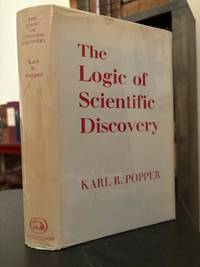
1959réf. 508Large Octavo. Publisher's cloth & dustwrapper. First edition first printing of one of the most significant works on the philosophy of science. The Logic of Scientific Discovery was originally published in Germany in 1934 and Popper rewrote and republished it in English in 1959 with the New York edition preceding this much rarer UK edition. A fine copy in an unclipped slightly worn and faded very good dust wrapper. Small inscription on the front pastedown of David Keyt 1930-2025 Professor Emeritus of Philosophy at Washington University Seattle. The book is mostly unopened and looks mostly unread. A very nice copy. Popper argues that science should adopt a methodology based on falsifiability because no number of experiments can ever prove a theory but a reproducible experiment or observation can refute one. According to Popper: "non-reproducible single occurrences are of no significance to science. Thus a few stray basic statements contradicting a theory will hardly induce us to reject it as falsified. We shall take it as falsified only if we discover a reproducible effect which refutes the theory". Popper argues that science should adopt a methodology based on "an asymmetry verifiability and falsifiability; an asymmetry which results from the logical form of universal statements. For these are never derivable from singular statements but can be contradicted by singular statements". Hutchinson hardcover
1934réf. 47071Paris Gauthier-Villars 1934. 4to. No wrappers. In: "Comptes Rendus Hebdomadaires des Séances de L'Academie des Sciences" Tome 198 No 3. Titlepage to vol. 198. Pp. 213- 292. Entire issue offered. The joint paper: pp. 254-256 a. 1 photographic illustration in the text. Titlepage with a stamp on verso 2 small tears and a tiny bit of upper right corner gone. Titlepage a bit browned. First appearance of this seminal paper in which artificial radioactivity was announced for the first time. Curie and Joliot were awarded the Nobel Prize in Chemistry 1935 "in recognition of their synthesis of new radioactive elements"."Until this date 1934 atomic nuclei emitting radiation were found in nature: it was called the natural radioactivity. It had been known since Rutherford that this natural radioactivity changed a nucleus into an other one: for instance radium becomes finally lead after many radioactive decays. We could say that lead does not become gold but gold becomes lead! But. this change of matter was not under control. It was not possible to construct the desired chemical element as the alchemist dreamed. But Irene and Frederic Joliot-Curie made the dream become almost reality.""Another very important development in the early 1934 by the Joliot-Curies in connection with irradiation of aluminum by alpha particles. The two French scientists detected the production of the recently discovered positrons. . However they soon realized that the positron activity continued after the alpha source was removed and that they had in fact discovered positive beta radioactivity. The importance of the discovery of artificial radioactivity was immediately recognized and resulted in a Nobel Prize in chemistry to the Joliot-Curies in 1935. The new phenomenon immediately became widely employed in nuclear physics chemistry biology and medicine." Kragh Quantum Generations p. 187"These elegant experiments which provided the first chemical proof of induced transmutations and showed the possibility of artificially creating radioisotopes of known stable elements were repeated and extended in the major nuclear physics laboratories of various countries " DSB.Born on 12 September 1897 in Paris Irène Curie was the daughter of Pierre and Marie Curie. "During World War I she worked as a nurse helping her mother operate radiography equipment and then studied physics and mathematics at the Sorbonne gaining a doctorate for studying the range of alpha particles. She then went to work for her mother at the Radium Institute. There she met Frédéric Joliot whom she married in 1926. Frédéric Joliot was born on 19 March 1900 in Paris - He joined the Radium Institute in 1925 and obtained his PhD in 1930. Together the Joliot-Curies worked on radioactivity and the transmutation of the elements. Twice they just missed major discoveries: in 1932 when Chadwick beat them to the neutron and in 1933 when Anderson discovered the positron. However in 1934 whilst bombarding light elements with alpha particles the Joliot-Curies noticed that although proton production stopped when the alpha particle bombardment stopped another form of radiation continued. The alpha particles had produced an isotope of phosphorus not found in nature. This isotope was radioactive and was decaying through beta-decay" DSB. unknown
1780réf. 53319Paris Théophile Barrois 1780. 8vo. Fine cont. full mottled calf richly gilt spine and gilt titlelabel in red leather. Edges gilt. LXVIII3333 pp. and 1 folded engraved plate showing his experimental apparatus. Light browning to margins of title-page otherwise clean and with broad margins. A fine copy. First French edition of perhaps the most important work in plant physiology. It is in this work that Ingen-Housz for the first time expounds the ideas and experiments that lead to his discovery of Photosynthesis in plant life and as such it is of fundamental importance in the economy of living things. "His Experiments upon vegetables was published in the autumn of 1779 and was at once recognized as a very important advance. In brief he showed that oxygen evolution by plant is absolutely dependent on light and that it only occurs from those parts which are green.The proof that light and green tissues are both essential for oxygen production finally cleared up the apparent contradictions and variable results of earlier experiments. Priestly was "much pleased" with Ingen-Housz's experiments and pointed immediately to the salient facts that he had established." A.G. Morton: History of Botanical Science. p. 332. Dibner: Heralds of Science No. 29. - Garrison & Morton No. 103. - Horblit No. 55. All the English edition of 1779. hardcover
1878réf. 44231Paris G. Masson 1878. 8vo. Contemp. hcalf raised bands gilt spine. Light wear along edges. Small stamps on verso of titlepage. In: "Annales de Chimie et de Physique" 4e Series - Tome 15. 512 pp. a. 3 folded engraved plates. The entire volume offered. Janssen's memoir: pp. 414-426. First appearance of this milestone paper in chemistry physics and astronomy announcing the discovery of the helium lines in the spectrum of the sun. It was Lockyer in the same year that named it 'helium' for Helios the Greek God of the Sun. Helium was not discovered on the earth before 1895 by William Ramsay and it was Crookes who established its identity with the helium Janssen and Lockyer observed in the spectrum of the sun."He Janssen met immortality by travelling to India in 1868 to study the total eclipse. It was then that he observed the helium line and forwarded the spectral data to ockyer. He also noted the size of the solar prominences. The day after the eclipse he attempted to take their spectra again and succeeded despite the absence of the obscuring moon. he then announced jubilantly that it was the day after the eclipse that was the real eclipse day for him. Lockyer also reported this method of studying prominences without an eclipse.Like Lockyer he lived to see his observation of the helium line vindicated by Ramsay's discovery of that element on earth."Asimov."This the discovery of helium lines in the sun by Lockyer was announced on the same day by the French astronomer Janssen who was in India observing a total eclipse. As a result the French government some ten years later struck a medallion showing the heads of both scientists.By that time the two men had made a much more dramatic discovery at the same time this time in cooperation. Janssen studying the spectrum ofthe sun during the eclipse had noted a fine line he did not recognize. he send a report on this to Lockyer an acknowledges expert on solar spectra. Lockyer compared the reported position of the line with lines of known elements concluding that it must belong to a yeat unknown element possibly not even existing on the earth. He named the element from the Greek word for the sun."Asimov.Parkinson "Breakthroughs" 1868 A. - The volume contains other notable papers by Dumas Berthelot et al. hardcover