2151 risultati
rif. DADAX0548653445New unknown
rif. DADAX0367384701New unknown
rif. DADAX0548691061New unknown
rif. DADAX1436997704New unknown
1862rif. 44063Leipzig Johann Ambrosius Barth 1862. Without wrappers as issued in "Annalen der Physik und Chemie. Hrsg. von J.C. Poggendorff" Vierte Reihe Bd. 27 117 Stück Zwei No. 10. The entire issue offered. Titlepage to vol. 27. Pp. 193-352 a. 1 engraved plate. Ångströms paper: pp. 290-302. First appearance in German of Ångström's famous paper in which he announced the discovery of hydrogen in the atmosphere of the sun and in which he also confirmed the probable existence of of other elements there. The paper appeared in "Oefversigt af K. Vet. Acad. Förhandl." in 1861. The German paper here is expanded. At the same time it was translated into English and publishe as "On the Fraunhofer Lines Visible in the Solar Spectrum".Ångström was one of the early formulators of the science of modern spectroscopy; he wrote extensively on terrestrial magnetism the conduction of heat and especially spectroscopy. He published a monumental map of the normal solar spectrum that expressed the length of light waves in units of one ten-millionth of a millimeter a unit of length now known as the angstrom. He discovered that hydrogen is present in the sun's atmosphere and he was the first to examine the spectrum of the aurora borealis. unknown
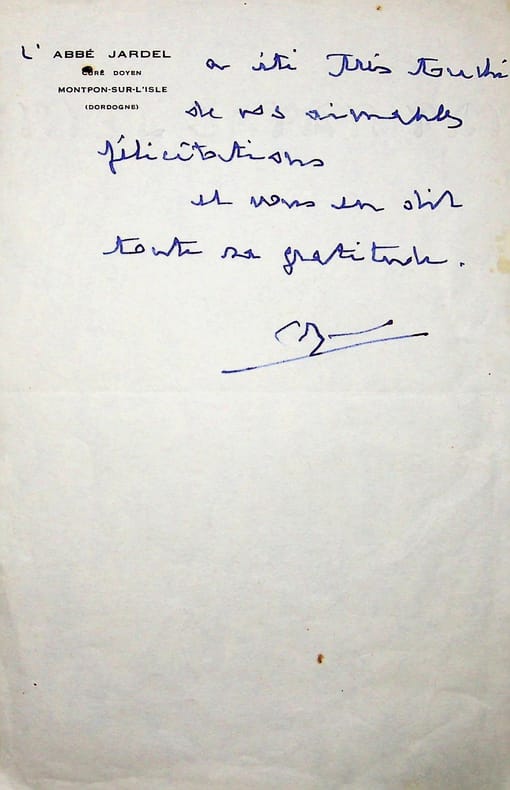
rif. 018061Abbé Edmond Jardel (XXe), curé-doyen de Montpon-sur-L'isle (Dordogne), lié a lé découverte de la grotte du Sorcier (Saint-Cirq). L.A.S., sd, 1/2p in-8. Remerciements pour des félicitations. [416]
1906rif. nb1013Plon Relié 1906 In-12 (12 x 18 cm), relié demi-basane, dos à 5 nerfs avec titre et auteur dorés, gardes marbrées, 318 pages, envoi de l'auteur en début d'ouvrage, ex-libris manuscrit collé au 2ème plat ; coiffes, coupes et coins frottés, légères rousseurs en début et fin d'ouvrage, par ailleurs intérieur frais, bon état. Livraison a domicile (La Poste) ou en Mondial Relay sur simple demande.
rif. DADAX0470227346New unknown
rif. 5466Album de vues de Constantinople et vues de Cordoue, Séville,Grenade 25 photographies tirage albuminés,19 x26 pour la plupart pour Costantiople et 23 x 32 pour Espagne,contrecollées sur carton très fort.l’ensemble monté sur onglets toilés,dans un Album pleine toile rouge,titre doré sur le premier plat,7 filets,et écoinçons dorés en encadrement.Format 47x34cm.Vers 1880 1) pont de Constantinople du quartier Pera enjambe la corne d’or en reliant Pera à Istambul.2) Sainte Sophie 3) intérieur de Sainte Sophie 4)la tribune impériale à Sainte Sophie 5)Eaux douces d’Asie 6)femmes Turcques en costumes d’apparat avec leurs admirateurs 7) Eaux douces d’Europe 8)Yildis–Kiosk 9)Palais de Beylerbey 10) Yéni-Mahallé 11)Tour de Léandre 12)Palais de Tchergham 13 Mosquée de St Isaac 14)les Isles 15) Palais sur le Bosphore 16) Environs de St Isaac 17)jardins à Cordoue 18 Palais à Cordoue 19)Cordoue la mezquita 20)Séville 21) Séville 22) Cordoue, 23) Cordoue, 24)et 25).(une décoloration angle supérieur droit au deuxième plat- rousseurs éparses sur les cartons forts) Photographes attitrés des sultans Abdulaziz et Abdülhamid II, les frères Abdullah, d’origine arménienne, se sont rendus célèbres dans tout l’Empire ottoman et jusqu’en Europe où leur participation aux Expositions universelles de 1867 et 1878 a été très remarquée. Situé à Péra, leur studio était le passage obligé des touristes à la recherche de vues sur Constantinople. Mais c’est avec le portrait en studio que les frères Abdullah ont acquis leur renommée. Ils ont notamment réalisé un portrait d’Abdulaziz qui leur a décerné en 1863 le titre de photographes officiels du sultan. Sous leur objectif, se sont alors succédés les membres de la famille impériale et les dignitaires ottomans, les monarques et les princes européens en visite ainsi que des figures éminentes des différentes communautés de Constantinople
Paris, Hachette et Cie, 1855. In-12, 270 pp. Demi-chagrin vert bronze, dos à nerfs, auteur titre en lettres dorées. (Reliure époque). Edition originale (pas de grand papier). Bon exemplaire.
rif. 27907Paris, Hachette et Cie, 1855. In-12, 270 pp. Demi-chagrin vert bronze, dos à nerfs, auteur titre en lettres dorées. (Reliure époque).
1913rif. 895921913 Librairie Hachette, Paris - 1913 - Nouvelle édition - In-4, - 297 pages - Nombreuses illustrations de Gustave Doré
1875Very Good Turkish, Ottoman (1500-1928) Original wrappers. Foolscap 8vo. (18 x 13 cm). In Ottoman script (Old Turkish with Arabic letters). 112 p. On the first page, written 'copies without seals are fake', and this copy is with a seal. Slightly faded and chipped on extremities. Foxing on first pages. Uncut marginal extremities Otherwise a good copy. Exceedingly rare first edition of the first Ottoman voyage to Cape of Good Hope and first-hand travel account of the Ottoman qadi Abubakr Effendi (1814-1880) of South Africa and Mozambique, who was sent in 1862 by Sultan Abdulaziz at the British Queen Victoria's request in order to teach and assist the Muslim community of the Cape Malays. The presence of the Muslim population in South Africa dates back to the 16th century, South Africa and the Cape of Hope have become a colony of Western countries such as Portugal, the Netherlands, and the United Kingdom. The Ottoman Empire was interested in the Far East, Javanese, and South African regions in the 16th century and then tried to establish a relationship. The direct relationship between the Ottoman Empire and South Africa in the 19th century, upon the request of the Muslim people and England, was formed through Abubakr Effendi. The Muslims in conflict with various religious issues have found the remedy by consulting a scholar from the Ottoman Empire through England. After all, Abubakr Effendi reached Cape Town in 1862 and tried to resolve the conflicts among the Muslim people. (Abubakr Effendi: An Ottoman Scholar in South Africa in the Nineteenth Century: Yilmaz, Yusuf). "Abubakr Efendi was sent to Cape Town by Ottoman Sultan Abdulaziz. When chaos reigned in the Islamic society because of the imams who declared themselves as leaders in the region, Muslim leaders in Cape of Good Hope conveyed their letters to the Queen of England in 1862 declaring that they needed a religious leader. Since they had not been educated for years, they had forgotten their Java language and could not read their own books. They sent a letter to the Queen of England, informing them that help could be sought from the Ottoman court, the center of Muslim countries in the period. The issue was refused in the Parliament and the Ottoman Ambassador Musurus Pasha was offered it to the Ottoman Sultan. Abubakr Effendi's mission was to prevent Muslims in Cape of Good Hope to clash with each other and teaching them authentic Islamic knowledge free of superstition. Although Abubakr Efendi had some Arabic translators in his service, he still learned English and African languages in a short time and wrote books in order to benefit the Muslims there. On the fifteenth day he set foot on the continent, he opened a madrasah called the "Ottoman School" and enrolled three hundred students in twenty days. He traveled to Mauritius and Mozambique. He wrote his famous book 'Bayan al-Din' (a sort of catechism) in Afrikaan in Arabic letters. Then he married Rukiye Hanim, but they divorced after a while since they had to communicate by using an English and Arabic dictionary. Then he married James Cook's nephew Tahota Saban Cook. In his memoir, Ömer Lütfi wrote down all the travels of Abubakr Efendi for two years. Abubakr Efendi stayed in South Africa for 22 years and died there." (140 yillik miras: Güney Afrika'da Osmanlilar: Uçar, Ahmet). Abubakr Efendi first traveled to London and then to South Africa by a ship with his assistant Omar Lutfi. He established the first Ottoman School in Cape Town and then wrote his work Bayan Al-Din in Afrikaans with Arabic letters and distributed it to the Muslim population of South Africa. Four printed copies in OCLC: 427674106 (Three copies); 635151131 (One copy). Özege 22397. First Edition. Extremely rare.
rif. DADAX1482239132New unknown
rif. 79640Paris, Gallimard, 1992. 15 x 22, 356 pp., nombreuses illustrations et cartes en couleurs, broché, bon état.
rif. Z1-C-088-07697Assn for Computing Machinery. Used - Good. Ships from UK in 48 hours or less usually same day. Your purchase helps support Sri Lankan Children's Charity 'The Rainbow Centre'. Ex-library so some stamps and wear but in good overall condition. 100% money back guarantee. We are a world class secondhand bookstore based in Hertfordshire United Kingdom and specialize in high quality textbooks across an enormous variety of subjects. We aim to provide a vast range of textbooks rare and collectible books at a great price. Our donations to The Rainbow Centre have helped provide an education and a safe haven to hundreds of children who live in appalling conditions. We provide a 100% money back guarantee and are dedicated to providing our customers with the highest standards of service in the bookselling industry. Assn for Computing Machinery unknown
rif. SONG1118898648Used: Good unknown
rif. 7837pour faire suite au Robinson Suisse.Nouvelle édition.Deux tomes en deux volumes in 12 demi-chagrin rouge à nerfs, titre,tomaison,caissons dorés,plats percaline rouge, chagrinée.Lycée de Reims,doré,sur le premier plat.Tome 1: faux-titre,frontispice illustré,titre,286 pages.Tome 2: faux-titre,frontispice illustré,titre,287 pages.24 gravures sur bois d’après Karl GIRARDET.Tours Alfred Mame et fils 1884.Rousseurs éparses habituelles(L54 suite GRE33)
rif. DADAX0429446616New unknown
rif. SONG1852338679Used: Good unknown
rif. DADAX3540681248New unknown
rif. SONG354022064XUsed: Good unknown
rif. SONG3540332065Used: Good unknown
rif. SONG3540047603Used: Good unknown
rif. DADAX0471975095New unknown